SUBSCRIBE TO OUR FREE NEWSLETTER
Daily news & progressive opinion—funded by the people, not the corporations—delivered straight to your inbox.
5
#000000
#FFFFFF
To donate by check, phone, or other method, see our More Ways to Give page.
Daily news & progressive opinion—funded by the people, not the corporations—delivered straight to your inbox.
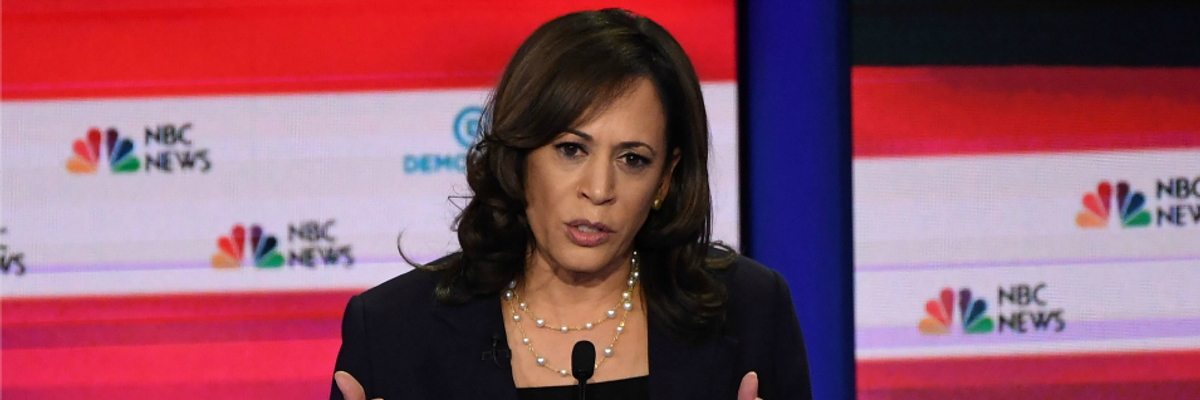
Sen. Kamala Harris (D-Calif.), a 2020 Democratic presidential candidate, speaks during the second Democratic primary debate of the 2020 presidential campaign season at the Adrienne Arsht Center for the Performing Arts in Miami, June 27, 2019. (Photo: Saul Loed/AFP/Getty Images)
Single-payer advocates on Monday accused Sen. Kamala Harris of hijacking the Medicare for All label to push an alternative that would fail to fundamentally overhaul America's for-profit healthcare system.
Harris, a 2020 Democratic presidential candidate, outlined what she described as her "Medicare for All" plan in a Medium post on Monday. But the California Democrat's proposal differs significantly from the Medicare for All legislation that she co-sponsored in the Senate earlier this year.
Instead of the four-year transition proposed by that bill, introduced by 2020 Democratic contender Sen. Bernie Sanders (I-Vt.), Harris's plan calls for a 10-year transition.
Matt Bruenig, founder of the left-wing think tank People's Policy Project, disputed the California senator's claim that extending the transition period by six years would "decrease the overall cost of the program compared to the Sanders proposal."
"In fact the opposite is true: the longer you take, the longer NHE remains unnecessarily elevated," Bruenig tweeted, referring to national health expenditures.
Harris's plan would also preserve a major role for private health insurance, which would be virtually eliminated under the Sanders legislation.
"Instead of completely replacing private coverage with a government-run, single-payer system based on traditional Medicare," the New York Times reported, "Ms. Harris would allow people to choose plans modeled on Medicare Advantage, which would be run not by the government but by private insurers."
Michael Lighty, a founding fellow at the Sanders Institute think tank and an activist with the Democratic Socialists of America's Medicare for All campaign, told Common Dreams that Harris's proposal would leave intact some of the harmful components of the profit-driven status quo.
"The alternatives put forth to single-payer Medicare for All--whether it's 'Medicare for America' or Medicare buy-ins, and now Senator Harris's alternative--rely on for-profit HMOs known as Medicare Advantage," said Lighty. "These plans restrict access to certain providers, charge seniors more for out of network care, and a receive an extra subsidy from the government."
"Hugely profitable and fast-growing, they keep insurers in charge," Lighty added. "Since under Senator Harris's plan an HMO, or other private commercial insurer, will continue to determine coverage and doctors for millions of people--and profit from denials of care--that's not healthcare as a human right."
Echoing Lighty's critique, Physicians for a National Health Program (PNHP) president Adam Gaffney called the reliance on private insurance the "major deficiency at the heart of Harris' healthcare plan."
RoseAnn DeMoro, a Sanders supporter and former executive director of National Nurses United, called Harris's plan "an insurance market masquerading as a health plan."
"Another market-based scheme to price gouge people and further enrich insurers," DeMoro tweeted. "You can't hijack the name Medicare for All while actually undermining it."
Harris introduced the plan just days before she is set to take the stage in Detroit Wednesday for the second round of Democratic presidential primary debates.
According to the Times, Harris appears to be positioning herself in the middle of Sanders and former Vice President Joe Biden, who unveiled his plan to build on the Affordable Care Act earlier this month.
"Ms. Harris's proposal seeks to straddle both camps," the Times reported, "using the 'Medicare for All' mantra as a long-term target while also seeking to keep a significant role for private insurers--which Mr. Sanders's plan would eliminate."
The Sanders campaign was quick to criticize Harris's plan.
"It's bad policy and bad politics," Faiz Shakir, Sanders's campaign manager, said in an interview with Bloomberg.
On Twitter, Shakir said the proposal represents another phase of Harris's "gradual backdown from Medicare for All."
"This is why you want a candidate with a lifetime of consistency and a track record on the big issues facing us," said Shakir.
Splinter's Libby Watson argued in an analysis of Harris's plan Monday that there "should be no role for profit in the healthcare system, and the level of profit that insurance companies currently enjoy--the top insurers raked in more than $7 billion in profits in just one quarter last year--is obscene."
"You can either take on the insurance industry and protect patients, or you can tiptoe around them and allow them to keep profiting off patients," Watson wrote. "There's no middle ground."
Dear Common Dreams reader, It’s been nearly 30 years since I co-founded Common Dreams with my late wife, Lina Newhouser. We had the radical notion that journalism should serve the public good, not corporate profits. It was clear to us from the outset what it would take to build such a project. No paid advertisements. No corporate sponsors. No millionaire publisher telling us what to think or do. Many people said we wouldn't last a year, but we proved those doubters wrong. Together with a tremendous team of journalists and dedicated staff, we built an independent media outlet free from the constraints of profits and corporate control. Our mission has always been simple: To inform. To inspire. To ignite change for the common good. Building Common Dreams was not easy. Our survival was never guaranteed. When you take on the most powerful forces—Wall Street greed, fossil fuel industry destruction, Big Tech lobbyists, and uber-rich oligarchs who have spent billions upon billions rigging the economy and democracy in their favor—the only bulwark you have is supporters who believe in your work. But here’s the urgent message from me today. It's never been this bad out there. And it's never been this hard to keep us going. At the very moment Common Dreams is most needed, the threats we face are intensifying. We need your support now more than ever. We don't accept corporate advertising and never will. We don't have a paywall because we don't think people should be blocked from critical news based on their ability to pay. Everything we do is funded by the donations of readers like you. When everyone does the little they can afford, we are strong. But if that support retreats or dries up, so do we. Will you donate now to make sure Common Dreams not only survives but thrives? —Craig Brown, Co-founder |
Single-payer advocates on Monday accused Sen. Kamala Harris of hijacking the Medicare for All label to push an alternative that would fail to fundamentally overhaul America's for-profit healthcare system.
Harris, a 2020 Democratic presidential candidate, outlined what she described as her "Medicare for All" plan in a Medium post on Monday. But the California Democrat's proposal differs significantly from the Medicare for All legislation that she co-sponsored in the Senate earlier this year.
Instead of the four-year transition proposed by that bill, introduced by 2020 Democratic contender Sen. Bernie Sanders (I-Vt.), Harris's plan calls for a 10-year transition.
Matt Bruenig, founder of the left-wing think tank People's Policy Project, disputed the California senator's claim that extending the transition period by six years would "decrease the overall cost of the program compared to the Sanders proposal."
"In fact the opposite is true: the longer you take, the longer NHE remains unnecessarily elevated," Bruenig tweeted, referring to national health expenditures.
Harris's plan would also preserve a major role for private health insurance, which would be virtually eliminated under the Sanders legislation.
"Instead of completely replacing private coverage with a government-run, single-payer system based on traditional Medicare," the New York Times reported, "Ms. Harris would allow people to choose plans modeled on Medicare Advantage, which would be run not by the government but by private insurers."
Michael Lighty, a founding fellow at the Sanders Institute think tank and an activist with the Democratic Socialists of America's Medicare for All campaign, told Common Dreams that Harris's proposal would leave intact some of the harmful components of the profit-driven status quo.
"The alternatives put forth to single-payer Medicare for All--whether it's 'Medicare for America' or Medicare buy-ins, and now Senator Harris's alternative--rely on for-profit HMOs known as Medicare Advantage," said Lighty. "These plans restrict access to certain providers, charge seniors more for out of network care, and a receive an extra subsidy from the government."
"Hugely profitable and fast-growing, they keep insurers in charge," Lighty added. "Since under Senator Harris's plan an HMO, or other private commercial insurer, will continue to determine coverage and doctors for millions of people--and profit from denials of care--that's not healthcare as a human right."
Echoing Lighty's critique, Physicians for a National Health Program (PNHP) president Adam Gaffney called the reliance on private insurance the "major deficiency at the heart of Harris' healthcare plan."
RoseAnn DeMoro, a Sanders supporter and former executive director of National Nurses United, called Harris's plan "an insurance market masquerading as a health plan."
"Another market-based scheme to price gouge people and further enrich insurers," DeMoro tweeted. "You can't hijack the name Medicare for All while actually undermining it."
Harris introduced the plan just days before she is set to take the stage in Detroit Wednesday for the second round of Democratic presidential primary debates.
According to the Times, Harris appears to be positioning herself in the middle of Sanders and former Vice President Joe Biden, who unveiled his plan to build on the Affordable Care Act earlier this month.
"Ms. Harris's proposal seeks to straddle both camps," the Times reported, "using the 'Medicare for All' mantra as a long-term target while also seeking to keep a significant role for private insurers--which Mr. Sanders's plan would eliminate."
The Sanders campaign was quick to criticize Harris's plan.
"It's bad policy and bad politics," Faiz Shakir, Sanders's campaign manager, said in an interview with Bloomberg.
On Twitter, Shakir said the proposal represents another phase of Harris's "gradual backdown from Medicare for All."
"This is why you want a candidate with a lifetime of consistency and a track record on the big issues facing us," said Shakir.
Splinter's Libby Watson argued in an analysis of Harris's plan Monday that there "should be no role for profit in the healthcare system, and the level of profit that insurance companies currently enjoy--the top insurers raked in more than $7 billion in profits in just one quarter last year--is obscene."
"You can either take on the insurance industry and protect patients, or you can tiptoe around them and allow them to keep profiting off patients," Watson wrote. "There's no middle ground."
Single-payer advocates on Monday accused Sen. Kamala Harris of hijacking the Medicare for All label to push an alternative that would fail to fundamentally overhaul America's for-profit healthcare system.
Harris, a 2020 Democratic presidential candidate, outlined what she described as her "Medicare for All" plan in a Medium post on Monday. But the California Democrat's proposal differs significantly from the Medicare for All legislation that she co-sponsored in the Senate earlier this year.
Instead of the four-year transition proposed by that bill, introduced by 2020 Democratic contender Sen. Bernie Sanders (I-Vt.), Harris's plan calls for a 10-year transition.
Matt Bruenig, founder of the left-wing think tank People's Policy Project, disputed the California senator's claim that extending the transition period by six years would "decrease the overall cost of the program compared to the Sanders proposal."
"In fact the opposite is true: the longer you take, the longer NHE remains unnecessarily elevated," Bruenig tweeted, referring to national health expenditures.
Harris's plan would also preserve a major role for private health insurance, which would be virtually eliminated under the Sanders legislation.
"Instead of completely replacing private coverage with a government-run, single-payer system based on traditional Medicare," the New York Times reported, "Ms. Harris would allow people to choose plans modeled on Medicare Advantage, which would be run not by the government but by private insurers."
Michael Lighty, a founding fellow at the Sanders Institute think tank and an activist with the Democratic Socialists of America's Medicare for All campaign, told Common Dreams that Harris's proposal would leave intact some of the harmful components of the profit-driven status quo.
"The alternatives put forth to single-payer Medicare for All--whether it's 'Medicare for America' or Medicare buy-ins, and now Senator Harris's alternative--rely on for-profit HMOs known as Medicare Advantage," said Lighty. "These plans restrict access to certain providers, charge seniors more for out of network care, and a receive an extra subsidy from the government."
"Hugely profitable and fast-growing, they keep insurers in charge," Lighty added. "Since under Senator Harris's plan an HMO, or other private commercial insurer, will continue to determine coverage and doctors for millions of people--and profit from denials of care--that's not healthcare as a human right."
Echoing Lighty's critique, Physicians for a National Health Program (PNHP) president Adam Gaffney called the reliance on private insurance the "major deficiency at the heart of Harris' healthcare plan."
RoseAnn DeMoro, a Sanders supporter and former executive director of National Nurses United, called Harris's plan "an insurance market masquerading as a health plan."
"Another market-based scheme to price gouge people and further enrich insurers," DeMoro tweeted. "You can't hijack the name Medicare for All while actually undermining it."
Harris introduced the plan just days before she is set to take the stage in Detroit Wednesday for the second round of Democratic presidential primary debates.
According to the Times, Harris appears to be positioning herself in the middle of Sanders and former Vice President Joe Biden, who unveiled his plan to build on the Affordable Care Act earlier this month.
"Ms. Harris's proposal seeks to straddle both camps," the Times reported, "using the 'Medicare for All' mantra as a long-term target while also seeking to keep a significant role for private insurers--which Mr. Sanders's plan would eliminate."
The Sanders campaign was quick to criticize Harris's plan.
"It's bad policy and bad politics," Faiz Shakir, Sanders's campaign manager, said in an interview with Bloomberg.
On Twitter, Shakir said the proposal represents another phase of Harris's "gradual backdown from Medicare for All."
"This is why you want a candidate with a lifetime of consistency and a track record on the big issues facing us," said Shakir.
Splinter's Libby Watson argued in an analysis of Harris's plan Monday that there "should be no role for profit in the healthcare system, and the level of profit that insurance companies currently enjoy--the top insurers raked in more than $7 billion in profits in just one quarter last year--is obscene."
"You can either take on the insurance industry and protect patients, or you can tiptoe around them and allow them to keep profiting off patients," Watson wrote. "There's no middle ground."