SUBSCRIBE TO OUR FREE NEWSLETTER
Daily news & progressive opinion—funded by the people, not the corporations—delivered straight to your inbox.
5
#000000
#FFFFFF
To donate by check, phone, or other method, see our More Ways to Give page.
Daily news & progressive opinion—funded by the people, not the corporations—delivered straight to your inbox.
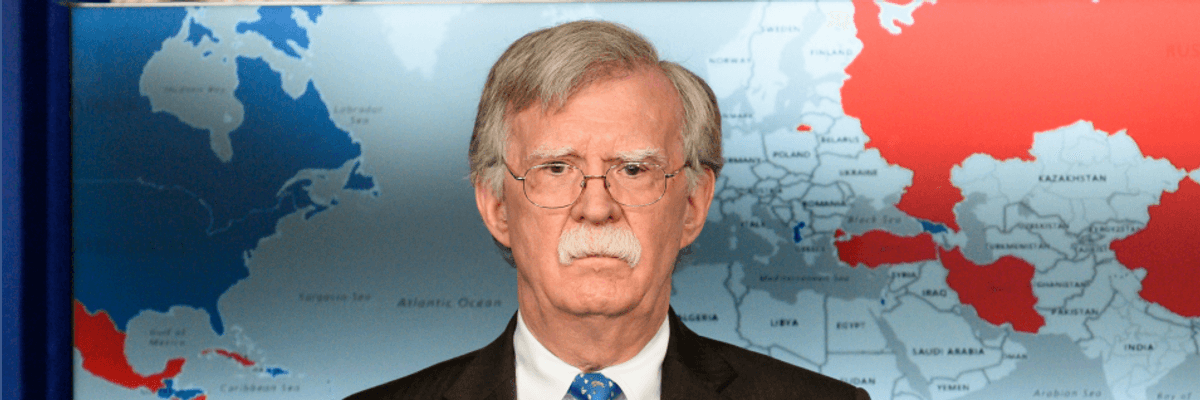
U.S. national security adviser John Bolton in the White House Press Briefing room at the White House in Washington, D.C. (Photo: Michael Brochstein/SOPA Images/LightRocket via Getty Images)
With the United Kingdom and Iran in the midst of a tense and dangerous standoff after the tit-for-tat seizure of oil tankers in the Strait of Hormuz, international observers are warning that the British government has fallen into a trap set by hawkish U.S. national security adviser John Bolton that could lead to a devastating military conflict.
After British commandos earlier this month swarmed and detained Iran's Grace 1 oil supertanker in waters east of Gibraltar, Bolton applauded the move as "excellent news" and said "America and our allies will continue to prevent regimes in Tehran and Damascus from profiting off this illicit trade."
"The Bolton gambit succeeded. Despite its misgivings, Britain has been co-opted on to the front line of Washington's confrontation with Iran."
--Simon Tisdall, The Guardian
Simon Tisdall, foreign affairs editor and commentator for The Guardian, wrote over the weekend that "Bolton's delighted reaction suggested the seizure was a surprise."
"But accumulating evidence suggests the opposite is true, and that Bolton's national security team was directly involved in manufacturing the Gibraltar incident," wrote Tisdall. "The suspicion is that Conservative politicians, distracted by picking a new prime minister, jockeying for power, and preoccupied with Brexit, stumbled into an American trap."
Shortly after British forces seized Grace 1, Spanish Foreign Minister Josep Borrell said the U.K.'s capture of the tanker was carried out under orders from the United States.
Tisdall pointed to a story last week by Spanish newspaper El Pais, which reported that the Iranian tanker "had been under surveillance by U.S. satellites since April."
"Although Spanish officials, speaking after the event, said they would have intercepted the ship 'if we had had the information and the opportunity,' Spain took no action at the time," Tisdall wrote. "But Bolton, in any case, was not relying on Madrid. The U.S. had already tipped off Britain. On 4 July, after Grace 1 entered British-Gibraltar territorial waters, the fateful order was issued in London--it is not known by whom--and 30 marines stormed aboard."
The U.K.'s seizure of Grace 1--denounced by the Iranian government as an act of "maritime piracy"--led Iran to counter on Friday by capturing a British tanker in the Strait of Hormuz, ratcheting up tensions in the Persian Gulf and prompting the British government to warn of "serious consequences" if the tanker was not released.
The perilous standoff, Tisdall argued, is precisely the outcome Bolton was seeking.
"The Bolton gambit succeeded," Tisdall wrote. "Despite its misgivings, Britain has been co-opted on to the front line of Washington's confrontation with Iran. The process of polarization, on both sides, is accelerating. The nuclear deal is closer to total collapse. And by threatening Iran with 'serious consequences,' without knowing what that may entail, Britain blindly dances to the beat of Bolton's war drums."
Iranian Foreign Minister Javad Zarif offered a similar assessment in a series of tweets on Sunday.
The B Team is the name Zarif has given to a group of officials that consists of Bolton, Saudi Crown Prince Mohammed bin Salman, Abu Dhabi Crown Prince Mohammed bin Zayed, and Israeli Prime Minister Benjamin Netanyahu.
Bolton in particular has been at the center of escalating military tensions between the U.S. and Iran, which were sparked by Trump's decision last year to violate the Iran nuclear accord.
As Common Dreams reported in May, Bolton used the routine deployment of a U.S. bomber task force to the Middle East to threaten Iran with "unrelenting force."
After Iran in June shot down an unmanned U.S. drone that it said violated its airspace, Bolton was among the group of officials urging Trump to retaliate with airstrikes. The president approved the strikes then backed off at the last minute.
Trita Parsi, executive vice president of the Quincy Institute for Responsible Statecraft, warned Sunday that by following Washington's orders in the Gulf, the U.K. is repeating the mistakes it made in the lead-up to the U.S.-led invasion if Iraq.
"In 2003, the U.K. broke with the E.U. and foolishly sided with Bush over Iraq. London not only devastated the Middle East, it also undermined the E.U.," Parsi tweeted. "Now, the U.K. is at it again by doing Bolton's bidding and allowing him to make the U.K./E.U. collateral damage in his war plans with Iran."
"Why did the U.K. agree to Bolton's request to confiscate an Iranian oil tanker, knowing very well Iran would retaliate by taking a British one in return?" Parsi asked. "Does the U.K. want war? Does E.U. interest not matter to London? Stunned these questions haven't been asked. Answers are needed."
Dear Common Dreams reader, It’s been nearly 30 years since I co-founded Common Dreams with my late wife, Lina Newhouser. We had the radical notion that journalism should serve the public good, not corporate profits. It was clear to us from the outset what it would take to build such a project. No paid advertisements. No corporate sponsors. No millionaire publisher telling us what to think or do. Many people said we wouldn't last a year, but we proved those doubters wrong. Together with a tremendous team of journalists and dedicated staff, we built an independent media outlet free from the constraints of profits and corporate control. Our mission has always been simple: To inform. To inspire. To ignite change for the common good. Building Common Dreams was not easy. Our survival was never guaranteed. When you take on the most powerful forces—Wall Street greed, fossil fuel industry destruction, Big Tech lobbyists, and uber-rich oligarchs who have spent billions upon billions rigging the economy and democracy in their favor—the only bulwark you have is supporters who believe in your work. But here’s the urgent message from me today. It's never been this bad out there. And it's never been this hard to keep us going. At the very moment Common Dreams is most needed, the threats we face are intensifying. We need your support now more than ever. We don't accept corporate advertising and never will. We don't have a paywall because we don't think people should be blocked from critical news based on their ability to pay. Everything we do is funded by the donations of readers like you. When everyone does the little they can afford, we are strong. But if that support retreats or dries up, so do we. Will you donate now to make sure Common Dreams not only survives but thrives? —Craig Brown, Co-founder |
With the United Kingdom and Iran in the midst of a tense and dangerous standoff after the tit-for-tat seizure of oil tankers in the Strait of Hormuz, international observers are warning that the British government has fallen into a trap set by hawkish U.S. national security adviser John Bolton that could lead to a devastating military conflict.
After British commandos earlier this month swarmed and detained Iran's Grace 1 oil supertanker in waters east of Gibraltar, Bolton applauded the move as "excellent news" and said "America and our allies will continue to prevent regimes in Tehran and Damascus from profiting off this illicit trade."
"The Bolton gambit succeeded. Despite its misgivings, Britain has been co-opted on to the front line of Washington's confrontation with Iran."
--Simon Tisdall, The Guardian
Simon Tisdall, foreign affairs editor and commentator for The Guardian, wrote over the weekend that "Bolton's delighted reaction suggested the seizure was a surprise."
"But accumulating evidence suggests the opposite is true, and that Bolton's national security team was directly involved in manufacturing the Gibraltar incident," wrote Tisdall. "The suspicion is that Conservative politicians, distracted by picking a new prime minister, jockeying for power, and preoccupied with Brexit, stumbled into an American trap."
Shortly after British forces seized Grace 1, Spanish Foreign Minister Josep Borrell said the U.K.'s capture of the tanker was carried out under orders from the United States.
Tisdall pointed to a story last week by Spanish newspaper El Pais, which reported that the Iranian tanker "had been under surveillance by U.S. satellites since April."
"Although Spanish officials, speaking after the event, said they would have intercepted the ship 'if we had had the information and the opportunity,' Spain took no action at the time," Tisdall wrote. "But Bolton, in any case, was not relying on Madrid. The U.S. had already tipped off Britain. On 4 July, after Grace 1 entered British-Gibraltar territorial waters, the fateful order was issued in London--it is not known by whom--and 30 marines stormed aboard."
The U.K.'s seizure of Grace 1--denounced by the Iranian government as an act of "maritime piracy"--led Iran to counter on Friday by capturing a British tanker in the Strait of Hormuz, ratcheting up tensions in the Persian Gulf and prompting the British government to warn of "serious consequences" if the tanker was not released.
The perilous standoff, Tisdall argued, is precisely the outcome Bolton was seeking.
"The Bolton gambit succeeded," Tisdall wrote. "Despite its misgivings, Britain has been co-opted on to the front line of Washington's confrontation with Iran. The process of polarization, on both sides, is accelerating. The nuclear deal is closer to total collapse. And by threatening Iran with 'serious consequences,' without knowing what that may entail, Britain blindly dances to the beat of Bolton's war drums."
Iranian Foreign Minister Javad Zarif offered a similar assessment in a series of tweets on Sunday.
The B Team is the name Zarif has given to a group of officials that consists of Bolton, Saudi Crown Prince Mohammed bin Salman, Abu Dhabi Crown Prince Mohammed bin Zayed, and Israeli Prime Minister Benjamin Netanyahu.
Bolton in particular has been at the center of escalating military tensions between the U.S. and Iran, which were sparked by Trump's decision last year to violate the Iran nuclear accord.
As Common Dreams reported in May, Bolton used the routine deployment of a U.S. bomber task force to the Middle East to threaten Iran with "unrelenting force."
After Iran in June shot down an unmanned U.S. drone that it said violated its airspace, Bolton was among the group of officials urging Trump to retaliate with airstrikes. The president approved the strikes then backed off at the last minute.
Trita Parsi, executive vice president of the Quincy Institute for Responsible Statecraft, warned Sunday that by following Washington's orders in the Gulf, the U.K. is repeating the mistakes it made in the lead-up to the U.S.-led invasion if Iraq.
"In 2003, the U.K. broke with the E.U. and foolishly sided with Bush over Iraq. London not only devastated the Middle East, it also undermined the E.U.," Parsi tweeted. "Now, the U.K. is at it again by doing Bolton's bidding and allowing him to make the U.K./E.U. collateral damage in his war plans with Iran."
"Why did the U.K. agree to Bolton's request to confiscate an Iranian oil tanker, knowing very well Iran would retaliate by taking a British one in return?" Parsi asked. "Does the U.K. want war? Does E.U. interest not matter to London? Stunned these questions haven't been asked. Answers are needed."
With the United Kingdom and Iran in the midst of a tense and dangerous standoff after the tit-for-tat seizure of oil tankers in the Strait of Hormuz, international observers are warning that the British government has fallen into a trap set by hawkish U.S. national security adviser John Bolton that could lead to a devastating military conflict.
After British commandos earlier this month swarmed and detained Iran's Grace 1 oil supertanker in waters east of Gibraltar, Bolton applauded the move as "excellent news" and said "America and our allies will continue to prevent regimes in Tehran and Damascus from profiting off this illicit trade."
"The Bolton gambit succeeded. Despite its misgivings, Britain has been co-opted on to the front line of Washington's confrontation with Iran."
--Simon Tisdall, The Guardian
Simon Tisdall, foreign affairs editor and commentator for The Guardian, wrote over the weekend that "Bolton's delighted reaction suggested the seizure was a surprise."
"But accumulating evidence suggests the opposite is true, and that Bolton's national security team was directly involved in manufacturing the Gibraltar incident," wrote Tisdall. "The suspicion is that Conservative politicians, distracted by picking a new prime minister, jockeying for power, and preoccupied with Brexit, stumbled into an American trap."
Shortly after British forces seized Grace 1, Spanish Foreign Minister Josep Borrell said the U.K.'s capture of the tanker was carried out under orders from the United States.
Tisdall pointed to a story last week by Spanish newspaper El Pais, which reported that the Iranian tanker "had been under surveillance by U.S. satellites since April."
"Although Spanish officials, speaking after the event, said they would have intercepted the ship 'if we had had the information and the opportunity,' Spain took no action at the time," Tisdall wrote. "But Bolton, in any case, was not relying on Madrid. The U.S. had already tipped off Britain. On 4 July, after Grace 1 entered British-Gibraltar territorial waters, the fateful order was issued in London--it is not known by whom--and 30 marines stormed aboard."
The U.K.'s seizure of Grace 1--denounced by the Iranian government as an act of "maritime piracy"--led Iran to counter on Friday by capturing a British tanker in the Strait of Hormuz, ratcheting up tensions in the Persian Gulf and prompting the British government to warn of "serious consequences" if the tanker was not released.
The perilous standoff, Tisdall argued, is precisely the outcome Bolton was seeking.
"The Bolton gambit succeeded," Tisdall wrote. "Despite its misgivings, Britain has been co-opted on to the front line of Washington's confrontation with Iran. The process of polarization, on both sides, is accelerating. The nuclear deal is closer to total collapse. And by threatening Iran with 'serious consequences,' without knowing what that may entail, Britain blindly dances to the beat of Bolton's war drums."
Iranian Foreign Minister Javad Zarif offered a similar assessment in a series of tweets on Sunday.
The B Team is the name Zarif has given to a group of officials that consists of Bolton, Saudi Crown Prince Mohammed bin Salman, Abu Dhabi Crown Prince Mohammed bin Zayed, and Israeli Prime Minister Benjamin Netanyahu.
Bolton in particular has been at the center of escalating military tensions between the U.S. and Iran, which were sparked by Trump's decision last year to violate the Iran nuclear accord.
As Common Dreams reported in May, Bolton used the routine deployment of a U.S. bomber task force to the Middle East to threaten Iran with "unrelenting force."
After Iran in June shot down an unmanned U.S. drone that it said violated its airspace, Bolton was among the group of officials urging Trump to retaliate with airstrikes. The president approved the strikes then backed off at the last minute.
Trita Parsi, executive vice president of the Quincy Institute for Responsible Statecraft, warned Sunday that by following Washington's orders in the Gulf, the U.K. is repeating the mistakes it made in the lead-up to the U.S.-led invasion if Iraq.
"In 2003, the U.K. broke with the E.U. and foolishly sided with Bush over Iraq. London not only devastated the Middle East, it also undermined the E.U.," Parsi tweeted. "Now, the U.K. is at it again by doing Bolton's bidding and allowing him to make the U.K./E.U. collateral damage in his war plans with Iran."
"Why did the U.K. agree to Bolton's request to confiscate an Iranian oil tanker, knowing very well Iran would retaliate by taking a British one in return?" Parsi asked. "Does the U.K. want war? Does E.U. interest not matter to London? Stunned these questions haven't been asked. Answers are needed."