SUBSCRIBE TO OUR FREE NEWSLETTER
Daily news & progressive opinion—funded by the people, not the corporations—delivered straight to your inbox.
5
#000000
#FFFFFF
To donate by check, phone, or other method, see our More Ways to Give page.
Daily news & progressive opinion—funded by the people, not the corporations—delivered straight to your inbox.
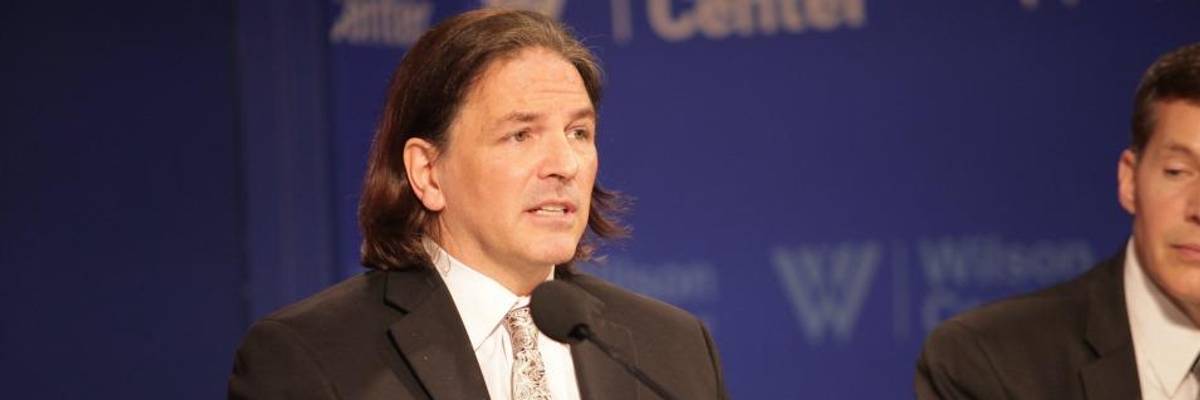
State Department intelligence analyst Rod Schoonover's testimony was nearly suppressed last week by the Trump administration. Schoonover testified before a House committee about the national security risks posed by the climate crisis. (Photo: Environmental Change and Security Program/Flickr/cc)
The Trump administration issued one of its most blatant attacks on climate science this past week when it tried to stop a State Department employee from testifying on the climate crisis, reports showed on Saturday.
As the Washington Post reported, intelligence analyst Rod Schoonover's testimony was submitted to the White House for approval ahead of his planned appearance before the House Permanent Select Committee on Intelligence. His remarks focused on the national security risks posed by the climate crisis.
The Trump administration refused to approve the testimony for entry into the congressional record, noting that the data Schoonover planned to present--drawing from top government scientists' research and peer-reviewed scientific reports--did not align with the executive branch's views.
National Security Council advisers wrote a number of comments on Schoonover's draft, saying the testimony was "not objective."
The testimony "includes lots of climate alarm propaganda that is not science at all," wrote William Happer, a senior member of the National Security Council who has sought to create a federal task force to challenge the consensus reached by 97 percent of peer-reviewed climate scientists who say humans are contributing to the climate crisis.
"I am embarrassed to have this go out on behalf of the executive branch of the federal government," Happer added, noting a particular objection to Schoonover's use of the term "tipping point" in reference to possible devastating, irreversible effects of the climate crisis.
"'Tipping points' is a propaganda slogan for the scientifically illiterate," Happer wrote.
Schoonover was ultimately permitted to testify before the committee, but his testimony was not submitted into the record because, the Office of Legislative Affairs said, it did not "jibe" with the Trump administration's views on the climate.
President Donald Trump and many of his appointees deny that human activity like the extraction of fossil fuels are contributing to the warming of the globe, which scientists warn is already causing extreme weather events like hurricanes and wildfires, rising sea levels, and melting glaciers. As Schoonover mentioned in his testimony, the last five years have been the warmest on record according to NASA.
Although Schoonover was able to testify, climate action advocates decried the White House's attempt to stifle the information he eventually shared with the committee.
"Any attempt to suppress information on the security risks of climate change threatens to leave the American public vulnerable and unsafe," Francesco Femia, chief executive of the Council on Strategic Risks and co-founder of the Center for Climate and Security, told the Post.
Dear Common Dreams reader, It’s been nearly 30 years since I co-founded Common Dreams with my late wife, Lina Newhouser. We had the radical notion that journalism should serve the public good, not corporate profits. It was clear to us from the outset what it would take to build such a project. No paid advertisements. No corporate sponsors. No millionaire publisher telling us what to think or do. Many people said we wouldn't last a year, but we proved those doubters wrong. Together with a tremendous team of journalists and dedicated staff, we built an independent media outlet free from the constraints of profits and corporate control. Our mission has always been simple: To inform. To inspire. To ignite change for the common good. Building Common Dreams was not easy. Our survival was never guaranteed. When you take on the most powerful forces—Wall Street greed, fossil fuel industry destruction, Big Tech lobbyists, and uber-rich oligarchs who have spent billions upon billions rigging the economy and democracy in their favor—the only bulwark you have is supporters who believe in your work. But here’s the urgent message from me today. It's never been this bad out there. And it's never been this hard to keep us going. At the very moment Common Dreams is most needed, the threats we face are intensifying. We need your support now more than ever. We don't accept corporate advertising and never will. We don't have a paywall because we don't think people should be blocked from critical news based on their ability to pay. Everything we do is funded by the donations of readers like you. When everyone does the little they can afford, we are strong. But if that support retreats or dries up, so do we. Will you donate now to make sure Common Dreams not only survives but thrives? —Craig Brown, Co-founder |
The Trump administration issued one of its most blatant attacks on climate science this past week when it tried to stop a State Department employee from testifying on the climate crisis, reports showed on Saturday.
As the Washington Post reported, intelligence analyst Rod Schoonover's testimony was submitted to the White House for approval ahead of his planned appearance before the House Permanent Select Committee on Intelligence. His remarks focused on the national security risks posed by the climate crisis.
The Trump administration refused to approve the testimony for entry into the congressional record, noting that the data Schoonover planned to present--drawing from top government scientists' research and peer-reviewed scientific reports--did not align with the executive branch's views.
National Security Council advisers wrote a number of comments on Schoonover's draft, saying the testimony was "not objective."
The testimony "includes lots of climate alarm propaganda that is not science at all," wrote William Happer, a senior member of the National Security Council who has sought to create a federal task force to challenge the consensus reached by 97 percent of peer-reviewed climate scientists who say humans are contributing to the climate crisis.
"I am embarrassed to have this go out on behalf of the executive branch of the federal government," Happer added, noting a particular objection to Schoonover's use of the term "tipping point" in reference to possible devastating, irreversible effects of the climate crisis.
"'Tipping points' is a propaganda slogan for the scientifically illiterate," Happer wrote.
Schoonover was ultimately permitted to testify before the committee, but his testimony was not submitted into the record because, the Office of Legislative Affairs said, it did not "jibe" with the Trump administration's views on the climate.
President Donald Trump and many of his appointees deny that human activity like the extraction of fossil fuels are contributing to the warming of the globe, which scientists warn is already causing extreme weather events like hurricanes and wildfires, rising sea levels, and melting glaciers. As Schoonover mentioned in his testimony, the last five years have been the warmest on record according to NASA.
Although Schoonover was able to testify, climate action advocates decried the White House's attempt to stifle the information he eventually shared with the committee.
"Any attempt to suppress information on the security risks of climate change threatens to leave the American public vulnerable and unsafe," Francesco Femia, chief executive of the Council on Strategic Risks and co-founder of the Center for Climate and Security, told the Post.
The Trump administration issued one of its most blatant attacks on climate science this past week when it tried to stop a State Department employee from testifying on the climate crisis, reports showed on Saturday.
As the Washington Post reported, intelligence analyst Rod Schoonover's testimony was submitted to the White House for approval ahead of his planned appearance before the House Permanent Select Committee on Intelligence. His remarks focused on the national security risks posed by the climate crisis.
The Trump administration refused to approve the testimony for entry into the congressional record, noting that the data Schoonover planned to present--drawing from top government scientists' research and peer-reviewed scientific reports--did not align with the executive branch's views.
National Security Council advisers wrote a number of comments on Schoonover's draft, saying the testimony was "not objective."
The testimony "includes lots of climate alarm propaganda that is not science at all," wrote William Happer, a senior member of the National Security Council who has sought to create a federal task force to challenge the consensus reached by 97 percent of peer-reviewed climate scientists who say humans are contributing to the climate crisis.
"I am embarrassed to have this go out on behalf of the executive branch of the federal government," Happer added, noting a particular objection to Schoonover's use of the term "tipping point" in reference to possible devastating, irreversible effects of the climate crisis.
"'Tipping points' is a propaganda slogan for the scientifically illiterate," Happer wrote.
Schoonover was ultimately permitted to testify before the committee, but his testimony was not submitted into the record because, the Office of Legislative Affairs said, it did not "jibe" with the Trump administration's views on the climate.
President Donald Trump and many of his appointees deny that human activity like the extraction of fossil fuels are contributing to the warming of the globe, which scientists warn is already causing extreme weather events like hurricanes and wildfires, rising sea levels, and melting glaciers. As Schoonover mentioned in his testimony, the last five years have been the warmest on record according to NASA.
Although Schoonover was able to testify, climate action advocates decried the White House's attempt to stifle the information he eventually shared with the committee.
"Any attempt to suppress information on the security risks of climate change threatens to leave the American public vulnerable and unsafe," Francesco Femia, chief executive of the Council on Strategic Risks and co-founder of the Center for Climate and Security, told the Post.