SUBSCRIBE TO OUR FREE NEWSLETTER
Daily news & progressive opinion—funded by the people, not the corporations—delivered straight to your inbox.
5
#000000
#FFFFFF
To donate by check, phone, or other method, see our More Ways to Give page.
Daily news & progressive opinion—funded by the people, not the corporations—delivered straight to your inbox.
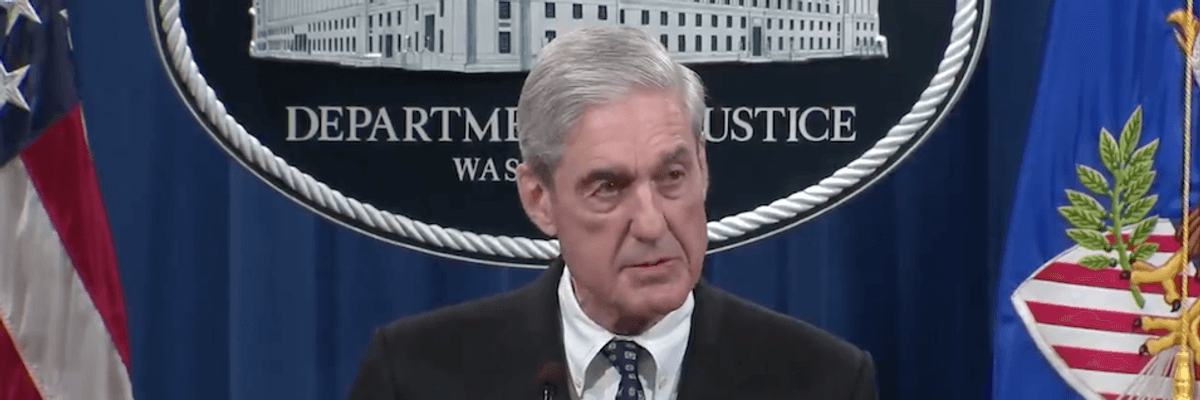
Special Counsel Robert Mueller speaks to reporters Wednesday at the Department of Justice. (Image: screenshot)
On Wednesday, Special Counsel Robert Mueller closed the investigation he was tasked to lead in 2017, announcing the end of the process, and his career, to the public in a 9 minute statement that put the onus for the next step--impeachment--on the House.
Mueller and his team never considered charging the president with a crime, he told reporters, because of DOJ guidelines that state the president cannot be indicted.
As the special counsel pointed out, that leaves the responsibility for holding the president accountable on Congress, the governmental body that has the power to begin impeachment proceedings.
"The Constitution requires a process other than the criminal justice system to formally accuse a sitting president of wrongdoing," said Mueller.
In remarks to the public at the Department of Justice, Mueller said that his investigation found that the Russian military's intelligence operation to disrupt the U.S. election in 2016 worked, but that the Russians and the campaign of then-candidate, and now-president, Donald Trump, did not conspire together.
The president's behavior toward the investigation was less cut and dry. As in the report, Mueller said on Wednesday that his office was less definitive on whether the president committed obstruction.
"Charging the president with a crime was not an option we could consider," said Mueller.
The special counsel also made clear that his report should not then be seen as an exoneration of the president.
"If we had had confidence the president clearly did not commit a crime," Mueller said, "we would have said so."
Impeachment has been a tough sell for House Democratic leadership. Speaker Nancy Pelosi (D-Calif.), as Common Dreams reported earlier in May, has repeatedly expressed hesitation over beginning the process. No Republicans, save Rep. Justin Amash (R-Mich.), have publicly stated their support for hearings.
Wednesday's statement from Mueller may test that level of resistance from Democrats, especially since Mueller is refusing to speak beyond what he's already written in the report if called before Congress.
Political scientist Jeffrey Isaac, in a column for Common Dreams, pointed out that Mueller may not want to testify, but that decision isn't his to make.
"He might not want to testify. He might truly believe that the report is his testimony," wrote Isaac. "But that is not for him to decide."
In a tweet, Sen. Elizabeth Warren (D-Mass.), who is also running for her party's nomination for president, said that Mueller's statement was effectively a call to action.
"It is an impeachment referral, and it's up to Congress to act," said Warren. "They should."
That language was echoed by Sen. Kamala Harris (D-Calif.), one of Warren's rivals in the 2020 race.
"We need to start impeachment proceedings," Harris said in a tweet. "It's our constitutional obligation."
In a statement, CREDO Action co-director Heidi Hess said that Mueller was "practically begging Congress to move forward with impeachment proceedings."
"In a room full of reporters, he explicitly conceded that there wasn't enough evidence to exonerate Donald Trump, a sitting president, on the possible crime of obstruction of justice," said Hess. "In any other year, that kind of earth-shattering finding would be immediate grounds for at least the beginning of an impeachment inquiry, and it's far past time for Congress to step up to its role as a co-equal branch of government and hold Trump accountable for his crimes."
Some House Democrats were signaling their intention to possibly back impeachment proceedings by midday Wednesday.
Rep. Jerry Nadler (D-N.Y.), the head of the House Judiciary Committee, tip-toed right up to the line of calling for impeachment in a statement to NBC News.
"Given that Special Counsel Mueller was unable to pursue criminal charges against the president, it falls to Congress to respond to the crimes, lies and other wrongdoing of President Trump--and we will do so," said Nadler.
Dear Common Dreams reader, It’s been nearly 30 years since I co-founded Common Dreams with my late wife, Lina Newhouser. We had the radical notion that journalism should serve the public good, not corporate profits. It was clear to us from the outset what it would take to build such a project. No paid advertisements. No corporate sponsors. No millionaire publisher telling us what to think or do. Many people said we wouldn't last a year, but we proved those doubters wrong. Together with a tremendous team of journalists and dedicated staff, we built an independent media outlet free from the constraints of profits and corporate control. Our mission has always been simple: To inform. To inspire. To ignite change for the common good. Building Common Dreams was not easy. Our survival was never guaranteed. When you take on the most powerful forces—Wall Street greed, fossil fuel industry destruction, Big Tech lobbyists, and uber-rich oligarchs who have spent billions upon billions rigging the economy and democracy in their favor—the only bulwark you have is supporters who believe in your work. But here’s the urgent message from me today. It's never been this bad out there. And it's never been this hard to keep us going. At the very moment Common Dreams is most needed, the threats we face are intensifying. We need your support now more than ever. We don't accept corporate advertising and never will. We don't have a paywall because we don't think people should be blocked from critical news based on their ability to pay. Everything we do is funded by the donations of readers like you. When everyone does the little they can afford, we are strong. But if that support retreats or dries up, so do we. Will you donate now to make sure Common Dreams not only survives but thrives? —Craig Brown, Co-founder |
On Wednesday, Special Counsel Robert Mueller closed the investigation he was tasked to lead in 2017, announcing the end of the process, and his career, to the public in a 9 minute statement that put the onus for the next step--impeachment--on the House.
Mueller and his team never considered charging the president with a crime, he told reporters, because of DOJ guidelines that state the president cannot be indicted.
As the special counsel pointed out, that leaves the responsibility for holding the president accountable on Congress, the governmental body that has the power to begin impeachment proceedings.
"The Constitution requires a process other than the criminal justice system to formally accuse a sitting president of wrongdoing," said Mueller.
In remarks to the public at the Department of Justice, Mueller said that his investigation found that the Russian military's intelligence operation to disrupt the U.S. election in 2016 worked, but that the Russians and the campaign of then-candidate, and now-president, Donald Trump, did not conspire together.
The president's behavior toward the investigation was less cut and dry. As in the report, Mueller said on Wednesday that his office was less definitive on whether the president committed obstruction.
"Charging the president with a crime was not an option we could consider," said Mueller.
The special counsel also made clear that his report should not then be seen as an exoneration of the president.
"If we had had confidence the president clearly did not commit a crime," Mueller said, "we would have said so."
Impeachment has been a tough sell for House Democratic leadership. Speaker Nancy Pelosi (D-Calif.), as Common Dreams reported earlier in May, has repeatedly expressed hesitation over beginning the process. No Republicans, save Rep. Justin Amash (R-Mich.), have publicly stated their support for hearings.
Wednesday's statement from Mueller may test that level of resistance from Democrats, especially since Mueller is refusing to speak beyond what he's already written in the report if called before Congress.
Political scientist Jeffrey Isaac, in a column for Common Dreams, pointed out that Mueller may not want to testify, but that decision isn't his to make.
"He might not want to testify. He might truly believe that the report is his testimony," wrote Isaac. "But that is not for him to decide."
In a tweet, Sen. Elizabeth Warren (D-Mass.), who is also running for her party's nomination for president, said that Mueller's statement was effectively a call to action.
"It is an impeachment referral, and it's up to Congress to act," said Warren. "They should."
That language was echoed by Sen. Kamala Harris (D-Calif.), one of Warren's rivals in the 2020 race.
"We need to start impeachment proceedings," Harris said in a tweet. "It's our constitutional obligation."
In a statement, CREDO Action co-director Heidi Hess said that Mueller was "practically begging Congress to move forward with impeachment proceedings."
"In a room full of reporters, he explicitly conceded that there wasn't enough evidence to exonerate Donald Trump, a sitting president, on the possible crime of obstruction of justice," said Hess. "In any other year, that kind of earth-shattering finding would be immediate grounds for at least the beginning of an impeachment inquiry, and it's far past time for Congress to step up to its role as a co-equal branch of government and hold Trump accountable for his crimes."
Some House Democrats were signaling their intention to possibly back impeachment proceedings by midday Wednesday.
Rep. Jerry Nadler (D-N.Y.), the head of the House Judiciary Committee, tip-toed right up to the line of calling for impeachment in a statement to NBC News.
"Given that Special Counsel Mueller was unable to pursue criminal charges against the president, it falls to Congress to respond to the crimes, lies and other wrongdoing of President Trump--and we will do so," said Nadler.
On Wednesday, Special Counsel Robert Mueller closed the investigation he was tasked to lead in 2017, announcing the end of the process, and his career, to the public in a 9 minute statement that put the onus for the next step--impeachment--on the House.
Mueller and his team never considered charging the president with a crime, he told reporters, because of DOJ guidelines that state the president cannot be indicted.
As the special counsel pointed out, that leaves the responsibility for holding the president accountable on Congress, the governmental body that has the power to begin impeachment proceedings.
"The Constitution requires a process other than the criminal justice system to formally accuse a sitting president of wrongdoing," said Mueller.
In remarks to the public at the Department of Justice, Mueller said that his investigation found that the Russian military's intelligence operation to disrupt the U.S. election in 2016 worked, but that the Russians and the campaign of then-candidate, and now-president, Donald Trump, did not conspire together.
The president's behavior toward the investigation was less cut and dry. As in the report, Mueller said on Wednesday that his office was less definitive on whether the president committed obstruction.
"Charging the president with a crime was not an option we could consider," said Mueller.
The special counsel also made clear that his report should not then be seen as an exoneration of the president.
"If we had had confidence the president clearly did not commit a crime," Mueller said, "we would have said so."
Impeachment has been a tough sell for House Democratic leadership. Speaker Nancy Pelosi (D-Calif.), as Common Dreams reported earlier in May, has repeatedly expressed hesitation over beginning the process. No Republicans, save Rep. Justin Amash (R-Mich.), have publicly stated their support for hearings.
Wednesday's statement from Mueller may test that level of resistance from Democrats, especially since Mueller is refusing to speak beyond what he's already written in the report if called before Congress.
Political scientist Jeffrey Isaac, in a column for Common Dreams, pointed out that Mueller may not want to testify, but that decision isn't his to make.
"He might not want to testify. He might truly believe that the report is his testimony," wrote Isaac. "But that is not for him to decide."
In a tweet, Sen. Elizabeth Warren (D-Mass.), who is also running for her party's nomination for president, said that Mueller's statement was effectively a call to action.
"It is an impeachment referral, and it's up to Congress to act," said Warren. "They should."
That language was echoed by Sen. Kamala Harris (D-Calif.), one of Warren's rivals in the 2020 race.
"We need to start impeachment proceedings," Harris said in a tweet. "It's our constitutional obligation."
In a statement, CREDO Action co-director Heidi Hess said that Mueller was "practically begging Congress to move forward with impeachment proceedings."
"In a room full of reporters, he explicitly conceded that there wasn't enough evidence to exonerate Donald Trump, a sitting president, on the possible crime of obstruction of justice," said Hess. "In any other year, that kind of earth-shattering finding would be immediate grounds for at least the beginning of an impeachment inquiry, and it's far past time for Congress to step up to its role as a co-equal branch of government and hold Trump accountable for his crimes."
Some House Democrats were signaling their intention to possibly back impeachment proceedings by midday Wednesday.
Rep. Jerry Nadler (D-N.Y.), the head of the House Judiciary Committee, tip-toed right up to the line of calling for impeachment in a statement to NBC News.
"Given that Special Counsel Mueller was unable to pursue criminal charges against the president, it falls to Congress to respond to the crimes, lies and other wrongdoing of President Trump--and we will do so," said Nadler.