
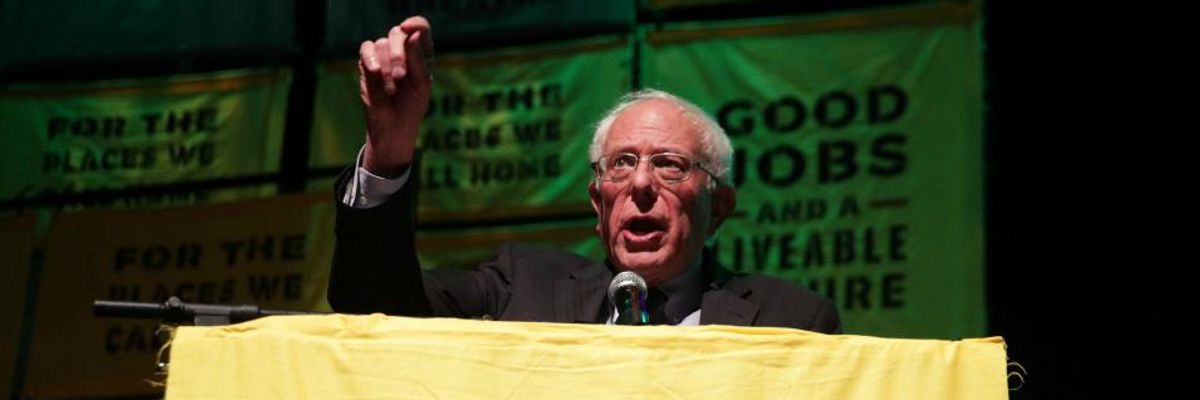
Sen. Bernie Sanders (I-Vt.) speaks during a rally at Howard University May 13, 2019 in Washington, D.C. (Photo: Alex Wong/Getty Images)
'Let's Expand Employee Ownership': Bernie Sanders Backs Plan to Give Workers Power Over Corporate Decisions
"We can move to an economy where workers feel that they're not just a cog in the machine—one where they have power over their jobs and can make decisions."
Decrying an economic status quo that "produces huge CEO bonuses while millions are paid starvation wages," Sen. Bernie Sanders on Tuesday backed a pair of policies aimed at reducing soaring inequality by giving workers more power over corporate decision-making.
According to the Washington Post's Jeff Stein--who first reported on Sanders's plans--the Vermont senator is developing a proposal that would force large companies to "regularly contribute a portion of their stocks to a fund controlled by employees, which would pay out a regular dividend to the workers."
" Democracy isn't just the opportunity to vote. What democracy really means is having control over your life."
--Sen. Bernie Sanders
Sanders is also set to introduce a plan that would require corporations to "let workers control a share of their boards of directors," Stein reported.
The two proposals, Stein wrote, "would give millions of workers the type of workplace influence typically reserved for shareholders and executives."
Sanders, a 2020 Democratic presidential candidate, said in an interview with the Post that the plans would help extend democracy to the workplace and ensure that employees have a say in decisions that affect their day-to-day lives.
"We can move to an economy where workers feel that they're not just a cog in the machine--one where they have power over their jobs and can make decisions," said the senator from Vermont. "Democracy isn't just the opportunity to vote. What democracy really means is having control over your life."
Highlighting his forthcoming proposals on Twitter, Sanders wrote, "Instead of more tax breaks to profitable corporations, let's expand employee ownership."
Peter Gowan, a policy associate at the Democracy Collaborative think tank, told the Post that Sanders "would become the first member of Congress to propose requiring corporations to create a fund of shares for their employees."
On Twitter, Gowan noted that "inclusive ownership funds" of the kind Sanders is planning to unveil are extremely popular among the U.S. public.
According to a survey conducted by the Democracy Collaborative in partnership with YouGov, 55 percent of respondents said they would support "a policy requiring companies with over 250 employees to put 10 percent of their shares into a workers fund, which would pay dividends out to the company's employees."
Gowan pointed out that Americans also favor giving workers a share of seats on corporate boards of directors, a plan known as codetermination.
Sanders did not offer specifics on his codetermination plan. Sen. Elizabeth Warren (D-Mass.), also a 2020 presidential hopeful, introduced legislation last August that give workers the power to elect 40 percent of corporate board members.
Joseph Blasi, director of the Rutgers University Institute for the Study of Employee Ownership and Profit Sharing, told the Post that as wages remain largely stagnant, "looking at employee ownership and profit-sharing is a compelling way for the middle class to get a share of the benefits of ownership."
On top of his forthcoming policy proposals, Sanders reintroduced legislation Friday designed "to increase the percentage of the American workforce in 'employee-owned' ownership models," the Post reported.
In a statement after introducing the WORK Act and the U.S. Employee Ownership Bank Act last year, Sanders said "we must invest in creating worker-owned companies" rather than "giving huge tax breaks to corporations who shut down in the United States and send jobs abroad to low wage countries."
"Employee-owned companies will not provide starvation wages to workers and huge compensation packages to CEOs. They will not allow for unsafe working conditions," said Sanders. "In fact, study after study has shown that employee ownership increases employment, increases sales and increases wages in the United States."
We are at a crossroads
This country and this world are at a monumental crossroads. In a few short weeks, US voters will have an opportunity to beat back the forces of fascism and confront the billionaires who are rigging the economy, our media system, and our democracy, making it increasingly impossible for ordinary people to get by. We’re not just talking about the election. We’re talking about what must be done once these fascist elements are vanquished from power. We need a bolder set of solutions than what either major party has so far been willing to offer and a working-class movement ready to fight like hell for it. Trump didn't emerge from nowhere. The conditions that fueled MAGA authoritarianism were created by decades of radical neoliberal economic policies and a corrupt political system dominated by corporate interests. They slashed taxes on the super-rich, promising that the benefits would trickle down. They said giveaways to the corporate titans would make life more affordable for the rest of us. It was all bullshit. And when a bitter, betrayed populace searches for someone to blame, right-wing demagogues have little trouble finding scapegoats. People know when they're being lied to, but you won't hear any of this from the corporate media. Only independent journalism—powered and funded by people who believe in building a better world—can deliver truly trustworthy daily news. Our Fall Campaign is underway, and we need your help. To power our newsroom through the rest of the year, we need to raise $125,000 by midnight on October 31. So if you share our vision, please contribute whatever you can to sustain our work. |
Decrying an economic status quo that "produces huge CEO bonuses while millions are paid starvation wages," Sen. Bernie Sanders on Tuesday backed a pair of policies aimed at reducing soaring inequality by giving workers more power over corporate decision-making.
According to the Washington Post's Jeff Stein--who first reported on Sanders's plans--the Vermont senator is developing a proposal that would force large companies to "regularly contribute a portion of their stocks to a fund controlled by employees, which would pay out a regular dividend to the workers."
" Democracy isn't just the opportunity to vote. What democracy really means is having control over your life."
--Sen. Bernie Sanders
Sanders is also set to introduce a plan that would require corporations to "let workers control a share of their boards of directors," Stein reported.
The two proposals, Stein wrote, "would give millions of workers the type of workplace influence typically reserved for shareholders and executives."
Sanders, a 2020 Democratic presidential candidate, said in an interview with the Post that the plans would help extend democracy to the workplace and ensure that employees have a say in decisions that affect their day-to-day lives.
"We can move to an economy where workers feel that they're not just a cog in the machine--one where they have power over their jobs and can make decisions," said the senator from Vermont. "Democracy isn't just the opportunity to vote. What democracy really means is having control over your life."
Highlighting his forthcoming proposals on Twitter, Sanders wrote, "Instead of more tax breaks to profitable corporations, let's expand employee ownership."
Peter Gowan, a policy associate at the Democracy Collaborative think tank, told the Post that Sanders "would become the first member of Congress to propose requiring corporations to create a fund of shares for their employees."
On Twitter, Gowan noted that "inclusive ownership funds" of the kind Sanders is planning to unveil are extremely popular among the U.S. public.
According to a survey conducted by the Democracy Collaborative in partnership with YouGov, 55 percent of respondents said they would support "a policy requiring companies with over 250 employees to put 10 percent of their shares into a workers fund, which would pay dividends out to the company's employees."
Gowan pointed out that Americans also favor giving workers a share of seats on corporate boards of directors, a plan known as codetermination.
Sanders did not offer specifics on his codetermination plan. Sen. Elizabeth Warren (D-Mass.), also a 2020 presidential hopeful, introduced legislation last August that give workers the power to elect 40 percent of corporate board members.
Joseph Blasi, director of the Rutgers University Institute for the Study of Employee Ownership and Profit Sharing, told the Post that as wages remain largely stagnant, "looking at employee ownership and profit-sharing is a compelling way for the middle class to get a share of the benefits of ownership."
On top of his forthcoming policy proposals, Sanders reintroduced legislation Friday designed "to increase the percentage of the American workforce in 'employee-owned' ownership models," the Post reported.
In a statement after introducing the WORK Act and the U.S. Employee Ownership Bank Act last year, Sanders said "we must invest in creating worker-owned companies" rather than "giving huge tax breaks to corporations who shut down in the United States and send jobs abroad to low wage countries."
"Employee-owned companies will not provide starvation wages to workers and huge compensation packages to CEOs. They will not allow for unsafe working conditions," said Sanders. "In fact, study after study has shown that employee ownership increases employment, increases sales and increases wages in the United States."
Decrying an economic status quo that "produces huge CEO bonuses while millions are paid starvation wages," Sen. Bernie Sanders on Tuesday backed a pair of policies aimed at reducing soaring inequality by giving workers more power over corporate decision-making.
According to the Washington Post's Jeff Stein--who first reported on Sanders's plans--the Vermont senator is developing a proposal that would force large companies to "regularly contribute a portion of their stocks to a fund controlled by employees, which would pay out a regular dividend to the workers."
" Democracy isn't just the opportunity to vote. What democracy really means is having control over your life."
--Sen. Bernie Sanders
Sanders is also set to introduce a plan that would require corporations to "let workers control a share of their boards of directors," Stein reported.
The two proposals, Stein wrote, "would give millions of workers the type of workplace influence typically reserved for shareholders and executives."
Sanders, a 2020 Democratic presidential candidate, said in an interview with the Post that the plans would help extend democracy to the workplace and ensure that employees have a say in decisions that affect their day-to-day lives.
"We can move to an economy where workers feel that they're not just a cog in the machine--one where they have power over their jobs and can make decisions," said the senator from Vermont. "Democracy isn't just the opportunity to vote. What democracy really means is having control over your life."
Highlighting his forthcoming proposals on Twitter, Sanders wrote, "Instead of more tax breaks to profitable corporations, let's expand employee ownership."
Peter Gowan, a policy associate at the Democracy Collaborative think tank, told the Post that Sanders "would become the first member of Congress to propose requiring corporations to create a fund of shares for their employees."
On Twitter, Gowan noted that "inclusive ownership funds" of the kind Sanders is planning to unveil are extremely popular among the U.S. public.
According to a survey conducted by the Democracy Collaborative in partnership with YouGov, 55 percent of respondents said they would support "a policy requiring companies with over 250 employees to put 10 percent of their shares into a workers fund, which would pay dividends out to the company's employees."
Gowan pointed out that Americans also favor giving workers a share of seats on corporate boards of directors, a plan known as codetermination.
Sanders did not offer specifics on his codetermination plan. Sen. Elizabeth Warren (D-Mass.), also a 2020 presidential hopeful, introduced legislation last August that give workers the power to elect 40 percent of corporate board members.
Joseph Blasi, director of the Rutgers University Institute for the Study of Employee Ownership and Profit Sharing, told the Post that as wages remain largely stagnant, "looking at employee ownership and profit-sharing is a compelling way for the middle class to get a share of the benefits of ownership."
On top of his forthcoming policy proposals, Sanders reintroduced legislation Friday designed "to increase the percentage of the American workforce in 'employee-owned' ownership models," the Post reported.
In a statement after introducing the WORK Act and the U.S. Employee Ownership Bank Act last year, Sanders said "we must invest in creating worker-owned companies" rather than "giving huge tax breaks to corporations who shut down in the United States and send jobs abroad to low wage countries."
"Employee-owned companies will not provide starvation wages to workers and huge compensation packages to CEOs. They will not allow for unsafe working conditions," said Sanders. "In fact, study after study has shown that employee ownership increases employment, increases sales and increases wages in the United States."