SUBSCRIBE TO OUR FREE NEWSLETTER
Daily news & progressive opinion—funded by the people, not the corporations—delivered straight to your inbox.
5
#000000
#FFFFFF
To donate by check, phone, or other method, see our More Ways to Give page.
Daily news & progressive opinion—funded by the people, not the corporations—delivered straight to your inbox.
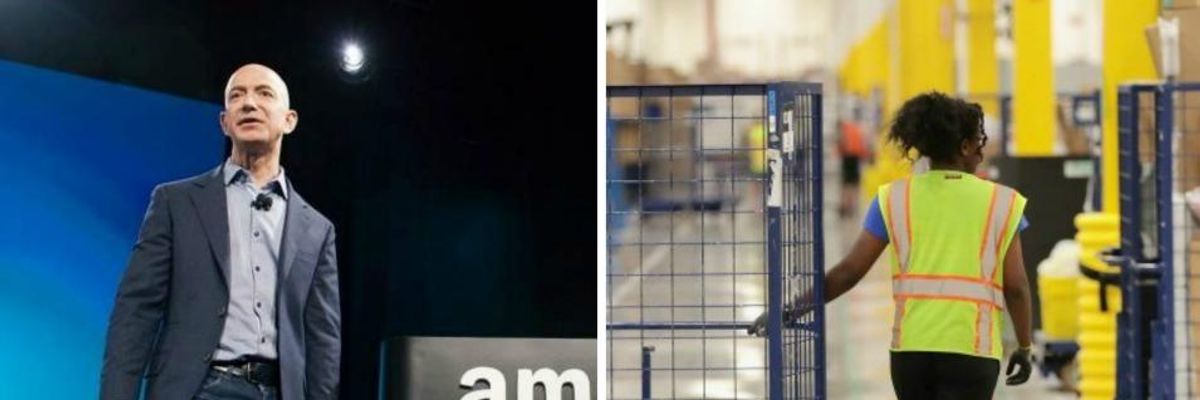
Compensation for CEOs like Amazon chief Jeff Bezos (left) is growing at twice the rate of pay for the average worker, a new study by the executive compensation firm Equilar found. (Photo: David Ryder/Scott Olson/Getty Images)
Two studies by the executive compensation firm Equilar on Friday revealed that CEOs of some of the wealthiest companies in the U.S. are seeing their pay rise at about twice the rate of the workers who make the day-to-day operations of their businesses run.
The Associated Press commissioned a study of compensation for 340 executives at S&P 500 companies which revealed that the CEOs earned raises averaging $800,000 in 2018--a seven percent increase over the previous year.
Workers would need to work 158 consecutive years to earn what their bosses make in one year, the AP reported.
"This is not sustainable," wrote Kristen Clarke, president of the Lawyers' Committee for Civil Rights Under Law, in response to the AP report.
Equilar also conducted an annual survey for the New York Times, examining compensation for 200 of the highest-paid executives in the country.
CEOs at companies including Tesla, Oracle, and T-Mobile saw their pay increase by an average of $1.1 million in 2018, bringing their median compansation to $18.6 million.
American workers were given a raise of just 84 cents on average, reported the Times.
CEOs were paid exorbitant sums "regardless of scandal," Times reporter Peter Eavis wrote, with many companies paying their leaders millions above their base salary just "to do the basics" of their jobs.
Timothy Sloan, for example, stepped down from his post at the helm of Wells Fargo this year after coming under fire for presiding over the bank where employees had opened fraudulent accounts in customers' names and sold them insurance that they didn't need. Sloan walked away with stock grants worth over $24 million.
Meanwhile, Disney CEO Robert Iger and T-Mobile head John Legere received tens of millions in extra compensation to reward them for leading their companies through mergers--even though as Eavis wrote, "carrying out mergers could be considered a core part of a CEO's job description, and not deserving of extra pay."
The firm's findings were bolstered by Bloomberg News' recent report on how the wealthiest CEOs in the U.S. were compensated in 2018.
Pedro Nicolaci da Costa of the Economic Policy Institute tweeted that mounting reports on astronomical executive compensation reveals that "CEO pay is totally out of control."
Both Equilar reports come amid intensifying anger from progressive lawmakers like Rep. Alexandria Ocasio Cortez (D-N.Y.) and presidential candidates Sens. Bernie Sanders (I-Vt.) and Elizabeth Warren (D-Mass.).
Sanders has frequently decried out-of-control income inequality, epitomized by the fact that the three wealthiest American families own more wealth than the bottom 50 percent of earners. One of Warren's first policy proposals as a presidential candidate was her Ultra-Millionaires Tax, which would tax wealth over $50 million at three percent per year.
Montana Gov. and presidential candidate Steve Bullock tweeted a link to the Times report, writing, "We can get our country back on track, but that starts with ensuring every working family gets a fair shot at success."
Dear Common Dreams reader, It’s been nearly 30 years since I co-founded Common Dreams with my late wife, Lina Newhouser. We had the radical notion that journalism should serve the public good, not corporate profits. It was clear to us from the outset what it would take to build such a project. No paid advertisements. No corporate sponsors. No millionaire publisher telling us what to think or do. Many people said we wouldn't last a year, but we proved those doubters wrong. Together with a tremendous team of journalists and dedicated staff, we built an independent media outlet free from the constraints of profits and corporate control. Our mission has always been simple: To inform. To inspire. To ignite change for the common good. Building Common Dreams was not easy. Our survival was never guaranteed. When you take on the most powerful forces—Wall Street greed, fossil fuel industry destruction, Big Tech lobbyists, and uber-rich oligarchs who have spent billions upon billions rigging the economy and democracy in their favor—the only bulwark you have is supporters who believe in your work. But here’s the urgent message from me today. It's never been this bad out there. And it's never been this hard to keep us going. At the very moment Common Dreams is most needed, the threats we face are intensifying. We need your support now more than ever. We don't accept corporate advertising and never will. We don't have a paywall because we don't think people should be blocked from critical news based on their ability to pay. Everything we do is funded by the donations of readers like you. When everyone does the little they can afford, we are strong. But if that support retreats or dries up, so do we. Will you donate now to make sure Common Dreams not only survives but thrives? —Craig Brown, Co-founder |
Two studies by the executive compensation firm Equilar on Friday revealed that CEOs of some of the wealthiest companies in the U.S. are seeing their pay rise at about twice the rate of the workers who make the day-to-day operations of their businesses run.
The Associated Press commissioned a study of compensation for 340 executives at S&P 500 companies which revealed that the CEOs earned raises averaging $800,000 in 2018--a seven percent increase over the previous year.
Workers would need to work 158 consecutive years to earn what their bosses make in one year, the AP reported.
"This is not sustainable," wrote Kristen Clarke, president of the Lawyers' Committee for Civil Rights Under Law, in response to the AP report.
Equilar also conducted an annual survey for the New York Times, examining compensation for 200 of the highest-paid executives in the country.
CEOs at companies including Tesla, Oracle, and T-Mobile saw their pay increase by an average of $1.1 million in 2018, bringing their median compansation to $18.6 million.
American workers were given a raise of just 84 cents on average, reported the Times.
CEOs were paid exorbitant sums "regardless of scandal," Times reporter Peter Eavis wrote, with many companies paying their leaders millions above their base salary just "to do the basics" of their jobs.
Timothy Sloan, for example, stepped down from his post at the helm of Wells Fargo this year after coming under fire for presiding over the bank where employees had opened fraudulent accounts in customers' names and sold them insurance that they didn't need. Sloan walked away with stock grants worth over $24 million.
Meanwhile, Disney CEO Robert Iger and T-Mobile head John Legere received tens of millions in extra compensation to reward them for leading their companies through mergers--even though as Eavis wrote, "carrying out mergers could be considered a core part of a CEO's job description, and not deserving of extra pay."
The firm's findings were bolstered by Bloomberg News' recent report on how the wealthiest CEOs in the U.S. were compensated in 2018.
Pedro Nicolaci da Costa of the Economic Policy Institute tweeted that mounting reports on astronomical executive compensation reveals that "CEO pay is totally out of control."
Both Equilar reports come amid intensifying anger from progressive lawmakers like Rep. Alexandria Ocasio Cortez (D-N.Y.) and presidential candidates Sens. Bernie Sanders (I-Vt.) and Elizabeth Warren (D-Mass.).
Sanders has frequently decried out-of-control income inequality, epitomized by the fact that the three wealthiest American families own more wealth than the bottom 50 percent of earners. One of Warren's first policy proposals as a presidential candidate was her Ultra-Millionaires Tax, which would tax wealth over $50 million at three percent per year.
Montana Gov. and presidential candidate Steve Bullock tweeted a link to the Times report, writing, "We can get our country back on track, but that starts with ensuring every working family gets a fair shot at success."
Two studies by the executive compensation firm Equilar on Friday revealed that CEOs of some of the wealthiest companies in the U.S. are seeing their pay rise at about twice the rate of the workers who make the day-to-day operations of their businesses run.
The Associated Press commissioned a study of compensation for 340 executives at S&P 500 companies which revealed that the CEOs earned raises averaging $800,000 in 2018--a seven percent increase over the previous year.
Workers would need to work 158 consecutive years to earn what their bosses make in one year, the AP reported.
"This is not sustainable," wrote Kristen Clarke, president of the Lawyers' Committee for Civil Rights Under Law, in response to the AP report.
Equilar also conducted an annual survey for the New York Times, examining compensation for 200 of the highest-paid executives in the country.
CEOs at companies including Tesla, Oracle, and T-Mobile saw their pay increase by an average of $1.1 million in 2018, bringing their median compansation to $18.6 million.
American workers were given a raise of just 84 cents on average, reported the Times.
CEOs were paid exorbitant sums "regardless of scandal," Times reporter Peter Eavis wrote, with many companies paying their leaders millions above their base salary just "to do the basics" of their jobs.
Timothy Sloan, for example, stepped down from his post at the helm of Wells Fargo this year after coming under fire for presiding over the bank where employees had opened fraudulent accounts in customers' names and sold them insurance that they didn't need. Sloan walked away with stock grants worth over $24 million.
Meanwhile, Disney CEO Robert Iger and T-Mobile head John Legere received tens of millions in extra compensation to reward them for leading their companies through mergers--even though as Eavis wrote, "carrying out mergers could be considered a core part of a CEO's job description, and not deserving of extra pay."
The firm's findings were bolstered by Bloomberg News' recent report on how the wealthiest CEOs in the U.S. were compensated in 2018.
Pedro Nicolaci da Costa of the Economic Policy Institute tweeted that mounting reports on astronomical executive compensation reveals that "CEO pay is totally out of control."
Both Equilar reports come amid intensifying anger from progressive lawmakers like Rep. Alexandria Ocasio Cortez (D-N.Y.) and presidential candidates Sens. Bernie Sanders (I-Vt.) and Elizabeth Warren (D-Mass.).
Sanders has frequently decried out-of-control income inequality, epitomized by the fact that the three wealthiest American families own more wealth than the bottom 50 percent of earners. One of Warren's first policy proposals as a presidential candidate was her Ultra-Millionaires Tax, which would tax wealth over $50 million at three percent per year.
Montana Gov. and presidential candidate Steve Bullock tweeted a link to the Times report, writing, "We can get our country back on track, but that starts with ensuring every working family gets a fair shot at success."