SUBSCRIBE TO OUR FREE NEWSLETTER
Daily news & progressive opinion—funded by the people, not the corporations—delivered straight to your inbox.
5
#000000
#FFFFFF
To donate by check, phone, or other method, see our More Ways to Give page.
Daily news & progressive opinion—funded by the people, not the corporations—delivered straight to your inbox.
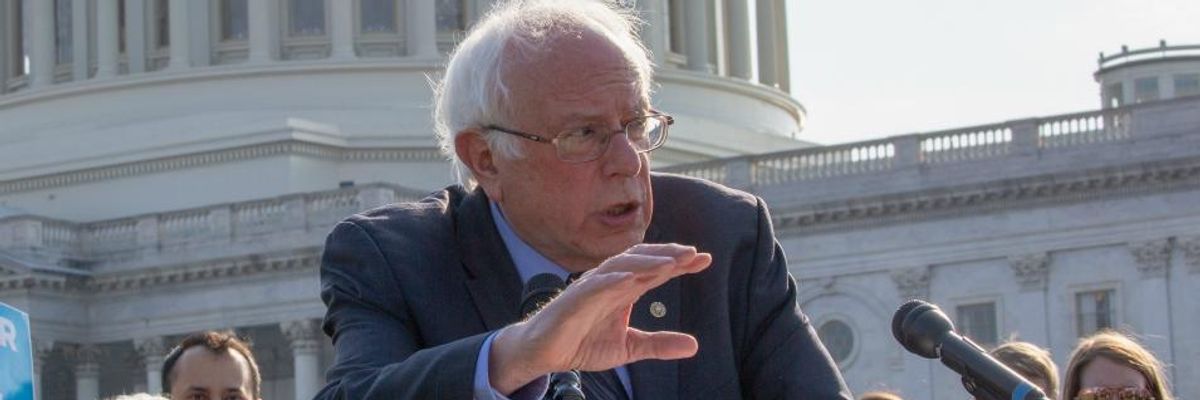
Sen. Bernie Sanders (I-VT) speaks at a rally with MoveOn members and allies gather with leading senators to demand that the Senate vote to reject Mike PompeoOs nomination for Secretary of State at US Capitol on April 11, 2018 in Washington, DC. (Photo: Tasos Katopodis/Getty Images for MoveOn.org)
Following recent efforts by media outlets to paint a picture that his opposition to past U.S. wars--from the Vietnam War when he was a young man to voting against the 2003 invasion of Iraq as a member of Congress--was something he might want to apologize or account for, Bernie Sanders on Friday released a video on Friday to make clear why he opposed those "disastrous" military misadventures and will continue to fight against similar follies in the future.
"I make no apologies to anybody, that when I was a young man--before I was elected to anything--I opposed the war in Vietnam," says Sanders, a 2020 Democratic presidential candidate, in the less than two-minute video. "And I know what that war did to my generation. And when I was a member of the House, I helped lead the effort against the war in Iraq, because I knew that Cheney and Bush and these other folks were lying about weapons of mass destruction."
The decision to invade Iraq in 2003, Sanders adds, was the "worst foreign policy blunder in the modern history of the United States."
Watch:
"This is great: Bernie tell tells the pro-war crowd and their enablers to bring it on," tweeted Mark Weisbrot, co-director of the Center for Economic and Policy Research, in response to the video. "Can't remember when a presidential candidate of his stature (he got 43% percent of the vote the 2016 Democratic primary) said something this honest about US wars."
In addition to noting his recent efforts to end U.S. complicity in the Saudi-led coalition's brutal assault on Yemen--a war that experts say is fueling tens of thousands of deaths and exacerbating the "worst humanitarian crisis in the world"--Sanders also vows in the video to do everything in his power to prevent any future war with Iran, something the Trump administration in recent weeks has made increasingly more likely.
"If you think the war in Iraq was a disaster," he warns in the video, "my guess is that the war in Iran would be even worse."
According to John Nichols, writing for The Nation this week, Sanders has no reason whatsoever to be sorry when it comes to his anti-war record.
"Sanders should never apologize for the anti-war stances he took in the past," wrote Nichols, "just as he should never apologize for the anti-war stances he is taking today as a leading contender for the Democratic presidential nomination."
Referencing his appearance on NBC's "Meet The Press" last Sunday, Nichols said it was nice to see a high-profile candidate like Sanders not cowing from subtle accusations that being opposed to war or militarism is politically problematic.
"[Sanders'] willingness to defend an anti-war stance on a Sunday-morning talk show," wrote Nichols, "was a refreshing rejoinder to the casually militaristic approach that characterizes so many media discussions of foreign policy."
Dear Common Dreams reader, It’s been nearly 30 years since I co-founded Common Dreams with my late wife, Lina Newhouser. We had the radical notion that journalism should serve the public good, not corporate profits. It was clear to us from the outset what it would take to build such a project. No paid advertisements. No corporate sponsors. No millionaire publisher telling us what to think or do. Many people said we wouldn't last a year, but we proved those doubters wrong. Together with a tremendous team of journalists and dedicated staff, we built an independent media outlet free from the constraints of profits and corporate control. Our mission has always been simple: To inform. To inspire. To ignite change for the common good. Building Common Dreams was not easy. Our survival was never guaranteed. When you take on the most powerful forces—Wall Street greed, fossil fuel industry destruction, Big Tech lobbyists, and uber-rich oligarchs who have spent billions upon billions rigging the economy and democracy in their favor—the only bulwark you have is supporters who believe in your work. But here’s the urgent message from me today. It's never been this bad out there. And it's never been this hard to keep us going. At the very moment Common Dreams is most needed, the threats we face are intensifying. We need your support now more than ever. We don't accept corporate advertising and never will. We don't have a paywall because we don't think people should be blocked from critical news based on their ability to pay. Everything we do is funded by the donations of readers like you. When everyone does the little they can afford, we are strong. But if that support retreats or dries up, so do we. Will you donate now to make sure Common Dreams not only survives but thrives? —Craig Brown, Co-founder |
Following recent efforts by media outlets to paint a picture that his opposition to past U.S. wars--from the Vietnam War when he was a young man to voting against the 2003 invasion of Iraq as a member of Congress--was something he might want to apologize or account for, Bernie Sanders on Friday released a video on Friday to make clear why he opposed those "disastrous" military misadventures and will continue to fight against similar follies in the future.
"I make no apologies to anybody, that when I was a young man--before I was elected to anything--I opposed the war in Vietnam," says Sanders, a 2020 Democratic presidential candidate, in the less than two-minute video. "And I know what that war did to my generation. And when I was a member of the House, I helped lead the effort against the war in Iraq, because I knew that Cheney and Bush and these other folks were lying about weapons of mass destruction."
The decision to invade Iraq in 2003, Sanders adds, was the "worst foreign policy blunder in the modern history of the United States."
Watch:
"This is great: Bernie tell tells the pro-war crowd and their enablers to bring it on," tweeted Mark Weisbrot, co-director of the Center for Economic and Policy Research, in response to the video. "Can't remember when a presidential candidate of his stature (he got 43% percent of the vote the 2016 Democratic primary) said something this honest about US wars."
In addition to noting his recent efforts to end U.S. complicity in the Saudi-led coalition's brutal assault on Yemen--a war that experts say is fueling tens of thousands of deaths and exacerbating the "worst humanitarian crisis in the world"--Sanders also vows in the video to do everything in his power to prevent any future war with Iran, something the Trump administration in recent weeks has made increasingly more likely.
"If you think the war in Iraq was a disaster," he warns in the video, "my guess is that the war in Iran would be even worse."
According to John Nichols, writing for The Nation this week, Sanders has no reason whatsoever to be sorry when it comes to his anti-war record.
"Sanders should never apologize for the anti-war stances he took in the past," wrote Nichols, "just as he should never apologize for the anti-war stances he is taking today as a leading contender for the Democratic presidential nomination."
Referencing his appearance on NBC's "Meet The Press" last Sunday, Nichols said it was nice to see a high-profile candidate like Sanders not cowing from subtle accusations that being opposed to war or militarism is politically problematic.
"[Sanders'] willingness to defend an anti-war stance on a Sunday-morning talk show," wrote Nichols, "was a refreshing rejoinder to the casually militaristic approach that characterizes so many media discussions of foreign policy."
Following recent efforts by media outlets to paint a picture that his opposition to past U.S. wars--from the Vietnam War when he was a young man to voting against the 2003 invasion of Iraq as a member of Congress--was something he might want to apologize or account for, Bernie Sanders on Friday released a video on Friday to make clear why he opposed those "disastrous" military misadventures and will continue to fight against similar follies in the future.
"I make no apologies to anybody, that when I was a young man--before I was elected to anything--I opposed the war in Vietnam," says Sanders, a 2020 Democratic presidential candidate, in the less than two-minute video. "And I know what that war did to my generation. And when I was a member of the House, I helped lead the effort against the war in Iraq, because I knew that Cheney and Bush and these other folks were lying about weapons of mass destruction."
The decision to invade Iraq in 2003, Sanders adds, was the "worst foreign policy blunder in the modern history of the United States."
Watch:
"This is great: Bernie tell tells the pro-war crowd and their enablers to bring it on," tweeted Mark Weisbrot, co-director of the Center for Economic and Policy Research, in response to the video. "Can't remember when a presidential candidate of his stature (he got 43% percent of the vote the 2016 Democratic primary) said something this honest about US wars."
In addition to noting his recent efforts to end U.S. complicity in the Saudi-led coalition's brutal assault on Yemen--a war that experts say is fueling tens of thousands of deaths and exacerbating the "worst humanitarian crisis in the world"--Sanders also vows in the video to do everything in his power to prevent any future war with Iran, something the Trump administration in recent weeks has made increasingly more likely.
"If you think the war in Iraq was a disaster," he warns in the video, "my guess is that the war in Iran would be even worse."
According to John Nichols, writing for The Nation this week, Sanders has no reason whatsoever to be sorry when it comes to his anti-war record.
"Sanders should never apologize for the anti-war stances he took in the past," wrote Nichols, "just as he should never apologize for the anti-war stances he is taking today as a leading contender for the Democratic presidential nomination."
Referencing his appearance on NBC's "Meet The Press" last Sunday, Nichols said it was nice to see a high-profile candidate like Sanders not cowing from subtle accusations that being opposed to war or militarism is politically problematic.
"[Sanders'] willingness to defend an anti-war stance on a Sunday-morning talk show," wrote Nichols, "was a refreshing rejoinder to the casually militaristic approach that characterizes so many media discussions of foreign policy."