SUBSCRIBE TO OUR FREE NEWSLETTER
Daily news & progressive opinion—funded by the people, not the corporations—delivered straight to your inbox.
5
#000000
#FFFFFF
To donate by check, phone, or other method, see our More Ways to Give page.
Daily news & progressive opinion—funded by the people, not the corporations—delivered straight to your inbox.
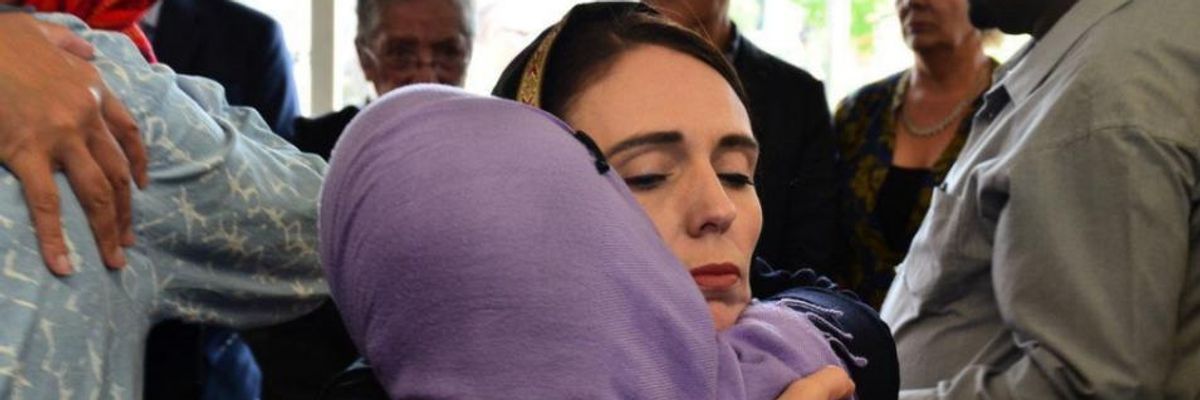
New Zealand Prime Minister Jacinda Ardern visited some of Christchurch's Muslim community at the Canterbury Refugee Center on Friday following an attack on two mosques. (Photo: @Sana_Jamal/Twitter)
New Zealand Prime Minister Jacinda Ardern awed American gun control advocates Friday night when she announced that her administration would promptly pursue changes to her country's gun laws following the shooting deaths of 49 people at two mosques in Christchurch--in stark contrast to the response of the U.S. government to similar attacks.
Ardern addressed New Zealanders hours after the attacks--which appears to have been driven by the white nationalist, anti-immigrant, and Islamophobic beliefs of the suspected attacker--to unequivocally call the shooting an act of terror and to say that the suspect had legally obtained the guns he used and had been able to modify them, allowing him to own the weapons without registering them.
"While work is being done as to the chain of events that led to both the holding of a gun license and the possession of these weapons, I can tell you one thing right now: our gun laws will change," said Ardern. "There have been attempts to change our laws in 2005, 2012, and after an inquiry in 2017. Now is the time for change."
Like most developed countries, New Zealand has far stricter gun laws than the United States, where more than 50 shootings involving more than one victim have already taken place this year.
But as German Lopez explained at Vox.com, gun control advocates have called for stricter enforcement, pressing for reforms of loopholes which allow New Zealanders to own many more military-style semi-automatic weapons than authorities can trace, and to modify firearms to make them operate as semi-automatic rifles:
Under the law, for instance, some semiautomatic rifles--commonly known as assault weapons--have to be registered as military-style semiautomatic rifles (MSSAs)... What is required to be registered and what isn't can often come down to weird technicalities: Just inserting a lower-capacity magazine into an AR-15, an assault rifle, can make the weapon not required to be registered.
[...]
Police have long worried that the gaps and loopholes make it easier for the wrong people to obtain and keep firearms.
Ardern is planning a cabinet meeting for Monday to discuss reforms, largely focused on the ability to modify weapons.
In contrast, President Donald Trump has repeatedly told mourning Americans in the wake of shootings that stricter gun control would make the country more dangerous, not less.
Gun control expert Philip Alpers suggested that Ardern's quick response to the attack may indicate that New Zealand will address the availability of military-style semi-automatic rifles as promptly as Australia did after a mass shooting in 1996.
"If Jacinda Ardern moves as quickly as [former Australian prime minister] John Howard did [when he banned guns following the 1996 Port Arthur massacre], and she does it in 12 days, the probability is that she will be able to do what she wants to do," Alpers told the Guardian.
Ardern further differentiated herself from Trump's conduct following attacks on minority communities when she was asked whether she agreed with the president's assessment, shared on Friday, that white supremacy is not a growing global problem.
"President Trump said in the Oval Office a few minutes ago that he did not think white supremacy worldwide was a problem that was rising in any way. Do you agree with him?" asked a reporter.
"No," she replied simply.
Ardern called on the U.S. government to show "sympathy and love for all Muslim communities," and told the press that "the person who has committed this violent act has no place here."
"You may have chosen us," Ardern said, addressing the suspect. "But we utterly condemn and reject you."
Dear Common Dreams reader, It’s been nearly 30 years since I co-founded Common Dreams with my late wife, Lina Newhouser. We had the radical notion that journalism should serve the public good, not corporate profits. It was clear to us from the outset what it would take to build such a project. No paid advertisements. No corporate sponsors. No millionaire publisher telling us what to think or do. Many people said we wouldn't last a year, but we proved those doubters wrong. Together with a tremendous team of journalists and dedicated staff, we built an independent media outlet free from the constraints of profits and corporate control. Our mission has always been simple: To inform. To inspire. To ignite change for the common good. Building Common Dreams was not easy. Our survival was never guaranteed. When you take on the most powerful forces—Wall Street greed, fossil fuel industry destruction, Big Tech lobbyists, and uber-rich oligarchs who have spent billions upon billions rigging the economy and democracy in their favor—the only bulwark you have is supporters who believe in your work. But here’s the urgent message from me today. It's never been this bad out there. And it's never been this hard to keep us going. At the very moment Common Dreams is most needed, the threats we face are intensifying. We need your support now more than ever. We don't accept corporate advertising and never will. We don't have a paywall because we don't think people should be blocked from critical news based on their ability to pay. Everything we do is funded by the donations of readers like you. When everyone does the little they can afford, we are strong. But if that support retreats or dries up, so do we. Will you donate now to make sure Common Dreams not only survives but thrives? —Craig Brown, Co-founder |
New Zealand Prime Minister Jacinda Ardern awed American gun control advocates Friday night when she announced that her administration would promptly pursue changes to her country's gun laws following the shooting deaths of 49 people at two mosques in Christchurch--in stark contrast to the response of the U.S. government to similar attacks.
Ardern addressed New Zealanders hours after the attacks--which appears to have been driven by the white nationalist, anti-immigrant, and Islamophobic beliefs of the suspected attacker--to unequivocally call the shooting an act of terror and to say that the suspect had legally obtained the guns he used and had been able to modify them, allowing him to own the weapons without registering them.
"While work is being done as to the chain of events that led to both the holding of a gun license and the possession of these weapons, I can tell you one thing right now: our gun laws will change," said Ardern. "There have been attempts to change our laws in 2005, 2012, and after an inquiry in 2017. Now is the time for change."
Like most developed countries, New Zealand has far stricter gun laws than the United States, where more than 50 shootings involving more than one victim have already taken place this year.
But as German Lopez explained at Vox.com, gun control advocates have called for stricter enforcement, pressing for reforms of loopholes which allow New Zealanders to own many more military-style semi-automatic weapons than authorities can trace, and to modify firearms to make them operate as semi-automatic rifles:
Under the law, for instance, some semiautomatic rifles--commonly known as assault weapons--have to be registered as military-style semiautomatic rifles (MSSAs)... What is required to be registered and what isn't can often come down to weird technicalities: Just inserting a lower-capacity magazine into an AR-15, an assault rifle, can make the weapon not required to be registered.
[...]
Police have long worried that the gaps and loopholes make it easier for the wrong people to obtain and keep firearms.
Ardern is planning a cabinet meeting for Monday to discuss reforms, largely focused on the ability to modify weapons.
In contrast, President Donald Trump has repeatedly told mourning Americans in the wake of shootings that stricter gun control would make the country more dangerous, not less.
Gun control expert Philip Alpers suggested that Ardern's quick response to the attack may indicate that New Zealand will address the availability of military-style semi-automatic rifles as promptly as Australia did after a mass shooting in 1996.
"If Jacinda Ardern moves as quickly as [former Australian prime minister] John Howard did [when he banned guns following the 1996 Port Arthur massacre], and she does it in 12 days, the probability is that she will be able to do what she wants to do," Alpers told the Guardian.
Ardern further differentiated herself from Trump's conduct following attacks on minority communities when she was asked whether she agreed with the president's assessment, shared on Friday, that white supremacy is not a growing global problem.
"President Trump said in the Oval Office a few minutes ago that he did not think white supremacy worldwide was a problem that was rising in any way. Do you agree with him?" asked a reporter.
"No," she replied simply.
Ardern called on the U.S. government to show "sympathy and love for all Muslim communities," and told the press that "the person who has committed this violent act has no place here."
"You may have chosen us," Ardern said, addressing the suspect. "But we utterly condemn and reject you."
New Zealand Prime Minister Jacinda Ardern awed American gun control advocates Friday night when she announced that her administration would promptly pursue changes to her country's gun laws following the shooting deaths of 49 people at two mosques in Christchurch--in stark contrast to the response of the U.S. government to similar attacks.
Ardern addressed New Zealanders hours after the attacks--which appears to have been driven by the white nationalist, anti-immigrant, and Islamophobic beliefs of the suspected attacker--to unequivocally call the shooting an act of terror and to say that the suspect had legally obtained the guns he used and had been able to modify them, allowing him to own the weapons without registering them.
"While work is being done as to the chain of events that led to both the holding of a gun license and the possession of these weapons, I can tell you one thing right now: our gun laws will change," said Ardern. "There have been attempts to change our laws in 2005, 2012, and after an inquiry in 2017. Now is the time for change."
Like most developed countries, New Zealand has far stricter gun laws than the United States, where more than 50 shootings involving more than one victim have already taken place this year.
But as German Lopez explained at Vox.com, gun control advocates have called for stricter enforcement, pressing for reforms of loopholes which allow New Zealanders to own many more military-style semi-automatic weapons than authorities can trace, and to modify firearms to make them operate as semi-automatic rifles:
Under the law, for instance, some semiautomatic rifles--commonly known as assault weapons--have to be registered as military-style semiautomatic rifles (MSSAs)... What is required to be registered and what isn't can often come down to weird technicalities: Just inserting a lower-capacity magazine into an AR-15, an assault rifle, can make the weapon not required to be registered.
[...]
Police have long worried that the gaps and loopholes make it easier for the wrong people to obtain and keep firearms.
Ardern is planning a cabinet meeting for Monday to discuss reforms, largely focused on the ability to modify weapons.
In contrast, President Donald Trump has repeatedly told mourning Americans in the wake of shootings that stricter gun control would make the country more dangerous, not less.
Gun control expert Philip Alpers suggested that Ardern's quick response to the attack may indicate that New Zealand will address the availability of military-style semi-automatic rifles as promptly as Australia did after a mass shooting in 1996.
"If Jacinda Ardern moves as quickly as [former Australian prime minister] John Howard did [when he banned guns following the 1996 Port Arthur massacre], and she does it in 12 days, the probability is that she will be able to do what she wants to do," Alpers told the Guardian.
Ardern further differentiated herself from Trump's conduct following attacks on minority communities when she was asked whether she agreed with the president's assessment, shared on Friday, that white supremacy is not a growing global problem.
"President Trump said in the Oval Office a few minutes ago that he did not think white supremacy worldwide was a problem that was rising in any way. Do you agree with him?" asked a reporter.
"No," she replied simply.
Ardern called on the U.S. government to show "sympathy and love for all Muslim communities," and told the press that "the person who has committed this violent act has no place here."
"You may have chosen us," Ardern said, addressing the suspect. "But we utterly condemn and reject you."