SUBSCRIBE TO OUR FREE NEWSLETTER
Daily news & progressive opinion—funded by the people, not the corporations—delivered straight to your inbox.
5
#000000
#FFFFFF
To donate by check, phone, or other method, see our More Ways to Give page.
Daily news & progressive opinion—funded by the people, not the corporations—delivered straight to your inbox.
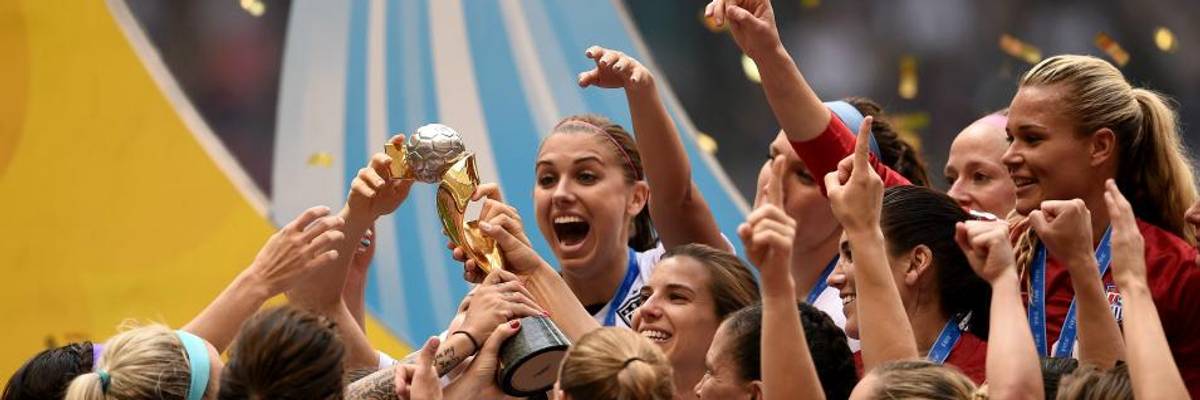
The U.S. women's national team celebrates after winning the FIFA Women's World Cup against Japan on July 5, 2015 in Vancouver, Canada. (Photo: Dennis Grombkowski/Getty Images)
As the global community celebrated International Women's Day on Friday, all 28 members of the World Cup-winning U.S. women's national soccer team filed a federal class-action lawsuit accusing the United States Soccer Federation of "institutionalized gender discrimination."
"Each of us is extremely proud to wear the United States jersey, and we also take seriously the responsibility that comes with that. We believe that fighting for gender equality in sports is a part of that responsibility."
--Alex Morgan, U.S. women's national team
The civil lawsuit, filed in U.S. District Court in Los Angeles, is just the latest development in the female athletes' long fight for pay, medical care, training, coaching, travel arrangements, and overall working conditions that are on par with the U.S. men's national team.
The suit alleges that by paying the men more, and granting them better working conditions, the federation is violating the Equal Pay Act and Title VII of the Civil Rights Act of 1964. The class of female players--which could grown to include dozens of more former team members--is seeking "punitive damages and all other appropriate relief."
Lawsuit plaintiffs Alex Morgan, Carli Lloyd, Megan Rapinoe, and Becky Sauerbrunn, along with former goalkeeper Hope Solo, filed a complaint against U.S. Soccer with the Equal Employment Opportunity Commission (EEOC) in 2016. The federal agency gave the players a right-to-sue letter last month.
"Each of us is extremely proud to wear the United States jersey, and we also take seriously the responsibility that comes with that," Morgan said in a statement. "We believe that fighting for gender equality in sports is a part of that responsibility. As players, we deserved to be paid equally for our work, regardless of our gender."
In terms of victories on the field, the women's team members have notably outperformed their male counterparts--winning three of the seven all-time Women's World Cups as well as gold medals in four of the six Olympic Games that have featured women's soccer.
Regarding their latest World Cup win in 2015, the lawsuit points out that the "title game garnered approximately 23 million viewers, making it the most watched soccer game in American TV history. The post-Cup Victory Tour drew tens of thousands of fans to soccer stadiums across the United States."
The filing comes just months before the next FIFA World Cup, which is scheduled to start on June 7 in Paris.
It also comes amid calls--on International Women's Day--for policymakers worldwide to recognize decades of failures to close gender gaps across industries, and to pursue "a transformative and measurable agenda for gender equality."
Outlining some of the build up to the federal lawsuit, New York Times sports journalist Andrew Das wrote Friday:
The American soccer players who filed the suit are some of the most well-known female athletes in the world and their prominence and willingness to leverage their profiles and their enormous social media followings to their cause has paid dividends already: the team has not played a match on artificial turf, a surface many players dislike, since 2017, for example, and its union holds biweekly meetings with U.S. Soccer to keep the team informed of everything from upcoming opponents and training camps to hotels and travel plans.
Direct comparisons between the compensation of the men's and women's teams can be complicated, however. Each team has its own collective bargaining agreement with U.S. Soccer, and among the major differences are pay structure: the men receive higher bonuses when they play for the United States, but are paid only when they make the team, while the women receive guaranteed salaries supplemented by smaller match bonuses.
One of the biggest differences in compensation is the multimillion-dollar bonuses the teams receive for participating in the World Cup, but those bonuses--a pool of $400 million for 32 men's teams versus $30 million for 24 women's teams--are determined by FIFA, world soccer's governing body, not U.S. Soccer.
Although not directly a part of the suit, the United States National Soccer Team Players Association said in a statement on Friday that it "fully supports the efforts" of the female players and remains "committed to the concept of a revenue-sharing model to... find a way towards fair compensation."
Dear Common Dreams reader, It’s been nearly 30 years since I co-founded Common Dreams with my late wife, Lina Newhouser. We had the radical notion that journalism should serve the public good, not corporate profits. It was clear to us from the outset what it would take to build such a project. No paid advertisements. No corporate sponsors. No millionaire publisher telling us what to think or do. Many people said we wouldn't last a year, but we proved those doubters wrong. Together with a tremendous team of journalists and dedicated staff, we built an independent media outlet free from the constraints of profits and corporate control. Our mission has always been simple: To inform. To inspire. To ignite change for the common good. Building Common Dreams was not easy. Our survival was never guaranteed. When you take on the most powerful forces—Wall Street greed, fossil fuel industry destruction, Big Tech lobbyists, and uber-rich oligarchs who have spent billions upon billions rigging the economy and democracy in their favor—the only bulwark you have is supporters who believe in your work. But here’s the urgent message from me today. It's never been this bad out there. And it's never been this hard to keep us going. At the very moment Common Dreams is most needed, the threats we face are intensifying. We need your support now more than ever. We don't accept corporate advertising and never will. We don't have a paywall because we don't think people should be blocked from critical news based on their ability to pay. Everything we do is funded by the donations of readers like you. When everyone does the little they can afford, we are strong. But if that support retreats or dries up, so do we. Will you donate now to make sure Common Dreams not only survives but thrives? —Craig Brown, Co-founder |
As the global community celebrated International Women's Day on Friday, all 28 members of the World Cup-winning U.S. women's national soccer team filed a federal class-action lawsuit accusing the United States Soccer Federation of "institutionalized gender discrimination."
"Each of us is extremely proud to wear the United States jersey, and we also take seriously the responsibility that comes with that. We believe that fighting for gender equality in sports is a part of that responsibility."
--Alex Morgan, U.S. women's national team
The civil lawsuit, filed in U.S. District Court in Los Angeles, is just the latest development in the female athletes' long fight for pay, medical care, training, coaching, travel arrangements, and overall working conditions that are on par with the U.S. men's national team.
The suit alleges that by paying the men more, and granting them better working conditions, the federation is violating the Equal Pay Act and Title VII of the Civil Rights Act of 1964. The class of female players--which could grown to include dozens of more former team members--is seeking "punitive damages and all other appropriate relief."
Lawsuit plaintiffs Alex Morgan, Carli Lloyd, Megan Rapinoe, and Becky Sauerbrunn, along with former goalkeeper Hope Solo, filed a complaint against U.S. Soccer with the Equal Employment Opportunity Commission (EEOC) in 2016. The federal agency gave the players a right-to-sue letter last month.
"Each of us is extremely proud to wear the United States jersey, and we also take seriously the responsibility that comes with that," Morgan said in a statement. "We believe that fighting for gender equality in sports is a part of that responsibility. As players, we deserved to be paid equally for our work, regardless of our gender."
In terms of victories on the field, the women's team members have notably outperformed their male counterparts--winning three of the seven all-time Women's World Cups as well as gold medals in four of the six Olympic Games that have featured women's soccer.
Regarding their latest World Cup win in 2015, the lawsuit points out that the "title game garnered approximately 23 million viewers, making it the most watched soccer game in American TV history. The post-Cup Victory Tour drew tens of thousands of fans to soccer stadiums across the United States."
The filing comes just months before the next FIFA World Cup, which is scheduled to start on June 7 in Paris.
It also comes amid calls--on International Women's Day--for policymakers worldwide to recognize decades of failures to close gender gaps across industries, and to pursue "a transformative and measurable agenda for gender equality."
Outlining some of the build up to the federal lawsuit, New York Times sports journalist Andrew Das wrote Friday:
The American soccer players who filed the suit are some of the most well-known female athletes in the world and their prominence and willingness to leverage their profiles and their enormous social media followings to their cause has paid dividends already: the team has not played a match on artificial turf, a surface many players dislike, since 2017, for example, and its union holds biweekly meetings with U.S. Soccer to keep the team informed of everything from upcoming opponents and training camps to hotels and travel plans.
Direct comparisons between the compensation of the men's and women's teams can be complicated, however. Each team has its own collective bargaining agreement with U.S. Soccer, and among the major differences are pay structure: the men receive higher bonuses when they play for the United States, but are paid only when they make the team, while the women receive guaranteed salaries supplemented by smaller match bonuses.
One of the biggest differences in compensation is the multimillion-dollar bonuses the teams receive for participating in the World Cup, but those bonuses--a pool of $400 million for 32 men's teams versus $30 million for 24 women's teams--are determined by FIFA, world soccer's governing body, not U.S. Soccer.
Although not directly a part of the suit, the United States National Soccer Team Players Association said in a statement on Friday that it "fully supports the efforts" of the female players and remains "committed to the concept of a revenue-sharing model to... find a way towards fair compensation."
As the global community celebrated International Women's Day on Friday, all 28 members of the World Cup-winning U.S. women's national soccer team filed a federal class-action lawsuit accusing the United States Soccer Federation of "institutionalized gender discrimination."
"Each of us is extremely proud to wear the United States jersey, and we also take seriously the responsibility that comes with that. We believe that fighting for gender equality in sports is a part of that responsibility."
--Alex Morgan, U.S. women's national team
The civil lawsuit, filed in U.S. District Court in Los Angeles, is just the latest development in the female athletes' long fight for pay, medical care, training, coaching, travel arrangements, and overall working conditions that are on par with the U.S. men's national team.
The suit alleges that by paying the men more, and granting them better working conditions, the federation is violating the Equal Pay Act and Title VII of the Civil Rights Act of 1964. The class of female players--which could grown to include dozens of more former team members--is seeking "punitive damages and all other appropriate relief."
Lawsuit plaintiffs Alex Morgan, Carli Lloyd, Megan Rapinoe, and Becky Sauerbrunn, along with former goalkeeper Hope Solo, filed a complaint against U.S. Soccer with the Equal Employment Opportunity Commission (EEOC) in 2016. The federal agency gave the players a right-to-sue letter last month.
"Each of us is extremely proud to wear the United States jersey, and we also take seriously the responsibility that comes with that," Morgan said in a statement. "We believe that fighting for gender equality in sports is a part of that responsibility. As players, we deserved to be paid equally for our work, regardless of our gender."
In terms of victories on the field, the women's team members have notably outperformed their male counterparts--winning three of the seven all-time Women's World Cups as well as gold medals in four of the six Olympic Games that have featured women's soccer.
Regarding their latest World Cup win in 2015, the lawsuit points out that the "title game garnered approximately 23 million viewers, making it the most watched soccer game in American TV history. The post-Cup Victory Tour drew tens of thousands of fans to soccer stadiums across the United States."
The filing comes just months before the next FIFA World Cup, which is scheduled to start on June 7 in Paris.
It also comes amid calls--on International Women's Day--for policymakers worldwide to recognize decades of failures to close gender gaps across industries, and to pursue "a transformative and measurable agenda for gender equality."
Outlining some of the build up to the federal lawsuit, New York Times sports journalist Andrew Das wrote Friday:
The American soccer players who filed the suit are some of the most well-known female athletes in the world and their prominence and willingness to leverage their profiles and their enormous social media followings to their cause has paid dividends already: the team has not played a match on artificial turf, a surface many players dislike, since 2017, for example, and its union holds biweekly meetings with U.S. Soccer to keep the team informed of everything from upcoming opponents and training camps to hotels and travel plans.
Direct comparisons between the compensation of the men's and women's teams can be complicated, however. Each team has its own collective bargaining agreement with U.S. Soccer, and among the major differences are pay structure: the men receive higher bonuses when they play for the United States, but are paid only when they make the team, while the women receive guaranteed salaries supplemented by smaller match bonuses.
One of the biggest differences in compensation is the multimillion-dollar bonuses the teams receive for participating in the World Cup, but those bonuses--a pool of $400 million for 32 men's teams versus $30 million for 24 women's teams--are determined by FIFA, world soccer's governing body, not U.S. Soccer.
Although not directly a part of the suit, the United States National Soccer Team Players Association said in a statement on Friday that it "fully supports the efforts" of the female players and remains "committed to the concept of a revenue-sharing model to... find a way towards fair compensation."