SUBSCRIBE TO OUR FREE NEWSLETTER
Daily news & progressive opinion—funded by the people, not the corporations—delivered straight to your inbox.
5
#000000
#FFFFFF
To donate by check, phone, or other method, see our More Ways to Give page.
Daily news & progressive opinion—funded by the people, not the corporations—delivered straight to your inbox.
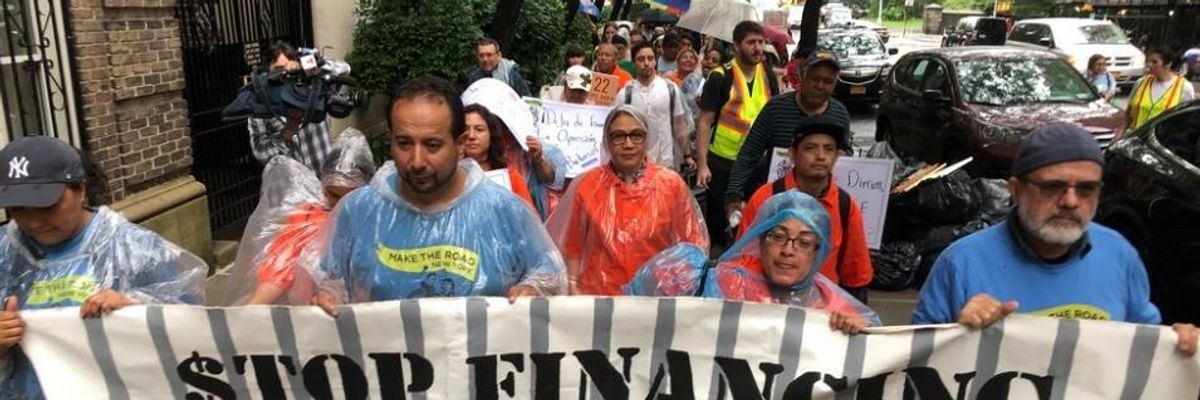
Dozens of New Yorkers assembled outside JPMorgan Chase CEO Jamie Dimon's home last summer, demanding that his bank divest from private prisons which run immigrant detention centers. (Photo: @altochulo/Twitter)
Civil and immigrant rights groups celebrated a victory Tuesday after JPMorgan Chase announced it was finally heeding their calls to end its financing of private for-profit prisons.
Make the Road NY, the Center for Popular Democracy, and New York Communities for Change were among the organizations credited with pressuring the bank to stop bankrolling CoreCivic and GEO Group, the nation's largest private prison operators.
"Once again, people power beats corporate greed," Make the Road tweeted.
"Today we are delighted to hear that JPMorgan Chase has decided to listen to our communities and end its harmful practice of financially backing private prisons and immigrant detention centers," said Ana Maria Archila, co-executive director of the Center for Popular Democracy. "This is an incredible victory for immigrant communities and for our society as a whole."
Elizabeth Chavez, a member of Make the Road New York, applauded JPMorgan's decision but stressed that her organization's work is not done.
"Immigrants and trans women like me have stood up to JPMorgan Chase for bankrolling private immigrant detention companies because it's people like us who face abuse and violence in their cages every day," said Chavez. "And we will continue to work to put the private prison industry out of business as we fight for respect and dignity for every member of our community."
About two-thirds of immigrants in U.S. custody are being held in privately-operated detention centers, according to Reuters. GEO Group and CoreCivic secured contracts to detain immigrants and run prisons holding about 10 percent of U.S. inmates thanks in part to loans and bonds brokered by JPMorgan Chase and other big banks in recent years.
Helping to fund the companies' prison operations has proven lucrative for banks including JPMorgan as well as Bank of America and Wells Fargo. In 2018, banks raised $1.8 billion in debt from loans to the prison operators.
Under pressure, Wells Fargo announced it was "reducing its relationship" with the companies earlier this year.
Activists challenged JPMorgan CEO Jamie Dimon at the bank's last two annual meetings, and have demonstrated outside his home in New York--holding signs reading, "Jamie Dimon: Stop Bankrolling Oppression!" and denouncing the bank as a "backer of hate" in the rain last summer, and demanding that Dimon "break up with prisons" this past Valentine's Day.
Former New York gubernatorial candidate Cynthia Nixon praised Make the Road NY and others for their campaigning, saying Dimon's decision offered "more evidence that organizing works" and calling on all banks to follow in JPMorgan's footsteps.
JPMorgan's decision was announced days after Rep. Alexandria Ocasio-Cortez (D-N.Y.) called for congressional hearings on banks' financing of private prisons.
"We're going to hold oversight hearings to make these banks accountable for investing in and making money off of the detention of immigrants," Ocasio Cortez said late last month. "Because it's wrong."
Dear Common Dreams reader, It’s been nearly 30 years since I co-founded Common Dreams with my late wife, Lina Newhouser. We had the radical notion that journalism should serve the public good, not corporate profits. It was clear to us from the outset what it would take to build such a project. No paid advertisements. No corporate sponsors. No millionaire publisher telling us what to think or do. Many people said we wouldn't last a year, but we proved those doubters wrong. Together with a tremendous team of journalists and dedicated staff, we built an independent media outlet free from the constraints of profits and corporate control. Our mission has always been simple: To inform. To inspire. To ignite change for the common good. Building Common Dreams was not easy. Our survival was never guaranteed. When you take on the most powerful forces—Wall Street greed, fossil fuel industry destruction, Big Tech lobbyists, and uber-rich oligarchs who have spent billions upon billions rigging the economy and democracy in their favor—the only bulwark you have is supporters who believe in your work. But here’s the urgent message from me today. It's never been this bad out there. And it's never been this hard to keep us going. At the very moment Common Dreams is most needed, the threats we face are intensifying. We need your support now more than ever. We don't accept corporate advertising and never will. We don't have a paywall because we don't think people should be blocked from critical news based on their ability to pay. Everything we do is funded by the donations of readers like you. When everyone does the little they can afford, we are strong. But if that support retreats or dries up, so do we. Will you donate now to make sure Common Dreams not only survives but thrives? —Craig Brown, Co-founder |
Civil and immigrant rights groups celebrated a victory Tuesday after JPMorgan Chase announced it was finally heeding their calls to end its financing of private for-profit prisons.
Make the Road NY, the Center for Popular Democracy, and New York Communities for Change were among the organizations credited with pressuring the bank to stop bankrolling CoreCivic and GEO Group, the nation's largest private prison operators.
"Once again, people power beats corporate greed," Make the Road tweeted.
"Today we are delighted to hear that JPMorgan Chase has decided to listen to our communities and end its harmful practice of financially backing private prisons and immigrant detention centers," said Ana Maria Archila, co-executive director of the Center for Popular Democracy. "This is an incredible victory for immigrant communities and for our society as a whole."
Elizabeth Chavez, a member of Make the Road New York, applauded JPMorgan's decision but stressed that her organization's work is not done.
"Immigrants and trans women like me have stood up to JPMorgan Chase for bankrolling private immigrant detention companies because it's people like us who face abuse and violence in their cages every day," said Chavez. "And we will continue to work to put the private prison industry out of business as we fight for respect and dignity for every member of our community."
About two-thirds of immigrants in U.S. custody are being held in privately-operated detention centers, according to Reuters. GEO Group and CoreCivic secured contracts to detain immigrants and run prisons holding about 10 percent of U.S. inmates thanks in part to loans and bonds brokered by JPMorgan Chase and other big banks in recent years.
Helping to fund the companies' prison operations has proven lucrative for banks including JPMorgan as well as Bank of America and Wells Fargo. In 2018, banks raised $1.8 billion in debt from loans to the prison operators.
Under pressure, Wells Fargo announced it was "reducing its relationship" with the companies earlier this year.
Activists challenged JPMorgan CEO Jamie Dimon at the bank's last two annual meetings, and have demonstrated outside his home in New York--holding signs reading, "Jamie Dimon: Stop Bankrolling Oppression!" and denouncing the bank as a "backer of hate" in the rain last summer, and demanding that Dimon "break up with prisons" this past Valentine's Day.
Former New York gubernatorial candidate Cynthia Nixon praised Make the Road NY and others for their campaigning, saying Dimon's decision offered "more evidence that organizing works" and calling on all banks to follow in JPMorgan's footsteps.
JPMorgan's decision was announced days after Rep. Alexandria Ocasio-Cortez (D-N.Y.) called for congressional hearings on banks' financing of private prisons.
"We're going to hold oversight hearings to make these banks accountable for investing in and making money off of the detention of immigrants," Ocasio Cortez said late last month. "Because it's wrong."
Civil and immigrant rights groups celebrated a victory Tuesday after JPMorgan Chase announced it was finally heeding their calls to end its financing of private for-profit prisons.
Make the Road NY, the Center for Popular Democracy, and New York Communities for Change were among the organizations credited with pressuring the bank to stop bankrolling CoreCivic and GEO Group, the nation's largest private prison operators.
"Once again, people power beats corporate greed," Make the Road tweeted.
"Today we are delighted to hear that JPMorgan Chase has decided to listen to our communities and end its harmful practice of financially backing private prisons and immigrant detention centers," said Ana Maria Archila, co-executive director of the Center for Popular Democracy. "This is an incredible victory for immigrant communities and for our society as a whole."
Elizabeth Chavez, a member of Make the Road New York, applauded JPMorgan's decision but stressed that her organization's work is not done.
"Immigrants and trans women like me have stood up to JPMorgan Chase for bankrolling private immigrant detention companies because it's people like us who face abuse and violence in their cages every day," said Chavez. "And we will continue to work to put the private prison industry out of business as we fight for respect and dignity for every member of our community."
About two-thirds of immigrants in U.S. custody are being held in privately-operated detention centers, according to Reuters. GEO Group and CoreCivic secured contracts to detain immigrants and run prisons holding about 10 percent of U.S. inmates thanks in part to loans and bonds brokered by JPMorgan Chase and other big banks in recent years.
Helping to fund the companies' prison operations has proven lucrative for banks including JPMorgan as well as Bank of America and Wells Fargo. In 2018, banks raised $1.8 billion in debt from loans to the prison operators.
Under pressure, Wells Fargo announced it was "reducing its relationship" with the companies earlier this year.
Activists challenged JPMorgan CEO Jamie Dimon at the bank's last two annual meetings, and have demonstrated outside his home in New York--holding signs reading, "Jamie Dimon: Stop Bankrolling Oppression!" and denouncing the bank as a "backer of hate" in the rain last summer, and demanding that Dimon "break up with prisons" this past Valentine's Day.
Former New York gubernatorial candidate Cynthia Nixon praised Make the Road NY and others for their campaigning, saying Dimon's decision offered "more evidence that organizing works" and calling on all banks to follow in JPMorgan's footsteps.
JPMorgan's decision was announced days after Rep. Alexandria Ocasio-Cortez (D-N.Y.) called for congressional hearings on banks' financing of private prisons.
"We're going to hold oversight hearings to make these banks accountable for investing in and making money off of the detention of immigrants," Ocasio Cortez said late last month. "Because it's wrong."