SUBSCRIBE TO OUR FREE NEWSLETTER
Daily news & progressive opinion—funded by the people, not the corporations—delivered straight to your inbox.
5
#000000
#FFFFFF
To donate by check, phone, or other method, see our More Ways to Give page.
Daily news & progressive opinion—funded by the people, not the corporations—delivered straight to your inbox.
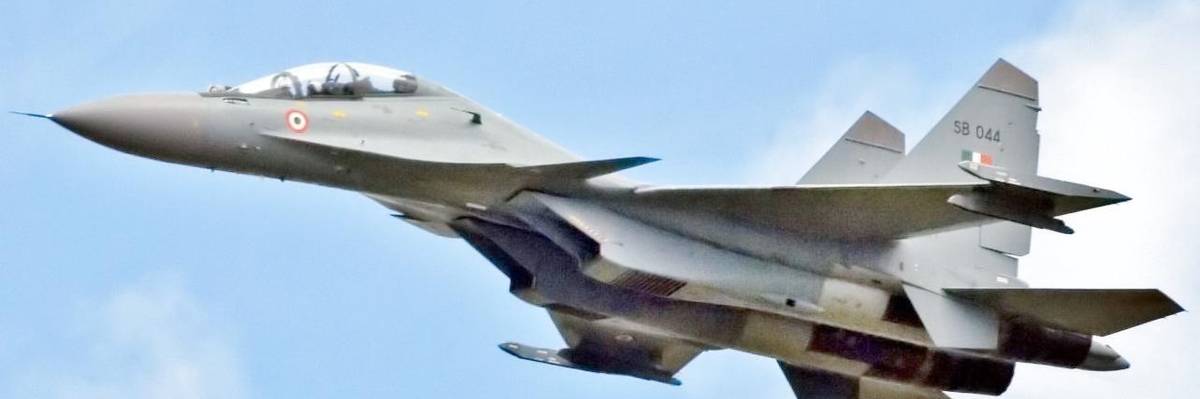
Photo: An Indian Air Force Sukhoi Su-30MKI fighter jet (Wikimedia Commons).
Warplanes from India launched an attack on an alleged militant camp Tuesday morning, violating Pakistani airspace in the disputed territory of Kashmir in the latest escalation between the two nuclear powers. The attack carried with it fears of wider war between the two countries.
"Armed conflicts once started take their own course without either side being in control to decide where such hostilities will end," Professor Muzaffar Ahmed told Indian news service IANS.
The aerial attack came in the wake of heightened tensions between India and Pakistan, after a Feb. 14 suicide attack on Indian security forces in the Kashmiri town of Pulwama, which killed 42, led to India cutting Pakistan off from a key water source controlled by the former on Feb. 21.
The result of the morning's Indian incursion was unclear at press time. Indian foreign secretary Vijay Gokhale claimed the attack struck a militant training camp and blamed the Pakistani government for allowing the camp to flourish. "The existence of such training facilities, capable of training hundreds of jihadis," said Gokhale, "could not have functioned without the knowledge of the Pakistani authorities."
Pakistani sources disagreed with the Indian version of events and said the Indian planes had dropped their payload without a target, showing craters near the small town of Balakot as evidence.
Balakot residents told the Associated Press that they were awakened in the early morning by the bombs but that the raid had no other effect than frightening them.
"We didn't think for a moment that it was from planes but the explosions were very powerful," said resident Mohammed Abbas.
The invasion of Pakistani territory by Indian jets marks a significant and dangerous step in the fraught relationship between the two nuclear neighbors, whose countries have fought four wars already in 1947, 1965, 1971, and 1999.
Imran Khan, Pakistan's new Prime Minister, referred to Indian allegations of hitting the training camp as "a self-serving, reckless and fictitious claim." Pakistan's National Security Committee said that the country would respond to the raid "at a time and place of our choosing."
Indian Prime Minister Narendra Modi, speaking at an election rally, did not refer specifically to the morning's attack but said that he would not give in to Pakistan.
"I will not let the country bend," Modi said.
Any escalation in tensions between India and Pakistan that could lead to war could lead to the use of nuclear weapons and possibly trigger a wider regional conflict. China, a longtime ally of India and the third claimant to Kashmiri territory, urged restraint on both sides.
Lu Kang, a spokesman for the Foreign Ministry, told reporters China hopes that its neighbors will "exercise restraint and take actions that will help stabilize the situation in the region and help to improve mutual relations."
That seemed unlikely Tuesday as gunfire was reportedly heard at the border.
Dear Common Dreams reader, It’s been nearly 30 years since I co-founded Common Dreams with my late wife, Lina Newhouser. We had the radical notion that journalism should serve the public good, not corporate profits. It was clear to us from the outset what it would take to build such a project. No paid advertisements. No corporate sponsors. No millionaire publisher telling us what to think or do. Many people said we wouldn't last a year, but we proved those doubters wrong. Together with a tremendous team of journalists and dedicated staff, we built an independent media outlet free from the constraints of profits and corporate control. Our mission has always been simple: To inform. To inspire. To ignite change for the common good. Building Common Dreams was not easy. Our survival was never guaranteed. When you take on the most powerful forces—Wall Street greed, fossil fuel industry destruction, Big Tech lobbyists, and uber-rich oligarchs who have spent billions upon billions rigging the economy and democracy in their favor—the only bulwark you have is supporters who believe in your work. But here’s the urgent message from me today. It's never been this bad out there. And it's never been this hard to keep us going. At the very moment Common Dreams is most needed, the threats we face are intensifying. We need your support now more than ever. We don't accept corporate advertising and never will. We don't have a paywall because we don't think people should be blocked from critical news based on their ability to pay. Everything we do is funded by the donations of readers like you. When everyone does the little they can afford, we are strong. But if that support retreats or dries up, so do we. Will you donate now to make sure Common Dreams not only survives but thrives? —Craig Brown, Co-founder |
Warplanes from India launched an attack on an alleged militant camp Tuesday morning, violating Pakistani airspace in the disputed territory of Kashmir in the latest escalation between the two nuclear powers. The attack carried with it fears of wider war between the two countries.
"Armed conflicts once started take their own course without either side being in control to decide where such hostilities will end," Professor Muzaffar Ahmed told Indian news service IANS.
The aerial attack came in the wake of heightened tensions between India and Pakistan, after a Feb. 14 suicide attack on Indian security forces in the Kashmiri town of Pulwama, which killed 42, led to India cutting Pakistan off from a key water source controlled by the former on Feb. 21.
The result of the morning's Indian incursion was unclear at press time. Indian foreign secretary Vijay Gokhale claimed the attack struck a militant training camp and blamed the Pakistani government for allowing the camp to flourish. "The existence of such training facilities, capable of training hundreds of jihadis," said Gokhale, "could not have functioned without the knowledge of the Pakistani authorities."
Pakistani sources disagreed with the Indian version of events and said the Indian planes had dropped their payload without a target, showing craters near the small town of Balakot as evidence.
Balakot residents told the Associated Press that they were awakened in the early morning by the bombs but that the raid had no other effect than frightening them.
"We didn't think for a moment that it was from planes but the explosions were very powerful," said resident Mohammed Abbas.
The invasion of Pakistani territory by Indian jets marks a significant and dangerous step in the fraught relationship between the two nuclear neighbors, whose countries have fought four wars already in 1947, 1965, 1971, and 1999.
Imran Khan, Pakistan's new Prime Minister, referred to Indian allegations of hitting the training camp as "a self-serving, reckless and fictitious claim." Pakistan's National Security Committee said that the country would respond to the raid "at a time and place of our choosing."
Indian Prime Minister Narendra Modi, speaking at an election rally, did not refer specifically to the morning's attack but said that he would not give in to Pakistan.
"I will not let the country bend," Modi said.
Any escalation in tensions between India and Pakistan that could lead to war could lead to the use of nuclear weapons and possibly trigger a wider regional conflict. China, a longtime ally of India and the third claimant to Kashmiri territory, urged restraint on both sides.
Lu Kang, a spokesman for the Foreign Ministry, told reporters China hopes that its neighbors will "exercise restraint and take actions that will help stabilize the situation in the region and help to improve mutual relations."
That seemed unlikely Tuesday as gunfire was reportedly heard at the border.
Warplanes from India launched an attack on an alleged militant camp Tuesday morning, violating Pakistani airspace in the disputed territory of Kashmir in the latest escalation between the two nuclear powers. The attack carried with it fears of wider war between the two countries.
"Armed conflicts once started take their own course without either side being in control to decide where such hostilities will end," Professor Muzaffar Ahmed told Indian news service IANS.
The aerial attack came in the wake of heightened tensions between India and Pakistan, after a Feb. 14 suicide attack on Indian security forces in the Kashmiri town of Pulwama, which killed 42, led to India cutting Pakistan off from a key water source controlled by the former on Feb. 21.
The result of the morning's Indian incursion was unclear at press time. Indian foreign secretary Vijay Gokhale claimed the attack struck a militant training camp and blamed the Pakistani government for allowing the camp to flourish. "The existence of such training facilities, capable of training hundreds of jihadis," said Gokhale, "could not have functioned without the knowledge of the Pakistani authorities."
Pakistani sources disagreed with the Indian version of events and said the Indian planes had dropped their payload without a target, showing craters near the small town of Balakot as evidence.
Balakot residents told the Associated Press that they were awakened in the early morning by the bombs but that the raid had no other effect than frightening them.
"We didn't think for a moment that it was from planes but the explosions were very powerful," said resident Mohammed Abbas.
The invasion of Pakistani territory by Indian jets marks a significant and dangerous step in the fraught relationship between the two nuclear neighbors, whose countries have fought four wars already in 1947, 1965, 1971, and 1999.
Imran Khan, Pakistan's new Prime Minister, referred to Indian allegations of hitting the training camp as "a self-serving, reckless and fictitious claim." Pakistan's National Security Committee said that the country would respond to the raid "at a time and place of our choosing."
Indian Prime Minister Narendra Modi, speaking at an election rally, did not refer specifically to the morning's attack but said that he would not give in to Pakistan.
"I will not let the country bend," Modi said.
Any escalation in tensions between India and Pakistan that could lead to war could lead to the use of nuclear weapons and possibly trigger a wider regional conflict. China, a longtime ally of India and the third claimant to Kashmiri territory, urged restraint on both sides.
Lu Kang, a spokesman for the Foreign Ministry, told reporters China hopes that its neighbors will "exercise restraint and take actions that will help stabilize the situation in the region and help to improve mutual relations."
That seemed unlikely Tuesday as gunfire was reportedly heard at the border.