

SUBSCRIBE TO OUR FREE NEWSLETTER
Daily news & progressive opinion—funded by the people, not the corporations—delivered straight to your inbox.
5
#000000
#FFFFFF
To donate by check, phone, or other method, see our More Ways to Give page.
Daily news & progressive opinion—funded by the people, not the corporations—delivered straight to your inbox.
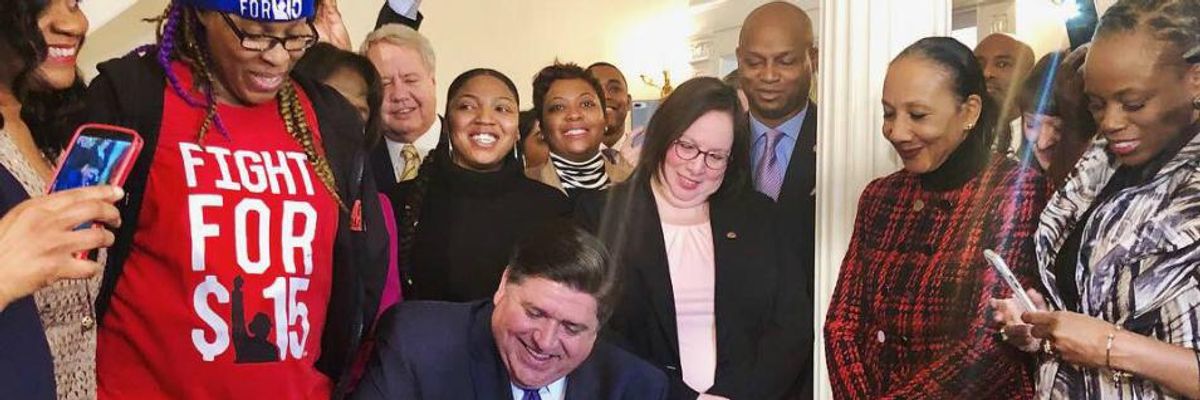
Illinois Gov. JB Pritzker signed a law on Tuesday that will raise the minimum wage in Illinois to $15 per hour by 2025. (Photo: @GovPritzker/Twitter)
Illinois workers and local Fight for $15 organizers celebrated a win on Tuesday as newly elected Democratic Gov. JB Pritzker signed a law that will gradually raise the state's hourly minimum wage from $8.25 to $15 by 2025.
"Fifteen dollars an hour will be life-changing for me. I can barely afford the basic needs for my two sons on my minimum-wage salary. Simple things like whether to buy school supplies for my older boy or formula and diapers for my little one become agonizing choices," said Fight for $15 member Ieshia Townsend, who works a McDonald's in Chicago.
Reflecting on the past six years of grassroots organizing to raise wages across the state, Townsend shared that "as a single mom and a Black woman on the south side of Chicago, I felt invisible before I joined the Fight for $15 and a union. But by coming togethe and speaking out, our voices have been heard." While welcoming the victory on Tuesday, she vowed to continue the fight for a union.
Pointing out that the new law comes just two years after former Republican Gov. Bruce Rauner--who was voted out in November--vetoed similar legislation, Patriotic Millionaires and Illinois residents Michael and Joan Pine said in a statement, "Illinois' working families will finally get the boost they deserve."
"So long as the federal minimum wage does not keep up with increases in the costs of goods and rising inflation, it will be necessary for states to step in," the Pines charged. "By Gov. Pritzker making a living wage one of his first priorities, he has shown a commitment to the working class and the businesses that service them."
"This is a monumental day for our state, a day that redefines what it means to live and work in Illinois," Pritzker said at a signing ceremony in Springfield Tuesday morning, surrounded by workers, labor leaders, and legislators. Thanking them for their years-long dedication to enacting the law, he added, "Make no mistake, this did not happen overnight nor did it happen without the powerful voices of those who fight for workers' rights."
Despite his status as a billionaire businessman, the governor promised during his campaign to promote economic inclusion, raise wages, and protect collective bargaining rights. "Today, we boldly declare that Illinois is a state that welcomes working families, setting a high standard for workers' rights, economic opportunity, and economic justice," he concluded.
While Pritzker's signature on Tuesday made Illinois the first Midwestern state, and fifth in the nation, to mandate a $15 hourly wage, the measure--which didn't receive any support from Republican lawmakers--does have some limitations in addition to its gradual implementation. As the Chicago Tribune outlined:
An estimated 1.4 million Illinois residents will see their pay go up Jan. 1 as a result of the law, which increases the statewide minimum wage to $9.25 per hour from $8.25. The minimum wage will increase again to $10 per hour on July 1, 2020, and will then go up $1 per hour each year on Jan. 1 until hitting $15 per hour in 2025...
In an attempt to ease the burden on employers, the law creates a tax credit to help businesses with 50 or fewer employees offset some of the cost of wage increases. Employers will be able to claim a tax credit for 25 percent of the cost in 2020, and the credit will scale back annually, then eventually phase out.
The law also preserves the way restaurants and other employers with tipped workers count gratuities toward employees' wages, and it sets a lower minimum wage for workers younger than 18 who work fewer than 650 hours in a year. The minimum wage for younger employees--currently $7.75 per hour--would increase to $8 on Jan. 1 and peak at $13 per hour in 2025.
Illinois' new law comes on the heels of an analysis from the Economic Policy Institute (EPI) that concluded the Raise the Wage Act of 2019 would improve the lives of an estimated 40 million Americans nationwide, particularly women, people of color, and single parents. Sponsored by Rep. Bobby Scott (D-Va.) and Sen. Bernie Sanders (I-Vt.)--who announced Tuesday that he is running for president--the measure would raise the federal hourly minimum wage from $7.25 to $15 by 2024.
Dear Common Dreams reader, It’s been nearly 30 years since I co-founded Common Dreams with my late wife, Lina Newhouser. We had the radical notion that journalism should serve the public good, not corporate profits. It was clear to us from the outset what it would take to build such a project. No paid advertisements. No corporate sponsors. No millionaire publisher telling us what to think or do. Many people said we wouldn't last a year, but we proved those doubters wrong. Together with a tremendous team of journalists and dedicated staff, we built an independent media outlet free from the constraints of profits and corporate control. Our mission has always been simple: To inform. To inspire. To ignite change for the common good. Building Common Dreams was not easy. Our survival was never guaranteed. When you take on the most powerful forces—Wall Street greed, fossil fuel industry destruction, Big Tech lobbyists, and uber-rich oligarchs who have spent billions upon billions rigging the economy and democracy in their favor—the only bulwark you have is supporters who believe in your work. But here’s the urgent message from me today. It's never been this bad out there. And it's never been this hard to keep us going. At the very moment Common Dreams is most needed, the threats we face are intensifying. We need your support now more than ever. We don't accept corporate advertising and never will. We don't have a paywall because we don't think people should be blocked from critical news based on their ability to pay. Everything we do is funded by the donations of readers like you. When everyone does the little they can afford, we are strong. But if that support retreats or dries up, so do we. Will you donate now to make sure Common Dreams not only survives but thrives? —Craig Brown, Co-founder |
Illinois workers and local Fight for $15 organizers celebrated a win on Tuesday as newly elected Democratic Gov. JB Pritzker signed a law that will gradually raise the state's hourly minimum wage from $8.25 to $15 by 2025.
"Fifteen dollars an hour will be life-changing for me. I can barely afford the basic needs for my two sons on my minimum-wage salary. Simple things like whether to buy school supplies for my older boy or formula and diapers for my little one become agonizing choices," said Fight for $15 member Ieshia Townsend, who works a McDonald's in Chicago.
Reflecting on the past six years of grassroots organizing to raise wages across the state, Townsend shared that "as a single mom and a Black woman on the south side of Chicago, I felt invisible before I joined the Fight for $15 and a union. But by coming togethe and speaking out, our voices have been heard." While welcoming the victory on Tuesday, she vowed to continue the fight for a union.
Pointing out that the new law comes just two years after former Republican Gov. Bruce Rauner--who was voted out in November--vetoed similar legislation, Patriotic Millionaires and Illinois residents Michael and Joan Pine said in a statement, "Illinois' working families will finally get the boost they deserve."
"So long as the federal minimum wage does not keep up with increases in the costs of goods and rising inflation, it will be necessary for states to step in," the Pines charged. "By Gov. Pritzker making a living wage one of his first priorities, he has shown a commitment to the working class and the businesses that service them."
"This is a monumental day for our state, a day that redefines what it means to live and work in Illinois," Pritzker said at a signing ceremony in Springfield Tuesday morning, surrounded by workers, labor leaders, and legislators. Thanking them for their years-long dedication to enacting the law, he added, "Make no mistake, this did not happen overnight nor did it happen without the powerful voices of those who fight for workers' rights."
Despite his status as a billionaire businessman, the governor promised during his campaign to promote economic inclusion, raise wages, and protect collective bargaining rights. "Today, we boldly declare that Illinois is a state that welcomes working families, setting a high standard for workers' rights, economic opportunity, and economic justice," he concluded.
While Pritzker's signature on Tuesday made Illinois the first Midwestern state, and fifth in the nation, to mandate a $15 hourly wage, the measure--which didn't receive any support from Republican lawmakers--does have some limitations in addition to its gradual implementation. As the Chicago Tribune outlined:
An estimated 1.4 million Illinois residents will see their pay go up Jan. 1 as a result of the law, which increases the statewide minimum wage to $9.25 per hour from $8.25. The minimum wage will increase again to $10 per hour on July 1, 2020, and will then go up $1 per hour each year on Jan. 1 until hitting $15 per hour in 2025...
In an attempt to ease the burden on employers, the law creates a tax credit to help businesses with 50 or fewer employees offset some of the cost of wage increases. Employers will be able to claim a tax credit for 25 percent of the cost in 2020, and the credit will scale back annually, then eventually phase out.
The law also preserves the way restaurants and other employers with tipped workers count gratuities toward employees' wages, and it sets a lower minimum wage for workers younger than 18 who work fewer than 650 hours in a year. The minimum wage for younger employees--currently $7.75 per hour--would increase to $8 on Jan. 1 and peak at $13 per hour in 2025.
Illinois' new law comes on the heels of an analysis from the Economic Policy Institute (EPI) that concluded the Raise the Wage Act of 2019 would improve the lives of an estimated 40 million Americans nationwide, particularly women, people of color, and single parents. Sponsored by Rep. Bobby Scott (D-Va.) and Sen. Bernie Sanders (I-Vt.)--who announced Tuesday that he is running for president--the measure would raise the federal hourly minimum wage from $7.25 to $15 by 2024.
Illinois workers and local Fight for $15 organizers celebrated a win on Tuesday as newly elected Democratic Gov. JB Pritzker signed a law that will gradually raise the state's hourly minimum wage from $8.25 to $15 by 2025.
"Fifteen dollars an hour will be life-changing for me. I can barely afford the basic needs for my two sons on my minimum-wage salary. Simple things like whether to buy school supplies for my older boy or formula and diapers for my little one become agonizing choices," said Fight for $15 member Ieshia Townsend, who works a McDonald's in Chicago.
Reflecting on the past six years of grassroots organizing to raise wages across the state, Townsend shared that "as a single mom and a Black woman on the south side of Chicago, I felt invisible before I joined the Fight for $15 and a union. But by coming togethe and speaking out, our voices have been heard." While welcoming the victory on Tuesday, she vowed to continue the fight for a union.
Pointing out that the new law comes just two years after former Republican Gov. Bruce Rauner--who was voted out in November--vetoed similar legislation, Patriotic Millionaires and Illinois residents Michael and Joan Pine said in a statement, "Illinois' working families will finally get the boost they deserve."
"So long as the federal minimum wage does not keep up with increases in the costs of goods and rising inflation, it will be necessary for states to step in," the Pines charged. "By Gov. Pritzker making a living wage one of his first priorities, he has shown a commitment to the working class and the businesses that service them."
"This is a monumental day for our state, a day that redefines what it means to live and work in Illinois," Pritzker said at a signing ceremony in Springfield Tuesday morning, surrounded by workers, labor leaders, and legislators. Thanking them for their years-long dedication to enacting the law, he added, "Make no mistake, this did not happen overnight nor did it happen without the powerful voices of those who fight for workers' rights."
Despite his status as a billionaire businessman, the governor promised during his campaign to promote economic inclusion, raise wages, and protect collective bargaining rights. "Today, we boldly declare that Illinois is a state that welcomes working families, setting a high standard for workers' rights, economic opportunity, and economic justice," he concluded.
While Pritzker's signature on Tuesday made Illinois the first Midwestern state, and fifth in the nation, to mandate a $15 hourly wage, the measure--which didn't receive any support from Republican lawmakers--does have some limitations in addition to its gradual implementation. As the Chicago Tribune outlined:
An estimated 1.4 million Illinois residents will see their pay go up Jan. 1 as a result of the law, which increases the statewide minimum wage to $9.25 per hour from $8.25. The minimum wage will increase again to $10 per hour on July 1, 2020, and will then go up $1 per hour each year on Jan. 1 until hitting $15 per hour in 2025...
In an attempt to ease the burden on employers, the law creates a tax credit to help businesses with 50 or fewer employees offset some of the cost of wage increases. Employers will be able to claim a tax credit for 25 percent of the cost in 2020, and the credit will scale back annually, then eventually phase out.
The law also preserves the way restaurants and other employers with tipped workers count gratuities toward employees' wages, and it sets a lower minimum wage for workers younger than 18 who work fewer than 650 hours in a year. The minimum wage for younger employees--currently $7.75 per hour--would increase to $8 on Jan. 1 and peak at $13 per hour in 2025.
Illinois' new law comes on the heels of an analysis from the Economic Policy Institute (EPI) that concluded the Raise the Wage Act of 2019 would improve the lives of an estimated 40 million Americans nationwide, particularly women, people of color, and single parents. Sponsored by Rep. Bobby Scott (D-Va.) and Sen. Bernie Sanders (I-Vt.)--who announced Tuesday that he is running for president--the measure would raise the federal hourly minimum wage from $7.25 to $15 by 2024.

