SUBSCRIBE TO OUR FREE NEWSLETTER
Daily news & progressive opinion—funded by the people, not the corporations—delivered straight to your inbox.
5
#000000
#FFFFFF
To donate by check, phone, or other method, see our More Ways to Give page.
Daily news & progressive opinion—funded by the people, not the corporations—delivered straight to your inbox.
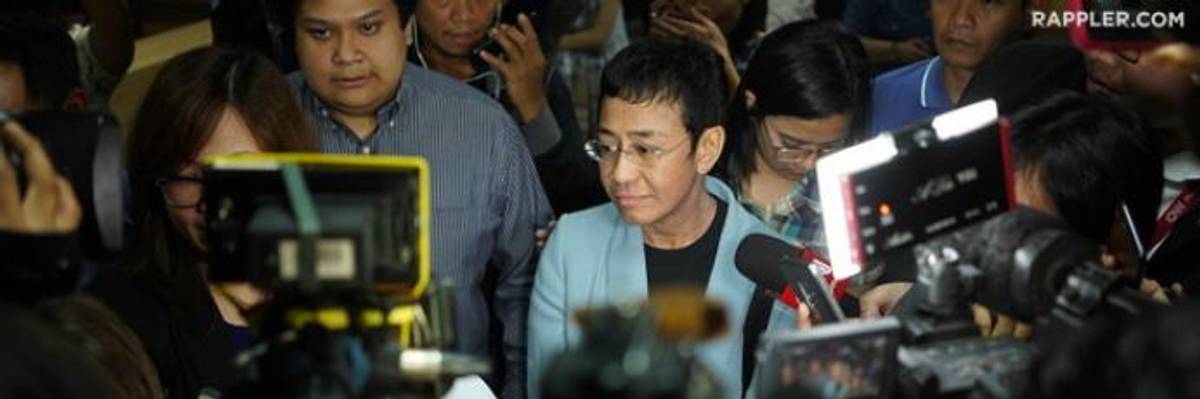
Maria Ressa, CEO and executive editor of Rappler, was questioned by reporters afer being arrested in the Philippines on Wednesday for what critics called "trumped-up and politically-motivated" libel charges. (Photo: Rappler)
Just a few months after directly blaming U.S. President Donald Trump for fueling crackdowns on the press in her country, award-winning Filipina journalist Maria Ressa--a long-time critic of the Philippines President Rodrigo Duterte--was arrested Wednesday for what reporters and media advocates around the world denounced as "trumped-up and politically-motivated" libel charges designed to intimidate and silence Ressa and her colleagues.
In November, while accepting an award from the Committee to Protect Journalists (CPJ), Ressa said: "Our problems are partly caused by yours: American social media technology platforms, once empowering, now weaponized against journalists, activists, and citizens, spreading lies across borders; and, a president so much like ours whose attacks against the press (and women) give permission to autocrats (like ours) to unleash the dark side of humanity and extend their already vast powers with impunity, especially in countries where institutions have crumbled."
Watch:
Ressa is far alone in calling out Trump for emboldening hostility toward journalists. In Reporters Sans Frontieres' (RSF) lastest World Press Freedom Index, U.S. ranking declined due to Trump, and the group warned the "downward trend has drastic consequences at the international level." Just this week, a BBC cameraman was violently attacked at a Trump rally in Texas after "the crowd had been whipped up into a frenzy against the media by Trump and other speakers."
In the Philippines, as the Washington Post reports, plainclothes officers arrived at the office of Rappler, of which Ressa is CEO and executive editor, Wednesday evening. She and former Rappler researcher Reynaldo Santos Jr. were arrested following a complaint from businessman Wilfredo Keng about an article published in May of 2012 that noted Keng's alleged ties to illegal drugs and human trafficking. The "cyber libel" law they are accused of violating was enacted four months after the story ran.
Ressa's arrest ignited a flurry of fresh concerns about Trump's attacks on the news media--from popularizing the phrases "fake news" and "enemy of the people" to laughing when Duterte denounced journalists as spies during a 2017 bilateral meeting--as well as the dangers of the U.S. president's high praise for Duterte, notorious for his vicious drug war on which Rappler has extensively reported:
RSF secretary general Christophe Deloire declared that Ressa's arrest "is an obvious violation of press freedom which should be denounced by all the heads of states and governments which can exercise influence on Rodrigo Duterte." He added that she has the full support of RSF's Commission on Information and Democracy, of which she is a member.
"This is brazenly politically motivated, and consistent with the authorities' threats and repeated targeting of Ressa and her team. Authorities should end this harassment, drop the charges, and repeal this repressive law," Amnesty International Philippines section director Butch Olano said in a statement.
"In a country where justice takes years to obtain," Olano noted, "we see the charges against her being railroaded and the law being used to relentlessly intimidate and harass journalists for doing their jobs as truth-tellers."
Ressa's arrest on Wednesday comes after Duterte's government--in a move also widely decried by journalists across the globe as an intimidation effort--hit her and Rappler with five charges of tax fraud, which could land the CEO behind bars for up to a decade. Ressa and the online outlet deny evading taxes.
She was arrested over the tax charges in early December, after returning to the Philippines from a trip to the United States, where she visited Washington, D.C. to accept the 2018 Knight International Journalism award as well as New York City to accept the CPJ's 2018 Gwen Ifill Press Freedom Award. She was also honored, alongside other journalists reporting in increasingly dangerous conditions, as TIME magazine's 2018 Person of the Year.
The Duterte government's intimidation tactics, meanwhile, don't appear to have fazed the decorated CEO and her fellow reporters of Rappler, who pledged in a statement on Wednesday to "continue to do our jobs as journalists. We will continue to tell the truth and report what we see and hear."
Ressa, for her part, added: "We are not intimidated. No amount of legal cases, black propaganda, and lies can silence Filipino journalists who continue to hold the line. These legal acrobatics show how far the government will go to silence journalists, including the pettiness of forcing me to spend the night in jail."
This post has been updated with comment from Amnesty International.
Dear Common Dreams reader, It’s been nearly 30 years since I co-founded Common Dreams with my late wife, Lina Newhouser. We had the radical notion that journalism should serve the public good, not corporate profits. It was clear to us from the outset what it would take to build such a project. No paid advertisements. No corporate sponsors. No millionaire publisher telling us what to think or do. Many people said we wouldn't last a year, but we proved those doubters wrong. Together with a tremendous team of journalists and dedicated staff, we built an independent media outlet free from the constraints of profits and corporate control. Our mission has always been simple: To inform. To inspire. To ignite change for the common good. Building Common Dreams was not easy. Our survival was never guaranteed. When you take on the most powerful forces—Wall Street greed, fossil fuel industry destruction, Big Tech lobbyists, and uber-rich oligarchs who have spent billions upon billions rigging the economy and democracy in their favor—the only bulwark you have is supporters who believe in your work. But here’s the urgent message from me today. It's never been this bad out there. And it's never been this hard to keep us going. At the very moment Common Dreams is most needed, the threats we face are intensifying. We need your support now more than ever. We don't accept corporate advertising and never will. We don't have a paywall because we don't think people should be blocked from critical news based on their ability to pay. Everything we do is funded by the donations of readers like you. When everyone does the little they can afford, we are strong. But if that support retreats or dries up, so do we. Will you donate now to make sure Common Dreams not only survives but thrives? —Craig Brown, Co-founder |
Just a few months after directly blaming U.S. President Donald Trump for fueling crackdowns on the press in her country, award-winning Filipina journalist Maria Ressa--a long-time critic of the Philippines President Rodrigo Duterte--was arrested Wednesday for what reporters and media advocates around the world denounced as "trumped-up and politically-motivated" libel charges designed to intimidate and silence Ressa and her colleagues.
In November, while accepting an award from the Committee to Protect Journalists (CPJ), Ressa said: "Our problems are partly caused by yours: American social media technology platforms, once empowering, now weaponized against journalists, activists, and citizens, spreading lies across borders; and, a president so much like ours whose attacks against the press (and women) give permission to autocrats (like ours) to unleash the dark side of humanity and extend their already vast powers with impunity, especially in countries where institutions have crumbled."
Watch:
Ressa is far alone in calling out Trump for emboldening hostility toward journalists. In Reporters Sans Frontieres' (RSF) lastest World Press Freedom Index, U.S. ranking declined due to Trump, and the group warned the "downward trend has drastic consequences at the international level." Just this week, a BBC cameraman was violently attacked at a Trump rally in Texas after "the crowd had been whipped up into a frenzy against the media by Trump and other speakers."
In the Philippines, as the Washington Post reports, plainclothes officers arrived at the office of Rappler, of which Ressa is CEO and executive editor, Wednesday evening. She and former Rappler researcher Reynaldo Santos Jr. were arrested following a complaint from businessman Wilfredo Keng about an article published in May of 2012 that noted Keng's alleged ties to illegal drugs and human trafficking. The "cyber libel" law they are accused of violating was enacted four months after the story ran.
Ressa's arrest ignited a flurry of fresh concerns about Trump's attacks on the news media--from popularizing the phrases "fake news" and "enemy of the people" to laughing when Duterte denounced journalists as spies during a 2017 bilateral meeting--as well as the dangers of the U.S. president's high praise for Duterte, notorious for his vicious drug war on which Rappler has extensively reported:
RSF secretary general Christophe Deloire declared that Ressa's arrest "is an obvious violation of press freedom which should be denounced by all the heads of states and governments which can exercise influence on Rodrigo Duterte." He added that she has the full support of RSF's Commission on Information and Democracy, of which she is a member.
"This is brazenly politically motivated, and consistent with the authorities' threats and repeated targeting of Ressa and her team. Authorities should end this harassment, drop the charges, and repeal this repressive law," Amnesty International Philippines section director Butch Olano said in a statement.
"In a country where justice takes years to obtain," Olano noted, "we see the charges against her being railroaded and the law being used to relentlessly intimidate and harass journalists for doing their jobs as truth-tellers."
Ressa's arrest on Wednesday comes after Duterte's government--in a move also widely decried by journalists across the globe as an intimidation effort--hit her and Rappler with five charges of tax fraud, which could land the CEO behind bars for up to a decade. Ressa and the online outlet deny evading taxes.
She was arrested over the tax charges in early December, after returning to the Philippines from a trip to the United States, where she visited Washington, D.C. to accept the 2018 Knight International Journalism award as well as New York City to accept the CPJ's 2018 Gwen Ifill Press Freedom Award. She was also honored, alongside other journalists reporting in increasingly dangerous conditions, as TIME magazine's 2018 Person of the Year.
The Duterte government's intimidation tactics, meanwhile, don't appear to have fazed the decorated CEO and her fellow reporters of Rappler, who pledged in a statement on Wednesday to "continue to do our jobs as journalists. We will continue to tell the truth and report what we see and hear."
Ressa, for her part, added: "We are not intimidated. No amount of legal cases, black propaganda, and lies can silence Filipino journalists who continue to hold the line. These legal acrobatics show how far the government will go to silence journalists, including the pettiness of forcing me to spend the night in jail."
This post has been updated with comment from Amnesty International.
Just a few months after directly blaming U.S. President Donald Trump for fueling crackdowns on the press in her country, award-winning Filipina journalist Maria Ressa--a long-time critic of the Philippines President Rodrigo Duterte--was arrested Wednesday for what reporters and media advocates around the world denounced as "trumped-up and politically-motivated" libel charges designed to intimidate and silence Ressa and her colleagues.
In November, while accepting an award from the Committee to Protect Journalists (CPJ), Ressa said: "Our problems are partly caused by yours: American social media technology platforms, once empowering, now weaponized against journalists, activists, and citizens, spreading lies across borders; and, a president so much like ours whose attacks against the press (and women) give permission to autocrats (like ours) to unleash the dark side of humanity and extend their already vast powers with impunity, especially in countries where institutions have crumbled."
Watch:
Ressa is far alone in calling out Trump for emboldening hostility toward journalists. In Reporters Sans Frontieres' (RSF) lastest World Press Freedom Index, U.S. ranking declined due to Trump, and the group warned the "downward trend has drastic consequences at the international level." Just this week, a BBC cameraman was violently attacked at a Trump rally in Texas after "the crowd had been whipped up into a frenzy against the media by Trump and other speakers."
In the Philippines, as the Washington Post reports, plainclothes officers arrived at the office of Rappler, of which Ressa is CEO and executive editor, Wednesday evening. She and former Rappler researcher Reynaldo Santos Jr. were arrested following a complaint from businessman Wilfredo Keng about an article published in May of 2012 that noted Keng's alleged ties to illegal drugs and human trafficking. The "cyber libel" law they are accused of violating was enacted four months after the story ran.
Ressa's arrest ignited a flurry of fresh concerns about Trump's attacks on the news media--from popularizing the phrases "fake news" and "enemy of the people" to laughing when Duterte denounced journalists as spies during a 2017 bilateral meeting--as well as the dangers of the U.S. president's high praise for Duterte, notorious for his vicious drug war on which Rappler has extensively reported:
RSF secretary general Christophe Deloire declared that Ressa's arrest "is an obvious violation of press freedom which should be denounced by all the heads of states and governments which can exercise influence on Rodrigo Duterte." He added that she has the full support of RSF's Commission on Information and Democracy, of which she is a member.
"This is brazenly politically motivated, and consistent with the authorities' threats and repeated targeting of Ressa and her team. Authorities should end this harassment, drop the charges, and repeal this repressive law," Amnesty International Philippines section director Butch Olano said in a statement.
"In a country where justice takes years to obtain," Olano noted, "we see the charges against her being railroaded and the law being used to relentlessly intimidate and harass journalists for doing their jobs as truth-tellers."
Ressa's arrest on Wednesday comes after Duterte's government--in a move also widely decried by journalists across the globe as an intimidation effort--hit her and Rappler with five charges of tax fraud, which could land the CEO behind bars for up to a decade. Ressa and the online outlet deny evading taxes.
She was arrested over the tax charges in early December, after returning to the Philippines from a trip to the United States, where she visited Washington, D.C. to accept the 2018 Knight International Journalism award as well as New York City to accept the CPJ's 2018 Gwen Ifill Press Freedom Award. She was also honored, alongside other journalists reporting in increasingly dangerous conditions, as TIME magazine's 2018 Person of the Year.
The Duterte government's intimidation tactics, meanwhile, don't appear to have fazed the decorated CEO and her fellow reporters of Rappler, who pledged in a statement on Wednesday to "continue to do our jobs as journalists. We will continue to tell the truth and report what we see and hear."
Ressa, for her part, added: "We are not intimidated. No amount of legal cases, black propaganda, and lies can silence Filipino journalists who continue to hold the line. These legal acrobatics show how far the government will go to silence journalists, including the pettiness of forcing me to spend the night in jail."
This post has been updated with comment from Amnesty International.