

SUBSCRIBE TO OUR FREE NEWSLETTER
Daily news & progressive opinion—funded by the people, not the corporations—delivered straight to your inbox.
5
#000000
#FFFFFF
To donate by check, phone, or other method, see our More Ways to Give page.
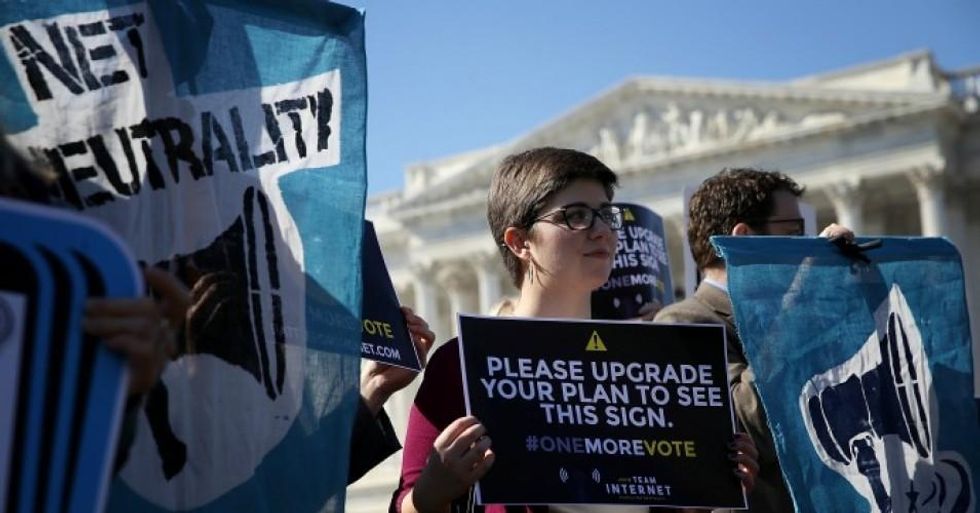
Advocates of net neutrality had their eyes on a federal court on Friday, where the showdown over the Federal Communications Commission's (FCC) repeal of the Obama-era open internet protections continued.
At the U.S. Court of Appeals for the District of Columbia, oral arguments in Mozilla v. FCC were heard. In that suit, which The Verge frames as "one of the most important cases in internet law history," technology and advocacy groups joined by over 20 state attorneys general challenge the FCC's 2017 gutting of net neutrality.
"The appeals court judges today heard in full detail just how awful a job the Trump FCC did," said Matt Wood, policy director at Free Press.
While the case covered "complex issues," said FCC commissioner Jessica Rosenworcel, who voiced opposition to the repeal of net neutrality, one thing is quite clear. She said "the court now has a chance to right what the @FCC got wrong when it made the misguided decision to roll back #NetNeutrality. I sat through it all. I'm hopeful."
As observers noted, the hearing drew out some interesting some interesting admissions from the FCC:
Yet, as The Verge reports, "there was no immediate sign of which way the three-judge panel overseeing the case would decide." According to the petitioners, the reporting continues,
The FCC failed in its analysis of the internet service market, failed to consider public safety, should not have blocked states from passing their own net neutrality rules, and erred in its determination of what a telecommunications service is, they said.
Some of those punches seemed to land, while others fell flat. [...]
The public safety argument, however, seemed to emerge as an important point in the hearing. The FCC received a sharp interrogation from one of the judges, who questioned repeatedly how the agency's decision might affect first responders.
The stakes of the case are huge, say open internet defenders. "Without protecting net neutrality," Mozilla's chief operating officer, Denelle Dixon, told the Washington Post, broadband providers "will control the internet experiences of everyone. And that cannot be what happens."
As Wired sums up the background,
The suit raises two main questions: whether the FCC broke the law by failing to consider evidence that went against its allegedly foregone conclusion that it should overturn the Obama-era rules, and whether it was legal for the FCC to stop considering broadband internet a telecommunications service, like telephone calls, and instead consider it an "information service" like Google or Facebook.
According to Senator Ed Markey (D-Mass.), one of the net neutrality defenders who was at the court hearing, FCC chairman Ajit Pai and President Donald Trump disregarded the Telecommunications Act of 1996 as well as "Congress's intent when the FCC reclassified broadband back to an information service and eviscerated the net neutrality rules."
"Nothing less than the fate of the internet is being argued in this court case, and we must do everything we can in this historic fight," he added in his statement.
At the forefront of the historic fight has been digital rights group Fight for the Future, which wrote in an email to supporters on Thursday:
You see, when a government agency changes a major rule like net neutrality, it is required to show that they have a good reason and consult with the public. They can't just change the rules to help big campaign donors or their former employers.
But in the case of net neutrality, that's exactly what happened. Ajit Pai ignored overwhelming expert testimony, mountains of evidence, small business owners, veterans, and millions of public comments in favor of net neutrality and pushed through the repeal anyway.
As Free Press's Wood sees it, the case against Pai's repeal of net neutrality is "rock solid." Pai, a former Verizon lawyer, "failed to assemble a shred of credible evidence against classifying internet-access providers as common carriers under the law," he stated Thursday, adding that the "FCC ignored the nature of the service these providers offer to internet users, along with the fact that the 2015 rules were working for everyone--including ISPs, which continued to invest in and deploy broadband."
Following Friday's oral arguments, Michael Copps, a former FCC commissioner who now serves as a special advisor to advocacy group Common Cause, said, "Our side's pro-net neutrality arguments before court today were light years more compelling than the time-worn and discredited arguments of those who oppose a truly open internet. And the Courts have agreed with us, twice upholding the FCC's 2015 net neutrality rules."
He went on to urge the court "to vacate the FCC's reckless repeal and return to the sound legal framework that ensures the internet is free and open for everyone."
Advocates of net neutrality had their eyes on a federal court on Friday, where the showdown over the Federal Communications Commission's (FCC) repeal of the Obama-era open internet protections continued.
At the U.S. Court of Appeals for the District of Columbia, oral arguments in Mozilla v. FCC were heard. In that suit, which The Verge frames as "one of the most important cases in internet law history," technology and advocacy groups joined by over 20 state attorneys general challenge the FCC's 2017 gutting of net neutrality.
"The appeals court judges today heard in full detail just how awful a job the Trump FCC did," said Matt Wood, policy director at Free Press.
While the case covered "complex issues," said FCC commissioner Jessica Rosenworcel, who voiced opposition to the repeal of net neutrality, one thing is quite clear. She said "the court now has a chance to right what the @FCC got wrong when it made the misguided decision to roll back #NetNeutrality. I sat through it all. I'm hopeful."
As observers noted, the hearing drew out some interesting some interesting admissions from the FCC:
Yet, as The Verge reports, "there was no immediate sign of which way the three-judge panel overseeing the case would decide." According to the petitioners, the reporting continues,
The FCC failed in its analysis of the internet service market, failed to consider public safety, should not have blocked states from passing their own net neutrality rules, and erred in its determination of what a telecommunications service is, they said.
Some of those punches seemed to land, while others fell flat. [...]
The public safety argument, however, seemed to emerge as an important point in the hearing. The FCC received a sharp interrogation from one of the judges, who questioned repeatedly how the agency's decision might affect first responders.
The stakes of the case are huge, say open internet defenders. "Without protecting net neutrality," Mozilla's chief operating officer, Denelle Dixon, told the Washington Post, broadband providers "will control the internet experiences of everyone. And that cannot be what happens."
As Wired sums up the background,
The suit raises two main questions: whether the FCC broke the law by failing to consider evidence that went against its allegedly foregone conclusion that it should overturn the Obama-era rules, and whether it was legal for the FCC to stop considering broadband internet a telecommunications service, like telephone calls, and instead consider it an "information service" like Google or Facebook.
According to Senator Ed Markey (D-Mass.), one of the net neutrality defenders who was at the court hearing, FCC chairman Ajit Pai and President Donald Trump disregarded the Telecommunications Act of 1996 as well as "Congress's intent when the FCC reclassified broadband back to an information service and eviscerated the net neutrality rules."
"Nothing less than the fate of the internet is being argued in this court case, and we must do everything we can in this historic fight," he added in his statement.
At the forefront of the historic fight has been digital rights group Fight for the Future, which wrote in an email to supporters on Thursday:
You see, when a government agency changes a major rule like net neutrality, it is required to show that they have a good reason and consult with the public. They can't just change the rules to help big campaign donors or their former employers.
But in the case of net neutrality, that's exactly what happened. Ajit Pai ignored overwhelming expert testimony, mountains of evidence, small business owners, veterans, and millions of public comments in favor of net neutrality and pushed through the repeal anyway.
As Free Press's Wood sees it, the case against Pai's repeal of net neutrality is "rock solid." Pai, a former Verizon lawyer, "failed to assemble a shred of credible evidence against classifying internet-access providers as common carriers under the law," he stated Thursday, adding that the "FCC ignored the nature of the service these providers offer to internet users, along with the fact that the 2015 rules were working for everyone--including ISPs, which continued to invest in and deploy broadband."
Following Friday's oral arguments, Michael Copps, a former FCC commissioner who now serves as a special advisor to advocacy group Common Cause, said, "Our side's pro-net neutrality arguments before court today were light years more compelling than the time-worn and discredited arguments of those who oppose a truly open internet. And the Courts have agreed with us, twice upholding the FCC's 2015 net neutrality rules."
He went on to urge the court "to vacate the FCC's reckless repeal and return to the sound legal framework that ensures the internet is free and open for everyone."
Advocates of net neutrality had their eyes on a federal court on Friday, where the showdown over the Federal Communications Commission's (FCC) repeal of the Obama-era open internet protections continued.
At the U.S. Court of Appeals for the District of Columbia, oral arguments in Mozilla v. FCC were heard. In that suit, which The Verge frames as "one of the most important cases in internet law history," technology and advocacy groups joined by over 20 state attorneys general challenge the FCC's 2017 gutting of net neutrality.
"The appeals court judges today heard in full detail just how awful a job the Trump FCC did," said Matt Wood, policy director at Free Press.
While the case covered "complex issues," said FCC commissioner Jessica Rosenworcel, who voiced opposition to the repeal of net neutrality, one thing is quite clear. She said "the court now has a chance to right what the @FCC got wrong when it made the misguided decision to roll back #NetNeutrality. I sat through it all. I'm hopeful."
As observers noted, the hearing drew out some interesting some interesting admissions from the FCC:
Yet, as The Verge reports, "there was no immediate sign of which way the three-judge panel overseeing the case would decide." According to the petitioners, the reporting continues,
The FCC failed in its analysis of the internet service market, failed to consider public safety, should not have blocked states from passing their own net neutrality rules, and erred in its determination of what a telecommunications service is, they said.
Some of those punches seemed to land, while others fell flat. [...]
The public safety argument, however, seemed to emerge as an important point in the hearing. The FCC received a sharp interrogation from one of the judges, who questioned repeatedly how the agency's decision might affect first responders.
The stakes of the case are huge, say open internet defenders. "Without protecting net neutrality," Mozilla's chief operating officer, Denelle Dixon, told the Washington Post, broadband providers "will control the internet experiences of everyone. And that cannot be what happens."
As Wired sums up the background,
The suit raises two main questions: whether the FCC broke the law by failing to consider evidence that went against its allegedly foregone conclusion that it should overturn the Obama-era rules, and whether it was legal for the FCC to stop considering broadband internet a telecommunications service, like telephone calls, and instead consider it an "information service" like Google or Facebook.
According to Senator Ed Markey (D-Mass.), one of the net neutrality defenders who was at the court hearing, FCC chairman Ajit Pai and President Donald Trump disregarded the Telecommunications Act of 1996 as well as "Congress's intent when the FCC reclassified broadband back to an information service and eviscerated the net neutrality rules."
"Nothing less than the fate of the internet is being argued in this court case, and we must do everything we can in this historic fight," he added in his statement.
At the forefront of the historic fight has been digital rights group Fight for the Future, which wrote in an email to supporters on Thursday:
You see, when a government agency changes a major rule like net neutrality, it is required to show that they have a good reason and consult with the public. They can't just change the rules to help big campaign donors or their former employers.
But in the case of net neutrality, that's exactly what happened. Ajit Pai ignored overwhelming expert testimony, mountains of evidence, small business owners, veterans, and millions of public comments in favor of net neutrality and pushed through the repeal anyway.
As Free Press's Wood sees it, the case against Pai's repeal of net neutrality is "rock solid." Pai, a former Verizon lawyer, "failed to assemble a shred of credible evidence against classifying internet-access providers as common carriers under the law," he stated Thursday, adding that the "FCC ignored the nature of the service these providers offer to internet users, along with the fact that the 2015 rules were working for everyone--including ISPs, which continued to invest in and deploy broadband."
Following Friday's oral arguments, Michael Copps, a former FCC commissioner who now serves as a special advisor to advocacy group Common Cause, said, "Our side's pro-net neutrality arguments before court today were light years more compelling than the time-worn and discredited arguments of those who oppose a truly open internet. And the Courts have agreed with us, twice upholding the FCC's 2015 net neutrality rules."
He went on to urge the court "to vacate the FCC's reckless repeal and return to the sound legal framework that ensures the internet is free and open for everyone."

