SUBSCRIBE TO OUR FREE NEWSLETTER
Daily news & progressive opinion—funded by the people, not the corporations—delivered straight to your inbox.
5
#000000
#FFFFFF
To donate by check, phone, or other method, see our More Ways to Give page.
Daily news & progressive opinion—funded by the people, not the corporations—delivered straight to your inbox.
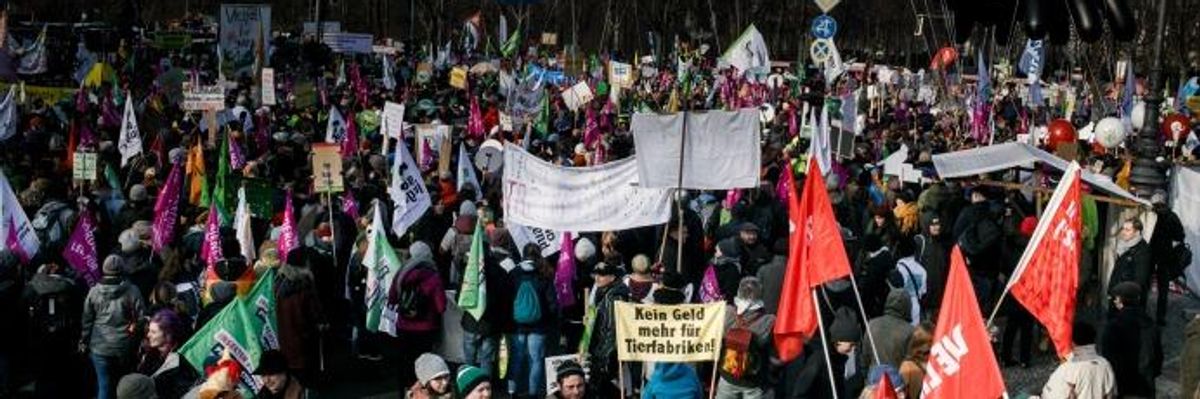
Demonstrators participate in a protest march over agricultural policy on January 19, 2019 in Berlin, Germany. Thousands of people participated in the march to protest against the current system of disbursement of EU farm subsidies in Germany. Activists complain that large-scale farms receive too much and that the system needs to better fund farmers pursuing environment and climate-friendly farming methods. The protest is coinciding with the Green Week agricultural trade fair currently taking place in Berlin. (Photo: Carsten Koall/Getty Images)
Organizers said 35,000 people marched through the streets of the German capital on Saturday to say they're "fed up" with industrial agriculture and call for a transformation to a system that instead supports the welfare of the environment, animals, and rural farmers.
Many held placards reading "Eating is political" at the action in Berlin, which coincided with the so-called "Green Week" agricultural fair.
The protest also featured a procession of 170 farmers driving tractors to the rally at the Brandenburg Gate.
"This protest," said Green party co-leader Robert Habeck, "shows that the desire for a different agricultural policy is now undeniable."
As DW reports
Protesters called out by some 100 organizations asserted that alleviation of climate change and species depletion required a reorganization of EU farming policy, including subsidies, currently amounting to EUR60 billion ($68 billion) annually, including EUR6.3 billion allocated in Germany.
That flowed mainly to larger companies focused on boosting yields, they said, but instead the funds should be distributed better to avert further farmyard closures and rural village die-offs.
"With over EUR6 billion that Germany distributes every year as EU farming monies, environmental and animal-appropriate transformation of agriculture must be promoted," said protest spokesperson Saskia Richartz.
Slow Food Europe captured some of the scenes on social media, and stated in a Twitter thread: "We believe that instead of propping up agro-industries, politicians should support the determination of small-scale farmers to keep climate-friendly farms, which are the future of agriculture."
The "inspiring gathering" capped off a week in which thousands of youth climate protetsters in Europe, including at dozens of actions in Germany, rebuked the lack of urgent action to address the climate crisis.
Noted activist and Swedish student Greta Thunberg, whose "strikes for climate" have inspired similar actions across the globe, nodded to the Swiss and German actions, writing Friday on Twitter: "The people are rising. The world is at a tipping point. Now we have to continue pushing hard! Everyone is needed. This is just the beginning."
Dear Common Dreams reader, It’s been nearly 30 years since I co-founded Common Dreams with my late wife, Lina Newhouser. We had the radical notion that journalism should serve the public good, not corporate profits. It was clear to us from the outset what it would take to build such a project. No paid advertisements. No corporate sponsors. No millionaire publisher telling us what to think or do. Many people said we wouldn't last a year, but we proved those doubters wrong. Together with a tremendous team of journalists and dedicated staff, we built an independent media outlet free from the constraints of profits and corporate control. Our mission has always been simple: To inform. To inspire. To ignite change for the common good. Building Common Dreams was not easy. Our survival was never guaranteed. When you take on the most powerful forces—Wall Street greed, fossil fuel industry destruction, Big Tech lobbyists, and uber-rich oligarchs who have spent billions upon billions rigging the economy and democracy in their favor—the only bulwark you have is supporters who believe in your work. But here’s the urgent message from me today. It's never been this bad out there. And it's never been this hard to keep us going. At the very moment Common Dreams is most needed, the threats we face are intensifying. We need your support now more than ever. We don't accept corporate advertising and never will. We don't have a paywall because we don't think people should be blocked from critical news based on their ability to pay. Everything we do is funded by the donations of readers like you. When everyone does the little they can afford, we are strong. But if that support retreats or dries up, so do we. Will you donate now to make sure Common Dreams not only survives but thrives? —Craig Brown, Co-founder |
Organizers said 35,000 people marched through the streets of the German capital on Saturday to say they're "fed up" with industrial agriculture and call for a transformation to a system that instead supports the welfare of the environment, animals, and rural farmers.
Many held placards reading "Eating is political" at the action in Berlin, which coincided with the so-called "Green Week" agricultural fair.
The protest also featured a procession of 170 farmers driving tractors to the rally at the Brandenburg Gate.
"This protest," said Green party co-leader Robert Habeck, "shows that the desire for a different agricultural policy is now undeniable."
As DW reports
Protesters called out by some 100 organizations asserted that alleviation of climate change and species depletion required a reorganization of EU farming policy, including subsidies, currently amounting to EUR60 billion ($68 billion) annually, including EUR6.3 billion allocated in Germany.
That flowed mainly to larger companies focused on boosting yields, they said, but instead the funds should be distributed better to avert further farmyard closures and rural village die-offs.
"With over EUR6 billion that Germany distributes every year as EU farming monies, environmental and animal-appropriate transformation of agriculture must be promoted," said protest spokesperson Saskia Richartz.
Slow Food Europe captured some of the scenes on social media, and stated in a Twitter thread: "We believe that instead of propping up agro-industries, politicians should support the determination of small-scale farmers to keep climate-friendly farms, which are the future of agriculture."
The "inspiring gathering" capped off a week in which thousands of youth climate protetsters in Europe, including at dozens of actions in Germany, rebuked the lack of urgent action to address the climate crisis.
Noted activist and Swedish student Greta Thunberg, whose "strikes for climate" have inspired similar actions across the globe, nodded to the Swiss and German actions, writing Friday on Twitter: "The people are rising. The world is at a tipping point. Now we have to continue pushing hard! Everyone is needed. This is just the beginning."
Organizers said 35,000 people marched through the streets of the German capital on Saturday to say they're "fed up" with industrial agriculture and call for a transformation to a system that instead supports the welfare of the environment, animals, and rural farmers.
Many held placards reading "Eating is political" at the action in Berlin, which coincided with the so-called "Green Week" agricultural fair.
The protest also featured a procession of 170 farmers driving tractors to the rally at the Brandenburg Gate.
"This protest," said Green party co-leader Robert Habeck, "shows that the desire for a different agricultural policy is now undeniable."
As DW reports
Protesters called out by some 100 organizations asserted that alleviation of climate change and species depletion required a reorganization of EU farming policy, including subsidies, currently amounting to EUR60 billion ($68 billion) annually, including EUR6.3 billion allocated in Germany.
That flowed mainly to larger companies focused on boosting yields, they said, but instead the funds should be distributed better to avert further farmyard closures and rural village die-offs.
"With over EUR6 billion that Germany distributes every year as EU farming monies, environmental and animal-appropriate transformation of agriculture must be promoted," said protest spokesperson Saskia Richartz.
Slow Food Europe captured some of the scenes on social media, and stated in a Twitter thread: "We believe that instead of propping up agro-industries, politicians should support the determination of small-scale farmers to keep climate-friendly farms, which are the future of agriculture."
The "inspiring gathering" capped off a week in which thousands of youth climate protetsters in Europe, including at dozens of actions in Germany, rebuked the lack of urgent action to address the climate crisis.
Noted activist and Swedish student Greta Thunberg, whose "strikes for climate" have inspired similar actions across the globe, nodded to the Swiss and German actions, writing Friday on Twitter: "The people are rising. The world is at a tipping point. Now we have to continue pushing hard! Everyone is needed. This is just the beginning."