SUBSCRIBE TO OUR FREE NEWSLETTER
Daily news & progressive opinion—funded by the people, not the corporations—delivered straight to your inbox.
5
#000000
#FFFFFF
To donate by check, phone, or other method, see our More Ways to Give page.
Daily news & progressive opinion—funded by the people, not the corporations—delivered straight to your inbox.
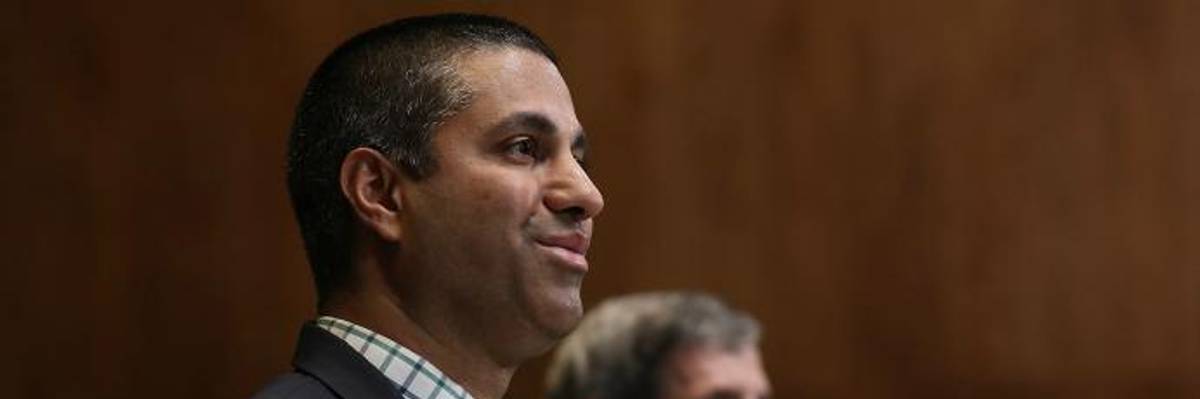
FCC Chairman Ajit Pai testifies before the Senate Appropriations Committee May 17, 2018 in Washington, D.C. (Photo: Win McNamee/Getty Images)
As Federal Communications Commission (FCC) chair Ajit Pai applauded House lawmakers on Wednesday for refusing to restore net neutrality before last month's deadline, open internet advocates vowed to keep up the fight for net neutrality in 2019 and promised that "Ajit Pai won't be laughing long."
"Every single lawmaker who voted against the CRA in the Senate or failed to sign on to the discharge petition in the House has exposed themselves as industry puppets."
--Evan Greer, Fight for the Future
"It's an uphill battle, but we are winning the fight to restore net neutrality," Evan Greer, deputy director of Fight for the Future, declared in a statement. "The internet freedom movement is stronger than it's ever been as we head into 2019. We'll keep fighting in the states, in the courts, and in Congress. It's only a matter of time before net neutrality is the law of the land again."
While open internet advocates failed in their ultimate goal of fully repealing Pai's attack on net neutrality--which the Republican-controlled FCC rammed through in December of 2017 despite opposition from the vast majority of Americans--Greer noted that the fight to pass the net neutrality Congressional Review Act (CRA) resolution "shined a giant spotlight on corruption in Congress."
"Every single lawmaker who voted against the CRA in the Senate or failed to sign on to the discharge petition in the House has exposed themselves as industry puppets. They put the interests of telecom giants like Comcast and AT&T over the basic rights of their constituents," Greer said.
See where every member of Congress stands on net neutrality here.
"We used the CRA as a powerful tool to get lawmakers on the record," she continued. "Pundits claimed it would never pass the Senate--but we channeled internet outrage into real political power and got more than enough votes. If House leadership had allowed a vote on the CRA, we likely would have won that too."
In his celebratory statement (pdf) on Wednesday, Pai--a former Verizon lawyer--called net neutrality protections that most Americans support "heavy-handed internet regulation," and argued that his agency's corporate-friendly approach is keeping the web "free and open."
As Jon Brodkin of Ars Technica noted, "Pai didn't mention a recent case in which CenturyLink temporarily blocked its customers' Internet access in order to show an ad or a recent research report accusing Sprint of throttling Skype (which Sprint denies)."
Pai went on to claim that "broadband speeds are up, with download speeds in the United States increasing more than 35 percent in 2018," suggesting that his agency's elimination of net neutrality protections did not harm the web like open internet advocates said it would.
Greer dismissed Pai's argument as "laughable," calling it "the tech policy equivalent of 'it's snowing outside, therefore climate change is a hoax.'"
With the new congressional session set to officially begin on Thursday, Greer expressed confidence that the struggle to restore net neutrality will ultimately be successful.
"Now that the clock has run out, every single American knows exactly where their representatives stand," Greer concluded. "Dozens of anti-net neutrality members of Congress have already lost their jobs, and supporters of the open internet will soon chair the key committees that provide oversight for the FCC."
Dear Common Dreams reader, It’s been nearly 30 years since I co-founded Common Dreams with my late wife, Lina Newhouser. We had the radical notion that journalism should serve the public good, not corporate profits. It was clear to us from the outset what it would take to build such a project. No paid advertisements. No corporate sponsors. No millionaire publisher telling us what to think or do. Many people said we wouldn't last a year, but we proved those doubters wrong. Together with a tremendous team of journalists and dedicated staff, we built an independent media outlet free from the constraints of profits and corporate control. Our mission has always been simple: To inform. To inspire. To ignite change for the common good. Building Common Dreams was not easy. Our survival was never guaranteed. When you take on the most powerful forces—Wall Street greed, fossil fuel industry destruction, Big Tech lobbyists, and uber-rich oligarchs who have spent billions upon billions rigging the economy and democracy in their favor—the only bulwark you have is supporters who believe in your work. But here’s the urgent message from me today. It's never been this bad out there. And it's never been this hard to keep us going. At the very moment Common Dreams is most needed, the threats we face are intensifying. We need your support now more than ever. We don't accept corporate advertising and never will. We don't have a paywall because we don't think people should be blocked from critical news based on their ability to pay. Everything we do is funded by the donations of readers like you. When everyone does the little they can afford, we are strong. But if that support retreats or dries up, so do we. Will you donate now to make sure Common Dreams not only survives but thrives? —Craig Brown, Co-founder |
As Federal Communications Commission (FCC) chair Ajit Pai applauded House lawmakers on Wednesday for refusing to restore net neutrality before last month's deadline, open internet advocates vowed to keep up the fight for net neutrality in 2019 and promised that "Ajit Pai won't be laughing long."
"Every single lawmaker who voted against the CRA in the Senate or failed to sign on to the discharge petition in the House has exposed themselves as industry puppets."
--Evan Greer, Fight for the Future
"It's an uphill battle, but we are winning the fight to restore net neutrality," Evan Greer, deputy director of Fight for the Future, declared in a statement. "The internet freedom movement is stronger than it's ever been as we head into 2019. We'll keep fighting in the states, in the courts, and in Congress. It's only a matter of time before net neutrality is the law of the land again."
While open internet advocates failed in their ultimate goal of fully repealing Pai's attack on net neutrality--which the Republican-controlled FCC rammed through in December of 2017 despite opposition from the vast majority of Americans--Greer noted that the fight to pass the net neutrality Congressional Review Act (CRA) resolution "shined a giant spotlight on corruption in Congress."
"Every single lawmaker who voted against the CRA in the Senate or failed to sign on to the discharge petition in the House has exposed themselves as industry puppets. They put the interests of telecom giants like Comcast and AT&T over the basic rights of their constituents," Greer said.
See where every member of Congress stands on net neutrality here.
"We used the CRA as a powerful tool to get lawmakers on the record," she continued. "Pundits claimed it would never pass the Senate--but we channeled internet outrage into real political power and got more than enough votes. If House leadership had allowed a vote on the CRA, we likely would have won that too."
In his celebratory statement (pdf) on Wednesday, Pai--a former Verizon lawyer--called net neutrality protections that most Americans support "heavy-handed internet regulation," and argued that his agency's corporate-friendly approach is keeping the web "free and open."
As Jon Brodkin of Ars Technica noted, "Pai didn't mention a recent case in which CenturyLink temporarily blocked its customers' Internet access in order to show an ad or a recent research report accusing Sprint of throttling Skype (which Sprint denies)."
Pai went on to claim that "broadband speeds are up, with download speeds in the United States increasing more than 35 percent in 2018," suggesting that his agency's elimination of net neutrality protections did not harm the web like open internet advocates said it would.
Greer dismissed Pai's argument as "laughable," calling it "the tech policy equivalent of 'it's snowing outside, therefore climate change is a hoax.'"
With the new congressional session set to officially begin on Thursday, Greer expressed confidence that the struggle to restore net neutrality will ultimately be successful.
"Now that the clock has run out, every single American knows exactly where their representatives stand," Greer concluded. "Dozens of anti-net neutrality members of Congress have already lost their jobs, and supporters of the open internet will soon chair the key committees that provide oversight for the FCC."
As Federal Communications Commission (FCC) chair Ajit Pai applauded House lawmakers on Wednesday for refusing to restore net neutrality before last month's deadline, open internet advocates vowed to keep up the fight for net neutrality in 2019 and promised that "Ajit Pai won't be laughing long."
"Every single lawmaker who voted against the CRA in the Senate or failed to sign on to the discharge petition in the House has exposed themselves as industry puppets."
--Evan Greer, Fight for the Future
"It's an uphill battle, but we are winning the fight to restore net neutrality," Evan Greer, deputy director of Fight for the Future, declared in a statement. "The internet freedom movement is stronger than it's ever been as we head into 2019. We'll keep fighting in the states, in the courts, and in Congress. It's only a matter of time before net neutrality is the law of the land again."
While open internet advocates failed in their ultimate goal of fully repealing Pai's attack on net neutrality--which the Republican-controlled FCC rammed through in December of 2017 despite opposition from the vast majority of Americans--Greer noted that the fight to pass the net neutrality Congressional Review Act (CRA) resolution "shined a giant spotlight on corruption in Congress."
"Every single lawmaker who voted against the CRA in the Senate or failed to sign on to the discharge petition in the House has exposed themselves as industry puppets. They put the interests of telecom giants like Comcast and AT&T over the basic rights of their constituents," Greer said.
See where every member of Congress stands on net neutrality here.
"We used the CRA as a powerful tool to get lawmakers on the record," she continued. "Pundits claimed it would never pass the Senate--but we channeled internet outrage into real political power and got more than enough votes. If House leadership had allowed a vote on the CRA, we likely would have won that too."
In his celebratory statement (pdf) on Wednesday, Pai--a former Verizon lawyer--called net neutrality protections that most Americans support "heavy-handed internet regulation," and argued that his agency's corporate-friendly approach is keeping the web "free and open."
As Jon Brodkin of Ars Technica noted, "Pai didn't mention a recent case in which CenturyLink temporarily blocked its customers' Internet access in order to show an ad or a recent research report accusing Sprint of throttling Skype (which Sprint denies)."
Pai went on to claim that "broadband speeds are up, with download speeds in the United States increasing more than 35 percent in 2018," suggesting that his agency's elimination of net neutrality protections did not harm the web like open internet advocates said it would.
Greer dismissed Pai's argument as "laughable," calling it "the tech policy equivalent of 'it's snowing outside, therefore climate change is a hoax.'"
With the new congressional session set to officially begin on Thursday, Greer expressed confidence that the struggle to restore net neutrality will ultimately be successful.
"Now that the clock has run out, every single American knows exactly where their representatives stand," Greer concluded. "Dozens of anti-net neutrality members of Congress have already lost their jobs, and supporters of the open internet will soon chair the key committees that provide oversight for the FCC."