SUBSCRIBE TO OUR FREE NEWSLETTER
Daily news & progressive opinion—funded by the people, not the corporations—delivered straight to your inbox.
5
#000000
#FFFFFF
To donate by check, phone, or other method, see our More Ways to Give page.
Daily news & progressive opinion—funded by the people, not the corporations—delivered straight to your inbox.
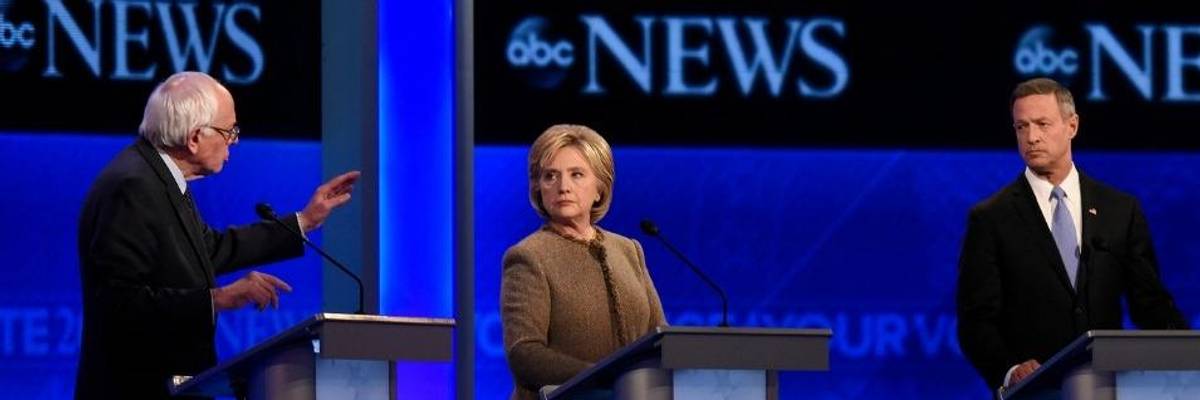
Former rivals Bernie Sanders, Hillary Clinton, and Martin O'Malley stood onstage during the third Democratic presidential debate on Dec. 19, 2015. (Photo: Disney-ABC Television/flickr/cc)
Addressing a demand that emerged in the 2016 season, the Democratic National Committee (DNC) said Thursday that there would be a dozen presidential primary debates for the 2020 contest.
"We will likely have a large field of candidates," DNC chair Tom Perez said on a call with reporters. "Accommodating a large field of such qualified candidates is a first-class challenge to have."
Six debates are scheduled to take place in 2019 and six debates in 2020. The first will be held in June 2019, and the last in April 2020, said Perez, arguing the change was part of an effort to provide greater transparency and elevate the voices of grassroots supporters. In the 2016 presidential primary, in contrast, the party had officially sanctioned only six debates, though it later increased the number to nine.
Perez announced the change on Twitter, and in an op-ed published Thursday at USA Today, Perez wrote that "over the course of more than 100 hours of conversation, we've listened to and learned from a diverse slate of stakeholders who have participated in past Democratic primary debates. Their feedback is the basis for the plan we've developed."
According to 350.org co-founder Jamie Henn, the sole focus of one of those debates should be "the greatest crisis of our time." He tweeted:
Perez added in his op-ed:
We also want to ensure a level playing field for each candidate. To that end, if necessary, the first two debates will be split into consecutive nights. Participating candidates will be chosen by random selection, which will be done publicly. This will allow candidates to make their case without starting at a disadvantage.
And unlike in previous cycles, we won't just focus on polling to determine which candidates get a spot in the first two debates. We'll also be taking into account other measures such as grassroots fundraising.
Perez didn't lay out specifics about what sort of grassroots funding threshold would need to be met. Ahead of the official announcement, however, CNN reporter David Wright offered a glimpse of how possible Democratic contenders are faring in terms of amassing small-donor contributions:
Earliar this week, following results of his organization's poll about the 2020 presidential election, Democracy for America executive director Charles Chamberlain said, "Unlike 2016, no candidate has support strong enough for the Democratic Party establishment to clear the field, which means progressives will have an excellent opportunity over the next year to kick the tires on a wide range of different candidates and find the best one to take on Trump."
"With a clear majority of the top five candidates being champions of Medicare for All," Chamberlain continued, "these results illustrate that Americans are eager for bold, progressive candidates who will fight for the multiracial inclusive populism America needs in 2020 and beyond."
Dear Common Dreams reader, It’s been nearly 30 years since I co-founded Common Dreams with my late wife, Lina Newhouser. We had the radical notion that journalism should serve the public good, not corporate profits. It was clear to us from the outset what it would take to build such a project. No paid advertisements. No corporate sponsors. No millionaire publisher telling us what to think or do. Many people said we wouldn't last a year, but we proved those doubters wrong. Together with a tremendous team of journalists and dedicated staff, we built an independent media outlet free from the constraints of profits and corporate control. Our mission has always been simple: To inform. To inspire. To ignite change for the common good. Building Common Dreams was not easy. Our survival was never guaranteed. When you take on the most powerful forces—Wall Street greed, fossil fuel industry destruction, Big Tech lobbyists, and uber-rich oligarchs who have spent billions upon billions rigging the economy and democracy in their favor—the only bulwark you have is supporters who believe in your work. But here’s the urgent message from me today. It's never been this bad out there. And it's never been this hard to keep us going. At the very moment Common Dreams is most needed, the threats we face are intensifying. We need your support now more than ever. We don't accept corporate advertising and never will. We don't have a paywall because we don't think people should be blocked from critical news based on their ability to pay. Everything we do is funded by the donations of readers like you. When everyone does the little they can afford, we are strong. But if that support retreats or dries up, so do we. Will you donate now to make sure Common Dreams not only survives but thrives? —Craig Brown, Co-founder |
Addressing a demand that emerged in the 2016 season, the Democratic National Committee (DNC) said Thursday that there would be a dozen presidential primary debates for the 2020 contest.
"We will likely have a large field of candidates," DNC chair Tom Perez said on a call with reporters. "Accommodating a large field of such qualified candidates is a first-class challenge to have."
Six debates are scheduled to take place in 2019 and six debates in 2020. The first will be held in June 2019, and the last in April 2020, said Perez, arguing the change was part of an effort to provide greater transparency and elevate the voices of grassroots supporters. In the 2016 presidential primary, in contrast, the party had officially sanctioned only six debates, though it later increased the number to nine.
Perez announced the change on Twitter, and in an op-ed published Thursday at USA Today, Perez wrote that "over the course of more than 100 hours of conversation, we've listened to and learned from a diverse slate of stakeholders who have participated in past Democratic primary debates. Their feedback is the basis for the plan we've developed."
According to 350.org co-founder Jamie Henn, the sole focus of one of those debates should be "the greatest crisis of our time." He tweeted:
Perez added in his op-ed:
We also want to ensure a level playing field for each candidate. To that end, if necessary, the first two debates will be split into consecutive nights. Participating candidates will be chosen by random selection, which will be done publicly. This will allow candidates to make their case without starting at a disadvantage.
And unlike in previous cycles, we won't just focus on polling to determine which candidates get a spot in the first two debates. We'll also be taking into account other measures such as grassroots fundraising.
Perez didn't lay out specifics about what sort of grassroots funding threshold would need to be met. Ahead of the official announcement, however, CNN reporter David Wright offered a glimpse of how possible Democratic contenders are faring in terms of amassing small-donor contributions:
Earliar this week, following results of his organization's poll about the 2020 presidential election, Democracy for America executive director Charles Chamberlain said, "Unlike 2016, no candidate has support strong enough for the Democratic Party establishment to clear the field, which means progressives will have an excellent opportunity over the next year to kick the tires on a wide range of different candidates and find the best one to take on Trump."
"With a clear majority of the top five candidates being champions of Medicare for All," Chamberlain continued, "these results illustrate that Americans are eager for bold, progressive candidates who will fight for the multiracial inclusive populism America needs in 2020 and beyond."
Addressing a demand that emerged in the 2016 season, the Democratic National Committee (DNC) said Thursday that there would be a dozen presidential primary debates for the 2020 contest.
"We will likely have a large field of candidates," DNC chair Tom Perez said on a call with reporters. "Accommodating a large field of such qualified candidates is a first-class challenge to have."
Six debates are scheduled to take place in 2019 and six debates in 2020. The first will be held in June 2019, and the last in April 2020, said Perez, arguing the change was part of an effort to provide greater transparency and elevate the voices of grassroots supporters. In the 2016 presidential primary, in contrast, the party had officially sanctioned only six debates, though it later increased the number to nine.
Perez announced the change on Twitter, and in an op-ed published Thursday at USA Today, Perez wrote that "over the course of more than 100 hours of conversation, we've listened to and learned from a diverse slate of stakeholders who have participated in past Democratic primary debates. Their feedback is the basis for the plan we've developed."
According to 350.org co-founder Jamie Henn, the sole focus of one of those debates should be "the greatest crisis of our time." He tweeted:
Perez added in his op-ed:
We also want to ensure a level playing field for each candidate. To that end, if necessary, the first two debates will be split into consecutive nights. Participating candidates will be chosen by random selection, which will be done publicly. This will allow candidates to make their case without starting at a disadvantage.
And unlike in previous cycles, we won't just focus on polling to determine which candidates get a spot in the first two debates. We'll also be taking into account other measures such as grassroots fundraising.
Perez didn't lay out specifics about what sort of grassroots funding threshold would need to be met. Ahead of the official announcement, however, CNN reporter David Wright offered a glimpse of how possible Democratic contenders are faring in terms of amassing small-donor contributions:
Earliar this week, following results of his organization's poll about the 2020 presidential election, Democracy for America executive director Charles Chamberlain said, "Unlike 2016, no candidate has support strong enough for the Democratic Party establishment to clear the field, which means progressives will have an excellent opportunity over the next year to kick the tires on a wide range of different candidates and find the best one to take on Trump."
"With a clear majority of the top five candidates being champions of Medicare for All," Chamberlain continued, "these results illustrate that Americans are eager for bold, progressive candidates who will fight for the multiracial inclusive populism America needs in 2020 and beyond."