

SUBSCRIBE TO OUR FREE NEWSLETTER
Daily news & progressive opinion—funded by the people, not the corporations—delivered straight to your inbox.
5
#000000
#FFFFFF
To donate by check, phone, or other method, see our More Ways to Give page.
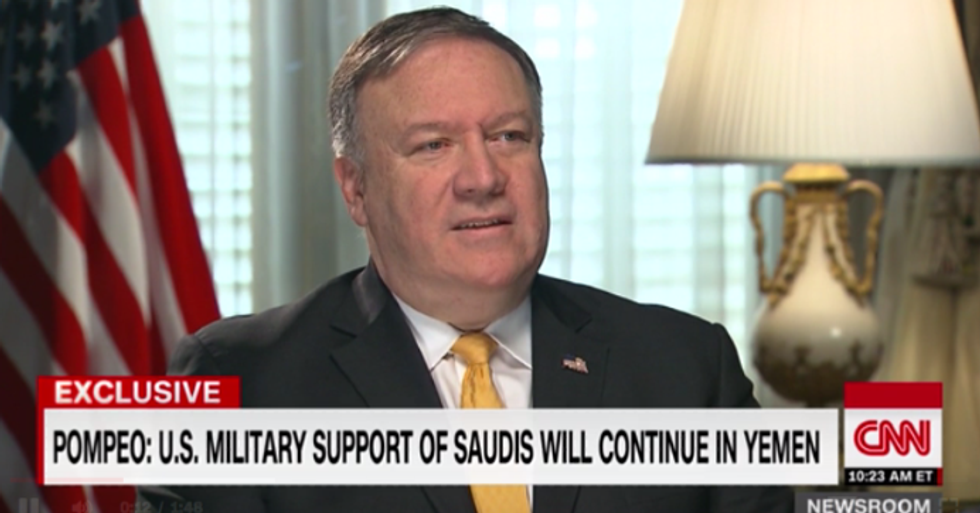
Pompeo's comments to CNN on Saturday come days after the U.S. Senate advanced legislation to bring an end to U.S. involvement in the 3-year war, as a United Nations official warned that "Yemen is on the brink of a major catastrophe," and as the Wall Street Journal reports on a CIA assessment strongly implicating Saudi Crown Prince Mohammed bin Salman in the killing of journalist Jamal Khashoggi.
Speaking to Wolf Blitzer on the sidelines of the G20 summit, Pompeo said the administration was intent on keeping "the strategic relationship with the Kingdom of Saudi Arabia."
Asked by Blitzer about dwindling support within Congress for participation in the war and whether the U.S. would continue to support the kingdom's bombing campaign of Yemen, Pompeo replied, "The program that we're involved in today we intend to continue."
The heads of prominent aid humanitarian organizations, however, this week pleaded for a cessation of that "program." They urged
the United States to back up its recent call for a cessation of hostilities with genuine diplomatic pressure, and to halt all military support for the Saudi/UAE coalition in Yemen in order to save millions of lives. It pains us to write these words, but we cannot escape the truth: if the U.S. does not cease its military support for the Saudi/UAE coalition, it too, will bear responsibility for what may be the largest famine in decades.
Writing at the Guardian Friday, Mark Weisbrot, co-director of the Center for Economic and Policy Research and the president of Just Foreign Policy, expressed hope that that military support finally has an expiration date thanks to the procedural vote on the War Powers Resolution.
"The Senate's action was truly historic for a number of reasons," he wrote:
First there is the magnitude of the war crimes that the Senate is trying to end. Mass starvation has been used as a weapon of war by the Saudis and their Emirati allies, pushing 14 million people to the brink of famine. More than 85,000 children have already died since their bombing campaign began in 2015. As was noted during the Senate debate on Thursday, the Saudi and UAE planes have also bombed water treatment plants and other essential civilian infrastructure, leading to a cholera outbreak that has killed thousands of people.
"The increasing publicity given to the war crimes in Yemen, their sheer scale, and now the undeniability of U.S. military participation may have forced some US politicians on the fence to rethink their positions," he continued. "Do they want to become known and remembered for voting to kill millions of innocent people in Yemen?"
Pompeo's comments to CNN on Saturday come days after the U.S. Senate advanced legislation to bring an end to U.S. involvement in the 3-year war, as a United Nations official warned that "Yemen is on the brink of a major catastrophe," and as the Wall Street Journal reports on a CIA assessment strongly implicating Saudi Crown Prince Mohammed bin Salman in the killing of journalist Jamal Khashoggi.
Speaking to Wolf Blitzer on the sidelines of the G20 summit, Pompeo said the administration was intent on keeping "the strategic relationship with the Kingdom of Saudi Arabia."
Asked by Blitzer about dwindling support within Congress for participation in the war and whether the U.S. would continue to support the kingdom's bombing campaign of Yemen, Pompeo replied, "The program that we're involved in today we intend to continue."
The heads of prominent aid humanitarian organizations, however, this week pleaded for a cessation of that "program." They urged
the United States to back up its recent call for a cessation of hostilities with genuine diplomatic pressure, and to halt all military support for the Saudi/UAE coalition in Yemen in order to save millions of lives. It pains us to write these words, but we cannot escape the truth: if the U.S. does not cease its military support for the Saudi/UAE coalition, it too, will bear responsibility for what may be the largest famine in decades.
Writing at the Guardian Friday, Mark Weisbrot, co-director of the Center for Economic and Policy Research and the president of Just Foreign Policy, expressed hope that that military support finally has an expiration date thanks to the procedural vote on the War Powers Resolution.
"The Senate's action was truly historic for a number of reasons," he wrote:
First there is the magnitude of the war crimes that the Senate is trying to end. Mass starvation has been used as a weapon of war by the Saudis and their Emirati allies, pushing 14 million people to the brink of famine. More than 85,000 children have already died since their bombing campaign began in 2015. As was noted during the Senate debate on Thursday, the Saudi and UAE planes have also bombed water treatment plants and other essential civilian infrastructure, leading to a cholera outbreak that has killed thousands of people.
"The increasing publicity given to the war crimes in Yemen, their sheer scale, and now the undeniability of U.S. military participation may have forced some US politicians on the fence to rethink their positions," he continued. "Do they want to become known and remembered for voting to kill millions of innocent people in Yemen?"
Pompeo's comments to CNN on Saturday come days after the U.S. Senate advanced legislation to bring an end to U.S. involvement in the 3-year war, as a United Nations official warned that "Yemen is on the brink of a major catastrophe," and as the Wall Street Journal reports on a CIA assessment strongly implicating Saudi Crown Prince Mohammed bin Salman in the killing of journalist Jamal Khashoggi.
Speaking to Wolf Blitzer on the sidelines of the G20 summit, Pompeo said the administration was intent on keeping "the strategic relationship with the Kingdom of Saudi Arabia."
Asked by Blitzer about dwindling support within Congress for participation in the war and whether the U.S. would continue to support the kingdom's bombing campaign of Yemen, Pompeo replied, "The program that we're involved in today we intend to continue."
The heads of prominent aid humanitarian organizations, however, this week pleaded for a cessation of that "program." They urged
the United States to back up its recent call for a cessation of hostilities with genuine diplomatic pressure, and to halt all military support for the Saudi/UAE coalition in Yemen in order to save millions of lives. It pains us to write these words, but we cannot escape the truth: if the U.S. does not cease its military support for the Saudi/UAE coalition, it too, will bear responsibility for what may be the largest famine in decades.
Writing at the Guardian Friday, Mark Weisbrot, co-director of the Center for Economic and Policy Research and the president of Just Foreign Policy, expressed hope that that military support finally has an expiration date thanks to the procedural vote on the War Powers Resolution.
"The Senate's action was truly historic for a number of reasons," he wrote:
First there is the magnitude of the war crimes that the Senate is trying to end. Mass starvation has been used as a weapon of war by the Saudis and their Emirati allies, pushing 14 million people to the brink of famine. More than 85,000 children have already died since their bombing campaign began in 2015. As was noted during the Senate debate on Thursday, the Saudi and UAE planes have also bombed water treatment plants and other essential civilian infrastructure, leading to a cholera outbreak that has killed thousands of people.
"The increasing publicity given to the war crimes in Yemen, their sheer scale, and now the undeniability of U.S. military participation may have forced some US politicians on the fence to rethink their positions," he continued. "Do they want to become known and remembered for voting to kill millions of innocent people in Yemen?"

