SUBSCRIBE TO OUR FREE NEWSLETTER
Daily news & progressive opinion—funded by the people, not the corporations—delivered straight to your inbox.
5
#000000
#FFFFFF
To donate by check, phone, or other method, see our More Ways to Give page.
Simply put, "The NAFTA 2.0 text is not the transformational replacement of the corporate-rigged trade-pact model that progressive activists, unions, and congressional Democrats have long demanded," wrote Lori Wallach, director of Public Citizen's Global Trade Watch.
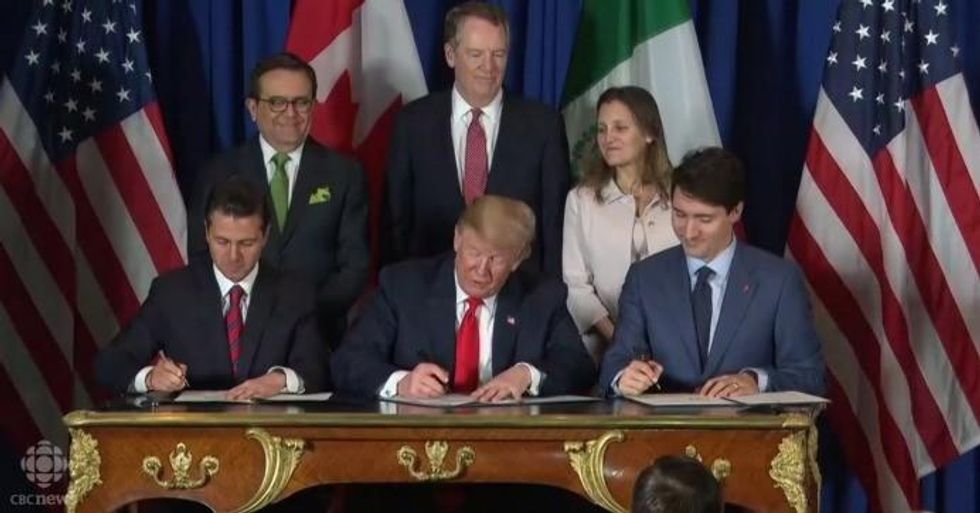
Inked by the North American leaders on the sidelines of the G20 summit in Buenos Aires, the deal, formally called the United States-Mexico-Canada Agreement (USMCA) in the U.S., comes after more than a year of negotiations. Canadian Foreign Affairs Minister Chrystia Freeland noted that the signing follows "what has been, at times, a difficult process." As The Toronto Star reported:
Trudeau's government has informally referred to the new agreement as a new NAFTA, noting that much of the original remains in place. Trump, who has called NAFTA the worst trade deal in world history, has wrongly insisted he is terminating NAFTA and replacing it with something entirely new.
Given that continuity, a number of family farm organizations from the U.S. and Canada including the National Farmers Union Canada and the U.S.-based National Family Farm Coalition have urged a better deal, one "that promotes fair and sustainable food systems." Unmet in the new deal, they say, are their demands to "restore local and national sovereignty over farm and food policy; stop corporate giveaways in trade agreements; and ensue economic viability and resilience in rural communities."
"This New NAFTA is a huge missed opportunity," said Karen Hansen-Kuhn, director of Trade and Global Governance at the Institute for Agriculture and Trade Policy. "Family farm groups in all three countries insisted on new rules to rebuild rural economies and food systems. Instead, we have a deal that locks in many of the old rules that have driven farmers out of agriculture for more than two decades."
The Council of Canadians' honorary chairperson Maude Barlow, meanwhile, said the deal in its current form has "many poison pills."
A positive development, added the group's trade campaigner Sujata Dey, was that some of their long-standing demands had been met. "The Council of Canadians was among the first to draw attention to how Chapter 11 would harm our ability to bring in public interest policy and legislation. Now, it is gone--at least between Canada and the U.S."
"But in the closed door negotiations of the USMCA, corporations came up with new rights: powers for corporations to monitor and change regulations before they see the light of day in areas that could affect food safety, chemicals, environmental regulations and other matters of public safety," Dey explained. "The agreement also supports higher drug prices because of Big Pharma protectionism and allows attacks on farmers and Crown corporations. Again, free trade is a goody bag for corporations. Why must we constantly sign agreements that empower the corporate one percent at the expense of the rest of us?"
It's not the end of the road for the deal. As Hansen-Kuhn stated, "Signing this new NAFTA is just one more step in a bad process." The deal still needs approval from the three countries' legislatures. In the U.S., as Politico notes, that could mean "months of fierce debate between the Trump administration and Congress."
Already, some U.S. lawmakers have announced their opposition to NAFTA 2.0.
Democratic Rep. Jan Schakowsky of Illinois, for one, said ahead of the signing that it does "not do nearly enough to raise wages for workers, lower costs for healthcare consumers, or protect the environment," and that barring major changes, the deal "will result in more broken promises by Donald Trump to American workers."
In addition, she said, the deal as is "would not only raise drug prices in Canada and Mexico, but would tie Congress' hands, preventing us from enacting essential reforms needed to lower prescription drug prices."
Denouncing the deal's "outrageous giveaways to the fossil fuel industry and big pharmaceutical companies," Sen. Bernie Sanders (I-Vt.) conveyed his opposition as well. "Unless strong enforcement mechanisms are written into the text of this agreement, corporations will continue to ship U.S. jobs to Mexico where workers are paid as little as $2 an hour."
"Before this deal is sent to Congress for a vote," Sanders said, "it must include strong enforcement mechanisms to increase jobs and wages and all of the riders that benefit big fossil fuel polluters and pharmaceutical companies must be taken out of it."
According to Hansen-Kuhn, "Legislatures in all three countries should insist that negotiators go back to the drawing board or reject this new NAFTA all together."
Simply put, "The NAFTA 2.0 text is not the transformational replacement of the corporate-rigged trade-pact model that progressive activists, unions, and congressional Democrats have long demanded," wrote Lori Wallach, director of Public Citizen's Global Trade Watch.
Inked by the North American leaders on the sidelines of the G20 summit in Buenos Aires, the deal, formally called the United States-Mexico-Canada Agreement (USMCA) in the U.S., comes after more than a year of negotiations. Canadian Foreign Affairs Minister Chrystia Freeland noted that the signing follows "what has been, at times, a difficult process." As The Toronto Star reported:
Trudeau's government has informally referred to the new agreement as a new NAFTA, noting that much of the original remains in place. Trump, who has called NAFTA the worst trade deal in world history, has wrongly insisted he is terminating NAFTA and replacing it with something entirely new.
Given that continuity, a number of family farm organizations from the U.S. and Canada including the National Farmers Union Canada and the U.S.-based National Family Farm Coalition have urged a better deal, one "that promotes fair and sustainable food systems." Unmet in the new deal, they say, are their demands to "restore local and national sovereignty over farm and food policy; stop corporate giveaways in trade agreements; and ensue economic viability and resilience in rural communities."
"This New NAFTA is a huge missed opportunity," said Karen Hansen-Kuhn, director of Trade and Global Governance at the Institute for Agriculture and Trade Policy. "Family farm groups in all three countries insisted on new rules to rebuild rural economies and food systems. Instead, we have a deal that locks in many of the old rules that have driven farmers out of agriculture for more than two decades."
The Council of Canadians' honorary chairperson Maude Barlow, meanwhile, said the deal in its current form has "many poison pills."
A positive development, added the group's trade campaigner Sujata Dey, was that some of their long-standing demands had been met. "The Council of Canadians was among the first to draw attention to how Chapter 11 would harm our ability to bring in public interest policy and legislation. Now, it is gone--at least between Canada and the U.S."
"But in the closed door negotiations of the USMCA, corporations came up with new rights: powers for corporations to monitor and change regulations before they see the light of day in areas that could affect food safety, chemicals, environmental regulations and other matters of public safety," Dey explained. "The agreement also supports higher drug prices because of Big Pharma protectionism and allows attacks on farmers and Crown corporations. Again, free trade is a goody bag for corporations. Why must we constantly sign agreements that empower the corporate one percent at the expense of the rest of us?"
It's not the end of the road for the deal. As Hansen-Kuhn stated, "Signing this new NAFTA is just one more step in a bad process." The deal still needs approval from the three countries' legislatures. In the U.S., as Politico notes, that could mean "months of fierce debate between the Trump administration and Congress."
Already, some U.S. lawmakers have announced their opposition to NAFTA 2.0.
Democratic Rep. Jan Schakowsky of Illinois, for one, said ahead of the signing that it does "not do nearly enough to raise wages for workers, lower costs for healthcare consumers, or protect the environment," and that barring major changes, the deal "will result in more broken promises by Donald Trump to American workers."
In addition, she said, the deal as is "would not only raise drug prices in Canada and Mexico, but would tie Congress' hands, preventing us from enacting essential reforms needed to lower prescription drug prices."
Denouncing the deal's "outrageous giveaways to the fossil fuel industry and big pharmaceutical companies," Sen. Bernie Sanders (I-Vt.) conveyed his opposition as well. "Unless strong enforcement mechanisms are written into the text of this agreement, corporations will continue to ship U.S. jobs to Mexico where workers are paid as little as $2 an hour."
"Before this deal is sent to Congress for a vote," Sanders said, "it must include strong enforcement mechanisms to increase jobs and wages and all of the riders that benefit big fossil fuel polluters and pharmaceutical companies must be taken out of it."
According to Hansen-Kuhn, "Legislatures in all three countries should insist that negotiators go back to the drawing board or reject this new NAFTA all together."
Simply put, "The NAFTA 2.0 text is not the transformational replacement of the corporate-rigged trade-pact model that progressive activists, unions, and congressional Democrats have long demanded," wrote Lori Wallach, director of Public Citizen's Global Trade Watch.
Inked by the North American leaders on the sidelines of the G20 summit in Buenos Aires, the deal, formally called the United States-Mexico-Canada Agreement (USMCA) in the U.S., comes after more than a year of negotiations. Canadian Foreign Affairs Minister Chrystia Freeland noted that the signing follows "what has been, at times, a difficult process." As The Toronto Star reported:
Trudeau's government has informally referred to the new agreement as a new NAFTA, noting that much of the original remains in place. Trump, who has called NAFTA the worst trade deal in world history, has wrongly insisted he is terminating NAFTA and replacing it with something entirely new.
Given that continuity, a number of family farm organizations from the U.S. and Canada including the National Farmers Union Canada and the U.S.-based National Family Farm Coalition have urged a better deal, one "that promotes fair and sustainable food systems." Unmet in the new deal, they say, are their demands to "restore local and national sovereignty over farm and food policy; stop corporate giveaways in trade agreements; and ensue economic viability and resilience in rural communities."
"This New NAFTA is a huge missed opportunity," said Karen Hansen-Kuhn, director of Trade and Global Governance at the Institute for Agriculture and Trade Policy. "Family farm groups in all three countries insisted on new rules to rebuild rural economies and food systems. Instead, we have a deal that locks in many of the old rules that have driven farmers out of agriculture for more than two decades."
The Council of Canadians' honorary chairperson Maude Barlow, meanwhile, said the deal in its current form has "many poison pills."
A positive development, added the group's trade campaigner Sujata Dey, was that some of their long-standing demands had been met. "The Council of Canadians was among the first to draw attention to how Chapter 11 would harm our ability to bring in public interest policy and legislation. Now, it is gone--at least between Canada and the U.S."
"But in the closed door negotiations of the USMCA, corporations came up with new rights: powers for corporations to monitor and change regulations before they see the light of day in areas that could affect food safety, chemicals, environmental regulations and other matters of public safety," Dey explained. "The agreement also supports higher drug prices because of Big Pharma protectionism and allows attacks on farmers and Crown corporations. Again, free trade is a goody bag for corporations. Why must we constantly sign agreements that empower the corporate one percent at the expense of the rest of us?"
It's not the end of the road for the deal. As Hansen-Kuhn stated, "Signing this new NAFTA is just one more step in a bad process." The deal still needs approval from the three countries' legislatures. In the U.S., as Politico notes, that could mean "months of fierce debate between the Trump administration and Congress."
Already, some U.S. lawmakers have announced their opposition to NAFTA 2.0.
Democratic Rep. Jan Schakowsky of Illinois, for one, said ahead of the signing that it does "not do nearly enough to raise wages for workers, lower costs for healthcare consumers, or protect the environment," and that barring major changes, the deal "will result in more broken promises by Donald Trump to American workers."
In addition, she said, the deal as is "would not only raise drug prices in Canada and Mexico, but would tie Congress' hands, preventing us from enacting essential reforms needed to lower prescription drug prices."
Denouncing the deal's "outrageous giveaways to the fossil fuel industry and big pharmaceutical companies," Sen. Bernie Sanders (I-Vt.) conveyed his opposition as well. "Unless strong enforcement mechanisms are written into the text of this agreement, corporations will continue to ship U.S. jobs to Mexico where workers are paid as little as $2 an hour."
"Before this deal is sent to Congress for a vote," Sanders said, "it must include strong enforcement mechanisms to increase jobs and wages and all of the riders that benefit big fossil fuel polluters and pharmaceutical companies must be taken out of it."
According to Hansen-Kuhn, "Legislatures in all three countries should insist that negotiators go back to the drawing board or reject this new NAFTA all together."