

SUBSCRIBE TO OUR FREE NEWSLETTER
Daily news & progressive opinion—funded by the people, not the corporations—delivered straight to your inbox.
5
#000000
#FFFFFF
To donate by check, phone, or other method, see our More Ways to Give page.
Daily news & progressive opinion—funded by the people, not the corporations—delivered straight to your inbox.
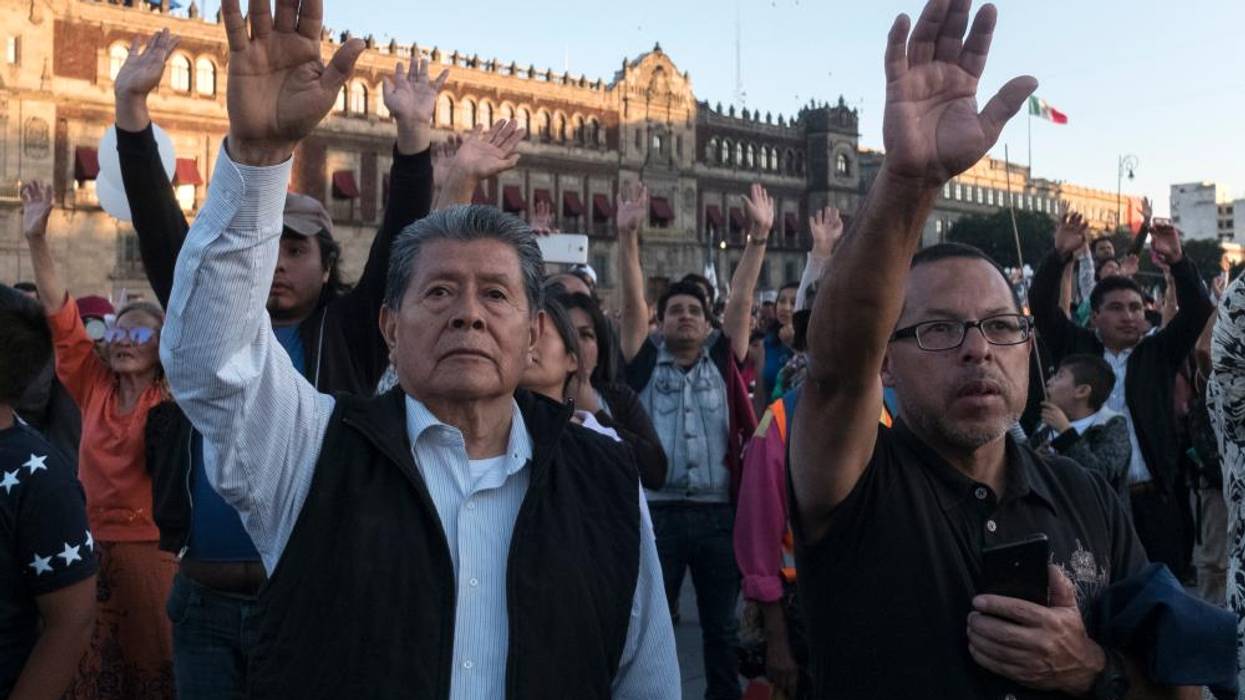
I had the great fortune to attend the inauguration of Andres Manuel Lopez Obrador (or AMLO, as he is known) as the 58th Mexican president on December 1. The atmosphere at the Legislative Palace was electric with the knowledge that Mexico would be beginning its "Fourth Transformation" -- following its 1810 independence, the 1855 reformation, and the 1910 revolution -- with the first left-wing presidency in its history.
It was AMLO's third attempt at the office. In 2006 Felipe Calderon orchestrated a cyber fraud that gave him a slim advantage over AMLO. And in order to win in 2012, outgoing president Enrique Pena Nieto engaged in tricks like giving away cash-loaded bank cards.
When AMLO arrives following his 2018 victory, his supporters chanted Si se pudo: "Yes we could!"
AMLO started his speech off by going full throttle against neoliberalism and corruption in Mexico, both of which he's fought for decades. He said the crisis in Mexico originated not only because of the failure of the neoliberal economic model, but also because of the "deep predominance during this period of the dirtiest display of public and private corruption."
Outgoing President Pena Nieto sat stoically, looking uncomfortable at times.
The new president explained how Mexico's economy grew from the end of the revolution in 1917 to the end of the 1970s at rates of 5 to 6 percent a year. With the neoliberal period starting in the 1980s came the debacle. It was marked by low growth, inflation, and indebtedness. Even after endless privatization schemes, the national debt reached 10 trillion pesos -- the equivalent of over $500 billion, more than 42 percent of Mexico's GDP -- under Pena Nieto who sank down further in his chair when the subject came up.
AMLO rambled on against neoliberalism for quite a while. He said that another "pearl" of this model is the "privatizations and the corruption, the former being synonymous with the latter." He explained how neoliberal policies have made Mexico a net importer of basic food staples like corn, how Mexican salaries have lost 60 percent of their purchasing power, and how Mexico became the one of the leading sources of out-migration in the world -- such that 24 million Mexicans live in the United States, according to him.
"Political and economic power have fed and nurtured each other," he concluded, "which has led to the robbery of the people's property as well as the wealth of the nation." Pena Nieto undoubtedly felt that at that moment all eyes were on him.
A Long Career
This was AMLO at his best. The script was completely his. Despite having created a mixed cabinet -- one that includes pro-business people such as cabinet chief Alfonso Romo -- for the purpose of helping him keep the trust of "the markets" during the exceedingly long six-month transition period, AMLO took the bull by its horns and made it clear what he has stood for all his political life.
As far back as 1991, he led rallies in his home state of Tabasco denouncing electoral fraud by the ruling party. Later he fought the privatization of Mexico's oil state company PEMEX, denounced the Savings Protection Banking Fund (FOBAPROA) scheme that bailed out bankers at the expense of the Mexican people, and left the Institutional Revolution Party (that monopolized political power for decades) to form with Cuauhtemoc Cardenas the Democratic Revolution Party (that has now almost disappeared).
As mayor of Mexico City from 2000 to 2005, he initiated social programs to help the elderly and the handicapped, improved access to free medicines and schools, and ensured the construction of new preparatory schools -- and even a new university -- for Mexico City's most disadvantaged sectors of society. He even had a new hospital built after decades of inaction from previous governments.
Eventually AMLO's own PRD became corrupted, complicit with privatization schemes and anti-union reforms. So AMLO left it and formed the MORENA (Movement of National Regeneration) party, which now has a majority in both houses of the national legislature.
Moreover, MORENA won four states (out of eight that had elections this year), and several municipalities and big cities -- including the biggest local prize, Mexico City, which elected a woman for the first time: Claudia Sheinbaum. MORENA offers the most gender-balanced governments and legislatures, and AMLO's cabinet does as well.
But What About NAFTA?
With such political favorable scenario, I have no doubt that AMLO can deliver on promises to help Mexico overcome decades of increasing inequality, rampant poverty, and forced migration.
But one thing gives me pause.
In his acceptance speech against neoliberalism, he mentioned NAFTA only once. He said he, president Trump, and Canadian prime minister Justin Trudeau were talking about how to go beyond NAFTA and "reach an investment agreement among companies and governments of the three countries to foster development of Central American countries and also ours," which he pitched as a "non-forcible" way to address "the migratory phenomenon."
However, AMLO didn't mention the recently concluded U.S.-Mexico-Canada Agreement (USMCA), aka NAFTA 2.0. Why would AMLO not tackle NAFTA more forcefully when this agreement has been the backbone of neoliberalism, and the cause of migration of millions of Mexicans to the United States?
Now that President Trump threatens to cancel NAFTA if legislators in the United States don't immediately ratify the "new" version, AMLO and his MORENA party have a golden opportunity to get rid of it once and for all.
That's exactly what Mexican civil society coalitions like Mexico Better off Without FTAs have been calling for.
It wouldn't be a disaster for Mexico. Our trade with the United States would revert to WTO rules, which are similar to NAFTA's. But withdrawing would effectively eliminate many other rules found in NAFTA (and apparently in the USCMA) that go well beyond trade. Those rules have handcuffed the Mexican government's capacity to promote the Mexican economy, particularly in the countryside; support the livelihoods of indigenous people; expand the provision of affordable medicines; and protect the environment.
The MORENA party and AMLO should be very vigilant. They must wait until the Mexican Senate receives the official text of the USMCA in Spanish (Pena Nieto's government pretended to "inform" the public with a propagandistic summary while the unfinished text remained only in English), and then should carry out an official consultation with all social and economic sectors.
AMLO has promised a series of consultations for development and infrastructure projects in Mexico. Good. He also consulted about the name of the new NAFTA -- Trump's "USMCA," rebranding that consciously put the United States first -- and rechristened it T-MEC (Tratado Mexico, Estados Unidos, Canada). Not so good, because it looks more like Trump-MEC. And it was Trump who pushed this new agreement on everyone.
More importantly, consulting people merely about the name of the renewed NAFTA is a serious shortcoming. What's needed is a much broader consultation about all aspects of Mexico's economy and society that have been, and will be, impacted by such an agreement.
In sum, there should be no ratification of the USMCA until the public has had an opportunity to read and discuss the official text already signed by Trump, Pena Nieto, and Trudeau -- on Pena Nieto's last day in office.
AMLO and MORENA represent a great hope for Mexicans. Opening the new NAFTA, before it's ratified, to broad and binding consultation with the Mexican people would be a bold first step. Not doing so -- and ratifying with haste -- would be giving in to neoliberalism and its corrupt practice of passing these agreements behind peoples' backs.
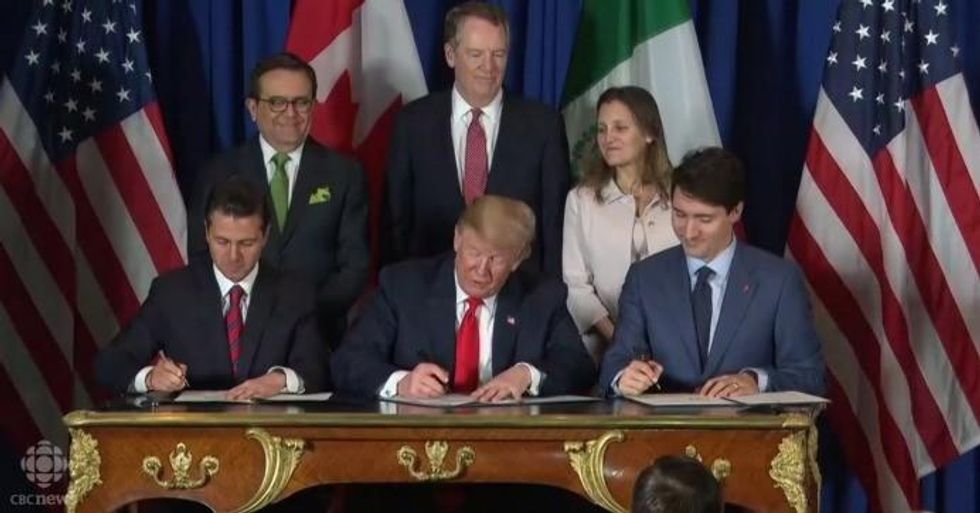
Simply put, "The NAFTA 2.0 text is not the transformational replacement of the corporate-rigged trade-pact model that progressive activists, unions, and congressional Democrats have long demanded," wrote Lori Wallach, director of Public Citizen's Global Trade Watch.
Inked by the North American leaders on the sidelines of the G20 summit in Buenos Aires, the deal, formally called the United States-Mexico-Canada Agreement (USMCA) in the U.S., comes after more than a year of negotiations. Canadian Foreign Affairs Minister Chrystia Freeland noted that the signing follows "what has been, at times, a difficult process." As The Toronto Star reported:
Trudeau's government has informally referred to the new agreement as a new NAFTA, noting that much of the original remains in place. Trump, who has called NAFTA the worst trade deal in world history, has wrongly insisted he is terminating NAFTA and replacing it with something entirely new.
Given that continuity, a number of family farm organizations from the U.S. and Canada including the National Farmers Union Canada and the U.S.-based National Family Farm Coalition have urged a better deal, one "that promotes fair and sustainable food systems." Unmet in the new deal, they say, are their demands to "restore local and national sovereignty over farm and food policy; stop corporate giveaways in trade agreements; and ensue economic viability and resilience in rural communities."
"This New NAFTA is a huge missed opportunity," said Karen Hansen-Kuhn, director of Trade and Global Governance at the Institute for Agriculture and Trade Policy. "Family farm groups in all three countries insisted on new rules to rebuild rural economies and food systems. Instead, we have a deal that locks in many of the old rules that have driven farmers out of agriculture for more than two decades."
The Council of Canadians' honorary chairperson Maude Barlow, meanwhile, said the deal in its current form has "many poison pills."
A positive development, added the group's trade campaigner Sujata Dey, was that some of their long-standing demands had been met. "The Council of Canadians was among the first to draw attention to how Chapter 11 would harm our ability to bring in public interest policy and legislation. Now, it is gone--at least between Canada and the U.S."
"But in the closed door negotiations of the USMCA, corporations came up with new rights: powers for corporations to monitor and change regulations before they see the light of day in areas that could affect food safety, chemicals, environmental regulations and other matters of public safety," Dey explained. "The agreement also supports higher drug prices because of Big Pharma protectionism and allows attacks on farmers and Crown corporations. Again, free trade is a goody bag for corporations. Why must we constantly sign agreements that empower the corporate one percent at the expense of the rest of us?"
It's not the end of the road for the deal. As Hansen-Kuhn stated, "Signing this new NAFTA is just one more step in a bad process." The deal still needs approval from the three countries' legislatures. In the U.S., as Politico notes, that could mean "months of fierce debate between the Trump administration and Congress."
Already, some U.S. lawmakers have announced their opposition to NAFTA 2.0.
Democratic Rep. Jan Schakowsky of Illinois, for one, said ahead of the signing that it does "not do nearly enough to raise wages for workers, lower costs for healthcare consumers, or protect the environment," and that barring major changes, the deal "will result in more broken promises by Donald Trump to American workers."
In addition, she said, the deal as is "would not only raise drug prices in Canada and Mexico, but would tie Congress' hands, preventing us from enacting essential reforms needed to lower prescription drug prices."
Denouncing the deal's "outrageous giveaways to the fossil fuel industry and big pharmaceutical companies," Sen. Bernie Sanders (I-Vt.) conveyed his opposition as well. "Unless strong enforcement mechanisms are written into the text of this agreement, corporations will continue to ship U.S. jobs to Mexico where workers are paid as little as $2 an hour."
"Before this deal is sent to Congress for a vote," Sanders said, "it must include strong enforcement mechanisms to increase jobs and wages and all of the riders that benefit big fossil fuel polluters and pharmaceutical companies must be taken out of it."
According to Hansen-Kuhn, "Legislatures in all three countries should insist that negotiators go back to the drawing board or reject this new NAFTA all together."
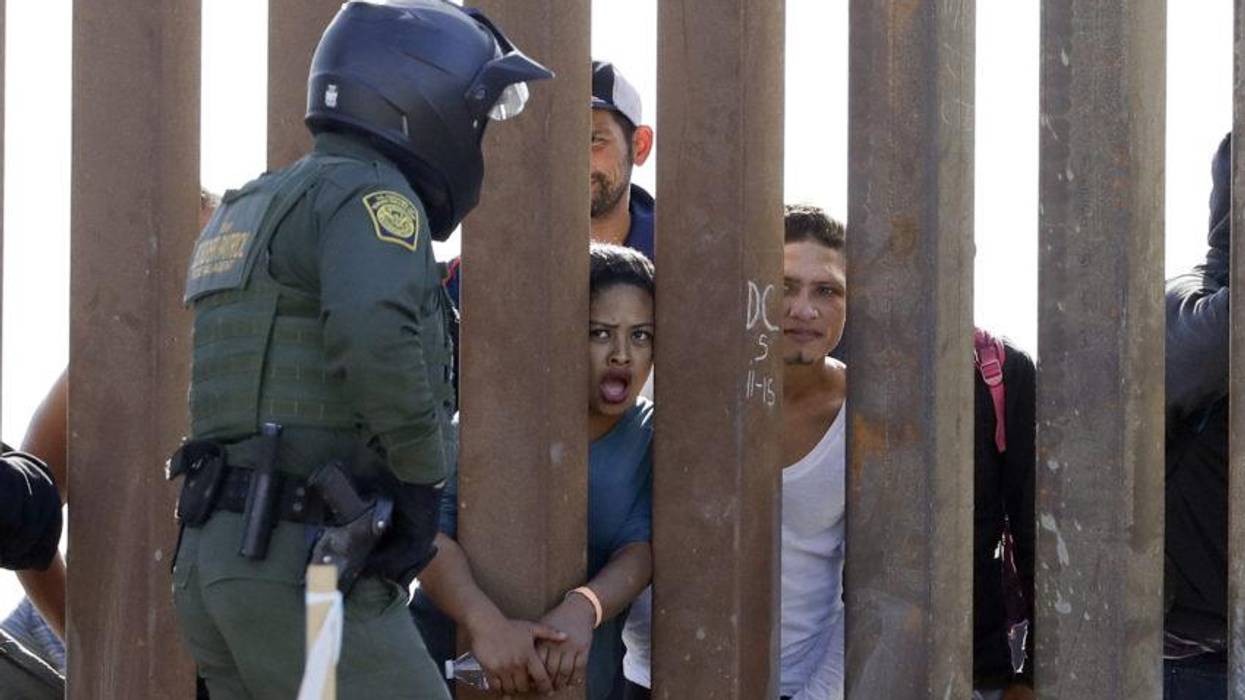
When a crowd is exposed to tear gas, an aerosol containing the chemical agent 2-chlorobenzaldene malononitrile (CS), nasal passages begin to run, eyes water uncontrollably and breathing grows short and painful. Those directly exposed can experience vomiting or diarrhea. Effects take hold within 30 seconds, and the symptoms can last up to 10 minutes, even after the air has cleared or the afflicted have managed to scramble to safety.
U.S. Border Patrol agents have fired upon Central American migrants and their toddlers in Tijuana, Mexico, seeking asylum in the United States--an act of aggression that almost certainly violates international law.
For these reasons, nearly every nation in the world banned the compound's use in warfare under the Chemical Weapons Convention of 1993. Yet despite ratifying these agreements, the United States continues to utilize tear gas for domestic riot control. Police shot dozens of canisters at protesters over several days in Ferguson, Mo., and now U.S. Border Patrol agents have fired upon Central American migrants and their toddlers in Tijuana, Mexico, seeking asylum in the United States--an act of aggression that almost certainly violates international law.
When President Donald Trump announced that he would be deploying soldiers to the southern border, in numbers that seemed to swell in direct proportion to the fever of his campaign rallies, the media eagerly enabled his hysteria, treating the arrival of a few hundred refugees as an impending alien invasion. And while Nicholas Kristof has since acknowledged that The New York Times allowed itself to be manipulated ahead of a midterm election, few appear willing to confront the darker reality this assault has laid bare: The Trump administration has sought to militarize the region from the start.
In January of 2017, mere days after Trump was sworn into office, Bloomberg published a report detailing Magal Security Systems' offer to construct the president's long-promised wall. (Shares in the company soared 50 percent following the 2016 presidential election.) During a conference on border security, the company presented its Fiber Patrol product to officials from the U.S. Department of Homeland Security, among others. Previously, Magal Security Systems had constructed Israel's border wall with Gaza, as well as a fence separating the country from Egypt.
That August, amid a tense meeting with then Mexican President Enrique Pena Nieto over who might fund such a construction, Trump made a confession of sorts. "You know, you look at Israel," a transcript of the conversation reveals him saying. "Israel has a wall and everyone said do not build a wall, walls do not work--99.9 percent of people trying to get across that wall cannot get across anymore. ... Bibi Netanyahu told me the wall works."
"Israel has a wall and everyone said do not build a wall, walls do not work--99.9 percent of people trying to get across that wall cannot get across anymore. ... Bibi Netanyahu told me the wall works."
While a physical wall will likely go unfunded with Democrats now controlling the House of Representatives, the president has nonetheless achieved its central aim. By separating children from their migrant parents at the border, the Trump administration has exerted its dominance over a vulnerable population, and signaled to its supporters that it will not simply accept white nationalism as a byproduct of American empire but embrace it as a matter of public policy. As of October, administration officials had failed to reunite hundreds of these children with their mothers and fathers, months after a court-imposed deadline to do so.
In recent weeks, the U.S. military has laid down miles of concertina barbed wire along the U.S. border with Mexico as part of Operation Faithful Patriot. Secretary of Defense Jim Mattis has since dropped the name of the mission on the grounds that it was too military sounding; when asked if the troops planned to remove the wiring, he replied, "We'll let you know."
It seems increasingly unlikely. During a recent stop in Montana, Trump gushed over the work of the U.S. military along the border, the new tracts of fencing in particular. "Mexico is trying, they are trying but we're different, we have our military on the border," he said. "And I noticed all that beautiful barbed wire going up today. Barbed wire, used properly, can be a beautiful sight."
If decades of U.S. foreign policy have shaped the migrant caravan, from President Ronald Reagan's violent maneuverings in Nicaragua and El Salvador during the waning days of the Cold War to Secretary of State Hillary Clinton's assistance in the Honduran coup of 2009, the crisis currently unfolding in Tijuana is almost entirely of the Trump administration's making. "Trump's border policy has squeezed asylum seekers at both ends," observes Vox's Dara Lind. "Officials stress that migrants ought to present themselves legally at ports of entry, while asylum seekers at ports are forced to wait days or weeks for entry to the US, and President Donald Trump himself says they shouldn't be coming at all."
For the president and his enablers, that a refugee's method of entering the country has no bearing on his or her claims to asylum is ultimately irrelevant. As is so often the case in this administration, the cruelty is the point. Trump has since threatened to shut down the Mexican border "permanently," an act of dubious legality that, coupled with acts of violent suppression, would only further Gaza-fy the southern border. This was the idea all along.
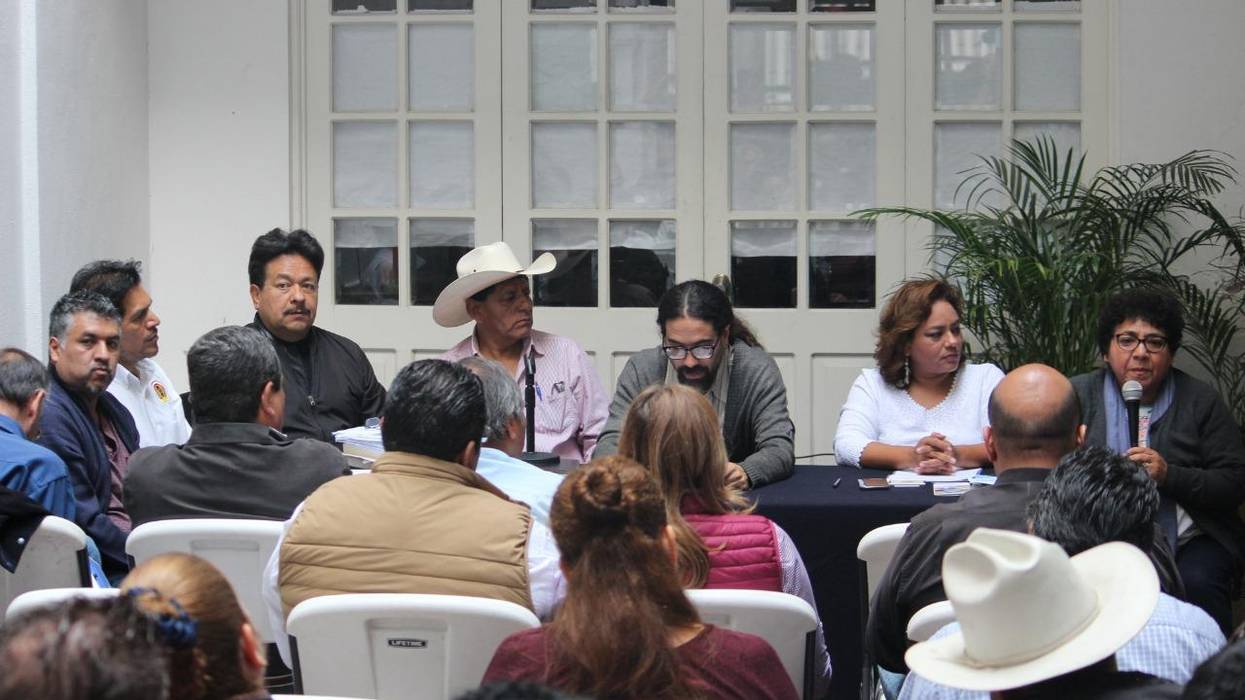
The smooth ride to a new North American Free Trade Agreement (NAFTA) may have just hit the bumpy roads of rural Mexico. On Tuesday, leaders of Mexico's farm movement strongly condemned the new agreement announced between the United States and Mexico, calling on the new president they supported in recent elections to get involved and slow the race to the new agreement.
"We need to push our new president to stop the signing of this agreement," said farm leader Geronimo Jacobo in an interview. "This is life or death for us. With NAFTA it will be a slow death. Our national sovereignty is at stake here!"
On August 27, U.S. President Donald Trump announced he had reached a deal with the Mexican government on a new version of the NAFTA. In a garbled televised phone call, the president congratulated lame duck Mexican President Enrique Pena Nieto, claiming he had fulfilled his campaign promise to "replace NAFTA" and christening the new deal "The U.S.-Mexico Free Trade Agreement." For his part, Pena Nieto, whose party was trounced in July 1 elections, claimed the agreement as his legacy.
What was surprising to Mexico's energized farm movement were the anti-agriculture biases in the negotiated text.
No one, though, could claim they actually had a new NAFTA. Canada, NAFTA's other commercial partner, was left out as President Trump rushed to meet a self-declared deadline that would allow the agreement to be signed by Pena Nieto, before Andres Manuel Lopez Obrador takes office December 1. Canada was offered the opportunity to join the agreement, though negotiations continue.
Surprisingly, representatives from the incoming government of Lopez Obrador (also known as AMLO) participated as observers and endorsed the new agreement. Jesus Seade, Lopez Obrador's designated NAFTA negotiator, raised a few small issues in the last days of the negotiations, but publicly supported the deal, a stance widely seen as trying to ensure financial stability in the transition to his new government. It was surprising because the incoming president had been a strong critic of NAFTA in the past.
Farmers: Not so fast!
What was surprising to Mexico's energized farm movement were the anti-agriculture biases in the negotiated text. The movement had gone all-out for Lopez Obrador and his Morena party, turning out more than 50% support across rural Mexico, unprecedented in a country in which the ruling Institutional Revolutionary Party tightly controlled the rural vote. They did so because the candidate had publicly signed on to their radical program for farm reform, the Plan de Ayala 21st Century, after Emiliano Zapata's original rural reform program early last century. (See my previous article.)
The Plan de Ayala also called for a renegotiation of NAFTA to stop U.S. farm products from flooding Mexico with cheap, subsidized crops.
The new program called for support for small-scale farmers of maize and other staple crops as part of a campaign to restore food self-sufficiency in a country that now imports some 46% of its food, mostly from the United States. The Plan de Ayala also called for a renegotiation of NAFTA to stop U.S. farm products from flooding Mexico with cheap, subsidized crops.
The new agreement fails to allow Mexico to protect staple crops from such U.S. agricultural dumping. New research from the Institute for Agriculture and Trade Policy shows that U.S. maize (corn) has been exported in the last three years at prices 10% below what it cost to produce. Wheat has been exported 33% below the costs of production, and rice as also seen a dumping margin. All three crops are priorities for Lopez Obrador's new Office of Food Self-Sufficiency, to be headed by longtime farm leader Victor Suarez.
At Tuesday's press conference, farm movement leaders rejected the new deal and called on the current government not to sign it, deferring the decision to the new president with his overwhelming mandate. (His party won 53% of the vote in a five-person race and took majorities of seats in both the House and the Senate.) In a statement, leaders said NAFTA is responsible for the impoverishment of small and medium-scale farmers.
They denounced the new agreements on biotechnology as a backdoor way to force genetically modified maize and other crops into Mexico. Lopez Obrador has been clear since the election that his administration will no longer allow the use of GM maize and soybeans. Farmers fear the new NAFTA could compel him to do so.
Lopez Obrador has been clear since the election that his administration will no longer allow the use of GM maize and soybeans. Farmers fear the new NAFTA could compel him to do so.
Similarly, there are rumors that an annex to the agreement would bar Mexico from putting labels on food packaging warning consumers about fattening, sugary, and unhealthy food. In other countries such measures have proven effective, and Mexico faces a growing obesity epidemic attributed significantly to imported processed food and sodas. Another provision could make it difficult for the new government to pay support prices to small-scale farmers as a way to stimulate local production.
With the actual text of the agreement still secret, farm leaders demanded that the full text be made public and that the new congress hold hearings on the agreement before it is signed.
"We have ghost towns because of NAFTA"
"Pena Neto shouldn't sign it," farm leader Rocio Miranda told me. "He has presided over a terrible increase in hunger. We have ghost towns in rural Mexico because of NAFTA."
Miranda said she is very optimistic about the government's commitment to small-scale farmers. "The new government represents the people harmed by NAFTA." But she hopes Lopez Obrador will step in to ensure that the new NAFTA does not contradict his ambitious rural agenda.
"The farmers' movement is concerned," she said, as negotiators wait to see if Canada will sign on before the end of September. "The new NAFTA could undermine our efforts to regain our food self-sufficiency."

With the United States and Mexico having both signed off on a reworked North American Free Trade Agreement (or whatever President Trump wants to call it), negotiators are now attempting to secure a last-minute agreement with Canada by a Friday deadline. The Trump administration has threatened auto tariffs on Canada if they don't climb aboard. Because Mexican president Enrique Pena Nieto's term ends in November, and U.S. trade law requires a 90-day waiting period before all parties can sign, the final agreement must be completed by August 31.
If Canada does sign on board, the results of the year-long negotiations will be decidedly mixed. Only lazy pundits would call the U.S./Mexico agreement "TPP 2.0." A number of features do eliminate corporate favors from prior trade agreements, and drive a better bargain for workers in all partner countries. Since this will be the template for other U.S. trade deals moving forward, that's important. On the other hand, those anti-corporate provisions have their limits, particularly because it's unclear how they will be enforced. And Canadian involvement means everything's subject to change. Let's take a look at what we know.
The end of corporate shakedowns: Perhaps the best provision signals the demise of the notorious investor-state dispute settlement (ISDS) process. Under ISDS, foreign corporations can sue countries for "expected future profits" when laws and regulations change. Extrajudicial tribunals composed of three corporate lawyers decide on the claims; some of the arbitrators simultaneously serve as counsel for corporations bringing other complaints.
ISDS has led to governments paying hundreds of millions of dollars to corporations. And it has increasingly become a means for rich investors to speculate on lawsuits, winning huge awards and forcing local taxpayers to foot the bill.
Under the new agreement, this process is virtually eliminated. U.S. and Canadian companies will only have access to domestic courts, making impossible nearly all previous NAFTA ISDS cases against the two countries, which have functioning legal systems to handle those complaints. For cases involving Mexico, domestic courts and administrative proceedings would have to be exhausted before ISDS could be invoked. Tribunals could not be stocked with lawyers working on ISDS claims for corporations, and several common "investor rights"--like demanding a minimum standard of treatment from a foreign government--would be revoked. Damages for "expected future profits" would be eliminated; only concrete damages could be demanded.
A small group of U.S. investors in Mexico who have contracts in the oil and gas sector would get wider protections through a carve-out. This led Roosevelt Institute fellow and ISDS expert Todd Tucker to call the changes "a privileged forum for Big Oil and Big Gas... handouts to big companies afraid of leftward progressive change in Mexico." While this was apparently the price of taking down ISDS elsewhere, if the new NAFTA sets a precedent that most corporations can't rely on a special process to hold up governments for cash, it might be worth it.
Auto rules: For some reason, the U.S.-Mexico agreement gets incredibly detailed on auto manufacturing, even though far more is traded between the two countries. Under the agreement, 75 percent of a car's value must be made in North America, as opposed to 62.5 percent in the original NAFTA. Close to half the vehicle must be made by workers who earn at least $16 an hour, either raising wages sharply for some Mexican workers (the current average wage for auto parts workers is between $3.60 and $3.90 an hour) or shifting production to higher-wage countries. This is the first wage standard in a trade agreement's "rule of origin" chapter. The deal also caps tariff-free imports of Mexican-made cars at 2.4 million per year, which may also move production.
Global trade experts are shocked that this may raise the price of cars for consumers, but this is a perennial complaint, that giving workers a living wage is just too burdensome to companies. Given the spike in corporate profits as a share of overall wealth, a worker backstop isn't the end of the world. But only auto workers can access such a backstop in the new agreement. Other U.S. and Mexican manufacturing workers are left out in the cold.
Labor standards, and the missing teeth: All North American workers, however, would benefit from the new labor chapter. Mexican "protection unions," set up before anyone is hired to lock in low wages, would be effectively banned under the agreement. All Mexican workers would have access to secret-ballot union elections for bargaining and contracts. Union leaders are excited about the prospect of using the trade deal to obtain valuable rights for workers in Mexico.
However, five U.S. union leaders noted in a statement that "there is more work that needs to be done to deliver the needed, real solutions to NAFTA's deeply ingrained flaws." Chief among their complaint is that the labor chapter doesn't have sufficient enforcement mechanisms to ensure worker rights. There's a history of weak enforcement in NAFTA when it comes to workers, and without legislative guarantees and active participation from all countries involved, that's bound to continue. That makes the pretty words in the labor chapter potentially all but irrelevant.
Odds and ends: Corporate lobbyists will not go home empty-handed in this deal. Copyright terms have been extended from 50 to 75 years, a gift to intellectual property holders like music and movie companies. The digital chapter may also include legal immunity for Internet companies that host illegal or pirated content; it's as yet unclear where that stands.
A government dispute resolution mechanism to prevent state subsidies and "dumping" of low-cost exports has been removed, and while those cases could still be fought at the World Trade Organization, Canada has previously called the faster NAFTA-specific dispute resolution vital. Negotiators have expressed willingness to end the protection of the Canadian dairy industry, with its 200-300 percent tariffs, in exchange for retaining dispute resolution, though Prime Minister Justin Trudeau quickly walked that back.
While the United States was seeking a five-year "sunset" of the entire agreement, the deal with Mexico has a 16-year expiration date, with the ability to extend every six years. There's also no mention of climate change in the agreement, something Canada deeply sought.
All in all, it's a good heuristic to judge trade deals by how mad business lobbyists are about them, and judging from the Business Roundtable's grumblings, the renegotiation has the potential to be decent. Corporate power is definitely weakened in key areas of the agreement. But you would have to believe that the Trump administration would be uniquely attuned to the conditions of Mexican laborers to believe that workers will really advance in this deal. There's not much history to suggest such concern.

President Trump and his Mexican counterpart, Enrique Pena Nieto, recently announced resolution of major sticking points that have held up the overall renegotiation of the NAFTA Treaty (or whatever new name Trump confers on the expected trilateral agreement). At first glance, there are some marginal improvements on the existing treaty, especially in terms of higher local content sourcing, and the theoretic redirection of more "high wage" jobs back to the U.S.
These benefits are more apparent than real. The new and improved NAFTA deal won't mean much, even if Canada ultimately signs on. The deal represents reshuffling a few deck chairs on the Titanic, which constitutes American manufacturing in the 21st century: a sector that has been decimated by policies of globalization and offshoring.
The deal represents reshuffling a few deck chairs on the Titanic, which constitutes American manufacturing in the 21st century: a sector that has been decimated by policies of globalization and offshoring.
Additionally, what has remained onshore is now affected adversely to an increasing degree by the Pentagon. The experience of companies that have become largely reliant on military-based demand is that they gradually lose the ability to compete in global markets.
As early as the 1980s, this insight was presciently confirmed by the late scholar Seymour Melman. Melman was one of the first to state the perhaps not-so-obvious fact that the huge amount of Department of Defense (DoD) Research and Development (R&D) pumped into the economy has actually stifled American civilian industry innovation and competitiveness, most notably in the very manufacturing sector that Trump is seeking to revitalize with these "reformed" trade deals.
The three biggest reasons are:
1. The huge diversion of national R&D investment into grossly overpriced and mostly unjustifiable DoD R&D programs has tremendously misallocated a large proportion America's finest engineering talent toward unproductive pursuits (e.g., the tactical fighter fiascos, such as the F-35 Joint Strike Fighter that, among myriad other deficiencies, cannot fly within 25 miles of a thunderstorm; producing legacy systems that reflect outdated Cold War defense programs to deal with a massive national power, as opposed to combatting 21st-century terrorist counterinsurgencies). Indicative of this waste, former congressional aide Mike Lofgren quotes a University of Massachusetts study, illustrating that comparable civilian expenditures "would produce anywhere from 35 percent to 138 percent more jobs than spending the same amount on DoD [projects]." The NAFTA reforms won't change any of that.
2. By extension, the wasteful, cost-is-irrelevant habits of mind inculcated into otherwise competent engineers by lavish DoD cost-plus contracting have ruined these engineers for innovation in competitive, cost-is-crucial civilian industries.
3. The ludicrously bureaucratized management systems (systems analysis, systems engineering, five-year planning and on and on through a forest of acronyms) that DoD has so heavily propagandized and forced on contractors has, in symbiosis with the Harvard Business School/Wall Street mega-corporate managerial mindset, thoroughly wrecked efficient management of most sectors of American industry.
Let's drill down to the details of the pact, notably automobiles, which have comprised a big part of NAFTA. Under the new deal, 25 percent of auto content can be produced elsewhere than North America, a reduction from 37.5 percent that could be produced outside before, because of the multinational nature of every major automobile manufacturer. Twenty-five percent is still a very large percentage of the high-end auto content, much of which is already manufactured in Europe--especially expensive parts like engines and transmissions, especially for non-U.S. manufacturers, that won't be much affected by this deal.
Additionally, much of the non-North American auto content that can be or is being manufactured in Europe is the high end of the value-added chain. Certainly the workers producing the engines and transmissions have higher-than-$16-per-hour wage rates, which are trumpeted in the new agreement as a proof that more "good jobs for working people" are being re-established by virtue of this deal. Since when is $16 per hour a Trumpian boon for U.S. auto workers? Objectively, $16 is only 27 percent above the 2018 Federal Poverty Threshold for a family with two kids; even worse, $16 is only 54 percent of today's actual average hourly pay ($29.60) in U.S. automobile manufacturing, according to 2018 BLS numbers.
But beyond cars, here's the real problem: Although the ostensible goal of all of Trump's trade negotiations is to revitalize American manufacturing, the truth is that U.S. manufacturing basically suffered a catastrophic setback when China entered the World Trade Organization (WTO) back in 2001. Along with liberalized capital flows, the extensive resort to "offshoring" of manufacturing to China has sapped the American manufacturing capabilities, as well as engendering a skills shortage. This includes (to quote a recent Harvard Business Review study co-authored by Professors Gary Pisano and Willy Shih):
"[the] tool and die makers, maintenance technicians, operators capable of working with highly sophisticated computer-controlled equipment, skilled welders, and even production engineers [all of whom] are in short supply.
"The reasons for such shortages are easy to understand. As manufacturing plants closed or scaled back, many people in those occupations moved on to other things or retired. Seeing fewer job prospects down the road, young people opted for other careers. And many community and vocational schools, starved of students, scaled back their technical programs."
The one ready source of demand for U.S.-manufactured goods is the military. High-tech enthusiasts like to claim that the U.S. Defense Department had a crucial role in creating Silicon Valley. The truth is far more nuanced. Silicon Valley grew like a weed with essentially no Department of Defense investment; in fact, until quite recently, most successful Silicon Valley enterprises avoided DoD contracts like the plague.
A bit of history: the transistor was invented by entirely private-funded research at Bell Labs in 1947. Next, the first integrated circuit patent was filed by Werner Jacobi, a Siemens commercial engineer in 1949 for application to hearing aids. The next advance, the idea of a silicon substrate, was patented in 1952 as a cheaper way of using transistors by Geoffrey Dummer, a reliability engineer working at a British government radar lab; for all of the talk of the defense establishment's role in developing high tech, ironically the British military showed no interest and Dummer couldn't secure the funding support to produce a working prototype. In 1958, Jack Kilby, a newbie at Texas Instruments (which had developed the first transistor radio as a commercial product in 1954) came up with the idea of multiple transistors on a germanium substrate. Almost simultaneously, in 1960, Robert Noyce at Fairchild Electronics patented a cheaper solution, a new approach to the silicon substrate, and implemented working prototypes. Both men envisioned mainly civilian applications (Kilby soon designed the first integrated circuit pocket calculator, a commercial success).
It is true that the first customers for both the Noyce and Kilby chips were the U.S. Air Force's B-70 and Minuteman I projects, which gave rise to the idea that the Pentagon played the key role in developing U.S. high-tech manufacturing, although it is worth noting that the electronics on both projects proved to be failures. Both companies soon developed major commercial applications for their integrated circuit innovations, Texas Instruments with considerably more success than Fairchild.
The Defense Advanced Research Projects Agency (aka "DARPA") is generally credited with inventing the internet. That's overblown. In fact, civilian computer science labs in the U.S., UK and France developed the idea of wide area networks in the 1950s. In the early '60s, DARPA started funding ARPANET design concepts to connect DoD laboratories and research facilities, initially without the idea of packet switching. Donald Davies at the UK's National Physics Lab first demonstrated practical packet switching in 1967 and had a full inter-lab network going by 1969. The first two nodes of the ARPANET were demonstrated in 1969 using a primitive centralized architecture and the Davies packet switching approach. In 1973, DARPA's Cerf and Kahn borrowed the idea of decentralized nodes from the French CYCLADES networking system, but this wasn't fully implemented as the TCP/IP protocol on the ARPANET until 1983. In 1985, the civilian National Science Foundation started funding the NSFNET, based on the ARPANET's TCP/IP protocol, for a much larger network of universities, supercomputer labs and research facilities. NSFNET started operations with a much larger backbone than ARPANET in 1986 (ARPANET itself was decommissioned in 1990) and started accepting limited commercial service providers in 1988, and, with further expansion and much-needed protocol upgrades, NSFNET morphed into the internet in 1995, at which time the NSFNET backbone was decommissioned.
Today, of course, the DoD is showering the largest Silicon Valley companies with multi-billions and begging them to help U.S. military out of the hopeless mess it has made of its metastasizing computer, communications and software systems. Needless to say, if this DoD money becomes a significant portion of the income stream of Google, Microsoft, Apple, etc., it is safe to predict their decay and destruction at the hands of new innovators unencumbered by DoD funding, much as occurred with aviation companies such as Lockheed. NAFTA's reforms won't change that reality.
As a result of the militarization of what's left of U.S. manufacturing, along with the enlargement of the trans-Pacific supply chains with China (brought about through decades of offshoring), a mere tweak of the "new NAFTA" is unlikely to achieve Trump's objective of revitalizing America's industrial commons. With China's entry into the WTO, it is possible that the U.S. manufacturing has hit a "point of no return," which mitigates the utility of regional trade deals, as a means of reorienting the multinational production networks in a way that produces high-quality, high-paying jobs for American workers.
Offshoring and the increasing militarization of the American economy, then, have rendered reforms of the kind introduced by NAFTA almost moot. When it becomes more profitable to move factories overseas, or when it becomes more profitable, more quickly, to focus on finance instead of manufacturing, then your average red-blooded capitalist is going to happily engage in the deconstruction of the manufacturing sector (most, if not all, outsourced factories are profitable, just not as profitable as they might be in China or, for that matter, Mexico). The spoils in a market go to the fastest and strongest, and profits from finance, measured in nanoseconds, are gained more quickly than profits from factories, whose time frame is measured in years. Add to that the desire to weaken unions and the championing of an overvalued dollar by the financial industry, and you have a perfect storm of national decline and growing economic inequality.
Seen in this broader context, the new NAFTA-that's-not-called-NAFTA is a nothing-burger. The much-trumpeted reforms give crumbs to U.S. labor, in contrast to the clear-cut bonanza granted to corporate America under the GOP's new tax "reform" legislation. Hardly a great source of celebration as we approach the Labor Day weekend. In fact, by the time the big bucks corporate lawyer-lobbyists for other mega corporations have slipped in their little wording refinements exempting hundreds of billions of special interest dollars, the new NAFTA-that's-not-called-NAFTA will most likely include an equal screwing for textile, steel, energy sector, chemical, and other U.S. industry workers, and anything else that is left of the civilian economy.
This article was produced by the Independent Media Institute.

Some observers, including lawmakers and journalists, were left scratching their heads on Monday after President Donald Trump suggested he was ditching the North American Free Trade Agreement (NAFTA) and switching to a bilateral U.S.-Mexico trade deal, while advocacy groups renewed their demand that any new trade deal must prioritize the needs of people and the environment over corporate profits.
Speaking from the Oval Office, where put Mexican President Enrique Pena Nieto on speaker phone, Trump said, "they used to call it NAFTA. We're going to call it the United States-Mexico Trade Agreement, and we'll get rid of the name NAFTA. It has a bad connotation because the United States was hurt very badly by NAFTA for many years. And now it's a really good deal for both countries, and we look very much forward to it."
A press statement from the Office of the U.S. Trade Representative issued Monday refers to "NAFTA."
The New York Times also reported:
while Mr. Trump may want to change the name, the agreement reached with Mexico is still Nafta, just a revised version with updates to provisions including those surrounding the digital economy, automobiles, and labor unions. Mr. Trump has often lambasted Nafta as a disaster, but the core of the trade pact, which allows American companies to operate in Mexico and Canada without tariffs, remains intact.
Trump said, "We will see whether or not we decide to put up Canada or just do a separate deal with Canada, if they want to make the deal." However, he added later that "one way or the other, we have a deal with Canada."
Pena Nieto stressed in the phone call his hopes that it would be "an agreement the way we proposed it from the initiation of this renegotiating process, a tripartite"--an understanding confirmed by Canadian Prime Minister Justin Trudeau's office on Monday.
Toronto Star correspondent Daniel Dale reacted to the developments on Twitter, writing of Trump: "It is very clear that he does not know what he's talking about and that he's making this up as he goes."
Dale and Alex Boutilier later reported at The Star:
a senior administration official, speaking to reporters later on condition of anonymity, said the Trump administration would, by Friday, issue a formal notification to Congress that a new trade agreement has been reached--whether or not Canada was part of it.
"Ideally, Canada will be in it and we'll be able to notify that," the official said. "If Canada's not in, we'll notify that we have an agreement with Mexico and we're open to Canada joining us. We will notify that we have a bilateral agreement that Canada is welcome to join."
The legalities and the politics of such a tactic were not immediately clear. For one, Mexican President Enrique Pena Nieto said repeatedly on Monday, on Twitter and to Trump directly, that he wants a three-country agreement. Asked if Mexico had actually agreed to be part of a two-country agreement, a senior administration did not respond directly.
Canadian Foreign Affairs Minister Chrystia Freeland, for her part, is headed to Washington to join the talks. A spokesperson for her office said, "We will only sign a new NAFTA that is good for Canada and good for the middle class."
Even with the details yet to be seen, Wenonah Hauter, executive director of Food & Water Watch, expressed pessimism, saying that "we have no confidence that the Trump administration will truly address the many flaws in NAFTA."
"The devil resides in the details of these corporate-driven free trade deals," she continued, "and we expect that the fine print will include the kind of pro-polluter, pro-fossil fuel industry, pro-Wall Street deregulation that has been a hallmark of Trump's domestic agenda. These rumored trade provisions would codify the administration's savage attacks on environmental protection, food safety, and consumer rights into trade deals that enshrine and globalize deregulation, making it harder to restore U.S. environmental and consumer protections once this administration is shown the White House door."
"We need a new trade agenda that puts people, communities, and the environment ahead of corporate profits," she stressed. "Today's announcement is most likely a deregulatory wolf in fair-trade sheep's clothing."

On July 1, the Mexican people elected Andres Manuel Lopez Obrador (AMLO) as their new president. "I confess that I have a legitimate ambition: I want to go down in history as a good president of Mexico," he said after announcing his landslide victory.
While what he does on the domestic front will surely be important, his administration will be defined by his approach to dealing with the United States.
Mexico-US relations deteriorated following the election of Donald Trump as US president in November 2016. Trump has repeatedly promised to build a wall on the US-Mexico border and make Mexico pay for it, called Mexican immigrants rapists and criminals, and slapped tariffs on steel and aluminium coming to the US from Mexico.
Despite Trump's hostile rhetoric, Mexico's outgoing President Enrique Pena Nieto advocated for dialogue and tried to avoid confrontations with his American counterpart. Mexicans deplored that subservient behaviour.
AMLO ran on a nationalist ticket and promised to be a lot less conciliatory than his predecessor towards the US, should he win the election.
On the campaign trail, he made repeated calls to assert Mexico's sovereignty. He lambasted the "erratic" US president's "hate campaign" against Latin American migrants and criticised what he called an "arrogant, racist and inhumane" family separation policy.
Many Mexicans liked this rhetoric and saw in him a man who can stand up to Trump and reclaim the nation's dignity on the international arena. Now he has to deliver on his promises.
For much of the 20th century the Mexican state promoted a brand of nationalism shaped by anti-US sentiment and as a result, Mexico remained a relatively closed country both in economic and political terms.
But Mexican attitudes towards the US changed significantly in the 1990s. The influential Mexican business community started to push heavily for a more open economy and put their support behind pro-US politicians. Consequently, President Carlos Salinas de Gortari signed the North American Free Trade Agreement (NAFTA) in 1994, starting a new era of economic cooperation between Mexico and the US.
In the following years, NAFTA not only transformed Mexico's economy but also affected its foreign policy towards the US. The nationalistic approach of the 20th century gave way to servile policies that readily responded to any whims of the US State Department.
President Pena Nieto, who took office in 2012, continued this trend, going out of his way to please his American counterparts. In August 2016, he invited then-candidate Trump to the presidential house. The move was widely criticised in Mexico as an unnecessarily obsequious gesture towards a candidate who had widely used anti-immigrant and anti-Mexican rhetoric in his campaign.
After Trump won the election, Mexican attempts to please the new administration reached unprecedented levels. The Pena Nieto government started to pursue a more aggressive immigration policy at Washington's command.
When the US told Mexico to stop, detain and deport Central American migrants who enter its territory, Pena Nieto eagerly complied. Mexico started separating Central American children from their parents long before the US adopted the controversial policy.
But Pena Nieto's pro-American policies proved to be highly unpopular among the Mexican public and, coupled with his failures on the economic front, made him one of the most unpopular presidents in Mexican history. His approval ratings plummeted in 2017 to an all-time low of 12 percent.
Meanwhile, for the first time in a decade and a half, Mexican public opinion of the US turned overwhelmingly negative. According to a September 2017 Pew poll, some 65 percent of Mexican respondents saw the US unfavourably (up from 29 percent); 93 percent had no confidence in the US president doing "the right thing regarding world affairs".
It is amid this atmosphere of rejection of the servile Mexican political elite that AMLO was elected president. He aptly cashed in on the Mexican public's anger towards Trump, who throughout the Mexican election campaign season continued to criticise Mexico's immigration policies, insist that Mexico should pay for the border wall, and fuel anti-Mexican and anti-immigrant rhetoric in the US.
"We won't do the dirty work of any foreign government," AMLO said, referring to detentions of Central American migrants trying to reach the US border. He even wrote a book titled Oye Trump (Listen up, Trump) in which he criticised Pena Nieto for not representing Mexico with dignity and condemned the border wall and Mexican "passivity" in its relations with the US. He also proposed mobilising Mexican consulates in the US to defend the rights of Mexican immigrants.
AMLO also broke with neoliberal dogma and called for Mexico to become agriculturally self-sufficient and to stop importing food from the US. Heavily subsidised agricultural products imported from the US under NAFTA destroyed the rural south, where Obrador is from, and sent many on the dangerous journey across the US border.
Now AMLO says this will change. He has also proposed a diversified approach towards commerce, recognising the risk of betting the country's economic fortunes on the US. He says he will seek to form new trade relationships around the world, thus reducing Mexico's dependence on the US.
Indeed, AMLO has said a lot of things that Mexicans have wanted to hear for a long time. But it is still unclear how he will implement them all.
His first interaction with Trump went more smoothly than expected, with the newly elected Mexican president tweeting: "I proposed that we explore an integral agreement of development projects, which generate jobs in Mexico and with that reduce migration and improve security. There was respectful treatment and our representatives will speak more."
This conciliatory tone and talk about "reaching an understanding" with the US after the election is not what many of his voters want to see.
They already gave him the mandate to act and change Mexican domestic and foreign policies. He won 53 percent of the vote in the election and has the political capital necessary to end decades of passive foreign policy and re-assert Mexico's sovereignty.
So he has to act now and translate his rhetoric into actions. While Mexico's business elites who benefited from free trade and complete compliance with US demands might be nervous about this approach, a tougher attitude is what the country needs to face the bully in the White House.
The Mexican public is ready for and wants a strong president who can protect Mexicans living in the US, oppose Trump's wall and remind its northern neighbour that Mexico is a sovereign nation.
If AMLO fails in this, he will face the same fate as Pena Nieto: His popularity would hit rock-bottom. But if he succeeds, he would indeed go down in history as a "good president."

When I was writing an article about street vendors in Mexico City, I saw firsthand how the country's ruling party operated. Vendors eke out a living selling trinkets and food on street corners. A group in one part of Mexico City had held a series of militant demonstrations opposing a violent police crackdown aimed at driving them out of that neighborhood.
The ruling Institutional Revolutionary Party (PRI) gave a few of the movement's leaders government jobs, had them call off the demonstrations, and then quietly displaced the vendors as originally planned. Since 1929 the PRI has honed the art of repression and cooptation. The PRI, along with the right-wing National Action Party (PAN), had hoped to use those tactics during Mexico's July 1 presidential elections. It didn't work.
On Sunday democratic socialist Andres Manuel Lopez Obrador received a stunning 53 percent of the presidential vote, compared to 22 percent for PAN's Ricardo Anaya and 15 percent for PRI's Jose Antonio Meade. A leftist coalition, led by Lopez Obrador's National Regeneration Movement (MORENA), won a blowout 300 of 500 seats in the House of Deputies and between 56-70 in the 128-seat Senate.
Lopez Obrador, known by his initials AMLO, presented a progressive alternative to the corrupt leadership of the past. He drew support from blue collar workers, peasant farmers, small business people, a sector of the intelligentsia and some big business people alienated from the major political parties.
AMLO called for free education, pensions for seniors and improving the country's petroleum infrastructure. He also called for a massive tree planting project that he said would create 400,000 jobs.
"AMLO focused on a few key programs aimed at increasing Mexican economic independence from the US and generating jobs," Bruce Hobson told me. Hobson is an American political activist and analyst who has lived for decades Guanajuato, Mexico.
Lopez Obrador also benefited from widespread voter anger at the establishment political parties.
Student Eugenia Gonzalez, said "In truth, I don't think any of them are worth much, but it's better (to pick Lopez Obrador), who is a useful vote against the PRI."
To Have and Have Not
AMLO's election represents a victory of the have nots over the haves. A wealthy elite in Mexico enjoy extravagant lifestyles in homes surrounded by high walls. Yet, of the country's 127.5 million people, a staggering 46 percent live below the poverty line. l
Drug cartels control swaths of major cities with the cooperation of government officials. The last two presidents, PAN's Felipe Calderon and PRI's Enrique Pena Nieto, promised to end the narco violence, only to see it increase. Since 2006, over 200,000 people were killed in the drug wars and some 30,000 disappeared.
The most infamous case remains officially unsolved, the 2014 disappearance and murder of 43 student teachers from Ayotzinapa in the state of Guerrero. An international human rights report implicated federal officials in the disappearances and subsequent cover up.
AMLO put forward a great slogan: "bicarios si, sicarios no," which means "scholarship students yes, contract killers, no."
Move to the center
During the campaign AMLO downplayed his socialist politics and moved towards the center in an effort to pick up alienated PAN and PRI voters. He promised to appoint wealthy capitalist Alfonso Romo as his chief of staff and Harvard-educated economist Graciela Marquez as his economy minister.
AMLO also formed an electoral alliance with the far right, evangelical Social Encounter Party (PES), which on first view, seems an odd alliance. PES opposes abortion, gay marriage and homosexuality. But AMLO comes from a Catholic background and didn't campaign on women's rights issues. The coalition with PES may have given AMLO a few extra percentage points in the presidential race and in the legislative elections.
In 1993 I appeared on a Mexico City radio station to discuss NAFTA, the North American Free Trade Agreement. A pro-NAFTA businessman assured the audience that jobs would increase and the economy would improve overall. In reality, inflation shot up, and since implementation of NAFTA in 1994, poverty grew exponentially.
Farmers were driven off the land because of cheaper imports from the United States. Some U.S. and Canadian companies opened factories along the border, but the new jobs never replaced those lost to cheap U.S. imports.
"NAFTA devastated countless Mexican lives," said activist Hobson.
Nevertheless, the new Lopez Obrador administration will face a belligerent Trump, the continent's 800 pound gorilla. "AMLO has clearly expressed that he wants better economic and political relations with the United States based on equal partnership and respect," said Hobson. "This isn't necessarily a bad thing."
Trump and AMLO can agree on some NAFTA changes, albeit for different reasons. Trump wants to raise hourly wages for auto workers in Mexico to $16/hour in order to encourage U.S. companies to keep more jobs at home. AMLO supports wage increase for Mexican auto workers.
However, NAFTA negotiations and Trump's absurd demand that Mexico pay for a border wall will remain major areas of conflict.
New president's future
On election night AMLO announced efforts to develop a peace plan, in consultation with UN human rights and religious organizations, that would help lessen drug cartel violence.
Javier Bravo, a history professor and MORENA activist, told me it won't be easy.
"Corruption is very deeply rooted in our political system," he said. "AMLO doesn't have a magic wand to change everything at once. It will be a long process."
Hobson said the rank and file will have to keep up the pressure for democratic and socialist policies within MORENA. Lopez Obrador exhibits some of the traits of a Latin American caudillo, or all powerful leader, he said.
Leftists within MORENA want the party "to undergo a cultural change so that leadership should be more collective," he said.
Hobson wants MORENA involved not just in electoral politics but to become rooted in the movements of indigenous people, women, gay/lesbian/trans, labor, counter-culture youth, and environmentalists.
Imagine for a moment if Bernie Sanders had won the 2016 presidential election. That would have been a tremendous step forward for the country, but only a first step towards fundamental change.
That's the admirable position now faced by the left in Mexico.

Right-wing populists are all the rage these days. Donald Trump and his spleen control the White House, while his counterparts have taken over in Italy, Hungary, Poland, Colombia, India, and elsewhere. Steve Bannon, Trump's former Svengali, hopes to inspire a worldwide revolution of nationalism-inflected right-wing extremism.
But what about left-wing populists? Bernie Sanders made an epic run at the presidency in 2016 only to fall short. Jeremy Corbyn likewise had a good showing in the last British elections, but he too remains distant from power.
Left-wing populism is also popular among certain political theorists, most notably the Belgian thinker Chantal Mouffe whose latest book champions an electoral strategy that appeals to disgruntled workers.
The major problem with left populism, however, is that it tends in practice toward autocracy. The examples of existing left populism -- Venezuela, Nicaragua, and (to a lesser extent) the Philippines -- are embarrassments to anyone who cares deeply about democracy and human rights.
In Venezuela, Nicolas Maduro presides over an economic collapse that has hit the poor the hardest. Corruption, human rights abuses, narcotrafficking: Venezuela under Maduro is a failed state masquerading as left-wing populism. In Nicaragua, former Sandinista Daniel Ortega has been gradually concentrating power in the hands of his presidency, his family, and his cronies, and he now faces a civil insurrection demanding "justice for those who have died at the government's hand and a return to democratic governance," as Rebecca Gordon wrote for TomDispatch. In the Philippines, Rodrigo Duterte also claims to be a leftist but has launched a catastrophic drug war, which has left more than 12,000 people dead, and declared open season on human rights advocates.
Fortunately another wave of left-wing populists, considerably more democratic than what's on offer elsewhere, has been building. The most prominent of these would-be leaders, Andres Manuel Lopez Obrador (AMLO), has an excellent chance of winning the presidential election in Mexico this Sunday.
Can these global Bernies turn the Trump tide?
Toward a Definition
Left-wing populism has two legs, political and economic, and it is clothed in a particular style.
The economic leg is rather old-fashioned. Left populists appeal to those left behind by the forces of globalization by offering a program of government subsidies, job-creation projects, and fair trade. It's an approach predicated on fairness -- that the wealthier members of society should invest in the common good and in raising the living standards of the country's most vulnerable.
Such a program is inspired, more or less, by a social democratic vision (or, if you prefer, a democratic socialist one). But populists also recognize that social democrats, and in some cases self-described socialists as well, have pushed the same austerity programs that their colleagues further to the right have championed. Because of their internationalist orientation, socialists have also been leery of appeals to nationalism (or, if you prefer, patriotism). So, their economic programs have a touch of globalism to them, whether in the form of worker solidarity across borders or transnational solutions to the global ecological crisis.
Left populists, on the other hand, appeal to the people of their own country first and foremost. They are leery of free trade deals, they are often close to unions, and they want to encourage the domestic consumption of industrial and agricultural production. It's "America First" without the racism. It's a variant of Bernie Sanders's economic vision. It's the mexicanismo of AMLO.
Politically, left populists square off against the elite. Members of the political elite are handy targets, for they can always be accused of being "out of touch." In many cases, too, they are corrupt, and a broadside against the "swamp" is always a crowd-pleaser.
In almost every case, of course, the anti-elitist is a member of the elite as well, or else they wouldn't have had the money, the political position, or the cultural notoriety to get on the ballot and attract sufficient votes. The political fortunes of these inside-outsiders rise and fall based on the credibility of their impersonation of a person "of the people."
What distinguishes left populists from the left more generally is their focus on economics rather than identity politics. The left has worked hard to create a "rainbow coalition." Left populists, while not exactly anti-diversity, prefer to emphasize pocketbook issues. They believe that the sharp economic divide between the haves and the have-nots -- the 99 percent versus the 1 percent -- provides a more useful way of contesting elections in the adversarial environment of Western politics. It also takes advantage of the swelling resentment of those who have been steamrollered by globalization.
Stylistically, left populists deploy a "common touch" by rolling up their sleeves, using simple and emotional language, and steering clear of the dreary policy nostrums of wannabe wonks. They do not go high when others go low. They are combative and sometimes even vulgar. You want these populists in your corner in a barroom fight.
And that's, in essence, what politics has always been.
Left Populism in Motion
In Europe, the two most successful left populist movements have been Syriza in Greece and Podemos in Spain.
In Greece, the Coalition of the Radical Left (Syriza) has been in power for three years. It has guided the country through one of its most difficult economic periods as the economy shrank by 26 percent. Greece hasn't yet caught up to where it was in 2007 -- and won't for another decade, according to the International Monetary Fund.
Instead of embracing default and leaving the euro zone, Syriza negotiated the best deal it thought it could get from the European Union and the banks. But the population is still 23 percent poorer than it was before the crisis. Syriza has made any number of political compromises to stay in power, including an alliance with a far-right party. Having started as a populist party, it has governed largely as a conventional political force.
Podemos (We Can) began as the political expression of the indignados-led social movement that took to the streets in Spain in 2011 to protest the government's austerity policies. Started in 2014, Podemos quickly became the country's second largest party in terms of membership. But it has lost ground since then, largely because of its ambivalent position on Catalan independence. In a sign of its political irrelevance, the new government formed by Spanish Socialist Pedro Sanchez snubbed Podemos entirely.
The electoral failures of Podemos are indicative of the political fortunes of left populists more generally. In country after country, they've gone up against conventional parties and lost. The French Bernie Sanders, Jean-Luc Melenchon, failed to make it into a run-off in the presidential elections against Emmanuel Macron. South Korea's Bernie Sanders, Lee Jae-Myung, made little headway in the Korean presidential elections last year. The Canadian Bernie Sanders, Niki Ashton, wound up third in the race to take over the leadership of the New Democratic Party. Iceland's Bernie Sanders, Birgitta Jonsdottir, failed to lead her Pirate Party to victory in the small island nation.
In the last three cases, some very good leftish politicians have instead triumphed: Moon Jae-in in South Korea, Katrin Jacobsdottir in Iceland, and Jagmeet Singh of the New Democratic Party in Canada. Left populism generates a good deal of excitement and press attention, but so far it hasn't won elections. Nor, in the case of Syriza, has it governed in unconventional ways.
But that might change, and soon.
AMLO and the Transformation of Mexico
Third time's the charm, if the polls are correct.
Andres Manuel Lopez Obrador (AMLO) has already run twice for the Mexican presidency and lost both times rather handily (though he claimed that the last election was rigged, which is entirely plausible in Mexico). This time around, he is leading the polls by a large margin. His nearest competitor, the candidate from the conservative PAN, is nearly 18 points behind.
There are several reasons for AMLO's reversal in fortune. Corruption is a huge issue in Mexico, and the circle around current President Enrique Pena Nieto is awash in it. AMLO's chief rival, Ricardo Anaya of PAN, has also run as an anti-corruption candidate. But then he became embroiled in a money-laundering scandal largely cooked up by the government. Still, the affair has undermined Anaya's credibility.
Then there's the Mexican economy, which has experienced only anemic growth under Pena Nieto. The rich, however, have done well, and it's estimated that 70 percent of Mexico City's police force work on behalf of private interests, like guarding banks. Meanwhile, the government spends a mere 7.5 percent of GDP on social programs (compared to 19 percent for the U.S. and 11.2 percent for Chile). Already a polarized country, Mexico has only become more so in recent years.
The last element in the triple whammy has been the explosive expansion of narco-trafficking and the murders that have accompanied it. In 2017, Mexico suffered 27,000 murders. With 11 journalists dead last year, Mexico was the second most dangerous country for reporters after Syria. The government seems incapable of reining in the drug cartels.
Finally, it doesn't hurt AMLO that Donald Trump has directed an endless stream of racist invective at his country. Pena Nieto has certainly criticized the U.S. president, but early on he welcomed the Republican presidential candidate to Mexico and shook his hand. That sealed Pena Nieto's fate as Mexico's "most hated man" and provided AMLO with the opportunity to promote himself as a far more resolute defender of Mexican dignity.
Although very clearly opposed to the U.S. president, AMLO shares some stylistic characteristics with Trump. For instance, AMLO speaks very simply, as Trump does, and even makes up cutting diminutives for his opponents. The Mexican candidate takes aim at the elite -- though as a political insider he is even more a member of the elite than Trump ever was -- and bills himself as the anti-corruption alternative.
In other ways, though, AMLO is definitely the Bernie Sanders of Mexico. He was the mayor of a city, like Sanders, though Mexico City is quite a bit bigger than Burlington, Vermont. He governed in the same pragmatic way that Bernie did, often partnering with the business community. As Jon Lee Anderson writes in The New Yorker, AMLO "succeeded in creating a pension fund for elderly residents, expanding highways to ease congestion, and devising a public-private scheme, with the telecommunications magnate Carlos Slim, to restore the historic downtown." The latter is reminiscent of Sanders's deals to revive Burlington's waterfront.
To win the more conservative north, AMLO has partnered with wealthy businessman Alfonso Romo, who is also slated to be his chief of staff. The proposals designed to win favor from the business community include, as Anderson reports, "establishing a thirty-kilometer duty-free zone along the entire northern border, and lowering taxes for companies, both Mexican and American, that set up factories there. He also offered government patronage, vowing to complete an unfinished dam project in Sinaloa and to provide agricultural subsidies."
Given these pragmatic partnerships, AMLO might follow the lead of Syriza and govern more like a conventional politician than his campaign suggests. That would certainly be a relief to Mexico's political and economic elite, which is practically quaking in its boots at the prospect of AMLO taking over.
But there's a good possibility that AMLO, like Trump, will follow a more surprising trajectory once in power. In his bid to clean the Augean stables of Mexican politics, he has "vowed to slash pensions for former presidents and eliminate private insurance for elected officials. He has promised to cut his own salary in half, to sell Pena Nieto's presidential jet, and not live in Mexico's presidential palace."
On the economic side, AMLO has promised to increase the minimum wage, support farmers so that they don't feel that they must seek a better life across the border, and possibly renationalize the oil sector. He wants to increase government funding for education and pensions, which will appeal to old and young alike.
The urgency of AMLO's campaign can be measured by the vitriol of those who attack him, including former foreign minister Jorge Castenada. "People don't go to his rallies or listen or believe in him because he speaks intelligently or eloquently or charismatically," the former leftist intellectual says. "They go because of what he represents -- the end of the system."
AMLO indeed represents the end of the system, a system that has impoverished so many and permitted narco-traffickers to operate with impunity. Mexicans are desperate for something different. Only AMLO promises a break with the present -- even as he emphasizes continuity with Mexico's more glorious past.
AMLO is likely to shake things up in Mexico. But will he also shock left populism back into life around the world?
His electoral victory, but more importantly his new style of governance, could inspire politicians elsewhere in Latin America, Europe, and Asia to offer a more popular alternative to right-wing populism. That would be quite a gift that Mexico gives to the world, one almost as important as chocolate and chili peppers.