SUBSCRIBE TO OUR FREE NEWSLETTER
Daily news & progressive opinion—funded by the people, not the corporations—delivered straight to your inbox.
5
#000000
#FFFFFF
To donate by check, phone, or other method, see our More Ways to Give page.
Daily news & progressive opinion—funded by the people, not the corporations—delivered straight to your inbox.
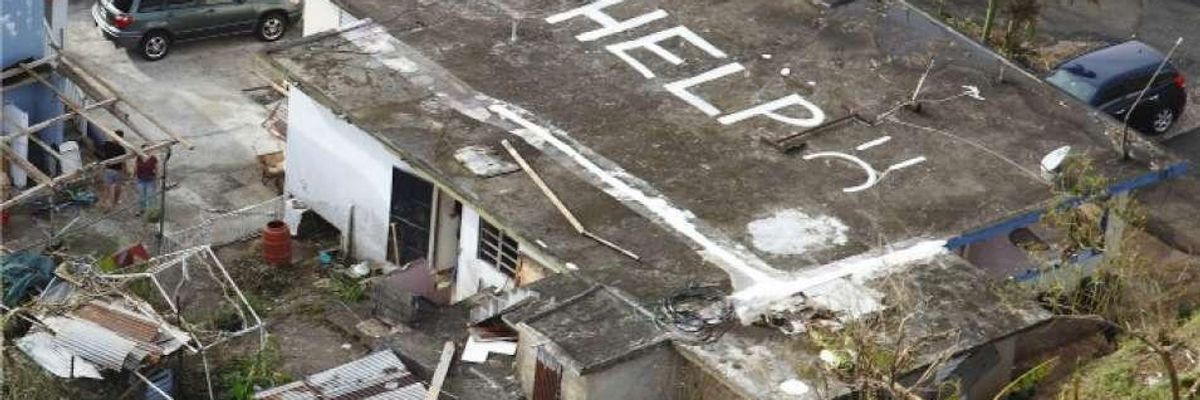
President Donald Trump reportedly wants to cut off federal relief funding to Puerto Rico even though much of the island is still devastated by Hurricane Maria, which hit the isalnd in September of 2017. (Chris Grogan/Air Force Magazine/Flickr)
Although it has been more than a year since Hurricane Maria ravaged Puerto Rico, in parts of the U.S. territory, "it's like the hurricane hit yesterday"--yet President Donald Trump wants to cut off recovery money, according to Axios, "because he claims, without evidence, that the island's government is using federal disaster relief money to pay off debt."
"We remind the Pres the 'help' you say will not come is YOUR RESPONSIBILITY. You are violating our human right by denying us what we need."
--San Juan Mayor Carmen Yulin Cruz
The unfounded claims about federal funds being misappropriated come from Trump's misreading of an October Wall Street Journal article, multiple unnamed sources told Axios' Jonathan Swan.
A day after the Journal report was published, Trump falsely alleged on Twitter that the island's "inept politicians are trying to use the massive and ridiculously high amounts of hurricane/disaster funding" to pay off Puerto Rico's substantial debt.
While "Puerto Rico is expecting billions in disaster recovery aid to help rebuild from last year's Hurricane Maria," as Bloomberg pointed out after the president's tweet, "neither the island's leaders--nor the board installed by the U.S. to oversee its budget--are proposing using disaster recovery aid to directly pay off bondholders or other lenders, who have been squaring off in federal court and stand to recover a portion of their investments once the government emerges from bankruptcy."
Some members of Congress and others, meanwhile, have called for canceling the island's debt as a form of relief, noting that decades of U.S. policy that produced the debt crisis, and the federally-mandated austerity plan crafted in response to it is cruel, particularly after the devastation left by the hurricane.
In addition to Trump's desire to block future funding for recovery from a storm that killed thousands of Americans, sources also revealed to Axios that the president wants "to claw back some of the federal money Congress has already set aside for Puerto Rico's disaster recovery."
Even though Trump can't take back money Congress already has set aside for the commonwealth, he could refuse to sign off on future spending bills, which could notably impact the island's already sluggish and widely criticized recovery process. So far, Federal Emergency Management Agency (FEMA) reports that more than $6 billion has been spent on Hurricane Maria relief, and the agency expects such spending to exceed $55 billion.
In contrast to federal Maria relief, when Hurricane Katrina devastated the Gulf Coast in 2005, "Congress approved $10 billion for the Federal Emergency Management Agency four days later, and another $50 billion six days later," the New York Times reported earlier this year. "The federal government is still spending money on Katrina assistance, more than 12 years after the storm's landfall."
The Axios report elicited immediate outrage from Puerto Ricans and others. San Juan Mayor Carmen Yulin Cruz--a long-time critic of the Trump administration's response to the storm--said in a pair of tweets, "[Trump] has never acknowledged his responsibility in the PR humanitarian crisis; 3000+ died on his watch. We remind the Pres the 'help' you say will not come is YOUR RESPONSIBILITY. You are violating our human right by denying us what we need."
Dear Common Dreams reader, It’s been nearly 30 years since I co-founded Common Dreams with my late wife, Lina Newhouser. We had the radical notion that journalism should serve the public good, not corporate profits. It was clear to us from the outset what it would take to build such a project. No paid advertisements. No corporate sponsors. No millionaire publisher telling us what to think or do. Many people said we wouldn't last a year, but we proved those doubters wrong. Together with a tremendous team of journalists and dedicated staff, we built an independent media outlet free from the constraints of profits and corporate control. Our mission has always been simple: To inform. To inspire. To ignite change for the common good. Building Common Dreams was not easy. Our survival was never guaranteed. When you take on the most powerful forces—Wall Street greed, fossil fuel industry destruction, Big Tech lobbyists, and uber-rich oligarchs who have spent billions upon billions rigging the economy and democracy in their favor—the only bulwark you have is supporters who believe in your work. But here’s the urgent message from me today. It's never been this bad out there. And it's never been this hard to keep us going. At the very moment Common Dreams is most needed, the threats we face are intensifying. We need your support now more than ever. We don't accept corporate advertising and never will. We don't have a paywall because we don't think people should be blocked from critical news based on their ability to pay. Everything we do is funded by the donations of readers like you. When everyone does the little they can afford, we are strong. But if that support retreats or dries up, so do we. Will you donate now to make sure Common Dreams not only survives but thrives? —Craig Brown, Co-founder |
Although it has been more than a year since Hurricane Maria ravaged Puerto Rico, in parts of the U.S. territory, "it's like the hurricane hit yesterday"--yet President Donald Trump wants to cut off recovery money, according to Axios, "because he claims, without evidence, that the island's government is using federal disaster relief money to pay off debt."
"We remind the Pres the 'help' you say will not come is YOUR RESPONSIBILITY. You are violating our human right by denying us what we need."
--San Juan Mayor Carmen Yulin Cruz
The unfounded claims about federal funds being misappropriated come from Trump's misreading of an October Wall Street Journal article, multiple unnamed sources told Axios' Jonathan Swan.
A day after the Journal report was published, Trump falsely alleged on Twitter that the island's "inept politicians are trying to use the massive and ridiculously high amounts of hurricane/disaster funding" to pay off Puerto Rico's substantial debt.
While "Puerto Rico is expecting billions in disaster recovery aid to help rebuild from last year's Hurricane Maria," as Bloomberg pointed out after the president's tweet, "neither the island's leaders--nor the board installed by the U.S. to oversee its budget--are proposing using disaster recovery aid to directly pay off bondholders or other lenders, who have been squaring off in federal court and stand to recover a portion of their investments once the government emerges from bankruptcy."
Some members of Congress and others, meanwhile, have called for canceling the island's debt as a form of relief, noting that decades of U.S. policy that produced the debt crisis, and the federally-mandated austerity plan crafted in response to it is cruel, particularly after the devastation left by the hurricane.
In addition to Trump's desire to block future funding for recovery from a storm that killed thousands of Americans, sources also revealed to Axios that the president wants "to claw back some of the federal money Congress has already set aside for Puerto Rico's disaster recovery."
Even though Trump can't take back money Congress already has set aside for the commonwealth, he could refuse to sign off on future spending bills, which could notably impact the island's already sluggish and widely criticized recovery process. So far, Federal Emergency Management Agency (FEMA) reports that more than $6 billion has been spent on Hurricane Maria relief, and the agency expects such spending to exceed $55 billion.
In contrast to federal Maria relief, when Hurricane Katrina devastated the Gulf Coast in 2005, "Congress approved $10 billion for the Federal Emergency Management Agency four days later, and another $50 billion six days later," the New York Times reported earlier this year. "The federal government is still spending money on Katrina assistance, more than 12 years after the storm's landfall."
The Axios report elicited immediate outrage from Puerto Ricans and others. San Juan Mayor Carmen Yulin Cruz--a long-time critic of the Trump administration's response to the storm--said in a pair of tweets, "[Trump] has never acknowledged his responsibility in the PR humanitarian crisis; 3000+ died on his watch. We remind the Pres the 'help' you say will not come is YOUR RESPONSIBILITY. You are violating our human right by denying us what we need."
Although it has been more than a year since Hurricane Maria ravaged Puerto Rico, in parts of the U.S. territory, "it's like the hurricane hit yesterday"--yet President Donald Trump wants to cut off recovery money, according to Axios, "because he claims, without evidence, that the island's government is using federal disaster relief money to pay off debt."
"We remind the Pres the 'help' you say will not come is YOUR RESPONSIBILITY. You are violating our human right by denying us what we need."
--San Juan Mayor Carmen Yulin Cruz
The unfounded claims about federal funds being misappropriated come from Trump's misreading of an October Wall Street Journal article, multiple unnamed sources told Axios' Jonathan Swan.
A day after the Journal report was published, Trump falsely alleged on Twitter that the island's "inept politicians are trying to use the massive and ridiculously high amounts of hurricane/disaster funding" to pay off Puerto Rico's substantial debt.
While "Puerto Rico is expecting billions in disaster recovery aid to help rebuild from last year's Hurricane Maria," as Bloomberg pointed out after the president's tweet, "neither the island's leaders--nor the board installed by the U.S. to oversee its budget--are proposing using disaster recovery aid to directly pay off bondholders or other lenders, who have been squaring off in federal court and stand to recover a portion of their investments once the government emerges from bankruptcy."
Some members of Congress and others, meanwhile, have called for canceling the island's debt as a form of relief, noting that decades of U.S. policy that produced the debt crisis, and the federally-mandated austerity plan crafted in response to it is cruel, particularly after the devastation left by the hurricane.
In addition to Trump's desire to block future funding for recovery from a storm that killed thousands of Americans, sources also revealed to Axios that the president wants "to claw back some of the federal money Congress has already set aside for Puerto Rico's disaster recovery."
Even though Trump can't take back money Congress already has set aside for the commonwealth, he could refuse to sign off on future spending bills, which could notably impact the island's already sluggish and widely criticized recovery process. So far, Federal Emergency Management Agency (FEMA) reports that more than $6 billion has been spent on Hurricane Maria relief, and the agency expects such spending to exceed $55 billion.
In contrast to federal Maria relief, when Hurricane Katrina devastated the Gulf Coast in 2005, "Congress approved $10 billion for the Federal Emergency Management Agency four days later, and another $50 billion six days later," the New York Times reported earlier this year. "The federal government is still spending money on Katrina assistance, more than 12 years after the storm's landfall."
The Axios report elicited immediate outrage from Puerto Ricans and others. San Juan Mayor Carmen Yulin Cruz--a long-time critic of the Trump administration's response to the storm--said in a pair of tweets, "[Trump] has never acknowledged his responsibility in the PR humanitarian crisis; 3000+ died on his watch. We remind the Pres the 'help' you say will not come is YOUR RESPONSIBILITY. You are violating our human right by denying us what we need."