SUBSCRIBE TO OUR FREE NEWSLETTER
Daily news & progressive opinion—funded by the people, not the corporations—delivered straight to your inbox.
5
#000000
#FFFFFF
To donate by check, phone, or other method, see our More Ways to Give page.
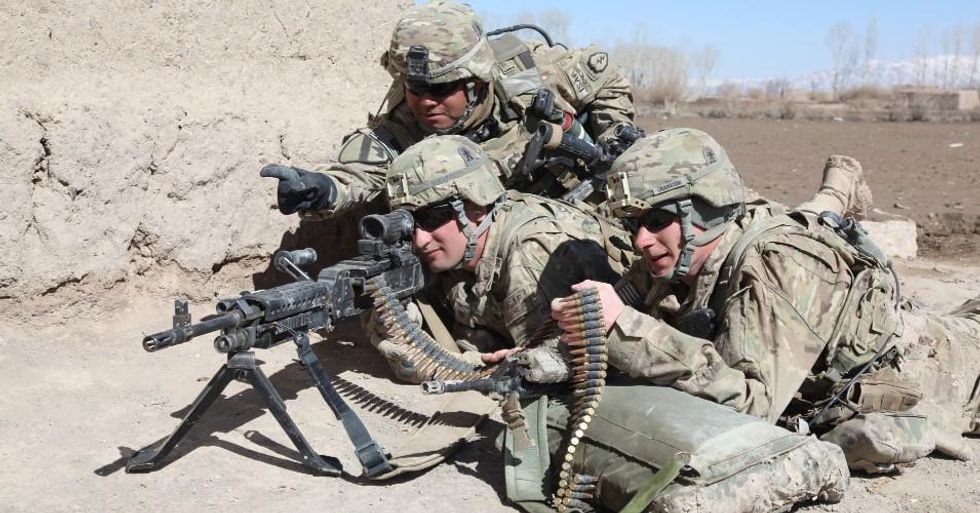
The United States' so-called War on Terror has killed about half a million people in Iraq, Afghanistan, and Pakistan, according to a new estimate from the Costs of War Project at Brown University's Watson Institute.
"This update just scratches the surface of the human consequences of 17 years of war."
--Neta C. Crawford, The Costs of War Project
"This new body count signals that, far from diminishing, the war is only intensifying," Stephanie Savell, co-director of the project, pointed out in a piece for Axios. The overall death toll "is an increase of 113,000 over the last count, issued just two years ago."
The new report (pdf) estimates that since 2001, between 480,000 and 507,000 people have been killed because of war violence in those three nations--a tally that does not include "the more than 500,000 deaths from the war in Syria, raging since 2011, which the U.S. joined in August 2014," and "indirect deaths," or those killed by war's impact on public health, such as limiting access to food, water, hospitals, and electricity.
The "direct deaths" accounted for in the estimate include U.S. military, contractors, and Defense Department employees; national military and police as well as other allied troops; opposition fighters; civilians; journalists; and aid workers. About half of those killed were civilians--between 244,000 and 266,000 across Iraq, Afghanistan, and Pakistan. Up to 204,000 of them were Iraqis.
While the U.S. government has repeatedly underestimated the costs of waging war, since the project launched in 2011, its team has aimed to provide a full account of the "human, economic, and political costs" of post-9/11 U.S. military action in the Middle East, "and to foster better informed public policies."
This latest report comes on the heels of the U.S. midterm elections in which Democrats took control of the U.S. House of Representatives. Looking forward, Savell suggested that "House Democrats will try to advance a national security strategy emphasizing restraint and accountability for the costs of the War on Terror."
Outlining some expressed goals from a handful of House Democrats, Savell wrote for Axios:
Research shows that governments become more careful when civilian deaths from "collateral damage" are reported on. A wave of Democrats now in control of the House plan to push for just that. Representative Ro Khanna says he wants to hold as many as three days of hearings with Trump's national security team to "justify, for the American people, what our mission is, what the costs are, what the risks are, and why we're there." Representative Adam Smith, poised to become chairman of the House Armed Services Committee, plans to increase oversight of the military, and others led by Representative Barbara Lee hope to end the war in Afghanistan.
Regardless of how Democrats in the House proceed, Neta C. Crawford, a Boston University political science professor who co-directs the Costs of War Project, argued in the report's conclusion that there is a need to keep the public more informed about the consequences of the seemingly endless wars in the Middle East in order to drive demands for improving U.S. foreign policy.
"This update just scratches the surface of the human consequences of 17 years of war," Crawford wrote. "Too often, legislators, NGOs, and the news media that try to track the consequences of the wars are inhibited by governments determined to paint a rosy picture of perfect execution and progress."
"The U.S. has made some effort to increase transparency," she acknowledged, "but there are a number of areas--the number of civilians killed and injured, and the number of U.S. military and veteran suicides, for instance--where greater transparency would lead to greater accountability and could lead to better policy."
Responding to the report's findings, Iranian Foreign Minister Javad Zarif drew attention to the human and financial consequences, tweeting: "Cost to U.S. taxpayers: 7K dead Americans + $5.6 trillion. Cost to MidEast: Unfathomable."
The United States' so-called War on Terror has killed about half a million people in Iraq, Afghanistan, and Pakistan, according to a new estimate from the Costs of War Project at Brown University's Watson Institute.
"This update just scratches the surface of the human consequences of 17 years of war."
--Neta C. Crawford, The Costs of War Project
"This new body count signals that, far from diminishing, the war is only intensifying," Stephanie Savell, co-director of the project, pointed out in a piece for Axios. The overall death toll "is an increase of 113,000 over the last count, issued just two years ago."
The new report (pdf) estimates that since 2001, between 480,000 and 507,000 people have been killed because of war violence in those three nations--a tally that does not include "the more than 500,000 deaths from the war in Syria, raging since 2011, which the U.S. joined in August 2014," and "indirect deaths," or those killed by war's impact on public health, such as limiting access to food, water, hospitals, and electricity.
The "direct deaths" accounted for in the estimate include U.S. military, contractors, and Defense Department employees; national military and police as well as other allied troops; opposition fighters; civilians; journalists; and aid workers. About half of those killed were civilians--between 244,000 and 266,000 across Iraq, Afghanistan, and Pakistan. Up to 204,000 of them were Iraqis.
While the U.S. government has repeatedly underestimated the costs of waging war, since the project launched in 2011, its team has aimed to provide a full account of the "human, economic, and political costs" of post-9/11 U.S. military action in the Middle East, "and to foster better informed public policies."
This latest report comes on the heels of the U.S. midterm elections in which Democrats took control of the U.S. House of Representatives. Looking forward, Savell suggested that "House Democrats will try to advance a national security strategy emphasizing restraint and accountability for the costs of the War on Terror."
Outlining some expressed goals from a handful of House Democrats, Savell wrote for Axios:
Research shows that governments become more careful when civilian deaths from "collateral damage" are reported on. A wave of Democrats now in control of the House plan to push for just that. Representative Ro Khanna says he wants to hold as many as three days of hearings with Trump's national security team to "justify, for the American people, what our mission is, what the costs are, what the risks are, and why we're there." Representative Adam Smith, poised to become chairman of the House Armed Services Committee, plans to increase oversight of the military, and others led by Representative Barbara Lee hope to end the war in Afghanistan.
Regardless of how Democrats in the House proceed, Neta C. Crawford, a Boston University political science professor who co-directs the Costs of War Project, argued in the report's conclusion that there is a need to keep the public more informed about the consequences of the seemingly endless wars in the Middle East in order to drive demands for improving U.S. foreign policy.
"This update just scratches the surface of the human consequences of 17 years of war," Crawford wrote. "Too often, legislators, NGOs, and the news media that try to track the consequences of the wars are inhibited by governments determined to paint a rosy picture of perfect execution and progress."
"The U.S. has made some effort to increase transparency," she acknowledged, "but there are a number of areas--the number of civilians killed and injured, and the number of U.S. military and veteran suicides, for instance--where greater transparency would lead to greater accountability and could lead to better policy."
Responding to the report's findings, Iranian Foreign Minister Javad Zarif drew attention to the human and financial consequences, tweeting: "Cost to U.S. taxpayers: 7K dead Americans + $5.6 trillion. Cost to MidEast: Unfathomable."
The United States' so-called War on Terror has killed about half a million people in Iraq, Afghanistan, and Pakistan, according to a new estimate from the Costs of War Project at Brown University's Watson Institute.
"This update just scratches the surface of the human consequences of 17 years of war."
--Neta C. Crawford, The Costs of War Project
"This new body count signals that, far from diminishing, the war is only intensifying," Stephanie Savell, co-director of the project, pointed out in a piece for Axios. The overall death toll "is an increase of 113,000 over the last count, issued just two years ago."
The new report (pdf) estimates that since 2001, between 480,000 and 507,000 people have been killed because of war violence in those three nations--a tally that does not include "the more than 500,000 deaths from the war in Syria, raging since 2011, which the U.S. joined in August 2014," and "indirect deaths," or those killed by war's impact on public health, such as limiting access to food, water, hospitals, and electricity.
The "direct deaths" accounted for in the estimate include U.S. military, contractors, and Defense Department employees; national military and police as well as other allied troops; opposition fighters; civilians; journalists; and aid workers. About half of those killed were civilians--between 244,000 and 266,000 across Iraq, Afghanistan, and Pakistan. Up to 204,000 of them were Iraqis.
While the U.S. government has repeatedly underestimated the costs of waging war, since the project launched in 2011, its team has aimed to provide a full account of the "human, economic, and political costs" of post-9/11 U.S. military action in the Middle East, "and to foster better informed public policies."
This latest report comes on the heels of the U.S. midterm elections in which Democrats took control of the U.S. House of Representatives. Looking forward, Savell suggested that "House Democrats will try to advance a national security strategy emphasizing restraint and accountability for the costs of the War on Terror."
Outlining some expressed goals from a handful of House Democrats, Savell wrote for Axios:
Research shows that governments become more careful when civilian deaths from "collateral damage" are reported on. A wave of Democrats now in control of the House plan to push for just that. Representative Ro Khanna says he wants to hold as many as three days of hearings with Trump's national security team to "justify, for the American people, what our mission is, what the costs are, what the risks are, and why we're there." Representative Adam Smith, poised to become chairman of the House Armed Services Committee, plans to increase oversight of the military, and others led by Representative Barbara Lee hope to end the war in Afghanistan.
Regardless of how Democrats in the House proceed, Neta C. Crawford, a Boston University political science professor who co-directs the Costs of War Project, argued in the report's conclusion that there is a need to keep the public more informed about the consequences of the seemingly endless wars in the Middle East in order to drive demands for improving U.S. foreign policy.
"This update just scratches the surface of the human consequences of 17 years of war," Crawford wrote. "Too often, legislators, NGOs, and the news media that try to track the consequences of the wars are inhibited by governments determined to paint a rosy picture of perfect execution and progress."
"The U.S. has made some effort to increase transparency," she acknowledged, "but there are a number of areas--the number of civilians killed and injured, and the number of U.S. military and veteran suicides, for instance--where greater transparency would lead to greater accountability and could lead to better policy."
Responding to the report's findings, Iranian Foreign Minister Javad Zarif drew attention to the human and financial consequences, tweeting: "Cost to U.S. taxpayers: 7K dead Americans + $5.6 trillion. Cost to MidEast: Unfathomable."