SUBSCRIBE TO OUR FREE NEWSLETTER
Daily news & progressive opinion—funded by the people, not the corporations—delivered straight to your inbox.
5
#000000
#FFFFFF
To donate by check, phone, or other method, see our More Ways to Give page.
Daily news & progressive opinion—funded by the people, not the corporations—delivered straight to your inbox.
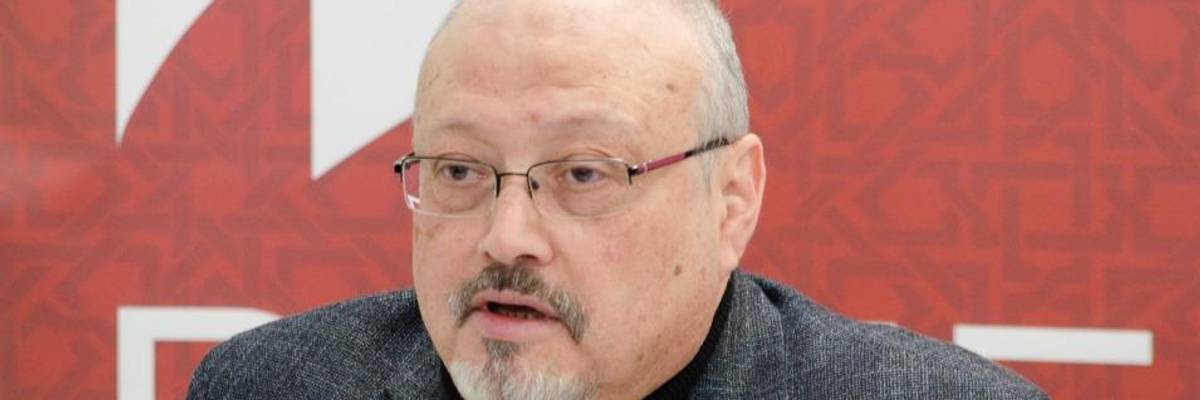
Saudi journalist, Global Opinions columnist for the Washington Post, and former editor-in-chief of Al-Arab News Channel Jamal Khashoggi offers remarks during POMED's "Mohammed bin Salman's Saudi Arabia: A Deeper Look." (Photo: POMED/Flickr/cc)
As a columnist for the Washington Post, Saudi journalist Jamal Khashoggi frequently criticized his home country's government--denouncing the country's treatment of women and most recently, in his final column published Wednesday, calling on Saudi officials to embrace press freedom.
But as critics accuse President Donald Trump of conspiring with the Saudis to cover up Khashoggi's suspected murder, one journalist on Wednesday highlighted an article published in the Independent, weeks after Trump was elected in November of 2016--noting that Khashoggi's criticism of the Saudis wasn't the only thing that led the government to ban his work from appearing in his home country.
While the move was likely fueled by his outspoken criticism of the monarchy and its policies, the journalist was only blacklisted from working in the kingdom after criticizing Trump.
Los Angeles Times columnist Virginia Heffernan posted about her realization late Wednesday after coming across the Independent article.
Soon after, a Saudi government source was quoted by the Middle East Eye as saying, "The author Jamal Khashoggi does not represent the government of Saudi Arabia or its positions at any level, and...his opinions only represent his personal views, not that of the Kingdom of Saudi Arabia."
By early December, Saudi authorities had banned Khashoggi "from writing in newspapers, appearing on TV, and attending conferences" in the kingdom, leading the author to a self-imposed exile.
To several political observers on Twitter, the revelation that the Saudis had so directly come to the defense of Trump gave new meaning to the fact that the president is now attempting to shield Saudi Arabia from the international outrage that's exploded in the 16 days since Khashoggi disappeared after entering the Saudi consulate in Istanbul--especially following reports that U.S. intelligence agencies had known of a Saudi plan to detain Khashoggi.
Mounting evidence has pointed to a murder by a "hit team" with links to MBS, but the Trump administration has criticized those accusing the Saudis of involvement, with Secretary of State Mike Pompeo telling reporters, "We ought to give them a few more days" to complete their own investigation and issuing a reminder that the Saudis "are an important strategic alliance of the U.S. and we need to be mindful of that as well."
Dear Common Dreams reader, It’s been nearly 30 years since I co-founded Common Dreams with my late wife, Lina Newhouser. We had the radical notion that journalism should serve the public good, not corporate profits. It was clear to us from the outset what it would take to build such a project. No paid advertisements. No corporate sponsors. No millionaire publisher telling us what to think or do. Many people said we wouldn't last a year, but we proved those doubters wrong. Together with a tremendous team of journalists and dedicated staff, we built an independent media outlet free from the constraints of profits and corporate control. Our mission has always been simple: To inform. To inspire. To ignite change for the common good. Building Common Dreams was not easy. Our survival was never guaranteed. When you take on the most powerful forces—Wall Street greed, fossil fuel industry destruction, Big Tech lobbyists, and uber-rich oligarchs who have spent billions upon billions rigging the economy and democracy in their favor—the only bulwark you have is supporters who believe in your work. But here’s the urgent message from me today. It's never been this bad out there. And it's never been this hard to keep us going. At the very moment Common Dreams is most needed, the threats we face are intensifying. We need your support now more than ever. We don't accept corporate advertising and never will. We don't have a paywall because we don't think people should be blocked from critical news based on their ability to pay. Everything we do is funded by the donations of readers like you. When everyone does the little they can afford, we are strong. But if that support retreats or dries up, so do we. Will you donate now to make sure Common Dreams not only survives but thrives? —Craig Brown, Co-founder |
As a columnist for the Washington Post, Saudi journalist Jamal Khashoggi frequently criticized his home country's government--denouncing the country's treatment of women and most recently, in his final column published Wednesday, calling on Saudi officials to embrace press freedom.
But as critics accuse President Donald Trump of conspiring with the Saudis to cover up Khashoggi's suspected murder, one journalist on Wednesday highlighted an article published in the Independent, weeks after Trump was elected in November of 2016--noting that Khashoggi's criticism of the Saudis wasn't the only thing that led the government to ban his work from appearing in his home country.
While the move was likely fueled by his outspoken criticism of the monarchy and its policies, the journalist was only blacklisted from working in the kingdom after criticizing Trump.
Los Angeles Times columnist Virginia Heffernan posted about her realization late Wednesday after coming across the Independent article.
Soon after, a Saudi government source was quoted by the Middle East Eye as saying, "The author Jamal Khashoggi does not represent the government of Saudi Arabia or its positions at any level, and...his opinions only represent his personal views, not that of the Kingdom of Saudi Arabia."
By early December, Saudi authorities had banned Khashoggi "from writing in newspapers, appearing on TV, and attending conferences" in the kingdom, leading the author to a self-imposed exile.
To several political observers on Twitter, the revelation that the Saudis had so directly come to the defense of Trump gave new meaning to the fact that the president is now attempting to shield Saudi Arabia from the international outrage that's exploded in the 16 days since Khashoggi disappeared after entering the Saudi consulate in Istanbul--especially following reports that U.S. intelligence agencies had known of a Saudi plan to detain Khashoggi.
Mounting evidence has pointed to a murder by a "hit team" with links to MBS, but the Trump administration has criticized those accusing the Saudis of involvement, with Secretary of State Mike Pompeo telling reporters, "We ought to give them a few more days" to complete their own investigation and issuing a reminder that the Saudis "are an important strategic alliance of the U.S. and we need to be mindful of that as well."
As a columnist for the Washington Post, Saudi journalist Jamal Khashoggi frequently criticized his home country's government--denouncing the country's treatment of women and most recently, in his final column published Wednesday, calling on Saudi officials to embrace press freedom.
But as critics accuse President Donald Trump of conspiring with the Saudis to cover up Khashoggi's suspected murder, one journalist on Wednesday highlighted an article published in the Independent, weeks after Trump was elected in November of 2016--noting that Khashoggi's criticism of the Saudis wasn't the only thing that led the government to ban his work from appearing in his home country.
While the move was likely fueled by his outspoken criticism of the monarchy and its policies, the journalist was only blacklisted from working in the kingdom after criticizing Trump.
Los Angeles Times columnist Virginia Heffernan posted about her realization late Wednesday after coming across the Independent article.
Soon after, a Saudi government source was quoted by the Middle East Eye as saying, "The author Jamal Khashoggi does not represent the government of Saudi Arabia or its positions at any level, and...his opinions only represent his personal views, not that of the Kingdom of Saudi Arabia."
By early December, Saudi authorities had banned Khashoggi "from writing in newspapers, appearing on TV, and attending conferences" in the kingdom, leading the author to a self-imposed exile.
To several political observers on Twitter, the revelation that the Saudis had so directly come to the defense of Trump gave new meaning to the fact that the president is now attempting to shield Saudi Arabia from the international outrage that's exploded in the 16 days since Khashoggi disappeared after entering the Saudi consulate in Istanbul--especially following reports that U.S. intelligence agencies had known of a Saudi plan to detain Khashoggi.
Mounting evidence has pointed to a murder by a "hit team" with links to MBS, but the Trump administration has criticized those accusing the Saudis of involvement, with Secretary of State Mike Pompeo telling reporters, "We ought to give them a few more days" to complete their own investigation and issuing a reminder that the Saudis "are an important strategic alliance of the U.S. and we need to be mindful of that as well."