SUBSCRIBE TO OUR FREE NEWSLETTER
Daily news & progressive opinion—funded by the people, not the corporations—delivered straight to your inbox.
5
#000000
#FFFFFF
To donate by check, phone, or other method, see our More Ways to Give page.
Daily news & progressive opinion—funded by the people, not the corporations—delivered straight to your inbox.
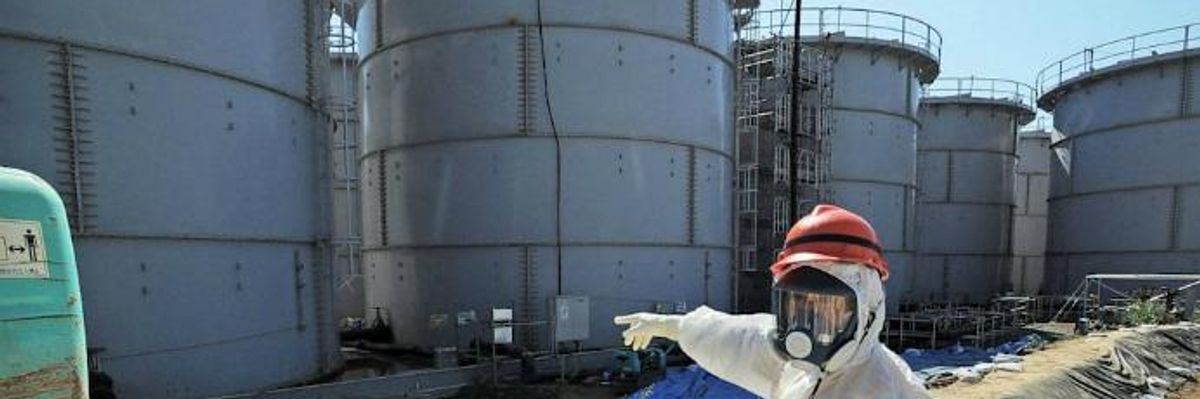
"The government is running out of space to store contaminated water that has come into contact with fuel that escaped from three nuclear reactors after the plant was destroyed in the March 2011 earthquake and tsunami that struck northeast Japan," the Telegraph reported. (Photo: AP)
In a move that has sparked outrage from local residents and dire health warnings from environmentalists, the Japanese government is reportedly planning to release 1.09 million tons of water from the Fukushima Dai-ichi nuclear plant into the Pacific Ocean despite evidence that it contains "radioactive material well above legally permitted levels."
While both the Japanese government and Tokyo Electric Power Co. (Tepco)--the company that runs the Fukushima Dai-ichi plant--have claimed that radioactive material in the water has been reduced to indetectable amounts and that only "safe levels of tritium" remain, documents obtained by the London-based Telegraph suggest that the cleaning system being used to decontaminate the water "has consistently failed to eliminate a cocktail of other radioactive elements, including iodine, ruthenium, rhodium, antimony, tellurium, cobalt, and strontium."
"The government is running out of space to store contaminated water that has come into contact with fuel that escaped from three nuclear reactors after the plant was destroyed in the March 2011 earthquake and tsunami that struck northeast Japan," the Telegraph reported. "Its plan to release the approximately 1.09 million tons of water currently stored in 900 tanks into the Pacific has triggered a fierce backlash from local residents and environmental organizations, as well as groups in South Korea and Taiwan fearful that radioactivity from the second-worst nuclear disaster in history might wash up on their shores."
One document the Telegraph obtained from the government body charged with responding to the 2011 Fukushima disaster reportedly indicates that the Japanese government is perfectly aware that the Advanced Liquid Processing System (ALPS) is failing to eliminate radioactive materials from the water stored at the Fukushima site, despite its claims to the contrary.
Last September, the Telegraph notes, "Tepco was forced to admit that around 80 percent of the water stored at the Fukushima site still contains radioactive substances above legal levels after the Ministry of Economy, Trade, and Industry held public hearings in Tokyo and Fukushima at which local residents and fishermen protested against the plans."
Shaun Burnie, a nuclear specialist with Greenpeace, argued that even so-called "safe" levels of tritium are harmful to humans and marine life.
"Its beta particles inside the human body are more harmful than most X-rays and gamma rays," Burnie told the Telegraph, adding that there "are major uncertainties over the long-term effects posed by radioactive tritium that is absorbed by marine life and, through the food chain, humans."
The Japanese government's reported plans to release the water into the Pacific despite these warnings "cannot be considered an action without risk to the marine environment and human health," Burnie concluded.
Dear Common Dreams reader, It’s been nearly 30 years since I co-founded Common Dreams with my late wife, Lina Newhouser. We had the radical notion that journalism should serve the public good, not corporate profits. It was clear to us from the outset what it would take to build such a project. No paid advertisements. No corporate sponsors. No millionaire publisher telling us what to think or do. Many people said we wouldn't last a year, but we proved those doubters wrong. Together with a tremendous team of journalists and dedicated staff, we built an independent media outlet free from the constraints of profits and corporate control. Our mission has always been simple: To inform. To inspire. To ignite change for the common good. Building Common Dreams was not easy. Our survival was never guaranteed. When you take on the most powerful forces—Wall Street greed, fossil fuel industry destruction, Big Tech lobbyists, and uber-rich oligarchs who have spent billions upon billions rigging the economy and democracy in their favor—the only bulwark you have is supporters who believe in your work. But here’s the urgent message from me today. It's never been this bad out there. And it's never been this hard to keep us going. At the very moment Common Dreams is most needed, the threats we face are intensifying. We need your support now more than ever. We don't accept corporate advertising and never will. We don't have a paywall because we don't think people should be blocked from critical news based on their ability to pay. Everything we do is funded by the donations of readers like you. When everyone does the little they can afford, we are strong. But if that support retreats or dries up, so do we. Will you donate now to make sure Common Dreams not only survives but thrives? —Craig Brown, Co-founder |
In a move that has sparked outrage from local residents and dire health warnings from environmentalists, the Japanese government is reportedly planning to release 1.09 million tons of water from the Fukushima Dai-ichi nuclear plant into the Pacific Ocean despite evidence that it contains "radioactive material well above legally permitted levels."
While both the Japanese government and Tokyo Electric Power Co. (Tepco)--the company that runs the Fukushima Dai-ichi plant--have claimed that radioactive material in the water has been reduced to indetectable amounts and that only "safe levels of tritium" remain, documents obtained by the London-based Telegraph suggest that the cleaning system being used to decontaminate the water "has consistently failed to eliminate a cocktail of other radioactive elements, including iodine, ruthenium, rhodium, antimony, tellurium, cobalt, and strontium."
"The government is running out of space to store contaminated water that has come into contact with fuel that escaped from three nuclear reactors after the plant was destroyed in the March 2011 earthquake and tsunami that struck northeast Japan," the Telegraph reported. "Its plan to release the approximately 1.09 million tons of water currently stored in 900 tanks into the Pacific has triggered a fierce backlash from local residents and environmental organizations, as well as groups in South Korea and Taiwan fearful that radioactivity from the second-worst nuclear disaster in history might wash up on their shores."
One document the Telegraph obtained from the government body charged with responding to the 2011 Fukushima disaster reportedly indicates that the Japanese government is perfectly aware that the Advanced Liquid Processing System (ALPS) is failing to eliminate radioactive materials from the water stored at the Fukushima site, despite its claims to the contrary.
Last September, the Telegraph notes, "Tepco was forced to admit that around 80 percent of the water stored at the Fukushima site still contains radioactive substances above legal levels after the Ministry of Economy, Trade, and Industry held public hearings in Tokyo and Fukushima at which local residents and fishermen protested against the plans."
Shaun Burnie, a nuclear specialist with Greenpeace, argued that even so-called "safe" levels of tritium are harmful to humans and marine life.
"Its beta particles inside the human body are more harmful than most X-rays and gamma rays," Burnie told the Telegraph, adding that there "are major uncertainties over the long-term effects posed by radioactive tritium that is absorbed by marine life and, through the food chain, humans."
The Japanese government's reported plans to release the water into the Pacific despite these warnings "cannot be considered an action without risk to the marine environment and human health," Burnie concluded.
In a move that has sparked outrage from local residents and dire health warnings from environmentalists, the Japanese government is reportedly planning to release 1.09 million tons of water from the Fukushima Dai-ichi nuclear plant into the Pacific Ocean despite evidence that it contains "radioactive material well above legally permitted levels."
While both the Japanese government and Tokyo Electric Power Co. (Tepco)--the company that runs the Fukushima Dai-ichi plant--have claimed that radioactive material in the water has been reduced to indetectable amounts and that only "safe levels of tritium" remain, documents obtained by the London-based Telegraph suggest that the cleaning system being used to decontaminate the water "has consistently failed to eliminate a cocktail of other radioactive elements, including iodine, ruthenium, rhodium, antimony, tellurium, cobalt, and strontium."
"The government is running out of space to store contaminated water that has come into contact with fuel that escaped from three nuclear reactors after the plant was destroyed in the March 2011 earthquake and tsunami that struck northeast Japan," the Telegraph reported. "Its plan to release the approximately 1.09 million tons of water currently stored in 900 tanks into the Pacific has triggered a fierce backlash from local residents and environmental organizations, as well as groups in South Korea and Taiwan fearful that radioactivity from the second-worst nuclear disaster in history might wash up on their shores."
One document the Telegraph obtained from the government body charged with responding to the 2011 Fukushima disaster reportedly indicates that the Japanese government is perfectly aware that the Advanced Liquid Processing System (ALPS) is failing to eliminate radioactive materials from the water stored at the Fukushima site, despite its claims to the contrary.
Last September, the Telegraph notes, "Tepco was forced to admit that around 80 percent of the water stored at the Fukushima site still contains radioactive substances above legal levels after the Ministry of Economy, Trade, and Industry held public hearings in Tokyo and Fukushima at which local residents and fishermen protested against the plans."
Shaun Burnie, a nuclear specialist with Greenpeace, argued that even so-called "safe" levels of tritium are harmful to humans and marine life.
"Its beta particles inside the human body are more harmful than most X-rays and gamma rays," Burnie told the Telegraph, adding that there "are major uncertainties over the long-term effects posed by radioactive tritium that is absorbed by marine life and, through the food chain, humans."
The Japanese government's reported plans to release the water into the Pacific despite these warnings "cannot be considered an action without risk to the marine environment and human health," Burnie concluded.