SUBSCRIBE TO OUR FREE NEWSLETTER
Daily news & progressive opinion—funded by the people, not the corporations—delivered straight to your inbox.
5
#000000
#FFFFFF
To donate by check, phone, or other method, see our More Ways to Give page.


Daily news & progressive opinion—funded by the people, not the corporations—delivered straight to your inbox.

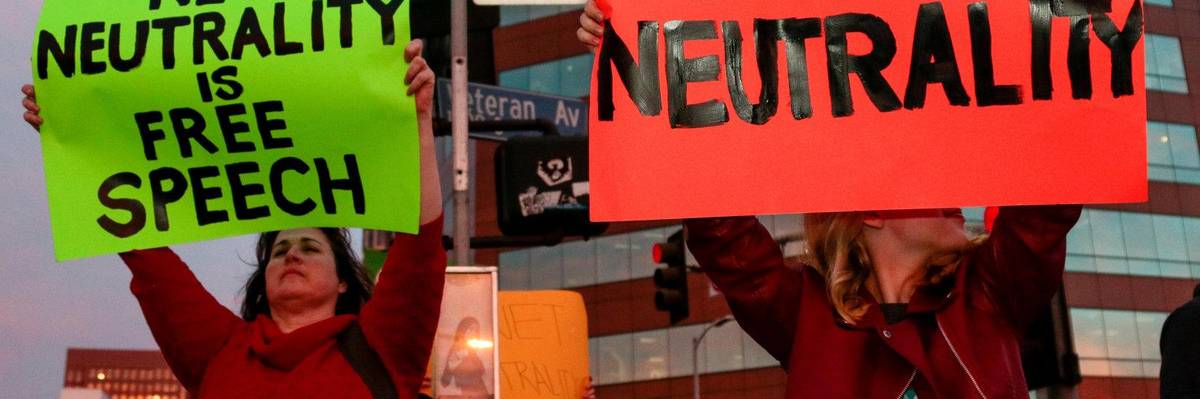
Supporter of Net Neutrality Ginger Gibson (L) of Valley Glen, California, protests the FCC's recent decision to repeal the program in Los Angeles, California, November 28, 2017. (Photo: Kyle Grillot / Reuters)
Denounced as a clear effort to appease the telecom giants who have been the main drivers behind destroying the egalitarian principles that insulate the internet from corporate control, the U.S. Department of Justice didn't even wait until morning to launch a federal lawsuit against the state of California after Gov. Jerry Brown on Sunday evening signed into a far-reaching net neutrality bill.
In a late-night statement supporting the DOJ lawsuit, Republican FCC Chairman Ajit Pai claimed the state-level effort was "illegal" and said the GOP-controlled commission under his command would assist in the court challenge.
While calling the bill signed into law "a significant milestone in the effort to restore essential communications rights for everyone in America," Matt Wood, from the Free Press Action Fund, said the move by Attorney General Jeff Sessions--and backed by Pai--makes clear the Republican Party's ongoing intentions to make sure companies like Verizon and Comcast get what they want.
"The Trump administration's decision to sue the state of California just for stepping in to fill the void created when Ajit Pai wrongly took away these congressionally granted rights is unfortunate and hypocritical in the extreme," Woods stated. "As the preemption suit moves forward, cable and phone lobbyists will wail about how they can't comply with a patchwork of different state laws prohibiting broadband providers from unreasonably discriminating against internet users' basic rights. This complaint is completely absurd given that the same lawyers and lobbyists from AT&T and Comcast were the chief culprits in destroying the blanket federal protections on the books."
Offering an opposing view from within the FCC, Democratic commissioner Jessica Rosenworcel countered Pai's support for the lawsuit by applauding California for its effort.
"A hefty thank you to the Golden State for your effort to get right what the FCC got wrong when it wiped out our open internet protections late last year," Rosenworcel said in a statement on Monday. "The FCC's misguided decision to roll back net neutrality gave broadband providers the green light to block websites, throttle services, and censor online content. That's why the California law is a welcome development--it's good for consumers, good for businesses, and good for anyone who connects and creates online."
While Trump's DOJ had chosen the courts as the next avenue to undermine online protections, Rosenworcel said the "regrettable" decision only "confirms that Washington is not listening to the American people."
Dear Common Dreams reader, It’s been nearly 30 years since I co-founded Common Dreams with my late wife, Lina Newhouser. We had the radical notion that journalism should serve the public good, not corporate profits. It was clear to us from the outset what it would take to build such a project. No paid advertisements. No corporate sponsors. No millionaire publisher telling us what to think or do. Many people said we wouldn't last a year, but we proved those doubters wrong. Together with a tremendous team of journalists and dedicated staff, we built an independent media outlet free from the constraints of profits and corporate control. Our mission has always been simple: To inform. To inspire. To ignite change for the common good. Building Common Dreams was not easy. Our survival was never guaranteed. When you take on the most powerful forces—Wall Street greed, fossil fuel industry destruction, Big Tech lobbyists, and uber-rich oligarchs who have spent billions upon billions rigging the economy and democracy in their favor—the only bulwark you have is supporters who believe in your work. But here’s the urgent message from me today. It's never been this bad out there. And it's never been this hard to keep us going. At the very moment Common Dreams is most needed, the threats we face are intensifying. We need your support now more than ever. We don't accept corporate advertising and never will. We don't have a paywall because we don't think people should be blocked from critical news based on their ability to pay. Everything we do is funded by the donations of readers like you. When everyone does the little they can afford, we are strong. But if that support retreats or dries up, so do we. Will you donate now to make sure Common Dreams not only survives but thrives? —Craig Brown, Co-founder |
Denounced as a clear effort to appease the telecom giants who have been the main drivers behind destroying the egalitarian principles that insulate the internet from corporate control, the U.S. Department of Justice didn't even wait until morning to launch a federal lawsuit against the state of California after Gov. Jerry Brown on Sunday evening signed into a far-reaching net neutrality bill.
In a late-night statement supporting the DOJ lawsuit, Republican FCC Chairman Ajit Pai claimed the state-level effort was "illegal" and said the GOP-controlled commission under his command would assist in the court challenge.
While calling the bill signed into law "a significant milestone in the effort to restore essential communications rights for everyone in America," Matt Wood, from the Free Press Action Fund, said the move by Attorney General Jeff Sessions--and backed by Pai--makes clear the Republican Party's ongoing intentions to make sure companies like Verizon and Comcast get what they want.
"The Trump administration's decision to sue the state of California just for stepping in to fill the void created when Ajit Pai wrongly took away these congressionally granted rights is unfortunate and hypocritical in the extreme," Woods stated. "As the preemption suit moves forward, cable and phone lobbyists will wail about how they can't comply with a patchwork of different state laws prohibiting broadband providers from unreasonably discriminating against internet users' basic rights. This complaint is completely absurd given that the same lawyers and lobbyists from AT&T and Comcast were the chief culprits in destroying the blanket federal protections on the books."
Offering an opposing view from within the FCC, Democratic commissioner Jessica Rosenworcel countered Pai's support for the lawsuit by applauding California for its effort.
"A hefty thank you to the Golden State for your effort to get right what the FCC got wrong when it wiped out our open internet protections late last year," Rosenworcel said in a statement on Monday. "The FCC's misguided decision to roll back net neutrality gave broadband providers the green light to block websites, throttle services, and censor online content. That's why the California law is a welcome development--it's good for consumers, good for businesses, and good for anyone who connects and creates online."
While Trump's DOJ had chosen the courts as the next avenue to undermine online protections, Rosenworcel said the "regrettable" decision only "confirms that Washington is not listening to the American people."

Denounced as a clear effort to appease the telecom giants who have been the main drivers behind destroying the egalitarian principles that insulate the internet from corporate control, the U.S. Department of Justice didn't even wait until morning to launch a federal lawsuit against the state of California after Gov. Jerry Brown on Sunday evening signed into a far-reaching net neutrality bill.
In a late-night statement supporting the DOJ lawsuit, Republican FCC Chairman Ajit Pai claimed the state-level effort was "illegal" and said the GOP-controlled commission under his command would assist in the court challenge.
While calling the bill signed into law "a significant milestone in the effort to restore essential communications rights for everyone in America," Matt Wood, from the Free Press Action Fund, said the move by Attorney General Jeff Sessions--and backed by Pai--makes clear the Republican Party's ongoing intentions to make sure companies like Verizon and Comcast get what they want.
"The Trump administration's decision to sue the state of California just for stepping in to fill the void created when Ajit Pai wrongly took away these congressionally granted rights is unfortunate and hypocritical in the extreme," Woods stated. "As the preemption suit moves forward, cable and phone lobbyists will wail about how they can't comply with a patchwork of different state laws prohibiting broadband providers from unreasonably discriminating against internet users' basic rights. This complaint is completely absurd given that the same lawyers and lobbyists from AT&T and Comcast were the chief culprits in destroying the blanket federal protections on the books."
Offering an opposing view from within the FCC, Democratic commissioner Jessica Rosenworcel countered Pai's support for the lawsuit by applauding California for its effort.
"A hefty thank you to the Golden State for your effort to get right what the FCC got wrong when it wiped out our open internet protections late last year," Rosenworcel said in a statement on Monday. "The FCC's misguided decision to roll back net neutrality gave broadband providers the green light to block websites, throttle services, and censor online content. That's why the California law is a welcome development--it's good for consumers, good for businesses, and good for anyone who connects and creates online."
While Trump's DOJ had chosen the courts as the next avenue to undermine online protections, Rosenworcel said the "regrettable" decision only "confirms that Washington is not listening to the American people."