SUBSCRIBE TO OUR FREE NEWSLETTER
Daily news & progressive opinion—funded by the people, not the corporations—delivered straight to your inbox.
5
#000000
#FFFFFF
To donate by check, phone, or other method, see our More Ways to Give page.
Daily news & progressive opinion—funded by the people, not the corporations—delivered straight to your inbox.
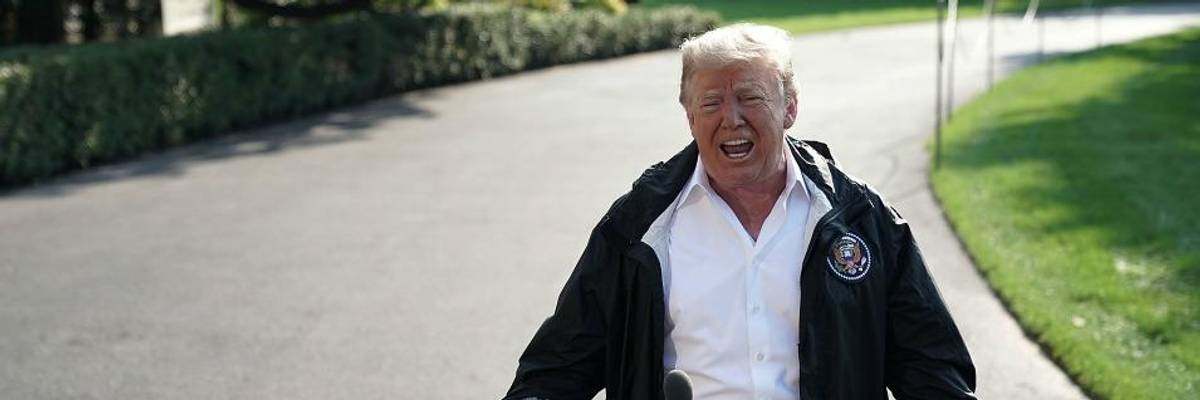
U.S. President Donald Trump speaks to members of the media prior to a Marine One departure at the South Lawn of the White House September 19, 2018 in Washington, DC. On the accusation levied against Supreme Court nominee Brett Kavanaugh by professor Chritine Blasey Ford, Trump said it's "very hard for me to imagine anything happened." (Photo: Alex Wong/Getty Images)
While the #MeToo movement has dramatically shifted the national dialogue on sexual harassment and assault in recent months, President Donald Trump once again proved impervious to such evolution on Wednesday when he stated he has a "very hard to imaginining that anything happened" after being asked by a reporter about the accusations levied by professor Christine Blasey Ford against Supreme Court nominee Brett Kavanaugh.
While women's rights advocates say it is well past time that credible allegations be taken seriously and that women who come forward be believed and treated with dignity, Trump on Tuesday placed his sympathies not with Ford, the accuser, but with Kavanaugh, the accused, when he said that he felt "so badly" for his nominee but expressed no such sympathy for the woman who says that during the attack--which she says took place at a high school party--she feared that Kavanaugh "might inadvertently kill me" when he put his hand over her mouth and smothered her when she began screaming.
Trump, who more than a dozen women have accused of sexually harassing or assaulting them, has a history of denigrating the #MeToo movement and discounting those who have accused men, including himself, of unwanted sexual advances or worse.
Dear Common Dreams reader, It’s been nearly 30 years since I co-founded Common Dreams with my late wife, Lina Newhouser. We had the radical notion that journalism should serve the public good, not corporate profits. It was clear to us from the outset what it would take to build such a project. No paid advertisements. No corporate sponsors. No millionaire publisher telling us what to think or do. Many people said we wouldn't last a year, but we proved those doubters wrong. Together with a tremendous team of journalists and dedicated staff, we built an independent media outlet free from the constraints of profits and corporate control. Our mission has always been simple: To inform. To inspire. To ignite change for the common good. Building Common Dreams was not easy. Our survival was never guaranteed. When you take on the most powerful forces—Wall Street greed, fossil fuel industry destruction, Big Tech lobbyists, and uber-rich oligarchs who have spent billions upon billions rigging the economy and democracy in their favor—the only bulwark you have is supporters who believe in your work. But here’s the urgent message from me today. It's never been this bad out there. And it's never been this hard to keep us going. At the very moment Common Dreams is most needed, the threats we face are intensifying. We need your support now more than ever. We don't accept corporate advertising and never will. We don't have a paywall because we don't think people should be blocked from critical news based on their ability to pay. Everything we do is funded by the donations of readers like you. When everyone does the little they can afford, we are strong. But if that support retreats or dries up, so do we. Will you donate now to make sure Common Dreams not only survives but thrives? —Craig Brown, Co-founder |
While the #MeToo movement has dramatically shifted the national dialogue on sexual harassment and assault in recent months, President Donald Trump once again proved impervious to such evolution on Wednesday when he stated he has a "very hard to imaginining that anything happened" after being asked by a reporter about the accusations levied by professor Christine Blasey Ford against Supreme Court nominee Brett Kavanaugh.
While women's rights advocates say it is well past time that credible allegations be taken seriously and that women who come forward be believed and treated with dignity, Trump on Tuesday placed his sympathies not with Ford, the accuser, but with Kavanaugh, the accused, when he said that he felt "so badly" for his nominee but expressed no such sympathy for the woman who says that during the attack--which she says took place at a high school party--she feared that Kavanaugh "might inadvertently kill me" when he put his hand over her mouth and smothered her when she began screaming.
Trump, who more than a dozen women have accused of sexually harassing or assaulting them, has a history of denigrating the #MeToo movement and discounting those who have accused men, including himself, of unwanted sexual advances or worse.
While the #MeToo movement has dramatically shifted the national dialogue on sexual harassment and assault in recent months, President Donald Trump once again proved impervious to such evolution on Wednesday when he stated he has a "very hard to imaginining that anything happened" after being asked by a reporter about the accusations levied by professor Christine Blasey Ford against Supreme Court nominee Brett Kavanaugh.
While women's rights advocates say it is well past time that credible allegations be taken seriously and that women who come forward be believed and treated with dignity, Trump on Tuesday placed his sympathies not with Ford, the accuser, but with Kavanaugh, the accused, when he said that he felt "so badly" for his nominee but expressed no such sympathy for the woman who says that during the attack--which she says took place at a high school party--she feared that Kavanaugh "might inadvertently kill me" when he put his hand over her mouth and smothered her when she began screaming.
Trump, who more than a dozen women have accused of sexually harassing or assaulting them, has a history of denigrating the #MeToo movement and discounting those who have accused men, including himself, of unwanted sexual advances or worse.