

SUBSCRIBE TO OUR FREE NEWSLETTER
Daily news & progressive opinion—funded by the people, not the corporations—delivered straight to your inbox.
5
#000000
#FFFFFF
To donate by check, phone, or other method, see our More Ways to Give page.
Daily news & progressive opinion—funded by the people, not the corporations—delivered straight to your inbox.
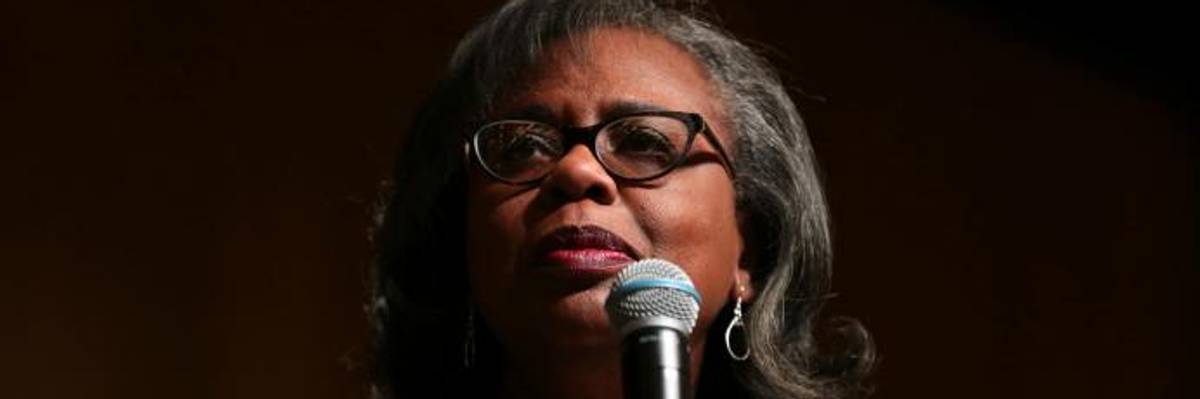
Anita Hill spoke with attendees at the John P. Frank Memorial Lecture at the Student Pavilion at Arizona State University in Tempe, Arizona in February of 2018. (Photo: Gage Skidmore/Flickr/cc)
Nearly three decades after her own brave testimony before the Senate Judiciary Committee during the confirmation hearings for U.S. Supreme Court nominee Clarence Thomas in 1991, Anita Hill on Tuesday spoke out about the allegations of sexual assault against Brett Kavanaugh and urged lawmakers not to repeat the mistakes that were made back then.
Hill, in a New York Times op-ed, joined Democratic lawmakers and advocacy groups calling for "a thorough and transparent investigation" into Dr. Christine Blasey Ford's claim that Kavanaugh tried to rape her when they were teenagers. Hill suggested the probe should be "guided by experts who have devoted their careers to understanding sexual violence."
When Hill famously testified that Thomas--now a justice on the high court--sexually harassed her, "the Senate Judiciary Committee had an opportunity to demonstrate its appreciation for both the seriousness of sexual harassment claims and the need for public confidence in the character of a nominee to the Supreme Court," she wrote. "It failed on both counts."
That the committee "still lacks a protocol for vetting sexual harassment and assault claims that surface during a confirmation hearing suggests that the committee has learned little from the Thomas hearing," she concluded, "much less the more recent #MeToo movement."
Although Hill said it is "discouraging" that committee Chairman Chuck Grassley (R-Iowa) has scheduled a hearing for Monday--because "a week's preparation is not enough time for meaningful inquiry into very serious charges"--she still offered some "basic ground rules" for the senators to follow:
Hill's guidance comes amid mounting calls for Kavanaugh, who has denied Ford's allegations, to withdraw from consideration. As of Monday afternoon, more than 800 survivors of domestic violence and sexual assault had signed an open letter circulated by the women's advocacy group UltraViolet urging senators to publicly oppose President Donald Trump's nominee.
"We will not sit by and let Republicans use this hearing to attack, undermine and shame Ford," declared UltraViolet executive director Shaunna Thomas. "The Senate must recognize that investigations and public hearings are systemically stacked against survivors of sexual assault--in this case, shifting the burden from Kavanaugh, who has already lied to the Senate, to Ford, who has no reason to lie."
However, as Kavanaugh--who already was deeply unpopular before Ford's allegations were made public--hasn't given any indication that he will stop seeking a lifetime appointment to the nation's highest court, other advocacy groups and Democratic lawmakers are calling for a delay of any confirmation vote until the FBI can fully investigate Ford's claims.
Meanwhile, key members the Trump administration, including the president himself, continue to defend Kavanaugh. The Justice Department, for its part, argued in a statement late Monday that it is the FBI's responsibility to evaluate any threat Kavanaugh may pose to national security, but that Ford's claim "does not involve any potential federal crime" for the FBI to investigate.
In an interview with CBS on Tuesday morning, Sen. Kamala Harris (D-Calif.), who is on the committee, said she believes Ford is telling the truth, and emphasized that "the American public deserves to know the character of someone who will serve for his entire life on the highest court in our country."
Harris asserted that agents in the FBI "are really well equipped to do this kind of investigation, but they're not being given the authority to do it" by the Justice Department or the Trump White House.
While Sen. Dianne Feinstein (D-Calif.), the top Democrat on the committee, has been criticized for how she's handled the allegations, she also expressed disappointment in Republicans and the Trump administration for "failing to take even the most basic steps to investigate this matter."
Calling for the FBI "to reopen and complete the background investigation," Feinstein drew comparisons to the hearings that were held after Hill's allegations against Thomas surfaced in 1991. "Now, just one week after Christine Blasey Ford shared her story, Republicans want to repeat past mistakes," Feinstein charged, "rushing the process to hold a hearing."
In a blog post on Monday, Lenora M. Lapidus, director of the ACLU's Women's Rights Project, echoed Hill's argument by encouraging members of the Senate Judiciary Committee to make sure they "get it right this time around" by not repeating the mistakes of the past.
"Dr. Ford may have been forced into the limelight against her will, just as Anita Hill was, but the treatment she receives should be different," wrote Lapidus. "She must be questioned fairly, not belittled or dismissed."
Ultimately, she concluded, "a fair process in which both sides are fully heard is in everyone's interest--including, most importantly, the country's, given the stakes."
Dear Common Dreams reader, It’s been nearly 30 years since I co-founded Common Dreams with my late wife, Lina Newhouser. We had the radical notion that journalism should serve the public good, not corporate profits. It was clear to us from the outset what it would take to build such a project. No paid advertisements. No corporate sponsors. No millionaire publisher telling us what to think or do. Many people said we wouldn't last a year, but we proved those doubters wrong. Together with a tremendous team of journalists and dedicated staff, we built an independent media outlet free from the constraints of profits and corporate control. Our mission has always been simple: To inform. To inspire. To ignite change for the common good. Building Common Dreams was not easy. Our survival was never guaranteed. When you take on the most powerful forces—Wall Street greed, fossil fuel industry destruction, Big Tech lobbyists, and uber-rich oligarchs who have spent billions upon billions rigging the economy and democracy in their favor—the only bulwark you have is supporters who believe in your work. But here’s the urgent message from me today. It's never been this bad out there. And it's never been this hard to keep us going. At the very moment Common Dreams is most needed, the threats we face are intensifying. We need your support now more than ever. We don't accept corporate advertising and never will. We don't have a paywall because we don't think people should be blocked from critical news based on their ability to pay. Everything we do is funded by the donations of readers like you. When everyone does the little they can afford, we are strong. But if that support retreats or dries up, so do we. Will you donate now to make sure Common Dreams not only survives but thrives? —Craig Brown, Co-founder |
Nearly three decades after her own brave testimony before the Senate Judiciary Committee during the confirmation hearings for U.S. Supreme Court nominee Clarence Thomas in 1991, Anita Hill on Tuesday spoke out about the allegations of sexual assault against Brett Kavanaugh and urged lawmakers not to repeat the mistakes that were made back then.
Hill, in a New York Times op-ed, joined Democratic lawmakers and advocacy groups calling for "a thorough and transparent investigation" into Dr. Christine Blasey Ford's claim that Kavanaugh tried to rape her when they were teenagers. Hill suggested the probe should be "guided by experts who have devoted their careers to understanding sexual violence."
When Hill famously testified that Thomas--now a justice on the high court--sexually harassed her, "the Senate Judiciary Committee had an opportunity to demonstrate its appreciation for both the seriousness of sexual harassment claims and the need for public confidence in the character of a nominee to the Supreme Court," she wrote. "It failed on both counts."
That the committee "still lacks a protocol for vetting sexual harassment and assault claims that surface during a confirmation hearing suggests that the committee has learned little from the Thomas hearing," she concluded, "much less the more recent #MeToo movement."
Although Hill said it is "discouraging" that committee Chairman Chuck Grassley (R-Iowa) has scheduled a hearing for Monday--because "a week's preparation is not enough time for meaningful inquiry into very serious charges"--she still offered some "basic ground rules" for the senators to follow:
Hill's guidance comes amid mounting calls for Kavanaugh, who has denied Ford's allegations, to withdraw from consideration. As of Monday afternoon, more than 800 survivors of domestic violence and sexual assault had signed an open letter circulated by the women's advocacy group UltraViolet urging senators to publicly oppose President Donald Trump's nominee.
"We will not sit by and let Republicans use this hearing to attack, undermine and shame Ford," declared UltraViolet executive director Shaunna Thomas. "The Senate must recognize that investigations and public hearings are systemically stacked against survivors of sexual assault--in this case, shifting the burden from Kavanaugh, who has already lied to the Senate, to Ford, who has no reason to lie."
However, as Kavanaugh--who already was deeply unpopular before Ford's allegations were made public--hasn't given any indication that he will stop seeking a lifetime appointment to the nation's highest court, other advocacy groups and Democratic lawmakers are calling for a delay of any confirmation vote until the FBI can fully investigate Ford's claims.
Meanwhile, key members the Trump administration, including the president himself, continue to defend Kavanaugh. The Justice Department, for its part, argued in a statement late Monday that it is the FBI's responsibility to evaluate any threat Kavanaugh may pose to national security, but that Ford's claim "does not involve any potential federal crime" for the FBI to investigate.
In an interview with CBS on Tuesday morning, Sen. Kamala Harris (D-Calif.), who is on the committee, said she believes Ford is telling the truth, and emphasized that "the American public deserves to know the character of someone who will serve for his entire life on the highest court in our country."
Harris asserted that agents in the FBI "are really well equipped to do this kind of investigation, but they're not being given the authority to do it" by the Justice Department or the Trump White House.
While Sen. Dianne Feinstein (D-Calif.), the top Democrat on the committee, has been criticized for how she's handled the allegations, she also expressed disappointment in Republicans and the Trump administration for "failing to take even the most basic steps to investigate this matter."
Calling for the FBI "to reopen and complete the background investigation," Feinstein drew comparisons to the hearings that were held after Hill's allegations against Thomas surfaced in 1991. "Now, just one week after Christine Blasey Ford shared her story, Republicans want to repeat past mistakes," Feinstein charged, "rushing the process to hold a hearing."
In a blog post on Monday, Lenora M. Lapidus, director of the ACLU's Women's Rights Project, echoed Hill's argument by encouraging members of the Senate Judiciary Committee to make sure they "get it right this time around" by not repeating the mistakes of the past.
"Dr. Ford may have been forced into the limelight against her will, just as Anita Hill was, but the treatment she receives should be different," wrote Lapidus. "She must be questioned fairly, not belittled or dismissed."
Ultimately, she concluded, "a fair process in which both sides are fully heard is in everyone's interest--including, most importantly, the country's, given the stakes."
Nearly three decades after her own brave testimony before the Senate Judiciary Committee during the confirmation hearings for U.S. Supreme Court nominee Clarence Thomas in 1991, Anita Hill on Tuesday spoke out about the allegations of sexual assault against Brett Kavanaugh and urged lawmakers not to repeat the mistakes that were made back then.
Hill, in a New York Times op-ed, joined Democratic lawmakers and advocacy groups calling for "a thorough and transparent investigation" into Dr. Christine Blasey Ford's claim that Kavanaugh tried to rape her when they were teenagers. Hill suggested the probe should be "guided by experts who have devoted their careers to understanding sexual violence."
When Hill famously testified that Thomas--now a justice on the high court--sexually harassed her, "the Senate Judiciary Committee had an opportunity to demonstrate its appreciation for both the seriousness of sexual harassment claims and the need for public confidence in the character of a nominee to the Supreme Court," she wrote. "It failed on both counts."
That the committee "still lacks a protocol for vetting sexual harassment and assault claims that surface during a confirmation hearing suggests that the committee has learned little from the Thomas hearing," she concluded, "much less the more recent #MeToo movement."
Although Hill said it is "discouraging" that committee Chairman Chuck Grassley (R-Iowa) has scheduled a hearing for Monday--because "a week's preparation is not enough time for meaningful inquiry into very serious charges"--she still offered some "basic ground rules" for the senators to follow:
Hill's guidance comes amid mounting calls for Kavanaugh, who has denied Ford's allegations, to withdraw from consideration. As of Monday afternoon, more than 800 survivors of domestic violence and sexual assault had signed an open letter circulated by the women's advocacy group UltraViolet urging senators to publicly oppose President Donald Trump's nominee.
"We will not sit by and let Republicans use this hearing to attack, undermine and shame Ford," declared UltraViolet executive director Shaunna Thomas. "The Senate must recognize that investigations and public hearings are systemically stacked against survivors of sexual assault--in this case, shifting the burden from Kavanaugh, who has already lied to the Senate, to Ford, who has no reason to lie."
However, as Kavanaugh--who already was deeply unpopular before Ford's allegations were made public--hasn't given any indication that he will stop seeking a lifetime appointment to the nation's highest court, other advocacy groups and Democratic lawmakers are calling for a delay of any confirmation vote until the FBI can fully investigate Ford's claims.
Meanwhile, key members the Trump administration, including the president himself, continue to defend Kavanaugh. The Justice Department, for its part, argued in a statement late Monday that it is the FBI's responsibility to evaluate any threat Kavanaugh may pose to national security, but that Ford's claim "does not involve any potential federal crime" for the FBI to investigate.
In an interview with CBS on Tuesday morning, Sen. Kamala Harris (D-Calif.), who is on the committee, said she believes Ford is telling the truth, and emphasized that "the American public deserves to know the character of someone who will serve for his entire life on the highest court in our country."
Harris asserted that agents in the FBI "are really well equipped to do this kind of investigation, but they're not being given the authority to do it" by the Justice Department or the Trump White House.
While Sen. Dianne Feinstein (D-Calif.), the top Democrat on the committee, has been criticized for how she's handled the allegations, she also expressed disappointment in Republicans and the Trump administration for "failing to take even the most basic steps to investigate this matter."
Calling for the FBI "to reopen and complete the background investigation," Feinstein drew comparisons to the hearings that were held after Hill's allegations against Thomas surfaced in 1991. "Now, just one week after Christine Blasey Ford shared her story, Republicans want to repeat past mistakes," Feinstein charged, "rushing the process to hold a hearing."
In a blog post on Monday, Lenora M. Lapidus, director of the ACLU's Women's Rights Project, echoed Hill's argument by encouraging members of the Senate Judiciary Committee to make sure they "get it right this time around" by not repeating the mistakes of the past.
"Dr. Ford may have been forced into the limelight against her will, just as Anita Hill was, but the treatment she receives should be different," wrote Lapidus. "She must be questioned fairly, not belittled or dismissed."
Ultimately, she concluded, "a fair process in which both sides are fully heard is in everyone's interest--including, most importantly, the country's, given the stakes."

