SUBSCRIBE TO OUR FREE NEWSLETTER
Daily news & progressive opinion—funded by the people, not the corporations—delivered straight to your inbox.
5
#000000
#FFFFFF
To donate by check, phone, or other method, see our More Ways to Give page.
Daily news & progressive opinion—funded by the people, not the corporations—delivered straight to your inbox.
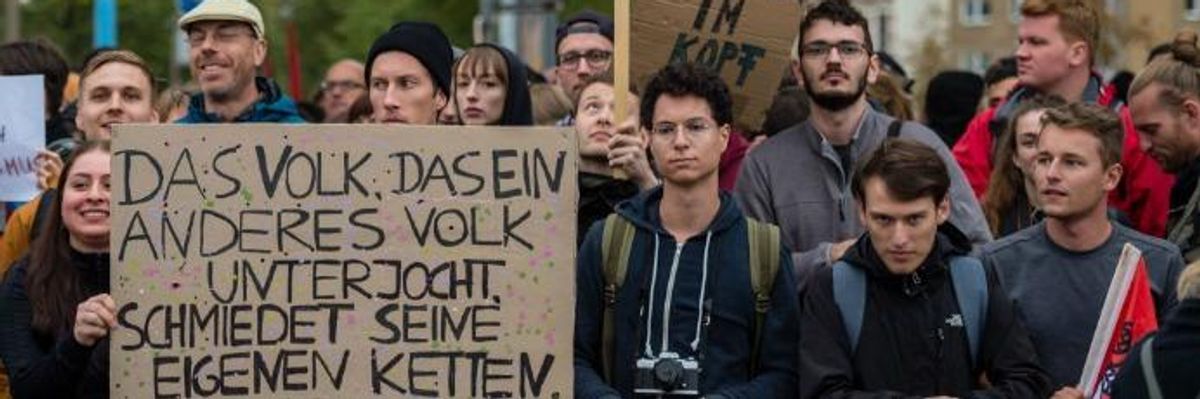
People take part in a gathering under the motto: 'Heart Instead Of Baiting' ('Herz Statt Hetze') to counter a right-wing gathering that was to take place nearby on September 1, 2018 in Chemnitz, Germany. (Photo: Jens Schlueter/Getty Images)
Looking to spark a political revolution in the mold of Sen. Bernie Sanders' in the U.S. and Labour Leader Jeremy Corbyn's in the U.K., Sahra Wagenknecht and her husband Oskar Lafontaine--two leading figures of the German left-wing party Die Linke--officially launched the "Stand Up" movement on Tuesday with the goal of confronting Germany's "crisis of democracy," countering the rise of the nation's racist far-right, and offering an inspiring alternative.
"The globalization steered by corporations, the disintegration of the welfare state, an endless string of new wars--this not a force of nature. There are alternatives to it and we want to give people back the hope that politics can be changed."
--Sahra Wagenknecht
"Many people don't feel represented any more and are turning their backs on politics. This is more than just a feeling," Wagenknect said at a press conference on Tuesday, citing economic data showing that 40 percent of German citizens have less take-home pay today than they did two decades ago. "In such a country democracy is no longer functioning."
"This is about courage to overcome the neoliberal mainstream, about a social policy in the interest of the majority," Wagenknecht added in an interview with the website Nachdenkenseiten.de. "The globalization steered by corporations, the disintegration of the welfare state, an endless string of new wars--this not a force of nature. There are alternatives to it and we want to give people back the hope that politics can be changed."
The emergence of the Stand Up movement--which has also been translated as "Get Up" and "Rise Up"--comes just days after thousands of neo-Nazis marched and rioted in the German city of Chemnitz, just one of many signs that the nation's far-right is emboldened and increasingly dangerous.
Wagenknect argued that a left-wing populist movement like Stand Up is necessary to counter the pseudo-populism of the right, which seeks to exploit very real economic suffering and despair for racist aims.
"Anger that has been piling up has helped form a breeding ground for hate and violence. If we don't take counter measures this country will not be recognisable within five to 10 years," Wagenknect argued during the launch of Stand Up on Tuesday. "The climate is more raw than ever, the social divides are deeper. Had we needed another impulse then the events in Chemnitz show us that we urgently need a new political revolt."
"That's why we want Stand Up, so that people like you and I get a voice, and that politics is done for the millions, not for billionaires."
--Mario, Stand Up supporterAccording to The Local, Stand Up's primary objective is to galvanize and inspire members of the "Die Linke party, the center-left Social Democrats (SPD), and ecologist Greens--but also to win back disenchanted working-class voters who have drifted to far-right protest parties."
While the leaders of Stand Up have not explicitly modeled their movement after Sanders' "political revolution" in the U.S. or Corbyn's "for the many, not the few" campaign in the U.K., the parallels are obvious in the rhetoric and political goals of the movement's supporters.
"The main problem for me is those in power have absolutely no feeling any more for what the people are going through," Mario, a supporter of Stand Up, declared in an interview on the movement's website. "That's why we want Stand Up, so that people like you and I get a voice, and that politics is done for the millions, not for billionaires."
Dear Common Dreams reader, It’s been nearly 30 years since I co-founded Common Dreams with my late wife, Lina Newhouser. We had the radical notion that journalism should serve the public good, not corporate profits. It was clear to us from the outset what it would take to build such a project. No paid advertisements. No corporate sponsors. No millionaire publisher telling us what to think or do. Many people said we wouldn't last a year, but we proved those doubters wrong. Together with a tremendous team of journalists and dedicated staff, we built an independent media outlet free from the constraints of profits and corporate control. Our mission has always been simple: To inform. To inspire. To ignite change for the common good. Building Common Dreams was not easy. Our survival was never guaranteed. When you take on the most powerful forces—Wall Street greed, fossil fuel industry destruction, Big Tech lobbyists, and uber-rich oligarchs who have spent billions upon billions rigging the economy and democracy in their favor—the only bulwark you have is supporters who believe in your work. But here’s the urgent message from me today. It's never been this bad out there. And it's never been this hard to keep us going. At the very moment Common Dreams is most needed, the threats we face are intensifying. We need your support now more than ever. We don't accept corporate advertising and never will. We don't have a paywall because we don't think people should be blocked from critical news based on their ability to pay. Everything we do is funded by the donations of readers like you. When everyone does the little they can afford, we are strong. But if that support retreats or dries up, so do we. Will you donate now to make sure Common Dreams not only survives but thrives? —Craig Brown, Co-founder |
Looking to spark a political revolution in the mold of Sen. Bernie Sanders' in the U.S. and Labour Leader Jeremy Corbyn's in the U.K., Sahra Wagenknecht and her husband Oskar Lafontaine--two leading figures of the German left-wing party Die Linke--officially launched the "Stand Up" movement on Tuesday with the goal of confronting Germany's "crisis of democracy," countering the rise of the nation's racist far-right, and offering an inspiring alternative.
"The globalization steered by corporations, the disintegration of the welfare state, an endless string of new wars--this not a force of nature. There are alternatives to it and we want to give people back the hope that politics can be changed."
--Sahra Wagenknecht
"Many people don't feel represented any more and are turning their backs on politics. This is more than just a feeling," Wagenknect said at a press conference on Tuesday, citing economic data showing that 40 percent of German citizens have less take-home pay today than they did two decades ago. "In such a country democracy is no longer functioning."
"This is about courage to overcome the neoliberal mainstream, about a social policy in the interest of the majority," Wagenknecht added in an interview with the website Nachdenkenseiten.de. "The globalization steered by corporations, the disintegration of the welfare state, an endless string of new wars--this not a force of nature. There are alternatives to it and we want to give people back the hope that politics can be changed."
The emergence of the Stand Up movement--which has also been translated as "Get Up" and "Rise Up"--comes just days after thousands of neo-Nazis marched and rioted in the German city of Chemnitz, just one of many signs that the nation's far-right is emboldened and increasingly dangerous.
Wagenknect argued that a left-wing populist movement like Stand Up is necessary to counter the pseudo-populism of the right, which seeks to exploit very real economic suffering and despair for racist aims.
"Anger that has been piling up has helped form a breeding ground for hate and violence. If we don't take counter measures this country will not be recognisable within five to 10 years," Wagenknect argued during the launch of Stand Up on Tuesday. "The climate is more raw than ever, the social divides are deeper. Had we needed another impulse then the events in Chemnitz show us that we urgently need a new political revolt."
"That's why we want Stand Up, so that people like you and I get a voice, and that politics is done for the millions, not for billionaires."
--Mario, Stand Up supporterAccording to The Local, Stand Up's primary objective is to galvanize and inspire members of the "Die Linke party, the center-left Social Democrats (SPD), and ecologist Greens--but also to win back disenchanted working-class voters who have drifted to far-right protest parties."
While the leaders of Stand Up have not explicitly modeled their movement after Sanders' "political revolution" in the U.S. or Corbyn's "for the many, not the few" campaign in the U.K., the parallels are obvious in the rhetoric and political goals of the movement's supporters.
"The main problem for me is those in power have absolutely no feeling any more for what the people are going through," Mario, a supporter of Stand Up, declared in an interview on the movement's website. "That's why we want Stand Up, so that people like you and I get a voice, and that politics is done for the millions, not for billionaires."
Looking to spark a political revolution in the mold of Sen. Bernie Sanders' in the U.S. and Labour Leader Jeremy Corbyn's in the U.K., Sahra Wagenknecht and her husband Oskar Lafontaine--two leading figures of the German left-wing party Die Linke--officially launched the "Stand Up" movement on Tuesday with the goal of confronting Germany's "crisis of democracy," countering the rise of the nation's racist far-right, and offering an inspiring alternative.
"The globalization steered by corporations, the disintegration of the welfare state, an endless string of new wars--this not a force of nature. There are alternatives to it and we want to give people back the hope that politics can be changed."
--Sahra Wagenknecht
"Many people don't feel represented any more and are turning their backs on politics. This is more than just a feeling," Wagenknect said at a press conference on Tuesday, citing economic data showing that 40 percent of German citizens have less take-home pay today than they did two decades ago. "In such a country democracy is no longer functioning."
"This is about courage to overcome the neoliberal mainstream, about a social policy in the interest of the majority," Wagenknecht added in an interview with the website Nachdenkenseiten.de. "The globalization steered by corporations, the disintegration of the welfare state, an endless string of new wars--this not a force of nature. There are alternatives to it and we want to give people back the hope that politics can be changed."
The emergence of the Stand Up movement--which has also been translated as "Get Up" and "Rise Up"--comes just days after thousands of neo-Nazis marched and rioted in the German city of Chemnitz, just one of many signs that the nation's far-right is emboldened and increasingly dangerous.
Wagenknect argued that a left-wing populist movement like Stand Up is necessary to counter the pseudo-populism of the right, which seeks to exploit very real economic suffering and despair for racist aims.
"Anger that has been piling up has helped form a breeding ground for hate and violence. If we don't take counter measures this country will not be recognisable within five to 10 years," Wagenknect argued during the launch of Stand Up on Tuesday. "The climate is more raw than ever, the social divides are deeper. Had we needed another impulse then the events in Chemnitz show us that we urgently need a new political revolt."
"That's why we want Stand Up, so that people like you and I get a voice, and that politics is done for the millions, not for billionaires."
--Mario, Stand Up supporterAccording to The Local, Stand Up's primary objective is to galvanize and inspire members of the "Die Linke party, the center-left Social Democrats (SPD), and ecologist Greens--but also to win back disenchanted working-class voters who have drifted to far-right protest parties."
While the leaders of Stand Up have not explicitly modeled their movement after Sanders' "political revolution" in the U.S. or Corbyn's "for the many, not the few" campaign in the U.K., the parallels are obvious in the rhetoric and political goals of the movement's supporters.
"The main problem for me is those in power have absolutely no feeling any more for what the people are going through," Mario, a supporter of Stand Up, declared in an interview on the movement's website. "That's why we want Stand Up, so that people like you and I get a voice, and that politics is done for the millions, not for billionaires."