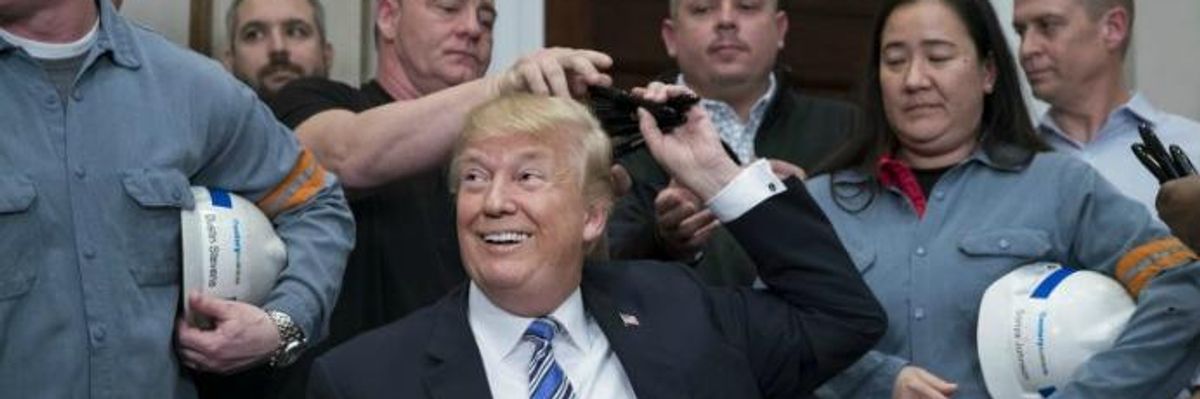
President Donald Trump hands out pens to workers while signing a presidential proclamation on steel and aluminium tariffs, in the Roosevelt Room of the White House in Washington, D.C. (Photo: Michael Reynolds/European Pressphoto Agency)
'Absolutely Repulsive': After $1.5 Trillion Tax Giveaway to the Rich, Trump Cancels Modest Pay Raise for Federal Workers
"President Trump pushed through a tax scam that gave unprecedented handouts to billionaires and corporations—but believes it's too expensive to pay hardworking federal workers a reasonable wage."
Suddenly expressing deep concern for "fiscal sustainability" just months after signing a tax bill that is expected to add $1.9 trillion to the national debt over the next ten years, President Donald Trump announced on Thursday that he is canceling pay raises for nearly 1.8 million federal workers because he claims "federal agency budgets cannot sustain such increases."
"What an insulting way to mark Labor Day."
--Rep. Barbara LeeThe president's abrupt move--which comes less than a week after a federal court struck down his attempt to undermine federal workers' right to bargain collectively--was met with widespread condemnation by progressive lawmakers and labor activists, who argued that the $25 billion Trump claimed the pay raises would cost is a drop in the bucket compared to the GOP's enormous gifts to the rich.
"President Trump pushed through a tax scam that gave unprecedented handouts to billionaires and corporations--but believes it's too expensive to pay hardworking federal workers a reasonable wage," wrote Rep. Barbara Lee (D-Calif.). "What an insulting way to mark Labor Day."
Rep. Elijah Cummings (D-Md.) similarly ripped the president's decision to cancel planned pay raises after handing billionaires huge tax breaks as a "slap in the face" to workers.
The American Federation of Government Employees (AFGE)--which filed the lawsuit that defeated Trump's anti-union directive last week--noted in a statement that the president's move completely ignores the fact that federal workers "are worse off today financially than they were at the start of the decade. Federal employees have had their pay and benefits cut by over $200 billion since 2011, and they are earning nearly five percent less today than they did at the start of the decade."
Trump's decision to cancel the modest 2.1 percent pay raises that were set to go into effect in 2019 comes as wages for most workers are either completely stagnant or declining. Meanwhile, corporate profits are soaring to record levels, the stock market is booming, and CEO pay remains sky-high.
According to West Wing Reports, 80 percent of the workers affected by the pay freeze live outside of Washington, D.C., and many live in red and swing states:
We are at a crossroads
This country and this world are at a monumental crossroads. In a few short weeks, US voters will have an opportunity to beat back the forces of fascism and confront the billionaires who are rigging the economy, our media system, and our democracy, making it increasingly impossible for ordinary people to get by. We’re not just talking about the election. We’re talking about what must be done once these fascist elements are vanquished from power. We need a bolder set of solutions than what either major party has so far been willing to offer and a working-class movement ready to fight like hell for it. Trump didn't emerge from nowhere. The conditions that fueled MAGA authoritarianism were created by decades of radical neoliberal economic policies and a corrupt political system dominated by corporate interests. They slashed taxes on the super-rich, promising that the benefits would trickle down. They said giveaways to the corporate titans would make life more affordable for the rest of us. It was all bullshit. And when a bitter, betrayed populace searches for someone to blame, right-wing demagogues have little trouble finding scapegoats. People know when they're being lied to, but you won't hear any of this from the corporate media. Only independent journalism—powered and funded by people who believe in building a better world—can deliver truly trustworthy daily news. Our Fall Campaign is underway, and we need your help. To power our newsroom through the rest of the year, we need to raise $125,000 by midnight on October 31. So if you share our vision, please contribute whatever you can to sustain our work. |
Suddenly expressing deep concern for "fiscal sustainability" just months after signing a tax bill that is expected to add $1.9 trillion to the national debt over the next ten years, President Donald Trump announced on Thursday that he is canceling pay raises for nearly 1.8 million federal workers because he claims "federal agency budgets cannot sustain such increases."
"What an insulting way to mark Labor Day."
--Rep. Barbara LeeThe president's abrupt move--which comes less than a week after a federal court struck down his attempt to undermine federal workers' right to bargain collectively--was met with widespread condemnation by progressive lawmakers and labor activists, who argued that the $25 billion Trump claimed the pay raises would cost is a drop in the bucket compared to the GOP's enormous gifts to the rich.
"President Trump pushed through a tax scam that gave unprecedented handouts to billionaires and corporations--but believes it's too expensive to pay hardworking federal workers a reasonable wage," wrote Rep. Barbara Lee (D-Calif.). "What an insulting way to mark Labor Day."
Rep. Elijah Cummings (D-Md.) similarly ripped the president's decision to cancel planned pay raises after handing billionaires huge tax breaks as a "slap in the face" to workers.
The American Federation of Government Employees (AFGE)--which filed the lawsuit that defeated Trump's anti-union directive last week--noted in a statement that the president's move completely ignores the fact that federal workers "are worse off today financially than they were at the start of the decade. Federal employees have had their pay and benefits cut by over $200 billion since 2011, and they are earning nearly five percent less today than they did at the start of the decade."
Trump's decision to cancel the modest 2.1 percent pay raises that were set to go into effect in 2019 comes as wages for most workers are either completely stagnant or declining. Meanwhile, corporate profits are soaring to record levels, the stock market is booming, and CEO pay remains sky-high.
According to West Wing Reports, 80 percent of the workers affected by the pay freeze live outside of Washington, D.C., and many live in red and swing states:
Suddenly expressing deep concern for "fiscal sustainability" just months after signing a tax bill that is expected to add $1.9 trillion to the national debt over the next ten years, President Donald Trump announced on Thursday that he is canceling pay raises for nearly 1.8 million federal workers because he claims "federal agency budgets cannot sustain such increases."
"What an insulting way to mark Labor Day."
--Rep. Barbara LeeThe president's abrupt move--which comes less than a week after a federal court struck down his attempt to undermine federal workers' right to bargain collectively--was met with widespread condemnation by progressive lawmakers and labor activists, who argued that the $25 billion Trump claimed the pay raises would cost is a drop in the bucket compared to the GOP's enormous gifts to the rich.
"President Trump pushed through a tax scam that gave unprecedented handouts to billionaires and corporations--but believes it's too expensive to pay hardworking federal workers a reasonable wage," wrote Rep. Barbara Lee (D-Calif.). "What an insulting way to mark Labor Day."
Rep. Elijah Cummings (D-Md.) similarly ripped the president's decision to cancel planned pay raises after handing billionaires huge tax breaks as a "slap in the face" to workers.
The American Federation of Government Employees (AFGE)--which filed the lawsuit that defeated Trump's anti-union directive last week--noted in a statement that the president's move completely ignores the fact that federal workers "are worse off today financially than they were at the start of the decade. Federal employees have had their pay and benefits cut by over $200 billion since 2011, and they are earning nearly five percent less today than they did at the start of the decade."
Trump's decision to cancel the modest 2.1 percent pay raises that were set to go into effect in 2019 comes as wages for most workers are either completely stagnant or declining. Meanwhile, corporate profits are soaring to record levels, the stock market is booming, and CEO pay remains sky-high.
According to West Wing Reports, 80 percent of the workers affected by the pay freeze live outside of Washington, D.C., and many live in red and swing states: