

SUBSCRIBE TO OUR FREE NEWSLETTER
Daily news & progressive opinion—funded by the people, not the corporations—delivered straight to your inbox.
5
#000000
#FFFFFF
To donate by check, phone, or other method, see our More Ways to Give page.
Daily news & progressive opinion—funded by the people, not the corporations—delivered straight to your inbox.
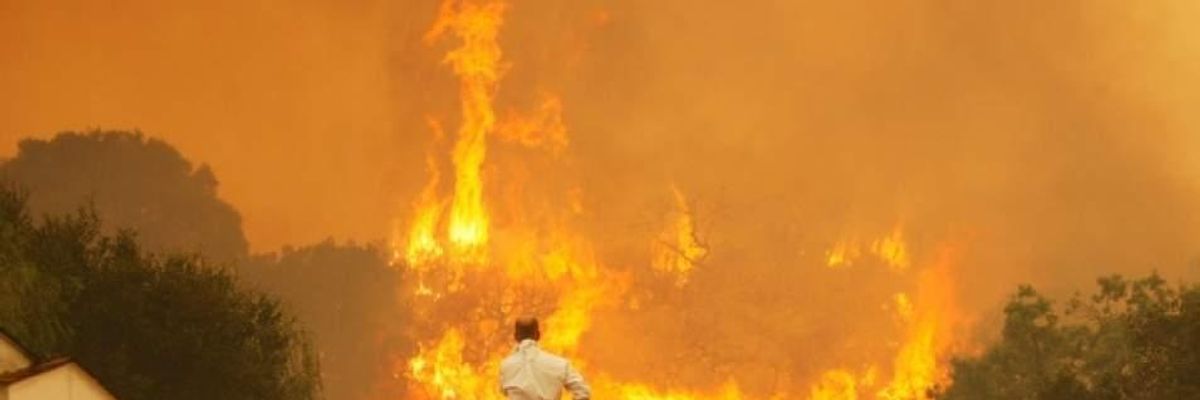
A California resident watched a wildfire from a roof. (Photo: David McNew/Getty Images)
Ahead of the Global Climate Action Summit that California Gov. Jerry Brown will host in San Francisco in September, the state has released a comprehensive climate report that warns of--as the Democratic governor put it on Twitter--"the apocalyptic threat of irreversible climate change."
California's Fourth Climate Change Assessment (pdf) was developed by state agencies and researchers to guide "effective and integrated action to safeguard California" from the mounting threats posed by the global crisis. It draws from more that 40 peer-reviewed studies to outline expected economic and public health impacts--billions of dollars in damage as well as "earlier death and worsening illnesses" among residents--based on climate projections, which include:
The state is currently battling increasingly devastating wildfires that scientists have said are exacerbated by the global climate crisis. One model highlighted in the report warns that if high greenhouse gas emissions continue, California could see a 77 percent increase in the area destroyed by wildfires by the end of this century. Although President Donald Trump announced last year that he was bailing on the Paris agreement, Brown has committed to working toward reaching the global accord's emissions reduction goals.
"The basic message is that changes are happening fast, and they're not good changes. We need to rise to the challenge."
--Robert Weisenmiller, California Energy Commission
While the report forecasts a frightening future for California--the world's fifth-largest economy--it also includes proposed actions that elected officials can take to manage the growing dangers of the changing climate.
As California Energy Commission Chairman Robert Weisenmiller told the Guardian: "The good news is that it's not 'here's the dire impact,' but 'here's some ways to mitigate the dire impacts.' It should give people some hope."
"The basic message is that changes are happening fast, and they're not good changes," he concluded in remarks to the San Francisco Chornicle. "We need to rise to the challenge."
State lawmakers are currently considering the "100 Percent Clean Energy Act," or Senate Bill 100, which would force utilities to fully shift to all renewable energy by 2045. Danny Cullenward, policy director at climate advocacy group Near Zero and a researcher with the Carnegie Institution for Science, told InsideClimate News, "If that passes, it would be the single most transformative climate policy in the history of North America."
Despite positioning himself as a climate leader--especially compared with the fossil fuel-friendly agenda of Trump--Brown has been criticized by many for a set of energy policies that ultimately do not match his lofty rhetoric.
Last week, signaling to the upcoming summit and Brown's stated commitment to tackling the climate crisis, Reps. Ro Khanna and Barbara Lee (D-Calif.) sent the governor a letter urging him to end permitting for all new fossil fuel projects and establish a "just transition" to renewable energy--requests that were made by hundreds of groups that sent the governor a similar letter in April as part of the Brown's Last Chance campaign.
Following the federal lawmakers' letter, a pair of Bay Area leaders--Benicia Mayor Elizabeth Patterson and Richmond Vice Mayor Melvin Willis--echoed that call in a open letter published by the Chronicle, emphasizing that both of their communities "face the toxic consequences of California's complicity in one of the most toxic, polluting, dangerous industries on Earth and the primary driver of climate change: the oil and gas industry."
As Andy Rowell, writing for Oil Change International, argued on Tuesday, Brown "cannot warn of an apocalyptic threat of climate change and be a force for carbonization at the same time by carrying on drilling. He is running out of time to be a true climate leader. This really is Brown's last chance."
Dear Common Dreams reader, It’s been nearly 30 years since I co-founded Common Dreams with my late wife, Lina Newhouser. We had the radical notion that journalism should serve the public good, not corporate profits. It was clear to us from the outset what it would take to build such a project. No paid advertisements. No corporate sponsors. No millionaire publisher telling us what to think or do. Many people said we wouldn't last a year, but we proved those doubters wrong. Together with a tremendous team of journalists and dedicated staff, we built an independent media outlet free from the constraints of profits and corporate control. Our mission has always been simple: To inform. To inspire. To ignite change for the common good. Building Common Dreams was not easy. Our survival was never guaranteed. When you take on the most powerful forces—Wall Street greed, fossil fuel industry destruction, Big Tech lobbyists, and uber-rich oligarchs who have spent billions upon billions rigging the economy and democracy in their favor—the only bulwark you have is supporters who believe in your work. But here’s the urgent message from me today. It's never been this bad out there. And it's never been this hard to keep us going. At the very moment Common Dreams is most needed, the threats we face are intensifying. We need your support now more than ever. We don't accept corporate advertising and never will. We don't have a paywall because we don't think people should be blocked from critical news based on their ability to pay. Everything we do is funded by the donations of readers like you. When everyone does the little they can afford, we are strong. But if that support retreats or dries up, so do we. Will you donate now to make sure Common Dreams not only survives but thrives? —Craig Brown, Co-founder |
Ahead of the Global Climate Action Summit that California Gov. Jerry Brown will host in San Francisco in September, the state has released a comprehensive climate report that warns of--as the Democratic governor put it on Twitter--"the apocalyptic threat of irreversible climate change."
California's Fourth Climate Change Assessment (pdf) was developed by state agencies and researchers to guide "effective and integrated action to safeguard California" from the mounting threats posed by the global crisis. It draws from more that 40 peer-reviewed studies to outline expected economic and public health impacts--billions of dollars in damage as well as "earlier death and worsening illnesses" among residents--based on climate projections, which include:
The state is currently battling increasingly devastating wildfires that scientists have said are exacerbated by the global climate crisis. One model highlighted in the report warns that if high greenhouse gas emissions continue, California could see a 77 percent increase in the area destroyed by wildfires by the end of this century. Although President Donald Trump announced last year that he was bailing on the Paris agreement, Brown has committed to working toward reaching the global accord's emissions reduction goals.
"The basic message is that changes are happening fast, and they're not good changes. We need to rise to the challenge."
--Robert Weisenmiller, California Energy Commission
While the report forecasts a frightening future for California--the world's fifth-largest economy--it also includes proposed actions that elected officials can take to manage the growing dangers of the changing climate.
As California Energy Commission Chairman Robert Weisenmiller told the Guardian: "The good news is that it's not 'here's the dire impact,' but 'here's some ways to mitigate the dire impacts.' It should give people some hope."
"The basic message is that changes are happening fast, and they're not good changes," he concluded in remarks to the San Francisco Chornicle. "We need to rise to the challenge."
State lawmakers are currently considering the "100 Percent Clean Energy Act," or Senate Bill 100, which would force utilities to fully shift to all renewable energy by 2045. Danny Cullenward, policy director at climate advocacy group Near Zero and a researcher with the Carnegie Institution for Science, told InsideClimate News, "If that passes, it would be the single most transformative climate policy in the history of North America."
Despite positioning himself as a climate leader--especially compared with the fossil fuel-friendly agenda of Trump--Brown has been criticized by many for a set of energy policies that ultimately do not match his lofty rhetoric.
Last week, signaling to the upcoming summit and Brown's stated commitment to tackling the climate crisis, Reps. Ro Khanna and Barbara Lee (D-Calif.) sent the governor a letter urging him to end permitting for all new fossil fuel projects and establish a "just transition" to renewable energy--requests that were made by hundreds of groups that sent the governor a similar letter in April as part of the Brown's Last Chance campaign.
Following the federal lawmakers' letter, a pair of Bay Area leaders--Benicia Mayor Elizabeth Patterson and Richmond Vice Mayor Melvin Willis--echoed that call in a open letter published by the Chronicle, emphasizing that both of their communities "face the toxic consequences of California's complicity in one of the most toxic, polluting, dangerous industries on Earth and the primary driver of climate change: the oil and gas industry."
As Andy Rowell, writing for Oil Change International, argued on Tuesday, Brown "cannot warn of an apocalyptic threat of climate change and be a force for carbonization at the same time by carrying on drilling. He is running out of time to be a true climate leader. This really is Brown's last chance."
Ahead of the Global Climate Action Summit that California Gov. Jerry Brown will host in San Francisco in September, the state has released a comprehensive climate report that warns of--as the Democratic governor put it on Twitter--"the apocalyptic threat of irreversible climate change."
California's Fourth Climate Change Assessment (pdf) was developed by state agencies and researchers to guide "effective and integrated action to safeguard California" from the mounting threats posed by the global crisis. It draws from more that 40 peer-reviewed studies to outline expected economic and public health impacts--billions of dollars in damage as well as "earlier death and worsening illnesses" among residents--based on climate projections, which include:
The state is currently battling increasingly devastating wildfires that scientists have said are exacerbated by the global climate crisis. One model highlighted in the report warns that if high greenhouse gas emissions continue, California could see a 77 percent increase in the area destroyed by wildfires by the end of this century. Although President Donald Trump announced last year that he was bailing on the Paris agreement, Brown has committed to working toward reaching the global accord's emissions reduction goals.
"The basic message is that changes are happening fast, and they're not good changes. We need to rise to the challenge."
--Robert Weisenmiller, California Energy Commission
While the report forecasts a frightening future for California--the world's fifth-largest economy--it also includes proposed actions that elected officials can take to manage the growing dangers of the changing climate.
As California Energy Commission Chairman Robert Weisenmiller told the Guardian: "The good news is that it's not 'here's the dire impact,' but 'here's some ways to mitigate the dire impacts.' It should give people some hope."
"The basic message is that changes are happening fast, and they're not good changes," he concluded in remarks to the San Francisco Chornicle. "We need to rise to the challenge."
State lawmakers are currently considering the "100 Percent Clean Energy Act," or Senate Bill 100, which would force utilities to fully shift to all renewable energy by 2045. Danny Cullenward, policy director at climate advocacy group Near Zero and a researcher with the Carnegie Institution for Science, told InsideClimate News, "If that passes, it would be the single most transformative climate policy in the history of North America."
Despite positioning himself as a climate leader--especially compared with the fossil fuel-friendly agenda of Trump--Brown has been criticized by many for a set of energy policies that ultimately do not match his lofty rhetoric.
Last week, signaling to the upcoming summit and Brown's stated commitment to tackling the climate crisis, Reps. Ro Khanna and Barbara Lee (D-Calif.) sent the governor a letter urging him to end permitting for all new fossil fuel projects and establish a "just transition" to renewable energy--requests that were made by hundreds of groups that sent the governor a similar letter in April as part of the Brown's Last Chance campaign.
Following the federal lawmakers' letter, a pair of Bay Area leaders--Benicia Mayor Elizabeth Patterson and Richmond Vice Mayor Melvin Willis--echoed that call in a open letter published by the Chronicle, emphasizing that both of their communities "face the toxic consequences of California's complicity in one of the most toxic, polluting, dangerous industries on Earth and the primary driver of climate change: the oil and gas industry."
As Andy Rowell, writing for Oil Change International, argued on Tuesday, Brown "cannot warn of an apocalyptic threat of climate change and be a force for carbonization at the same time by carrying on drilling. He is running out of time to be a true climate leader. This really is Brown's last chance."

