

SUBSCRIBE TO OUR FREE NEWSLETTER
Daily news & progressive opinion—funded by the people, not the corporations—delivered straight to your inbox.
5
#000000
#FFFFFF
To donate by check, phone, or other method, see our More Ways to Give page.
Daily news & progressive opinion—funded by the people, not the corporations—delivered straight to your inbox.
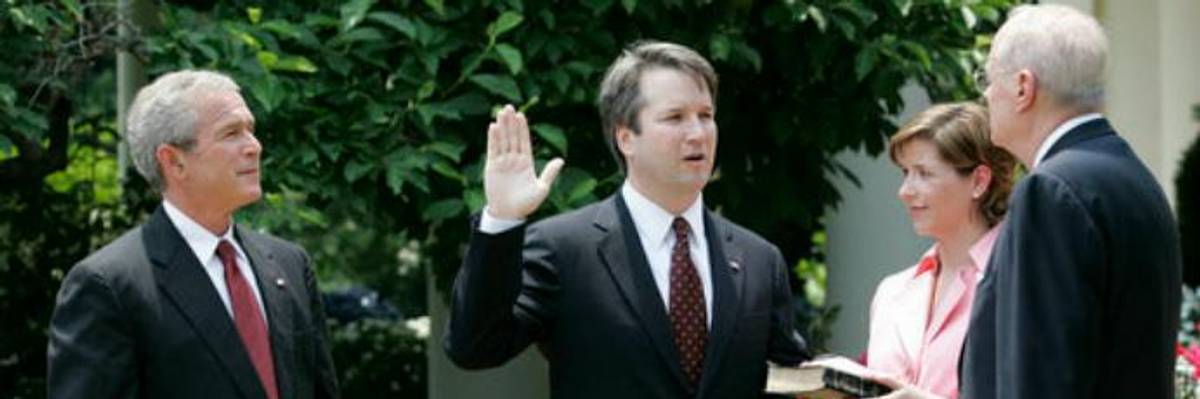
Then-President George W. Bush looks on as Justice Anthony Kennedy swears in Brett Kavanaugh to the U.S. Court of Appeals for the District of Columbia on June 1, 2006. (Photo: Eric Draper/White House)
Three Senate Democrats on the Judiciary Committee claimed Thursday that documents suggest "wildly unpopular" U.S. Supreme Court nominee Brett Kavanaugh lied to lawmakers about his role in the George W. Bush administration's torture program during his 2006 confirmation hearing to serve on the U.S. Court of Appeals for the District of Columbia Circuit.
Ben Wikler, Washington director of MoveOn.org--one of the groups leading the #StopKavanaugh effort that has grown out of concerns about Kavanaugh's record on reproductive rights, the environment, human rights, labor, healthcare, and net neutrality--tweeted:
The revelation was detailed in a letter to Senate Judiciary Chairman Chuck Grassley (R-Iowa) from Ranking Member Dianne Feinstein (D-Calif.) as well as Sens. Patrick Leahy (D-Vt.) and Dick Durbin (D-Ill.), and came as Minority Leader Chuck Schumer (D-N.Y.) threatened to sue the National Archives to get records about Kavanaugh's time working as Bush's staff secretary.
"We have repeatedly expressed our serious concerns about the unprecedented lack of transparency and partisan process that is being used to hide Brett Kavanaugh's record from the Senate Judiciary Committee, the Senate as a whole, and the American people," the letter to Grassley reads.
Noting that "although Judge Kavanaugh amassed a substantial record during his five years in the Bush White House, to date, less than 3 percent of his record has been made available to the committee, and 98.4 percent of his record is being withheld from the full Senate and the public," the letter continues:
Now, we are seeing firsthand the problems that result from attempts to hide Judge Kavanaugh's record. In particular, from the limited set of documents available, we have already seen records that call into serious question whether Judge Kavanaugh was truthful about his involvement in the Bush administration's post-9/11 terrorism policies when he testified before this committee during his 2006 nomination hearing.
As you know, in 2006, Judge Kavanaugh told the committee under oath that he was "not aware of any issues" regarding "the legal justifications or the policies relating to the treatment of detainees"; was "not involved in the questions about the rules governing detention of combatants"; had nothing to do with issues related to rendition; and was unaware of, and saw no documents related to, the warrantless wiretapping program conducted without congressional authorization.
However, at least two documents that are publicly available on the Bush Library website from Judge Kavanaugh's time as staff secretary suggest that he was involved in issues related to torture and rendition after 9/11.
The letter claims that "documents that have been produced to the committee as part of the partisan process" that Grassley "brokered with Bill Burck"--who is heading the Bush legal team that's vetting many of records being sent to the Senate--"further undercut Judge Kavanaugh's blanket assertions that he had no involvement in or knowledge of post-9/11 terrorism policies."
Before serving as staff secretary from 2003 to 2006, the letter notes that "Kavanaugh was an Associate White House Counsel on 9/11," and "over the next several months and years, the White House sought legal opinions from the Office of Legal Counsel and advised the president on the legality of several controversial programs."
"Whether Judge Kavanaugh misled this Committee in 2006 and his involvement in these White House policies are critically important to our consideration of his fitness for a lifetime appointment to the highest court in the land," the letter asserts. Now, with hearings scheduled to begin Sept. 4, whether Grassley, Burck, and the National Archives submit to Democrats' demands to publicly release records from Kavanaugh's time in the Bush White House could significantly impact his confirmation hearings, scheduled to begin Sept. 4.
Wikler pointed out, in a pair of tweets, that Burck also represents multiple Republicans with ties to President Donald Trump regarding their involvement in the Russia investigation, and that GOP Sens. Susan Collins (Maine) and Lisa Murkowski (Alaska)--two lawmakers who Kavanaugh critics have identified as possible "no" votes for Kavanaugh's confirmation--do not have access to many of the records being reviewed by the Judiciary Committee:
The Democrats' letter calls on Grassley to join their request for the staff secretary records from the National Archives and "to publicly release documents from Judge Kavanaugh's time in the White House in the same manner as was done for all previous Supreme Court nominees," concluding, "the truth should not be hidden from the Senate or the American people."
Ahead of the letter's release, Leahy spoke in the Senate on Thursday about the fight over Kavanaugh records compared with the committee's review of current U.S. Supreme Court Justice Elena Kagan, who was appointed by former President Barack Obama and had previously served in the Clinton administration.
As then-chairman of the Judiciary Committee, Leahy worked with then-Ranking Member Jeff Sessions (R-Ala.)--who is now Trump's Attorney General--to request documents from the Clinton Presidential Library about Kagan's work as Associate White House Counsel. "We received 99 percent of them," Leahy said.
Dear Common Dreams reader, It’s been nearly 30 years since I co-founded Common Dreams with my late wife, Lina Newhouser. We had the radical notion that journalism should serve the public good, not corporate profits. It was clear to us from the outset what it would take to build such a project. No paid advertisements. No corporate sponsors. No millionaire publisher telling us what to think or do. Many people said we wouldn't last a year, but we proved those doubters wrong. Together with a tremendous team of journalists and dedicated staff, we built an independent media outlet free from the constraints of profits and corporate control. Our mission has always been simple: To inform. To inspire. To ignite change for the common good. Building Common Dreams was not easy. Our survival was never guaranteed. When you take on the most powerful forces—Wall Street greed, fossil fuel industry destruction, Big Tech lobbyists, and uber-rich oligarchs who have spent billions upon billions rigging the economy and democracy in their favor—the only bulwark you have is supporters who believe in your work. But here’s the urgent message from me today. It's never been this bad out there. And it's never been this hard to keep us going. At the very moment Common Dreams is most needed, the threats we face are intensifying. We need your support now more than ever. We don't accept corporate advertising and never will. We don't have a paywall because we don't think people should be blocked from critical news based on their ability to pay. Everything we do is funded by the donations of readers like you. When everyone does the little they can afford, we are strong. But if that support retreats or dries up, so do we. Will you donate now to make sure Common Dreams not only survives but thrives? —Craig Brown, Co-founder |
Three Senate Democrats on the Judiciary Committee claimed Thursday that documents suggest "wildly unpopular" U.S. Supreme Court nominee Brett Kavanaugh lied to lawmakers about his role in the George W. Bush administration's torture program during his 2006 confirmation hearing to serve on the U.S. Court of Appeals for the District of Columbia Circuit.
Ben Wikler, Washington director of MoveOn.org--one of the groups leading the #StopKavanaugh effort that has grown out of concerns about Kavanaugh's record on reproductive rights, the environment, human rights, labor, healthcare, and net neutrality--tweeted:
The revelation was detailed in a letter to Senate Judiciary Chairman Chuck Grassley (R-Iowa) from Ranking Member Dianne Feinstein (D-Calif.) as well as Sens. Patrick Leahy (D-Vt.) and Dick Durbin (D-Ill.), and came as Minority Leader Chuck Schumer (D-N.Y.) threatened to sue the National Archives to get records about Kavanaugh's time working as Bush's staff secretary.
"We have repeatedly expressed our serious concerns about the unprecedented lack of transparency and partisan process that is being used to hide Brett Kavanaugh's record from the Senate Judiciary Committee, the Senate as a whole, and the American people," the letter to Grassley reads.
Noting that "although Judge Kavanaugh amassed a substantial record during his five years in the Bush White House, to date, less than 3 percent of his record has been made available to the committee, and 98.4 percent of his record is being withheld from the full Senate and the public," the letter continues:
Now, we are seeing firsthand the problems that result from attempts to hide Judge Kavanaugh's record. In particular, from the limited set of documents available, we have already seen records that call into serious question whether Judge Kavanaugh was truthful about his involvement in the Bush administration's post-9/11 terrorism policies when he testified before this committee during his 2006 nomination hearing.
As you know, in 2006, Judge Kavanaugh told the committee under oath that he was "not aware of any issues" regarding "the legal justifications or the policies relating to the treatment of detainees"; was "not involved in the questions about the rules governing detention of combatants"; had nothing to do with issues related to rendition; and was unaware of, and saw no documents related to, the warrantless wiretapping program conducted without congressional authorization.
However, at least two documents that are publicly available on the Bush Library website from Judge Kavanaugh's time as staff secretary suggest that he was involved in issues related to torture and rendition after 9/11.
The letter claims that "documents that have been produced to the committee as part of the partisan process" that Grassley "brokered with Bill Burck"--who is heading the Bush legal team that's vetting many of records being sent to the Senate--"further undercut Judge Kavanaugh's blanket assertions that he had no involvement in or knowledge of post-9/11 terrorism policies."
Before serving as staff secretary from 2003 to 2006, the letter notes that "Kavanaugh was an Associate White House Counsel on 9/11," and "over the next several months and years, the White House sought legal opinions from the Office of Legal Counsel and advised the president on the legality of several controversial programs."
"Whether Judge Kavanaugh misled this Committee in 2006 and his involvement in these White House policies are critically important to our consideration of his fitness for a lifetime appointment to the highest court in the land," the letter asserts. Now, with hearings scheduled to begin Sept. 4, whether Grassley, Burck, and the National Archives submit to Democrats' demands to publicly release records from Kavanaugh's time in the Bush White House could significantly impact his confirmation hearings, scheduled to begin Sept. 4.
Wikler pointed out, in a pair of tweets, that Burck also represents multiple Republicans with ties to President Donald Trump regarding their involvement in the Russia investigation, and that GOP Sens. Susan Collins (Maine) and Lisa Murkowski (Alaska)--two lawmakers who Kavanaugh critics have identified as possible "no" votes for Kavanaugh's confirmation--do not have access to many of the records being reviewed by the Judiciary Committee:
The Democrats' letter calls on Grassley to join their request for the staff secretary records from the National Archives and "to publicly release documents from Judge Kavanaugh's time in the White House in the same manner as was done for all previous Supreme Court nominees," concluding, "the truth should not be hidden from the Senate or the American people."
Ahead of the letter's release, Leahy spoke in the Senate on Thursday about the fight over Kavanaugh records compared with the committee's review of current U.S. Supreme Court Justice Elena Kagan, who was appointed by former President Barack Obama and had previously served in the Clinton administration.
As then-chairman of the Judiciary Committee, Leahy worked with then-Ranking Member Jeff Sessions (R-Ala.)--who is now Trump's Attorney General--to request documents from the Clinton Presidential Library about Kagan's work as Associate White House Counsel. "We received 99 percent of them," Leahy said.
Three Senate Democrats on the Judiciary Committee claimed Thursday that documents suggest "wildly unpopular" U.S. Supreme Court nominee Brett Kavanaugh lied to lawmakers about his role in the George W. Bush administration's torture program during his 2006 confirmation hearing to serve on the U.S. Court of Appeals for the District of Columbia Circuit.
Ben Wikler, Washington director of MoveOn.org--one of the groups leading the #StopKavanaugh effort that has grown out of concerns about Kavanaugh's record on reproductive rights, the environment, human rights, labor, healthcare, and net neutrality--tweeted:
The revelation was detailed in a letter to Senate Judiciary Chairman Chuck Grassley (R-Iowa) from Ranking Member Dianne Feinstein (D-Calif.) as well as Sens. Patrick Leahy (D-Vt.) and Dick Durbin (D-Ill.), and came as Minority Leader Chuck Schumer (D-N.Y.) threatened to sue the National Archives to get records about Kavanaugh's time working as Bush's staff secretary.
"We have repeatedly expressed our serious concerns about the unprecedented lack of transparency and partisan process that is being used to hide Brett Kavanaugh's record from the Senate Judiciary Committee, the Senate as a whole, and the American people," the letter to Grassley reads.
Noting that "although Judge Kavanaugh amassed a substantial record during his five years in the Bush White House, to date, less than 3 percent of his record has been made available to the committee, and 98.4 percent of his record is being withheld from the full Senate and the public," the letter continues:
Now, we are seeing firsthand the problems that result from attempts to hide Judge Kavanaugh's record. In particular, from the limited set of documents available, we have already seen records that call into serious question whether Judge Kavanaugh was truthful about his involvement in the Bush administration's post-9/11 terrorism policies when he testified before this committee during his 2006 nomination hearing.
As you know, in 2006, Judge Kavanaugh told the committee under oath that he was "not aware of any issues" regarding "the legal justifications or the policies relating to the treatment of detainees"; was "not involved in the questions about the rules governing detention of combatants"; had nothing to do with issues related to rendition; and was unaware of, and saw no documents related to, the warrantless wiretapping program conducted without congressional authorization.
However, at least two documents that are publicly available on the Bush Library website from Judge Kavanaugh's time as staff secretary suggest that he was involved in issues related to torture and rendition after 9/11.
The letter claims that "documents that have been produced to the committee as part of the partisan process" that Grassley "brokered with Bill Burck"--who is heading the Bush legal team that's vetting many of records being sent to the Senate--"further undercut Judge Kavanaugh's blanket assertions that he had no involvement in or knowledge of post-9/11 terrorism policies."
Before serving as staff secretary from 2003 to 2006, the letter notes that "Kavanaugh was an Associate White House Counsel on 9/11," and "over the next several months and years, the White House sought legal opinions from the Office of Legal Counsel and advised the president on the legality of several controversial programs."
"Whether Judge Kavanaugh misled this Committee in 2006 and his involvement in these White House policies are critically important to our consideration of his fitness for a lifetime appointment to the highest court in the land," the letter asserts. Now, with hearings scheduled to begin Sept. 4, whether Grassley, Burck, and the National Archives submit to Democrats' demands to publicly release records from Kavanaugh's time in the Bush White House could significantly impact his confirmation hearings, scheduled to begin Sept. 4.
Wikler pointed out, in a pair of tweets, that Burck also represents multiple Republicans with ties to President Donald Trump regarding their involvement in the Russia investigation, and that GOP Sens. Susan Collins (Maine) and Lisa Murkowski (Alaska)--two lawmakers who Kavanaugh critics have identified as possible "no" votes for Kavanaugh's confirmation--do not have access to many of the records being reviewed by the Judiciary Committee:
The Democrats' letter calls on Grassley to join their request for the staff secretary records from the National Archives and "to publicly release documents from Judge Kavanaugh's time in the White House in the same manner as was done for all previous Supreme Court nominees," concluding, "the truth should not be hidden from the Senate or the American people."
Ahead of the letter's release, Leahy spoke in the Senate on Thursday about the fight over Kavanaugh records compared with the committee's review of current U.S. Supreme Court Justice Elena Kagan, who was appointed by former President Barack Obama and had previously served in the Clinton administration.
As then-chairman of the Judiciary Committee, Leahy worked with then-Ranking Member Jeff Sessions (R-Ala.)--who is now Trump's Attorney General--to request documents from the Clinton Presidential Library about Kagan's work as Associate White House Counsel. "We received 99 percent of them," Leahy said.

