SUBSCRIBE TO OUR FREE NEWSLETTER
Daily news & progressive opinion—funded by the people, not the corporations—delivered straight to your inbox.
5
#000000
#FFFFFF
To donate by check, phone, or other method, see our More Ways to Give page.
Daily news & progressive opinion—funded by the people, not the corporations—delivered straight to your inbox.
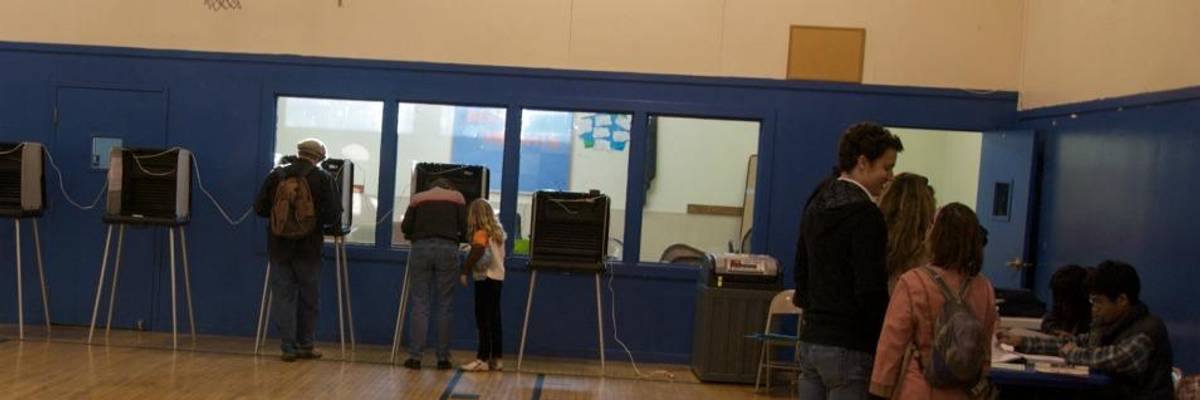
San Francisco opened voter registration to non-citizens this week, allowing all parents and guardians of children in the city's schools to register to vote in school board elections. (Photo: Steve Rhodes/Flickr/cc)
San Francisco officials began registering non-U.S. citizens to vote in school board elections this week, reasoning that parents whose children are educated there should have a say in how the schools are run--but fears about the federal government's potential response to the new limited voting rights of non-citizens has led the city to enact a contingency plan.
"There's a lot of concern regarding the federal government obtaining the personal information of voters who would register as non-citizens," San Francisco Department of Elections Director John Arntz told KQED.
The city is responding to fears of the Trump administration targeting those with new limited voting rights by allocating $150,000 to the Office of Civic Engagement and Immigration Affairs for community outreach initiatives. The office will work with local immigration support groups to provide information and counseling to non-citizens who fear their participation in school board elections could be used against them.
San Francisco voters approved a ballot measure in November 2016, extending school board voting rights to all parents and guardians of children in city schools, provided they are not in prison or on parole for a felony conviction. The city's Board of Supervisors adopted the new law earlier this year.
One in three students in the city's schools come from immigrant families, according to KQED.
"This is no-brainer legislation," Hillary Ronen, a San Francisco supervisor, told the San Francisco Chronicle. "Why would we not want our parents invested in the education of their children?"
The law makes San Francisco the first city in California to extend voting rights to non-citizens. Boston's City Council is currently considering its own initiative to allow immigrants with visas, permanent residents, and those living under the Temporary Protected Status (TPS) or the Deferred Action for Childhood Arrivals (DACA) programs to vote in local elections.
The Trump administration earlier this year added a question about citizenship to the U.S. Census, raising concerns among immigrant rights advocates that the federal government will use the information to target non-citizens.
While some in San Francisco may opt out of registering to vote for school officials, non-citizens and voting rights advocates celebrated the city's decision to make local elections more inclusive.
"At the end of the day, the choice is yours to assess that risk and to decide whether or not this is the right time for you to register to vote," San Francisco resident Ruiyi Lee told KQED. "The important thing is that right now, we actually have a choice to make, the right to choose."
Dear Common Dreams reader, It’s been nearly 30 years since I co-founded Common Dreams with my late wife, Lina Newhouser. We had the radical notion that journalism should serve the public good, not corporate profits. It was clear to us from the outset what it would take to build such a project. No paid advertisements. No corporate sponsors. No millionaire publisher telling us what to think or do. Many people said we wouldn't last a year, but we proved those doubters wrong. Together with a tremendous team of journalists and dedicated staff, we built an independent media outlet free from the constraints of profits and corporate control. Our mission has always been simple: To inform. To inspire. To ignite change for the common good. Building Common Dreams was not easy. Our survival was never guaranteed. When you take on the most powerful forces—Wall Street greed, fossil fuel industry destruction, Big Tech lobbyists, and uber-rich oligarchs who have spent billions upon billions rigging the economy and democracy in their favor—the only bulwark you have is supporters who believe in your work. But here’s the urgent message from me today. It's never been this bad out there. And it's never been this hard to keep us going. At the very moment Common Dreams is most needed, the threats we face are intensifying. We need your support now more than ever. We don't accept corporate advertising and never will. We don't have a paywall because we don't think people should be blocked from critical news based on their ability to pay. Everything we do is funded by the donations of readers like you. When everyone does the little they can afford, we are strong. But if that support retreats or dries up, so do we. Will you donate now to make sure Common Dreams not only survives but thrives? —Craig Brown, Co-founder |
San Francisco officials began registering non-U.S. citizens to vote in school board elections this week, reasoning that parents whose children are educated there should have a say in how the schools are run--but fears about the federal government's potential response to the new limited voting rights of non-citizens has led the city to enact a contingency plan.
"There's a lot of concern regarding the federal government obtaining the personal information of voters who would register as non-citizens," San Francisco Department of Elections Director John Arntz told KQED.
The city is responding to fears of the Trump administration targeting those with new limited voting rights by allocating $150,000 to the Office of Civic Engagement and Immigration Affairs for community outreach initiatives. The office will work with local immigration support groups to provide information and counseling to non-citizens who fear their participation in school board elections could be used against them.
San Francisco voters approved a ballot measure in November 2016, extending school board voting rights to all parents and guardians of children in city schools, provided they are not in prison or on parole for a felony conviction. The city's Board of Supervisors adopted the new law earlier this year.
One in three students in the city's schools come from immigrant families, according to KQED.
"This is no-brainer legislation," Hillary Ronen, a San Francisco supervisor, told the San Francisco Chronicle. "Why would we not want our parents invested in the education of their children?"
The law makes San Francisco the first city in California to extend voting rights to non-citizens. Boston's City Council is currently considering its own initiative to allow immigrants with visas, permanent residents, and those living under the Temporary Protected Status (TPS) or the Deferred Action for Childhood Arrivals (DACA) programs to vote in local elections.
The Trump administration earlier this year added a question about citizenship to the U.S. Census, raising concerns among immigrant rights advocates that the federal government will use the information to target non-citizens.
While some in San Francisco may opt out of registering to vote for school officials, non-citizens and voting rights advocates celebrated the city's decision to make local elections more inclusive.
"At the end of the day, the choice is yours to assess that risk and to decide whether or not this is the right time for you to register to vote," San Francisco resident Ruiyi Lee told KQED. "The important thing is that right now, we actually have a choice to make, the right to choose."
San Francisco officials began registering non-U.S. citizens to vote in school board elections this week, reasoning that parents whose children are educated there should have a say in how the schools are run--but fears about the federal government's potential response to the new limited voting rights of non-citizens has led the city to enact a contingency plan.
"There's a lot of concern regarding the federal government obtaining the personal information of voters who would register as non-citizens," San Francisco Department of Elections Director John Arntz told KQED.
The city is responding to fears of the Trump administration targeting those with new limited voting rights by allocating $150,000 to the Office of Civic Engagement and Immigration Affairs for community outreach initiatives. The office will work with local immigration support groups to provide information and counseling to non-citizens who fear their participation in school board elections could be used against them.
San Francisco voters approved a ballot measure in November 2016, extending school board voting rights to all parents and guardians of children in city schools, provided they are not in prison or on parole for a felony conviction. The city's Board of Supervisors adopted the new law earlier this year.
One in three students in the city's schools come from immigrant families, according to KQED.
"This is no-brainer legislation," Hillary Ronen, a San Francisco supervisor, told the San Francisco Chronicle. "Why would we not want our parents invested in the education of their children?"
The law makes San Francisco the first city in California to extend voting rights to non-citizens. Boston's City Council is currently considering its own initiative to allow immigrants with visas, permanent residents, and those living under the Temporary Protected Status (TPS) or the Deferred Action for Childhood Arrivals (DACA) programs to vote in local elections.
The Trump administration earlier this year added a question about citizenship to the U.S. Census, raising concerns among immigrant rights advocates that the federal government will use the information to target non-citizens.
While some in San Francisco may opt out of registering to vote for school officials, non-citizens and voting rights advocates celebrated the city's decision to make local elections more inclusive.
"At the end of the day, the choice is yours to assess that risk and to decide whether or not this is the right time for you to register to vote," San Francisco resident Ruiyi Lee told KQED. "The important thing is that right now, we actually have a choice to make, the right to choose."