SUBSCRIBE TO OUR FREE NEWSLETTER
Daily news & progressive opinion—funded by the people, not the corporations—delivered straight to your inbox.
5
#000000
#FFFFFF
To donate by check, phone, or other method, see our More Ways to Give page.
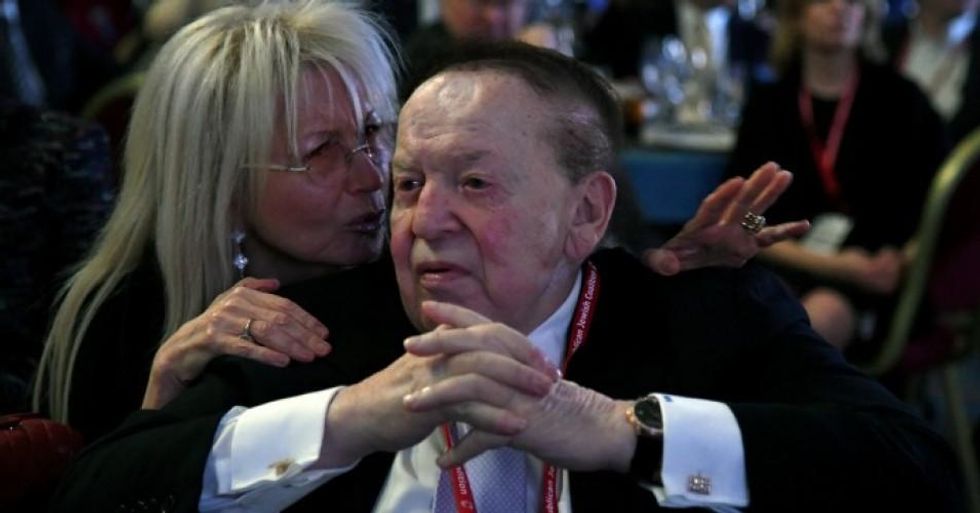
With the midterm elections less than six months out, casino mogul and right-wing megadonor Sheldon Adelson has reportedly cut a $30 million check to the Congressional Leadership Fund (CLF)--a super PAC that works to keep Republicans in control of the U.S. House--provoking renewed calls for stricter campaign finance rules nationwide.
" Democracy means one person, one vote. It does not mean billionaires like Sheldon Adelson buying elections," Sen. Bernie Sanders (I-Vt.), a longtime advocate of shifting to publicly funded elections, tweeted in response to Politico's exclusive report.
"The long-sought donation was sealed last week," Politico reported, citing two senior Republicans. According to the pair of anonymous insiders:
House Speaker Paul Ryan flew to Las Vegas to meet with the billionaire at his Venetian Hotel. Also at the meeting with Adelson was his wife, Miriam; Norm Coleman, the former Minnesota senator who chairs the Republican Jewish Coalition; Corry Bliss, who oversees the super PAC; and Jake Kastan, Ryan's No. 2 political aide. They laid out a case to Adelson about how crucial it is to protect the House.
As a federally elected official, Ryan is not permitted to solicit seven-figure political donations. When Ryan (R-Wis.) left the room, Coleman made the ask and secured the $30 million contribution.
This infusion of cash, Politico noted, "is three times as much as Adelson gave to CLF in 2016," and comes three months earlier--likely due to rising fears within the Republican Party about holding onto a majority in the House, as "dozens of incumbents [are] being outraised by emboldened Democratic challengers."
While President Donald Trump and Republican congressional candidates have risen to power in recent years by appealing to working-class voters, as Matt Yglesias writes for Vox, "The commitment of the likes of Adelson to the GOP cause is a reminder that despite the way culture war topics dominate the messaging of Republican Party politicians, economic issues remain core to the actual stakes of American politics."
"The $30 million the octogenarian casino billionaire is spending on the midterms may sound like a lot, but it's actually a drop in the bucket compared to what Adelson's heirs will gain thanks to the estate tax cut provisions of Trump tax bill alone," Yglesias points out, referencing claims that in just the first few months of 2018, Adelson banked $670 million thanks to the GOP's recent tax code overhaul.
"Throw in the benefits of the other tax cut provisions and Adelson's interest in maintaining a business-friendly National Labor Relations Board and the investment is very small and sensible," Yglesias concluded. "The same goes for even richer people like the Koch brothers, who are planning to spend even larger sums in the midterms."
Chair of the Patriotic Millionaires Morris Pearl said Thursday that Adelson's contribution "is yet another sign of just how broken our political system is. Rather than try to write and pass policy that is actually good for their constituents, Congress follows the money and does whatever their billionaire donors tell them to do, consequences for the rest of the country be damned."
News of Adelson's massive donation was met with demands that lawmakers "fix the system," and as Libby Watson notes at Splinter, "Studies continue to find that money in politics is a big issue for voters."
One such study from the University of Maryland found that the large majority of Republicans and Democrats "would support a constitutional amendment outlawing Citizens United," the landmark Supreme Court ruling that opened the floodgates for corporate contributions to political campaigns.
"And yet news of this gigantic donation--a clear case of a billionaire seeking to influence politics--will almost certainly do less harm to the GOP's reputation than the donation itself will bolster their electoral prospects," Watson muses, "partly because the public feels the Democrats do exactly same thing, which they mostly do, just not as successfully."
With the midterm elections less than six months out, casino mogul and right-wing megadonor Sheldon Adelson has reportedly cut a $30 million check to the Congressional Leadership Fund (CLF)--a super PAC that works to keep Republicans in control of the U.S. House--provoking renewed calls for stricter campaign finance rules nationwide.
" Democracy means one person, one vote. It does not mean billionaires like Sheldon Adelson buying elections," Sen. Bernie Sanders (I-Vt.), a longtime advocate of shifting to publicly funded elections, tweeted in response to Politico's exclusive report.
"The long-sought donation was sealed last week," Politico reported, citing two senior Republicans. According to the pair of anonymous insiders:
House Speaker Paul Ryan flew to Las Vegas to meet with the billionaire at his Venetian Hotel. Also at the meeting with Adelson was his wife, Miriam; Norm Coleman, the former Minnesota senator who chairs the Republican Jewish Coalition; Corry Bliss, who oversees the super PAC; and Jake Kastan, Ryan's No. 2 political aide. They laid out a case to Adelson about how crucial it is to protect the House.
As a federally elected official, Ryan is not permitted to solicit seven-figure political donations. When Ryan (R-Wis.) left the room, Coleman made the ask and secured the $30 million contribution.
This infusion of cash, Politico noted, "is three times as much as Adelson gave to CLF in 2016," and comes three months earlier--likely due to rising fears within the Republican Party about holding onto a majority in the House, as "dozens of incumbents [are] being outraised by emboldened Democratic challengers."
While President Donald Trump and Republican congressional candidates have risen to power in recent years by appealing to working-class voters, as Matt Yglesias writes for Vox, "The commitment of the likes of Adelson to the GOP cause is a reminder that despite the way culture war topics dominate the messaging of Republican Party politicians, economic issues remain core to the actual stakes of American politics."
"The $30 million the octogenarian casino billionaire is spending on the midterms may sound like a lot, but it's actually a drop in the bucket compared to what Adelson's heirs will gain thanks to the estate tax cut provisions of Trump tax bill alone," Yglesias points out, referencing claims that in just the first few months of 2018, Adelson banked $670 million thanks to the GOP's recent tax code overhaul.
"Throw in the benefits of the other tax cut provisions and Adelson's interest in maintaining a business-friendly National Labor Relations Board and the investment is very small and sensible," Yglesias concluded. "The same goes for even richer people like the Koch brothers, who are planning to spend even larger sums in the midterms."
Chair of the Patriotic Millionaires Morris Pearl said Thursday that Adelson's contribution "is yet another sign of just how broken our political system is. Rather than try to write and pass policy that is actually good for their constituents, Congress follows the money and does whatever their billionaire donors tell them to do, consequences for the rest of the country be damned."
News of Adelson's massive donation was met with demands that lawmakers "fix the system," and as Libby Watson notes at Splinter, "Studies continue to find that money in politics is a big issue for voters."
One such study from the University of Maryland found that the large majority of Republicans and Democrats "would support a constitutional amendment outlawing Citizens United," the landmark Supreme Court ruling that opened the floodgates for corporate contributions to political campaigns.
"And yet news of this gigantic donation--a clear case of a billionaire seeking to influence politics--will almost certainly do less harm to the GOP's reputation than the donation itself will bolster their electoral prospects," Watson muses, "partly because the public feels the Democrats do exactly same thing, which they mostly do, just not as successfully."
With the midterm elections less than six months out, casino mogul and right-wing megadonor Sheldon Adelson has reportedly cut a $30 million check to the Congressional Leadership Fund (CLF)--a super PAC that works to keep Republicans in control of the U.S. House--provoking renewed calls for stricter campaign finance rules nationwide.
" Democracy means one person, one vote. It does not mean billionaires like Sheldon Adelson buying elections," Sen. Bernie Sanders (I-Vt.), a longtime advocate of shifting to publicly funded elections, tweeted in response to Politico's exclusive report.
"The long-sought donation was sealed last week," Politico reported, citing two senior Republicans. According to the pair of anonymous insiders:
House Speaker Paul Ryan flew to Las Vegas to meet with the billionaire at his Venetian Hotel. Also at the meeting with Adelson was his wife, Miriam; Norm Coleman, the former Minnesota senator who chairs the Republican Jewish Coalition; Corry Bliss, who oversees the super PAC; and Jake Kastan, Ryan's No. 2 political aide. They laid out a case to Adelson about how crucial it is to protect the House.
As a federally elected official, Ryan is not permitted to solicit seven-figure political donations. When Ryan (R-Wis.) left the room, Coleman made the ask and secured the $30 million contribution.
This infusion of cash, Politico noted, "is three times as much as Adelson gave to CLF in 2016," and comes three months earlier--likely due to rising fears within the Republican Party about holding onto a majority in the House, as "dozens of incumbents [are] being outraised by emboldened Democratic challengers."
While President Donald Trump and Republican congressional candidates have risen to power in recent years by appealing to working-class voters, as Matt Yglesias writes for Vox, "The commitment of the likes of Adelson to the GOP cause is a reminder that despite the way culture war topics dominate the messaging of Republican Party politicians, economic issues remain core to the actual stakes of American politics."
"The $30 million the octogenarian casino billionaire is spending on the midterms may sound like a lot, but it's actually a drop in the bucket compared to what Adelson's heirs will gain thanks to the estate tax cut provisions of Trump tax bill alone," Yglesias points out, referencing claims that in just the first few months of 2018, Adelson banked $670 million thanks to the GOP's recent tax code overhaul.
"Throw in the benefits of the other tax cut provisions and Adelson's interest in maintaining a business-friendly National Labor Relations Board and the investment is very small and sensible," Yglesias concluded. "The same goes for even richer people like the Koch brothers, who are planning to spend even larger sums in the midterms."
Chair of the Patriotic Millionaires Morris Pearl said Thursday that Adelson's contribution "is yet another sign of just how broken our political system is. Rather than try to write and pass policy that is actually good for their constituents, Congress follows the money and does whatever their billionaire donors tell them to do, consequences for the rest of the country be damned."
News of Adelson's massive donation was met with demands that lawmakers "fix the system," and as Libby Watson notes at Splinter, "Studies continue to find that money in politics is a big issue for voters."
One such study from the University of Maryland found that the large majority of Republicans and Democrats "would support a constitutional amendment outlawing Citizens United," the landmark Supreme Court ruling that opened the floodgates for corporate contributions to political campaigns.
"And yet news of this gigantic donation--a clear case of a billionaire seeking to influence politics--will almost certainly do less harm to the GOP's reputation than the donation itself will bolster their electoral prospects," Watson muses, "partly because the public feels the Democrats do exactly same thing, which they mostly do, just not as successfully."