SUBSCRIBE TO OUR FREE NEWSLETTER
Daily news & progressive opinion—funded by the people, not the corporations—delivered straight to your inbox.
5
#000000
#FFFFFF
To donate by check, phone, or other method, see our More Ways to Give page.
Daily news & progressive opinion—funded by the people, not the corporations—delivered straight to your inbox.
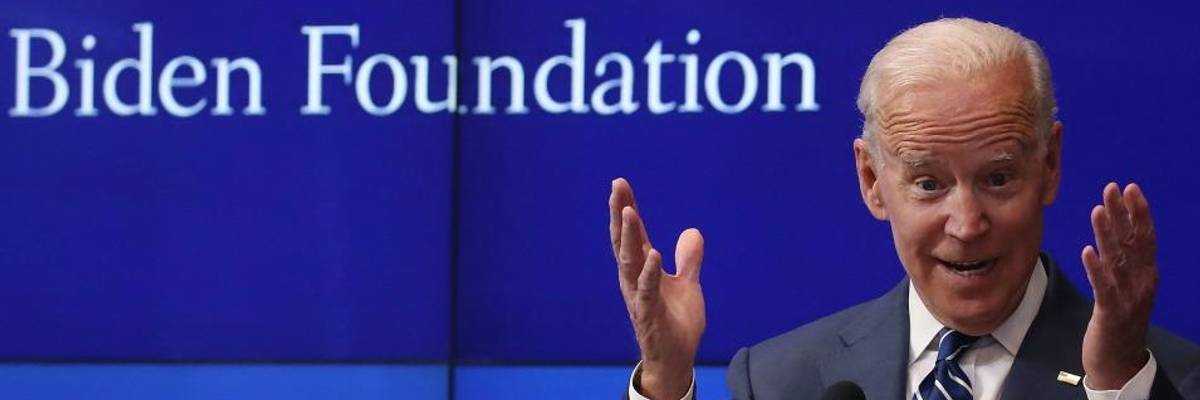
Former U.S. Vice President Joe Biden delivers a keynote address regarding the future of the middle class, at the Brookings Institution, on May 8, 2018 in Washington, DC. (Photo: Mark Wilson/Getty Images)
With the so-called "invisible primary" already underway among Democrats for the 2020 presidential election, former vice president Joe Biden on Tuesday staked a familiar position for the party as he tried to straddle the fence between the reality of extreme inequality and the apparent need not to offend the mega-rich who play such a central role in how the economy--and society more broadly--currently operate.
"I love Bernie, but I'm not Bernie Sanders," Biden said during remarks at the Brookings Institute in the nation's capital. "I don't think 500 billionaires are the reason we're in trouble. The folks at the top aren't bad guys. But this gap is yawning, and it's having the effect of pulling us apart. You see the politics of it."
While Sanders--who polls have shown ranks as the most popular active politician of any party in the U.S.--ran his insurgent 2016 primary campaign on a platform that railed against extreme inequality and the power of the "billionaire class" while also rallying support for an agenda that included a Medicare for All healthcare system, free higher education, taxing Wall Street, an urgent jobs and energy transformation program to address climate change, and an end to the "outrageous" size of the Pentagon budget, Biden appears more comfortable using the Clinton and Obama playbook of the Democratic Party that hopes to address inequality while doing everything possible not to offend the key beneficiaries of the system that drives it.
At Brookings, CNN reports,
Biden proposed a number of solutions that have been floated by the Democratic party's most progressive members, like offering free college to everyone and banning tactics used by employers to keep workers from being paid higher wages.
But he stopped short of pitching some of the more sweeping proposals emanating from the party's left flank. Instead, he offered up more mainstream ideas, like providing more federal funding for infrastructure projects and making the tax code less friendly to investors while expanding tax credits for low-income families.
In his remarks on Tuesday, Biden said, "I get in trouble in my party when I say, 'Wealthy Americans are just as patriotic as poor folks.' I found no distinction."
Dear Common Dreams reader, It’s been nearly 30 years since I co-founded Common Dreams with my late wife, Lina Newhouser. We had the radical notion that journalism should serve the public good, not corporate profits. It was clear to us from the outset what it would take to build such a project. No paid advertisements. No corporate sponsors. No millionaire publisher telling us what to think or do. Many people said we wouldn't last a year, but we proved those doubters wrong. Together with a tremendous team of journalists and dedicated staff, we built an independent media outlet free from the constraints of profits and corporate control. Our mission has always been simple: To inform. To inspire. To ignite change for the common good. Building Common Dreams was not easy. Our survival was never guaranteed. When you take on the most powerful forces—Wall Street greed, fossil fuel industry destruction, Big Tech lobbyists, and uber-rich oligarchs who have spent billions upon billions rigging the economy and democracy in their favor—the only bulwark you have is supporters who believe in your work. But here’s the urgent message from me today. It's never been this bad out there. And it's never been this hard to keep us going. At the very moment Common Dreams is most needed, the threats we face are intensifying. We need your support now more than ever. We don't accept corporate advertising and never will. We don't have a paywall because we don't think people should be blocked from critical news based on their ability to pay. Everything we do is funded by the donations of readers like you. When everyone does the little they can afford, we are strong. But if that support retreats or dries up, so do we. Will you donate now to make sure Common Dreams not only survives but thrives? —Craig Brown, Co-founder |
With the so-called "invisible primary" already underway among Democrats for the 2020 presidential election, former vice president Joe Biden on Tuesday staked a familiar position for the party as he tried to straddle the fence between the reality of extreme inequality and the apparent need not to offend the mega-rich who play such a central role in how the economy--and society more broadly--currently operate.
"I love Bernie, but I'm not Bernie Sanders," Biden said during remarks at the Brookings Institute in the nation's capital. "I don't think 500 billionaires are the reason we're in trouble. The folks at the top aren't bad guys. But this gap is yawning, and it's having the effect of pulling us apart. You see the politics of it."
While Sanders--who polls have shown ranks as the most popular active politician of any party in the U.S.--ran his insurgent 2016 primary campaign on a platform that railed against extreme inequality and the power of the "billionaire class" while also rallying support for an agenda that included a Medicare for All healthcare system, free higher education, taxing Wall Street, an urgent jobs and energy transformation program to address climate change, and an end to the "outrageous" size of the Pentagon budget, Biden appears more comfortable using the Clinton and Obama playbook of the Democratic Party that hopes to address inequality while doing everything possible not to offend the key beneficiaries of the system that drives it.
At Brookings, CNN reports,
Biden proposed a number of solutions that have been floated by the Democratic party's most progressive members, like offering free college to everyone and banning tactics used by employers to keep workers from being paid higher wages.
But he stopped short of pitching some of the more sweeping proposals emanating from the party's left flank. Instead, he offered up more mainstream ideas, like providing more federal funding for infrastructure projects and making the tax code less friendly to investors while expanding tax credits for low-income families.
In his remarks on Tuesday, Biden said, "I get in trouble in my party when I say, 'Wealthy Americans are just as patriotic as poor folks.' I found no distinction."
With the so-called "invisible primary" already underway among Democrats for the 2020 presidential election, former vice president Joe Biden on Tuesday staked a familiar position for the party as he tried to straddle the fence between the reality of extreme inequality and the apparent need not to offend the mega-rich who play such a central role in how the economy--and society more broadly--currently operate.
"I love Bernie, but I'm not Bernie Sanders," Biden said during remarks at the Brookings Institute in the nation's capital. "I don't think 500 billionaires are the reason we're in trouble. The folks at the top aren't bad guys. But this gap is yawning, and it's having the effect of pulling us apart. You see the politics of it."
While Sanders--who polls have shown ranks as the most popular active politician of any party in the U.S.--ran his insurgent 2016 primary campaign on a platform that railed against extreme inequality and the power of the "billionaire class" while also rallying support for an agenda that included a Medicare for All healthcare system, free higher education, taxing Wall Street, an urgent jobs and energy transformation program to address climate change, and an end to the "outrageous" size of the Pentagon budget, Biden appears more comfortable using the Clinton and Obama playbook of the Democratic Party that hopes to address inequality while doing everything possible not to offend the key beneficiaries of the system that drives it.
At Brookings, CNN reports,
Biden proposed a number of solutions that have been floated by the Democratic party's most progressive members, like offering free college to everyone and banning tactics used by employers to keep workers from being paid higher wages.
But he stopped short of pitching some of the more sweeping proposals emanating from the party's left flank. Instead, he offered up more mainstream ideas, like providing more federal funding for infrastructure projects and making the tax code less friendly to investors while expanding tax credits for low-income families.
In his remarks on Tuesday, Biden said, "I get in trouble in my party when I say, 'Wealthy Americans are just as patriotic as poor folks.' I found no distinction."