SUBSCRIBE TO OUR FREE NEWSLETTER
Daily news & progressive opinion—funded by the people, not the corporations—delivered straight to your inbox.
5
#000000
#FFFFFF
To donate by check, phone, or other method, see our More Ways to Give page.
Daily news & progressive opinion—funded by the people, not the corporations—delivered straight to your inbox.
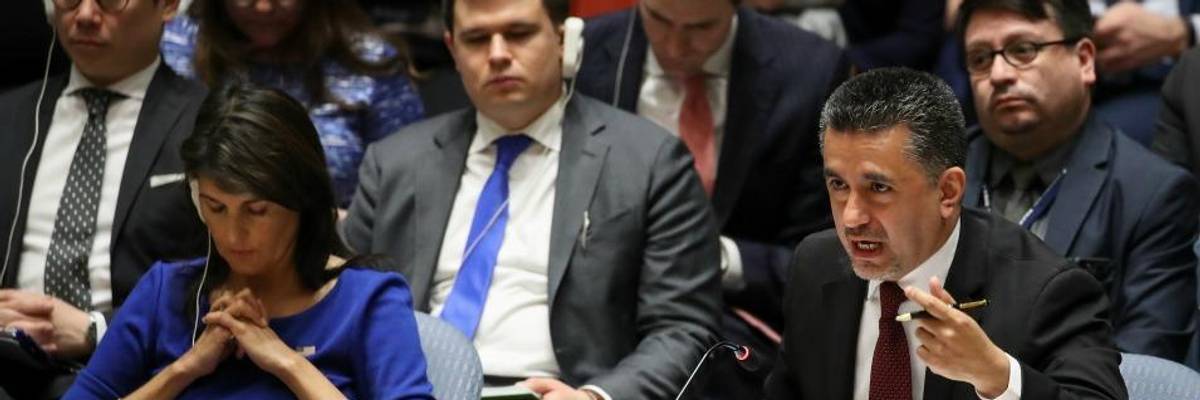
Bolivian ambassador Sacha Sergio Llorenty Soliz denounced the air strikes in Syria, expressing hope that international law would "prevail." (Photo: Drew Angerer/Getty Images)
As foreign policy experts denounced the missile strikes ordered by President Donald Trump Friday night, U.S. ambassador to the U.N. Nikki Haley further troubled critics on Saturday when she warned that the U.S. is prepared to attack the war-torn country again.
"I spoke to the US president this morning and he said that if the Syrian regime uses this poisonous gas again, the United States is locked and loaded," Haley intoned at an emergency meeting of the U.N. Security Council, referring to a suspected chemical attack that Trump has accused Syrian President Bashar al-Assad of carrying out last weekend.
Her statement came before the Security Council voted against a Russian resolution that would have condemned the missile strikes, with eight nations rejecting the resolution, four abstaining, and three countries--Bolivia, China, and Russia--voting in favor of it.
Haley's declaration was denounced by some of her counterparts at the UN, with Bolivian ambassador Sacha Sergio Llorenty Soliz expressing hope that international law would "prevail."
"Her country is ready, is 'locked and loaded,'" said Soliz. "Of course, we clearly heard her words with a great deal of concern and a great deal of sadness. We know that the United States has aircraft carriers, that they have satellites, that they have 'intelligent missiles, smart bombs,' they have a huge arsenal of nuclear weapons."
Holding up the U.N. charter, which allows the use of military force for members only when necessary for self-defense or with the approval of the Security Council, Soliz concluded, "And we also know that they have nothing but scorn for international law, but we have this."
"We know that the United States has aircraft carriers, that they have satellites, that they have 'intelligent missiles, smart bombs,' they have a huge arsenal of nuclear weapons. And we also know that they have nothing but scorn for international law." --Bolivian ambassador Sacha Sergio Llorenty Soliz
Russia's ambassador, Vasily A. Nebenzia, added that the airstrikes, carried out by the U.S. as well as the U.K. and France, amounted to "aggression against a sovereign state" without allowing the U.N. to investigate the suspected poison gas attack. A probe by the Organization for the Prohibition of Chemical Weapons was set to begin Saturday.
U.N. Secretary-General Antonio Guterres urged "restraint" at the meeting, and asked all nations "to avoid any acts that could escalate matters and worsen the suffering of the Syrian people."
The British and French officials at the meeting joined Haley in defending their countries' actions, calling the strikes "limited, targeted and effective" and claiming they had evidence of Assad's responsibility for the chemical attack, with French ambassador Francois Delattre saying the gas attack tested "the threshold of the international community's tolerance."
"You can't combat the alleged violation of international law by violating international law," Soliz countered.
In the Middle East, the missile strikes were met with condemnation and anxiety over what the escalation could mean for the region.
"Such action could have dangerous consequences, threatening the security and stability of the region and giving terrorism another opportunity to expand after it was ousted from Iraq and forced into Syria to retreat to a large extent," said the Iraqi foreign ministry in a statement Saturday.
Dear Common Dreams reader, It’s been nearly 30 years since I co-founded Common Dreams with my late wife, Lina Newhouser. We had the radical notion that journalism should serve the public good, not corporate profits. It was clear to us from the outset what it would take to build such a project. No paid advertisements. No corporate sponsors. No millionaire publisher telling us what to think or do. Many people said we wouldn't last a year, but we proved those doubters wrong. Together with a tremendous team of journalists and dedicated staff, we built an independent media outlet free from the constraints of profits and corporate control. Our mission has always been simple: To inform. To inspire. To ignite change for the common good. Building Common Dreams was not easy. Our survival was never guaranteed. When you take on the most powerful forces—Wall Street greed, fossil fuel industry destruction, Big Tech lobbyists, and uber-rich oligarchs who have spent billions upon billions rigging the economy and democracy in their favor—the only bulwark you have is supporters who believe in your work. But here’s the urgent message from me today. It's never been this bad out there. And it's never been this hard to keep us going. At the very moment Common Dreams is most needed, the threats we face are intensifying. We need your support now more than ever. We don't accept corporate advertising and never will. We don't have a paywall because we don't think people should be blocked from critical news based on their ability to pay. Everything we do is funded by the donations of readers like you. When everyone does the little they can afford, we are strong. But if that support retreats or dries up, so do we. Will you donate now to make sure Common Dreams not only survives but thrives? —Craig Brown, Co-founder |
As foreign policy experts denounced the missile strikes ordered by President Donald Trump Friday night, U.S. ambassador to the U.N. Nikki Haley further troubled critics on Saturday when she warned that the U.S. is prepared to attack the war-torn country again.
"I spoke to the US president this morning and he said that if the Syrian regime uses this poisonous gas again, the United States is locked and loaded," Haley intoned at an emergency meeting of the U.N. Security Council, referring to a suspected chemical attack that Trump has accused Syrian President Bashar al-Assad of carrying out last weekend.
Her statement came before the Security Council voted against a Russian resolution that would have condemned the missile strikes, with eight nations rejecting the resolution, four abstaining, and three countries--Bolivia, China, and Russia--voting in favor of it.
Haley's declaration was denounced by some of her counterparts at the UN, with Bolivian ambassador Sacha Sergio Llorenty Soliz expressing hope that international law would "prevail."
"Her country is ready, is 'locked and loaded,'" said Soliz. "Of course, we clearly heard her words with a great deal of concern and a great deal of sadness. We know that the United States has aircraft carriers, that they have satellites, that they have 'intelligent missiles, smart bombs,' they have a huge arsenal of nuclear weapons."
Holding up the U.N. charter, which allows the use of military force for members only when necessary for self-defense or with the approval of the Security Council, Soliz concluded, "And we also know that they have nothing but scorn for international law, but we have this."
"We know that the United States has aircraft carriers, that they have satellites, that they have 'intelligent missiles, smart bombs,' they have a huge arsenal of nuclear weapons. And we also know that they have nothing but scorn for international law." --Bolivian ambassador Sacha Sergio Llorenty Soliz
Russia's ambassador, Vasily A. Nebenzia, added that the airstrikes, carried out by the U.S. as well as the U.K. and France, amounted to "aggression against a sovereign state" without allowing the U.N. to investigate the suspected poison gas attack. A probe by the Organization for the Prohibition of Chemical Weapons was set to begin Saturday.
U.N. Secretary-General Antonio Guterres urged "restraint" at the meeting, and asked all nations "to avoid any acts that could escalate matters and worsen the suffering of the Syrian people."
The British and French officials at the meeting joined Haley in defending their countries' actions, calling the strikes "limited, targeted and effective" and claiming they had evidence of Assad's responsibility for the chemical attack, with French ambassador Francois Delattre saying the gas attack tested "the threshold of the international community's tolerance."
"You can't combat the alleged violation of international law by violating international law," Soliz countered.
In the Middle East, the missile strikes were met with condemnation and anxiety over what the escalation could mean for the region.
"Such action could have dangerous consequences, threatening the security and stability of the region and giving terrorism another opportunity to expand after it was ousted from Iraq and forced into Syria to retreat to a large extent," said the Iraqi foreign ministry in a statement Saturday.
As foreign policy experts denounced the missile strikes ordered by President Donald Trump Friday night, U.S. ambassador to the U.N. Nikki Haley further troubled critics on Saturday when she warned that the U.S. is prepared to attack the war-torn country again.
"I spoke to the US president this morning and he said that if the Syrian regime uses this poisonous gas again, the United States is locked and loaded," Haley intoned at an emergency meeting of the U.N. Security Council, referring to a suspected chemical attack that Trump has accused Syrian President Bashar al-Assad of carrying out last weekend.
Her statement came before the Security Council voted against a Russian resolution that would have condemned the missile strikes, with eight nations rejecting the resolution, four abstaining, and three countries--Bolivia, China, and Russia--voting in favor of it.
Haley's declaration was denounced by some of her counterparts at the UN, with Bolivian ambassador Sacha Sergio Llorenty Soliz expressing hope that international law would "prevail."
"Her country is ready, is 'locked and loaded,'" said Soliz. "Of course, we clearly heard her words with a great deal of concern and a great deal of sadness. We know that the United States has aircraft carriers, that they have satellites, that they have 'intelligent missiles, smart bombs,' they have a huge arsenal of nuclear weapons."
Holding up the U.N. charter, which allows the use of military force for members only when necessary for self-defense or with the approval of the Security Council, Soliz concluded, "And we also know that they have nothing but scorn for international law, but we have this."
"We know that the United States has aircraft carriers, that they have satellites, that they have 'intelligent missiles, smart bombs,' they have a huge arsenal of nuclear weapons. And we also know that they have nothing but scorn for international law." --Bolivian ambassador Sacha Sergio Llorenty Soliz
Russia's ambassador, Vasily A. Nebenzia, added that the airstrikes, carried out by the U.S. as well as the U.K. and France, amounted to "aggression against a sovereign state" without allowing the U.N. to investigate the suspected poison gas attack. A probe by the Organization for the Prohibition of Chemical Weapons was set to begin Saturday.
U.N. Secretary-General Antonio Guterres urged "restraint" at the meeting, and asked all nations "to avoid any acts that could escalate matters and worsen the suffering of the Syrian people."
The British and French officials at the meeting joined Haley in defending their countries' actions, calling the strikes "limited, targeted and effective" and claiming they had evidence of Assad's responsibility for the chemical attack, with French ambassador Francois Delattre saying the gas attack tested "the threshold of the international community's tolerance."
"You can't combat the alleged violation of international law by violating international law," Soliz countered.
In the Middle East, the missile strikes were met with condemnation and anxiety over what the escalation could mean for the region.
"Such action could have dangerous consequences, threatening the security and stability of the region and giving terrorism another opportunity to expand after it was ousted from Iraq and forced into Syria to retreat to a large extent," said the Iraqi foreign ministry in a statement Saturday.