

SUBSCRIBE TO OUR FREE NEWSLETTER
Daily news & progressive opinion—funded by the people, not the corporations—delivered straight to your inbox.
5
#000000
#FFFFFF
To donate by check, phone, or other method, see our More Ways to Give page.
Daily news & progressive opinion—funded by the people, not the corporations—delivered straight to your inbox.
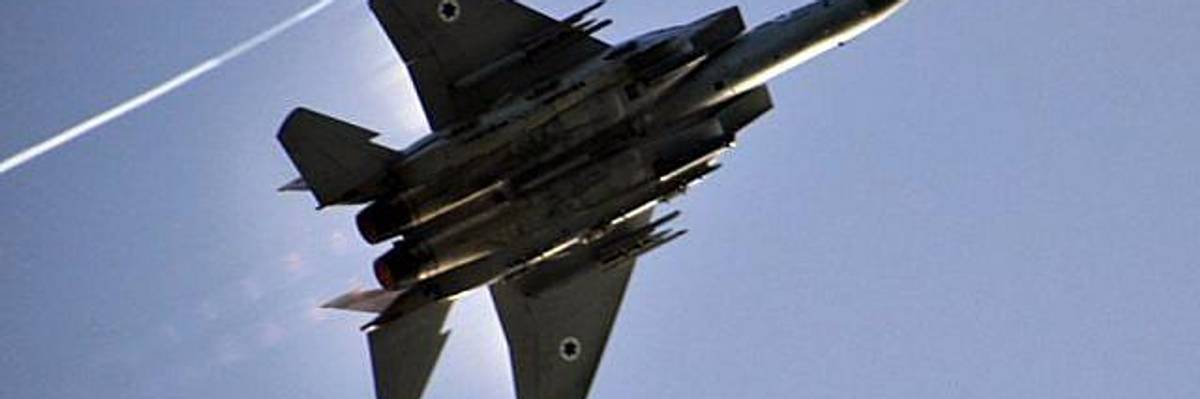
An Israel Air Force F-15 flies overhead during an exercise in the Golan Heights on February 23, 2014. Overnight, airstrikes were reported targeting the Syrian government's T4 airbase near Homs. Though the Pentagon has so far denied any involvement and while the Israeli Defense Forces would not comment, the Russian government on Monday indicated their belief the attack was carried out by a pair of Israeli F-15 fighter jets armed with guided missiles. (Photo: Gu Ashash/Israel Air Force/Flickr)
Staking out its position ahead of an emergency UN Security Council meeting later in the day, Russian government officials early on Monday are warning the U.S. government and President Donald Trump from direct retaliation or further intervention in Syria following an alleged weekend gas attack outside Damascus that has caused heartbreak and uproar inside the war-torn nation, across the region, and beyond.
While Trump declared Sunday there would be a "big price to pay" for whoever was responsible for Saturday's attack in the city of Douma--where local aid groups said at least 49 people were killed and footage emerged of people, including young children, who appeared to be victims of a chemical weapon or agent--the Russian foreign ministry responded by warning of "most serious consequences" if the U.S. took military action against the Syrian government of President Bashar Al-Assad before all the facts are known.
Western intervention, whether by the U.S. or NATO countries, warns Iranian foreign minister, "will definitely increase the complexity of the situation in this country and region."
In the midst of what foreign policy analyst Phyllis Bennis described to Common Dreams as an "extremely perilous moment" in the region and for global conflict between major powers, the foreign ministry in Moscow said in a statement that elements of the chemical attack were "fabricated"--suggesting it was a false flag operation perpetrated by rebel militant forces within Syria--and designed to provoke further intervention or a retaliatory strike against Assad's forces.
"It is necessary to warn again that military intervention under invented and fabricated pretexts in Syria, where at the request of the lawful government there are Russian military personnel, is absolutely unacceptable and can lead to the most serious consequences," read the statement. "The aim of these false speculations, that have no basis, is to shield the terrorists and the irreconcilable radical opposition, who reject a political solution, at the same time while trying to justify possible armed strikes from outside."
At a Monday morning press conference, Foreign Minister Sergey Lavrov said that the Russian and Syrian government have been trying to warn the Organization for the Prohibition of Chemical Weapons (OPCW), which has been investigating the use of chemical weapons in Syria, that such an event was likely coming.
"We already had a chance to comment on the current situation before this current situation became reality," Lavrov told reporters. "Our servicemen staying in the Syrian Arab Republic, 'on soil,' repeatedly warned--and the Syrian government also said about it--that a serious provocation is being prepared, aimed at blaming Damascus for the use of a chemical poisoning agent against civilians."
In a statement on Sunday, the US Ambassador to the UN Nikki Haley said, "The Security Council has to come together and demand immediate access for first responders, support an independent investigation into what happened, and hold accountable those responsible for this atrocious act."
Meanwhile, Syria's other regional ally, Iran, also warned the international community not to blindly accept that the horrific attack on Saturday was the work of the Assad regime. Iranian Foreign Minister Bahram Qasemi on Sunday "denounced using chemical weapons by any country and in any part of the world," but said it was "not compatible with realities" to suggest Assad would carry out this attack and suggested that nobody should jump to conclusions until the facts are known.
"While, the Syrian Army has the upper-hand in battle field against armed terrorists, using chemical weapons seems illogical," Qasemi said. "Such claims by the US and some Western countries is an indication of a new plot against the Syrian government and people, and an excuse for military action against them."
Western intervention, whether by the U.S. or NATO countries, he added, "will definitely increase the complexity of the situation in this country and region."
Overnight, airstrikes were reported targeting the Syrian government's T4 airbase near Homs, though the Pentagon has so far denied any involvement.
And while the Israeli Defense Forces would not comment, the Russian government on Monday indicated their belief the attack was carried out by a pair of Israeli F-15 fighter jets armed with guided missiles. Al Arabiya TV reports that least 14 Syrian soldiers, including several Iranian advisers, were killed in the strikes.
Dear Common Dreams reader, It’s been nearly 30 years since I co-founded Common Dreams with my late wife, Lina Newhouser. We had the radical notion that journalism should serve the public good, not corporate profits. It was clear to us from the outset what it would take to build such a project. No paid advertisements. No corporate sponsors. No millionaire publisher telling us what to think or do. Many people said we wouldn't last a year, but we proved those doubters wrong. Together with a tremendous team of journalists and dedicated staff, we built an independent media outlet free from the constraints of profits and corporate control. Our mission has always been simple: To inform. To inspire. To ignite change for the common good. Building Common Dreams was not easy. Our survival was never guaranteed. When you take on the most powerful forces—Wall Street greed, fossil fuel industry destruction, Big Tech lobbyists, and uber-rich oligarchs who have spent billions upon billions rigging the economy and democracy in their favor—the only bulwark you have is supporters who believe in your work. But here’s the urgent message from me today. It's never been this bad out there. And it's never been this hard to keep us going. At the very moment Common Dreams is most needed, the threats we face are intensifying. We need your support now more than ever. We don't accept corporate advertising and never will. We don't have a paywall because we don't think people should be blocked from critical news based on their ability to pay. Everything we do is funded by the donations of readers like you. When everyone does the little they can afford, we are strong. But if that support retreats or dries up, so do we. Will you donate now to make sure Common Dreams not only survives but thrives? —Craig Brown, Co-founder |
Staking out its position ahead of an emergency UN Security Council meeting later in the day, Russian government officials early on Monday are warning the U.S. government and President Donald Trump from direct retaliation or further intervention in Syria following an alleged weekend gas attack outside Damascus that has caused heartbreak and uproar inside the war-torn nation, across the region, and beyond.
While Trump declared Sunday there would be a "big price to pay" for whoever was responsible for Saturday's attack in the city of Douma--where local aid groups said at least 49 people were killed and footage emerged of people, including young children, who appeared to be victims of a chemical weapon or agent--the Russian foreign ministry responded by warning of "most serious consequences" if the U.S. took military action against the Syrian government of President Bashar Al-Assad before all the facts are known.
Western intervention, whether by the U.S. or NATO countries, warns Iranian foreign minister, "will definitely increase the complexity of the situation in this country and region."
In the midst of what foreign policy analyst Phyllis Bennis described to Common Dreams as an "extremely perilous moment" in the region and for global conflict between major powers, the foreign ministry in Moscow said in a statement that elements of the chemical attack were "fabricated"--suggesting it was a false flag operation perpetrated by rebel militant forces within Syria--and designed to provoke further intervention or a retaliatory strike against Assad's forces.
"It is necessary to warn again that military intervention under invented and fabricated pretexts in Syria, where at the request of the lawful government there are Russian military personnel, is absolutely unacceptable and can lead to the most serious consequences," read the statement. "The aim of these false speculations, that have no basis, is to shield the terrorists and the irreconcilable radical opposition, who reject a political solution, at the same time while trying to justify possible armed strikes from outside."
At a Monday morning press conference, Foreign Minister Sergey Lavrov said that the Russian and Syrian government have been trying to warn the Organization for the Prohibition of Chemical Weapons (OPCW), which has been investigating the use of chemical weapons in Syria, that such an event was likely coming.
"We already had a chance to comment on the current situation before this current situation became reality," Lavrov told reporters. "Our servicemen staying in the Syrian Arab Republic, 'on soil,' repeatedly warned--and the Syrian government also said about it--that a serious provocation is being prepared, aimed at blaming Damascus for the use of a chemical poisoning agent against civilians."
In a statement on Sunday, the US Ambassador to the UN Nikki Haley said, "The Security Council has to come together and demand immediate access for first responders, support an independent investigation into what happened, and hold accountable those responsible for this atrocious act."
Meanwhile, Syria's other regional ally, Iran, also warned the international community not to blindly accept that the horrific attack on Saturday was the work of the Assad regime. Iranian Foreign Minister Bahram Qasemi on Sunday "denounced using chemical weapons by any country and in any part of the world," but said it was "not compatible with realities" to suggest Assad would carry out this attack and suggested that nobody should jump to conclusions until the facts are known.
"While, the Syrian Army has the upper-hand in battle field against armed terrorists, using chemical weapons seems illogical," Qasemi said. "Such claims by the US and some Western countries is an indication of a new plot against the Syrian government and people, and an excuse for military action against them."
Western intervention, whether by the U.S. or NATO countries, he added, "will definitely increase the complexity of the situation in this country and region."
Overnight, airstrikes were reported targeting the Syrian government's T4 airbase near Homs, though the Pentagon has so far denied any involvement.
And while the Israeli Defense Forces would not comment, the Russian government on Monday indicated their belief the attack was carried out by a pair of Israeli F-15 fighter jets armed with guided missiles. Al Arabiya TV reports that least 14 Syrian soldiers, including several Iranian advisers, were killed in the strikes.
Staking out its position ahead of an emergency UN Security Council meeting later in the day, Russian government officials early on Monday are warning the U.S. government and President Donald Trump from direct retaliation or further intervention in Syria following an alleged weekend gas attack outside Damascus that has caused heartbreak and uproar inside the war-torn nation, across the region, and beyond.
While Trump declared Sunday there would be a "big price to pay" for whoever was responsible for Saturday's attack in the city of Douma--where local aid groups said at least 49 people were killed and footage emerged of people, including young children, who appeared to be victims of a chemical weapon or agent--the Russian foreign ministry responded by warning of "most serious consequences" if the U.S. took military action against the Syrian government of President Bashar Al-Assad before all the facts are known.
Western intervention, whether by the U.S. or NATO countries, warns Iranian foreign minister, "will definitely increase the complexity of the situation in this country and region."
In the midst of what foreign policy analyst Phyllis Bennis described to Common Dreams as an "extremely perilous moment" in the region and for global conflict between major powers, the foreign ministry in Moscow said in a statement that elements of the chemical attack were "fabricated"--suggesting it was a false flag operation perpetrated by rebel militant forces within Syria--and designed to provoke further intervention or a retaliatory strike against Assad's forces.
"It is necessary to warn again that military intervention under invented and fabricated pretexts in Syria, where at the request of the lawful government there are Russian military personnel, is absolutely unacceptable and can lead to the most serious consequences," read the statement. "The aim of these false speculations, that have no basis, is to shield the terrorists and the irreconcilable radical opposition, who reject a political solution, at the same time while trying to justify possible armed strikes from outside."
At a Monday morning press conference, Foreign Minister Sergey Lavrov said that the Russian and Syrian government have been trying to warn the Organization for the Prohibition of Chemical Weapons (OPCW), which has been investigating the use of chemical weapons in Syria, that such an event was likely coming.
"We already had a chance to comment on the current situation before this current situation became reality," Lavrov told reporters. "Our servicemen staying in the Syrian Arab Republic, 'on soil,' repeatedly warned--and the Syrian government also said about it--that a serious provocation is being prepared, aimed at blaming Damascus for the use of a chemical poisoning agent against civilians."
In a statement on Sunday, the US Ambassador to the UN Nikki Haley said, "The Security Council has to come together and demand immediate access for first responders, support an independent investigation into what happened, and hold accountable those responsible for this atrocious act."
Meanwhile, Syria's other regional ally, Iran, also warned the international community not to blindly accept that the horrific attack on Saturday was the work of the Assad regime. Iranian Foreign Minister Bahram Qasemi on Sunday "denounced using chemical weapons by any country and in any part of the world," but said it was "not compatible with realities" to suggest Assad would carry out this attack and suggested that nobody should jump to conclusions until the facts are known.
"While, the Syrian Army has the upper-hand in battle field against armed terrorists, using chemical weapons seems illogical," Qasemi said. "Such claims by the US and some Western countries is an indication of a new plot against the Syrian government and people, and an excuse for military action against them."
Western intervention, whether by the U.S. or NATO countries, he added, "will definitely increase the complexity of the situation in this country and region."
Overnight, airstrikes were reported targeting the Syrian government's T4 airbase near Homs, though the Pentagon has so far denied any involvement.
And while the Israeli Defense Forces would not comment, the Russian government on Monday indicated their belief the attack was carried out by a pair of Israeli F-15 fighter jets armed with guided missiles. Al Arabiya TV reports that least 14 Syrian soldiers, including several Iranian advisers, were killed in the strikes.

