

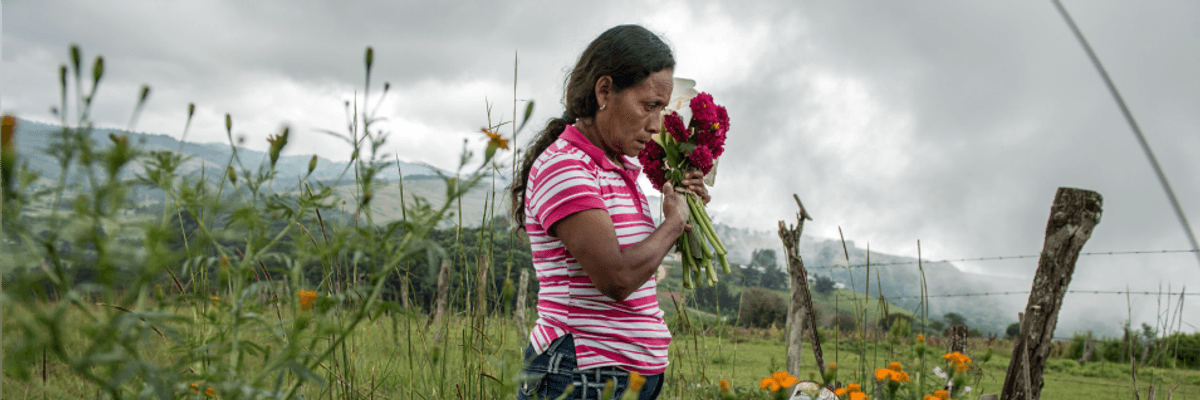
Julia Francisco Martinez at the grave of her husband, who was killed after protesting the construction of a dam on indigenous lands. (Photo: Giles Clark/Getty Images)
Nearly Four Eco-Defenders Killed Per Week in 2017 Amid 'Ruthless Scramble' for Resources
"Until companies, investors, and governments genuinely include communities in decisions around the use of their land and natural resources, the people who dare to speak out will continue to face violence, imprisonment, and loss of life."
Nearly four people per week were killed in 2017 while defending their land and the environment from what environmental and human rights group Global Witness calls "the ruthless scramble for natural wealth."
A new analysis by the group counted 197 victims of the quest by miners, poachers, and agribusiness to take control of land around the world in order to sell natural resources--but believes many more deaths have likely gone unreported.
"Until companies, investors, and governments genuinely include communities in decisions around the use of their land and natural resources, the people who dare to speak out will continue to face violence, imprisonment, and loss of life," said Rachel Cox, a campaigner for Global Witness.
"We hope that our work helps to end levels of impunity that have emboldened the perpetrators of violence and in most cases, allowed them to literally get away with murder."--Rachel Cox, Global Witness campaigner
Agribusiness overtook mining as the industry linked to the most killings, according to the report, as demand for soy, meat, sugarcane, and palm oil grows around the world.
Latin America saw the most eco-defenders killed last year, with 46 people killed in Brazil and 32 in Colombia alone. In September, six farmers were killed in Peru by a criminal gang that had tried to seize their land for use in the palm oil trade.
Other notable examples of deadly fights over resources include the deaths of a Turkish couple who were shot to death in their home after winning a legal battle over the extraction of marble from a quarry, and an Indian family that was killed for protesting the use of sand from a riverbank in their village--sought by developers who wanted to use it for construction projects.
In its report, Global Witness stressed the importance of accounting for the deaths of every environmental defender. While the number of killings in 2017 is four times that which was first recorded by the group in 2002, eco-defenders' deaths have leveled off for the first time in four years.
"As the international community sits up and listens to these hidden stories, there is a momentum for renewed pressure on companies and investors to take more responsibility and further scrutinize governments who have allowed those who kill to get away with it," wrote Cox.
"By putting these killings on the map, and campaigning for governments, companies, and investors to safeguard and consult communities affected by projects on their land, we hope that our work helps to end levels of impunity that have emboldened the perpetrators of violence and in most cases, allowed them to literally get away with murder."
We are at a crossroads
This country and this world are at a monumental crossroads. In a few short weeks, US voters will have an opportunity to beat back the forces of fascism and confront the billionaires who are rigging the economy, our media system, and our democracy, making it increasingly impossible for ordinary people to get by. We’re not just talking about the election. We’re talking about what must be done once these fascist elements are vanquished from power. We need a bolder set of solutions than what either major party has so far been willing to offer and a working-class movement ready to fight like hell for it. Trump didn't emerge from nowhere. The conditions that fueled MAGA authoritarianism were created by decades of radical neoliberal economic policies and a corrupt political system dominated by corporate interests. They slashed taxes on the super-rich, promising that the benefits would trickle down. They said giveaways to the corporate titans would make life more affordable for the rest of us. It was all bullshit. And when a bitter, betrayed populace searches for someone to blame, right-wing demagogues have little trouble finding scapegoats. People know when they're being lied to, but you won't hear any of this from the corporate media. Only independent journalism—powered and funded by people who believe in building a better world—can deliver truly trustworthy daily news. Our Fall Campaign is underway, and we need your help. To power our newsroom through the rest of the year, we need to raise $125,000 by midnight on October 31. So if you share our vision, please contribute whatever you can to sustain our work. |
Nearly four people per week were killed in 2017 while defending their land and the environment from what environmental and human rights group Global Witness calls "the ruthless scramble for natural wealth."
A new analysis by the group counted 197 victims of the quest by miners, poachers, and agribusiness to take control of land around the world in order to sell natural resources--but believes many more deaths have likely gone unreported.
"Until companies, investors, and governments genuinely include communities in decisions around the use of their land and natural resources, the people who dare to speak out will continue to face violence, imprisonment, and loss of life," said Rachel Cox, a campaigner for Global Witness.
"We hope that our work helps to end levels of impunity that have emboldened the perpetrators of violence and in most cases, allowed them to literally get away with murder."--Rachel Cox, Global Witness campaigner
Agribusiness overtook mining as the industry linked to the most killings, according to the report, as demand for soy, meat, sugarcane, and palm oil grows around the world.
Latin America saw the most eco-defenders killed last year, with 46 people killed in Brazil and 32 in Colombia alone. In September, six farmers were killed in Peru by a criminal gang that had tried to seize their land for use in the palm oil trade.
Other notable examples of deadly fights over resources include the deaths of a Turkish couple who were shot to death in their home after winning a legal battle over the extraction of marble from a quarry, and an Indian family that was killed for protesting the use of sand from a riverbank in their village--sought by developers who wanted to use it for construction projects.
In its report, Global Witness stressed the importance of accounting for the deaths of every environmental defender. While the number of killings in 2017 is four times that which was first recorded by the group in 2002, eco-defenders' deaths have leveled off for the first time in four years.
"As the international community sits up and listens to these hidden stories, there is a momentum for renewed pressure on companies and investors to take more responsibility and further scrutinize governments who have allowed those who kill to get away with it," wrote Cox.
"By putting these killings on the map, and campaigning for governments, companies, and investors to safeguard and consult communities affected by projects on their land, we hope that our work helps to end levels of impunity that have emboldened the perpetrators of violence and in most cases, allowed them to literally get away with murder."
Nearly four people per week were killed in 2017 while defending their land and the environment from what environmental and human rights group Global Witness calls "the ruthless scramble for natural wealth."
A new analysis by the group counted 197 victims of the quest by miners, poachers, and agribusiness to take control of land around the world in order to sell natural resources--but believes many more deaths have likely gone unreported.
"Until companies, investors, and governments genuinely include communities in decisions around the use of their land and natural resources, the people who dare to speak out will continue to face violence, imprisonment, and loss of life," said Rachel Cox, a campaigner for Global Witness.
"We hope that our work helps to end levels of impunity that have emboldened the perpetrators of violence and in most cases, allowed them to literally get away with murder."--Rachel Cox, Global Witness campaigner
Agribusiness overtook mining as the industry linked to the most killings, according to the report, as demand for soy, meat, sugarcane, and palm oil grows around the world.
Latin America saw the most eco-defenders killed last year, with 46 people killed in Brazil and 32 in Colombia alone. In September, six farmers were killed in Peru by a criminal gang that had tried to seize their land for use in the palm oil trade.
Other notable examples of deadly fights over resources include the deaths of a Turkish couple who were shot to death in their home after winning a legal battle over the extraction of marble from a quarry, and an Indian family that was killed for protesting the use of sand from a riverbank in their village--sought by developers who wanted to use it for construction projects.
In its report, Global Witness stressed the importance of accounting for the deaths of every environmental defender. While the number of killings in 2017 is four times that which was first recorded by the group in 2002, eco-defenders' deaths have leveled off for the first time in four years.
"As the international community sits up and listens to these hidden stories, there is a momentum for renewed pressure on companies and investors to take more responsibility and further scrutinize governments who have allowed those who kill to get away with it," wrote Cox.
"By putting these killings on the map, and campaigning for governments, companies, and investors to safeguard and consult communities affected by projects on their land, we hope that our work helps to end levels of impunity that have emboldened the perpetrators of violence and in most cases, allowed them to literally get away with murder."