SUBSCRIBE TO OUR FREE NEWSLETTER
Daily news & progressive opinion—funded by the people, not the corporations—delivered straight to your inbox.
5
#000000
#FFFFFF
To donate by check, phone, or other method, see our More Ways to Give page.
Daily news & progressive opinion—funded by the people, not the corporations—delivered straight to your inbox.
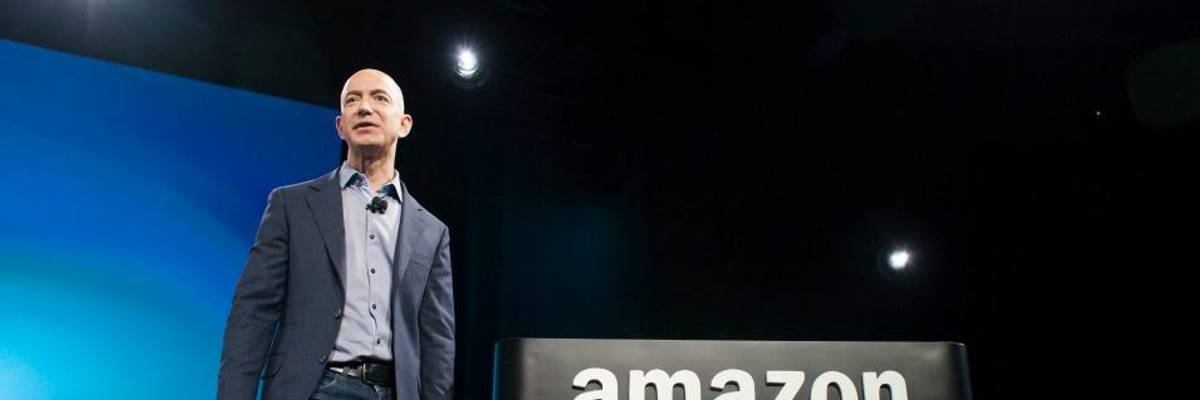
The tech conglomerate Amazon, headed by the world's richest man, Jeff Bezos, released a shortlist of 20 cities that could be the new home of the company's second headquarters on Thursday. (Photo: David Ryder/Getty)
Critics of Amazon's "race to the bottom" as it searches for a home for its second headquarters said on Thursday that the company's newly released shortlist of 20 cities highlights a crisis in the U.S. economy--one exemplified by the huge incentives offered to Amazon in the bidding war among potential hosts.
Rep. Keith Ellison (D-Minn.) was among those slamming Amazon and the state and local governments willing to give billions of dollars in tax breaks to the extremely wealthy multinational company.
In addition to the incentives mentioned by Ellison, Boston offered $75 million to provide affordable housing to Amazon employees, while Maryland's offer exceeded $5 billion.
Some noted that Amazon's top 20 contenders--also including New York, Los Angeles, Atlanta, and Raleigh, N.C.--are fairly prosperous cities, with the company leaving out areas that could benefit from an influx of jobs and economic activity.
After Amazon announced its search in September, promising to bring 50,000 jobs to the city it chose for its $5 billion headquarters, groups including Jobs With Justice and the Working Families Party released their own set of demands for the company.
As Common Dreams reported, the groups asked the company to "reserve a substantial number of construction jobs for local residents, especially underrepresented people of color and women," protect the right to form unions, pay living wages, and--in light of reports of unsafe conditions at Amazon warehouses--"allow independent, third party organizations to conduct health and safety trainings."
But as Lina Khan of the Open Markets Institute noted last month on Ellison's podcast, We the Podcast, Amazon's meteoric rise has been due largely to unfair business practices--leaving critics skeptical of the idea that Amazon's arrival in one of the 20 finalist cities will actually benefit those who call it home.
"In many instances, Amazon has gotten where it is because it has undertaken business practices and forms of conduct that previously used to be illegal," Khan said.
Dear Common Dreams reader, It’s been nearly 30 years since I co-founded Common Dreams with my late wife, Lina Newhouser. We had the radical notion that journalism should serve the public good, not corporate profits. It was clear to us from the outset what it would take to build such a project. No paid advertisements. No corporate sponsors. No millionaire publisher telling us what to think or do. Many people said we wouldn't last a year, but we proved those doubters wrong. Together with a tremendous team of journalists and dedicated staff, we built an independent media outlet free from the constraints of profits and corporate control. Our mission has always been simple: To inform. To inspire. To ignite change for the common good. Building Common Dreams was not easy. Our survival was never guaranteed. When you take on the most powerful forces—Wall Street greed, fossil fuel industry destruction, Big Tech lobbyists, and uber-rich oligarchs who have spent billions upon billions rigging the economy and democracy in their favor—the only bulwark you have is supporters who believe in your work. But here’s the urgent message from me today. It's never been this bad out there. And it's never been this hard to keep us going. At the very moment Common Dreams is most needed, the threats we face are intensifying. We need your support now more than ever. We don't accept corporate advertising and never will. We don't have a paywall because we don't think people should be blocked from critical news based on their ability to pay. Everything we do is funded by the donations of readers like you. When everyone does the little they can afford, we are strong. But if that support retreats or dries up, so do we. Will you donate now to make sure Common Dreams not only survives but thrives? —Craig Brown, Co-founder |
Critics of Amazon's "race to the bottom" as it searches for a home for its second headquarters said on Thursday that the company's newly released shortlist of 20 cities highlights a crisis in the U.S. economy--one exemplified by the huge incentives offered to Amazon in the bidding war among potential hosts.
Rep. Keith Ellison (D-Minn.) was among those slamming Amazon and the state and local governments willing to give billions of dollars in tax breaks to the extremely wealthy multinational company.
In addition to the incentives mentioned by Ellison, Boston offered $75 million to provide affordable housing to Amazon employees, while Maryland's offer exceeded $5 billion.
Some noted that Amazon's top 20 contenders--also including New York, Los Angeles, Atlanta, and Raleigh, N.C.--are fairly prosperous cities, with the company leaving out areas that could benefit from an influx of jobs and economic activity.
After Amazon announced its search in September, promising to bring 50,000 jobs to the city it chose for its $5 billion headquarters, groups including Jobs With Justice and the Working Families Party released their own set of demands for the company.
As Common Dreams reported, the groups asked the company to "reserve a substantial number of construction jobs for local residents, especially underrepresented people of color and women," protect the right to form unions, pay living wages, and--in light of reports of unsafe conditions at Amazon warehouses--"allow independent, third party organizations to conduct health and safety trainings."
But as Lina Khan of the Open Markets Institute noted last month on Ellison's podcast, We the Podcast, Amazon's meteoric rise has been due largely to unfair business practices--leaving critics skeptical of the idea that Amazon's arrival in one of the 20 finalist cities will actually benefit those who call it home.
"In many instances, Amazon has gotten where it is because it has undertaken business practices and forms of conduct that previously used to be illegal," Khan said.
Critics of Amazon's "race to the bottom" as it searches for a home for its second headquarters said on Thursday that the company's newly released shortlist of 20 cities highlights a crisis in the U.S. economy--one exemplified by the huge incentives offered to Amazon in the bidding war among potential hosts.
Rep. Keith Ellison (D-Minn.) was among those slamming Amazon and the state and local governments willing to give billions of dollars in tax breaks to the extremely wealthy multinational company.
In addition to the incentives mentioned by Ellison, Boston offered $75 million to provide affordable housing to Amazon employees, while Maryland's offer exceeded $5 billion.
Some noted that Amazon's top 20 contenders--also including New York, Los Angeles, Atlanta, and Raleigh, N.C.--are fairly prosperous cities, with the company leaving out areas that could benefit from an influx of jobs and economic activity.
After Amazon announced its search in September, promising to bring 50,000 jobs to the city it chose for its $5 billion headquarters, groups including Jobs With Justice and the Working Families Party released their own set of demands for the company.
As Common Dreams reported, the groups asked the company to "reserve a substantial number of construction jobs for local residents, especially underrepresented people of color and women," protect the right to form unions, pay living wages, and--in light of reports of unsafe conditions at Amazon warehouses--"allow independent, third party organizations to conduct health and safety trainings."
But as Lina Khan of the Open Markets Institute noted last month on Ellison's podcast, We the Podcast, Amazon's meteoric rise has been due largely to unfair business practices--leaving critics skeptical of the idea that Amazon's arrival in one of the 20 finalist cities will actually benefit those who call it home.
"In many instances, Amazon has gotten where it is because it has undertaken business practices and forms of conduct that previously used to be illegal," Khan said.