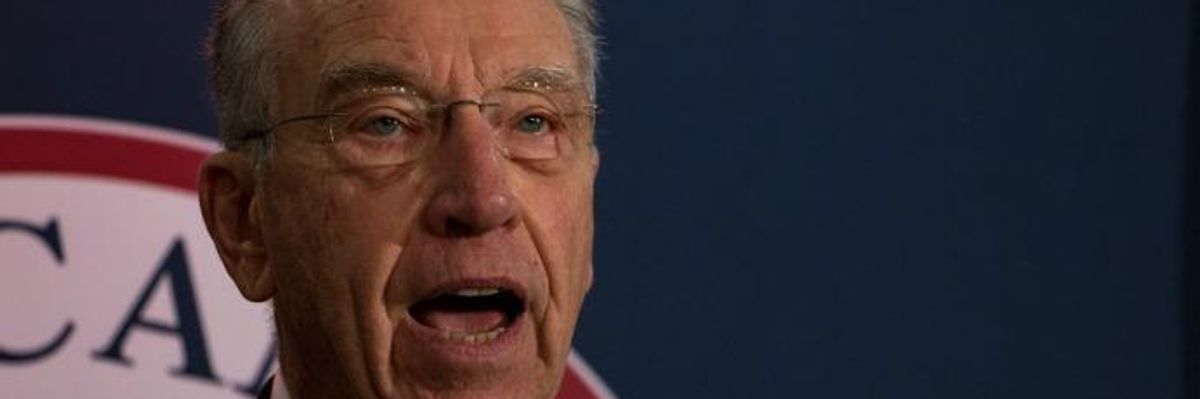
Sen. Chuck Grassley (R-Iowa), who defended repealing the estate tax by saying it "recognizes the people that are investing as opposed to those that are just spending every darn penny they have, whether it's on booze or women or movies." (Photo: Iowa Public Radio Images/flickr/cc)
Senator Slammed for 'Booze and Women' Comment Amid Call for 'All-Out Blitz' to Stop #GOPTaxScam
"Here's what my constituents are spending 'every darn penny' on: Rent. Groceries. Prescriptions. College tuition," Rep. Lee tells Sen. Grassley
As grassroots groups urge increased pressure on members of Congress to stop the #GOPTaxScam from becoming law, a pair of Democratic lawmakers on Monday were among those to shoot down a top Republican's defense of ending a tax that benefits a small group of super wealthy--the estate tax.
The House bill phases out the tax entirely, while the Senate version, passed on Saturday, doubles the amount of inheritance exempt from the tax.
Sen. Chuck Grassley (R-Iowa) told the Des Moines Register that ending the tax, which affects estates valued at $5.5 million for individuals and $11 million for couples, "recognizes the people that are investing as opposed to those that are just spending every darn penny they have, whether it's on booze or women or movies."
In a Monday afternoon tweet, Rep. Barbara Lee (D-Calif.) said, "Just so we're clear, Senator Grassley, here's what my constituents are spending 'every darn penny' on: Rent. Groceries. Prescriptions. College tuition. You just made their lives harder in order to give billionaires massive tax breaks."
Though Grassley said Monday that his comments were misinterpreted, the Patriotic Millionaires, a wealthy group advocating a more just tax system, said, "This isn't just a gaffe, this is him saying what he believes, and giving us a window into the utter contempt the GOP holds for middle class Americans who don't qualify for the estate tax."
Rep. Keith Ellison (D-Minn.) weighed in on the senator's comments as well on Monday, telling Democracy Now! that "the elites always want to shame the poor--right?--and everyone else."
"If people do not purchase goods and services, this economy will grind to recession. And that is why, if you are going to do a tax cut, it ought to really be aimed at low-income and middle-income people," he said. "That might actually spur demand. But the way they've done it is to just give, you know, more to people who already have everything. So, the economic impact of getting rid of the estate tax will not be greater investment or greater consumer demand. It will simply be more money for political influence, mergers, and more bonuses."
What the GOP put forth, Ellison argued, is a plan for "reordering our society, creating a hereditary aristocracy in the United States, and really taking our country and leading it down a path where we will one day see a very tiny group of very, very, very rich elite people in an ocean of desperate people just trying to hang on and make it every single day."
Echoing that perspective, Alan Essig, executive director of the Institute on Taxation and Economic Policy, said the Senate Republicans' passage of the bill "demonstrated that their top priority is satisfying the policy wants of the wealthy and the powerful. Tax increases and loss of healthcare for millions of hardworking low- and middle-income families apparently are inconsequential collateral damage as long as well-heeled donors and corporations get their tax cuts."
"There's only one way to stop the legislation from becoming law: massive public mobilization that makes very clear the culprits will be held to account."Also fueling anger over the tax bills is that the tax cuts afforded to corporations are permanent, while any tax relief seen by the middle class is just temporary. With these factors in mind, opponents of the tax bill are calling for all hands on deck to stop the effort during the short window of time for the two versions to be reconciled before heading to President Donald Trump's desk.
As Robert Weissman, president of Public Citizen, argues in a Common Dreams op-ed on Monday: "There are only days or weeks to go before both houses will vote on a reconciled bill. And there's only one way to stop the legislation from becoming law: massive public mobilization that makes very clear the culprits will be held to account."
MoveOn.org made a call for such action to its members in an email on Monday.
"We've entered the critical final phase of the fight over the GOP tax bill--a tax hike on the middle class and full-scale burglary of our nation to benefit the superrich. What happens in the coming weeks will have consequences for a generation--and the reaction over the next 48 hours will shape the rest of this fight," the letter said.
"It's time for an all-out blitz to stop the GOP tax hike," it continued, "and, win or lose, to ensure that the public understands exactly how viciously the Republicans are trying to rip off the public to enrich their donors."
We are at a crossroads
This country and this world are at a monumental crossroads. In a few short weeks, US voters will have an opportunity to beat back the forces of fascism and confront the billionaires who are rigging the economy, our media system, and our democracy, making it increasingly impossible for ordinary people to get by. We’re not just talking about the election. We’re talking about what must be done once these fascist elements are vanquished from power. We need a bolder set of solutions than what either major party has so far been willing to offer and a working-class movement ready to fight like hell for it. Trump didn't emerge from nowhere. The conditions that fueled MAGA authoritarianism were created by decades of radical neoliberal economic policies and a corrupt political system dominated by corporate interests. They slashed taxes on the super-rich, promising that the benefits would trickle down. They said giveaways to the corporate titans would make life more affordable for the rest of us. It was all bullshit. And when a bitter, betrayed populace searches for someone to blame, right-wing demagogues have little trouble finding scapegoats. People know when they're being lied to, but you won't hear any of this from the corporate media. Only independent journalism—powered and funded by people who believe in building a better world—can deliver truly trustworthy daily news. Our Fall Campaign is underway, and we need your help. To power our newsroom through the rest of the year, we need to raise $125,000 by midnight on October 31. So if you share our vision, please contribute whatever you can to sustain our work. |
As grassroots groups urge increased pressure on members of Congress to stop the #GOPTaxScam from becoming law, a pair of Democratic lawmakers on Monday were among those to shoot down a top Republican's defense of ending a tax that benefits a small group of super wealthy--the estate tax.
The House bill phases out the tax entirely, while the Senate version, passed on Saturday, doubles the amount of inheritance exempt from the tax.
Sen. Chuck Grassley (R-Iowa) told the Des Moines Register that ending the tax, which affects estates valued at $5.5 million for individuals and $11 million for couples, "recognizes the people that are investing as opposed to those that are just spending every darn penny they have, whether it's on booze or women or movies."
In a Monday afternoon tweet, Rep. Barbara Lee (D-Calif.) said, "Just so we're clear, Senator Grassley, here's what my constituents are spending 'every darn penny' on: Rent. Groceries. Prescriptions. College tuition. You just made their lives harder in order to give billionaires massive tax breaks."
Though Grassley said Monday that his comments were misinterpreted, the Patriotic Millionaires, a wealthy group advocating a more just tax system, said, "This isn't just a gaffe, this is him saying what he believes, and giving us a window into the utter contempt the GOP holds for middle class Americans who don't qualify for the estate tax."
Rep. Keith Ellison (D-Minn.) weighed in on the senator's comments as well on Monday, telling Democracy Now! that "the elites always want to shame the poor--right?--and everyone else."
"If people do not purchase goods and services, this economy will grind to recession. And that is why, if you are going to do a tax cut, it ought to really be aimed at low-income and middle-income people," he said. "That might actually spur demand. But the way they've done it is to just give, you know, more to people who already have everything. So, the economic impact of getting rid of the estate tax will not be greater investment or greater consumer demand. It will simply be more money for political influence, mergers, and more bonuses."
What the GOP put forth, Ellison argued, is a plan for "reordering our society, creating a hereditary aristocracy in the United States, and really taking our country and leading it down a path where we will one day see a very tiny group of very, very, very rich elite people in an ocean of desperate people just trying to hang on and make it every single day."
Echoing that perspective, Alan Essig, executive director of the Institute on Taxation and Economic Policy, said the Senate Republicans' passage of the bill "demonstrated that their top priority is satisfying the policy wants of the wealthy and the powerful. Tax increases and loss of healthcare for millions of hardworking low- and middle-income families apparently are inconsequential collateral damage as long as well-heeled donors and corporations get their tax cuts."
"There's only one way to stop the legislation from becoming law: massive public mobilization that makes very clear the culprits will be held to account."Also fueling anger over the tax bills is that the tax cuts afforded to corporations are permanent, while any tax relief seen by the middle class is just temporary. With these factors in mind, opponents of the tax bill are calling for all hands on deck to stop the effort during the short window of time for the two versions to be reconciled before heading to President Donald Trump's desk.
As Robert Weissman, president of Public Citizen, argues in a Common Dreams op-ed on Monday: "There are only days or weeks to go before both houses will vote on a reconciled bill. And there's only one way to stop the legislation from becoming law: massive public mobilization that makes very clear the culprits will be held to account."
MoveOn.org made a call for such action to its members in an email on Monday.
"We've entered the critical final phase of the fight over the GOP tax bill--a tax hike on the middle class and full-scale burglary of our nation to benefit the superrich. What happens in the coming weeks will have consequences for a generation--and the reaction over the next 48 hours will shape the rest of this fight," the letter said.
"It's time for an all-out blitz to stop the GOP tax hike," it continued, "and, win or lose, to ensure that the public understands exactly how viciously the Republicans are trying to rip off the public to enrich their donors."