SUBSCRIBE TO OUR FREE NEWSLETTER
Daily news & progressive opinion—funded by the people, not the corporations—delivered straight to your inbox.
5
#000000
#FFFFFF
To donate by check, phone, or other method, see our More Ways to Give page.
Daily news & progressive opinion—funded by the people, not the corporations—delivered straight to your inbox.
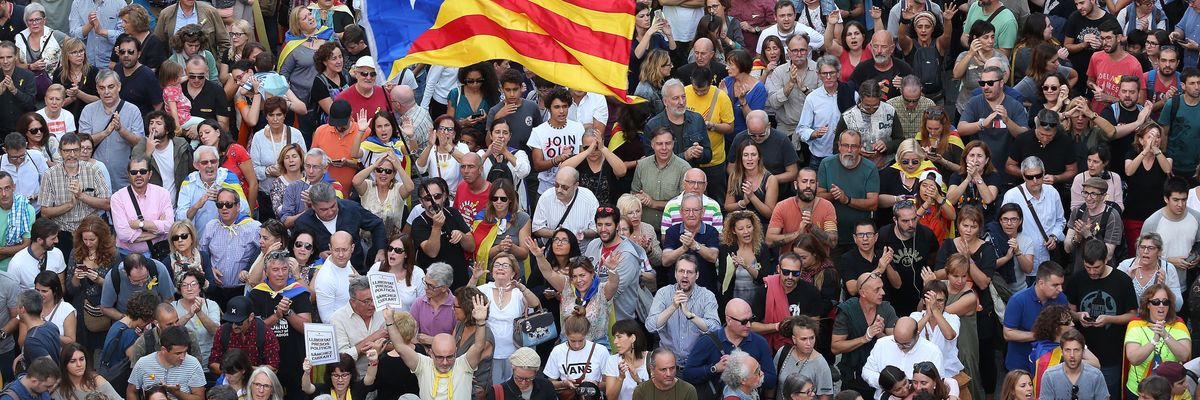
People hold up Catalan independence flags at a Catalan independence rally to demand the release of imprisoned Catalan leaders Jordi Sanchez and Jordi Cuixart on October 21, 2017 in Barcelona, Spain. The Spanish government announced measures today it will implement in triggering Article 155, which would lead to the imposition of direct rule by Spanish authorities in Catalonia and at least temporarily suspend the region's autonomy. The government also plans to hold Catalan regional elections in January. The moves come after Catalan regional President Carles Puigdemont let a Thursday deadline today pass and threatened to go forward with Catalan independence. (Photo: Sean Gallup/Getty Images)
This post may be updated.
Catalans did not take the news that Spanish Prime Minister will move to impose direct rule on their region quietly on Saturday. Nearly half a million people marched in Barcelona soon after the prime minister's press conference.
Carles Puigdemont, president of Catalonia, joined the demonstration before a planned speech responding to Mariano Rajoy's statement that pending the approval of the senate, which his party controls, he would remove the Catalan government from power and call for a special election in the coming months.
The protesters chanted, "Freedom!" and "Rajoy, Rajoy, so you know we are leaving!"
Saturday, October 21, 10:00am:
Thousands of Catalans were expected to protest Saturday afternoon after Spanish Prime Minister Mariano Rajoy announced he would take control of Catalonia by invoking Article 155 of the Spanish constitution, weeks after the region's independence referendum.
Defying the majority of Catalan voters who approved of a split from Spain in Catalonia's independence referendum this month, Rajoy spoke at a press conference about his plans to transfer the power of the region's president, Carles Puigdemont, to the central government, and hold early elections in the next six months.
Forty percent of Catalonia's 5.5 eligible voters cast ballots in the referendum, despite a show of force by Spanish police that left nearly 900 people injured ahead of the October 1 vote.
Ninety percent of those who voted approved of independence, according to the regional government. Officials said that in addition to police violence, Spanish law enforcement raided polling stations, resulting in the loss of 770,000 ballots.
Following the vote, large crowds in Barcelona last weekend called for peaceful negotiations to determine the next step, but Rajoy has rejected dialogue on the grounds that the Spanish government sees Catalonia's referendum as illegal.
Observers and supporters of Catalonia's independence movement denounced Rajoy's planned power grab on social media.
Dear Common Dreams reader, It’s been nearly 30 years since I co-founded Common Dreams with my late wife, Lina Newhouser. We had the radical notion that journalism should serve the public good, not corporate profits. It was clear to us from the outset what it would take to build such a project. No paid advertisements. No corporate sponsors. No millionaire publisher telling us what to think or do. Many people said we wouldn't last a year, but we proved those doubters wrong. Together with a tremendous team of journalists and dedicated staff, we built an independent media outlet free from the constraints of profits and corporate control. Our mission has always been simple: To inform. To inspire. To ignite change for the common good. Building Common Dreams was not easy. Our survival was never guaranteed. When you take on the most powerful forces—Wall Street greed, fossil fuel industry destruction, Big Tech lobbyists, and uber-rich oligarchs who have spent billions upon billions rigging the economy and democracy in their favor—the only bulwark you have is supporters who believe in your work. But here’s the urgent message from me today. It's never been this bad out there. And it's never been this hard to keep us going. At the very moment Common Dreams is most needed, the threats we face are intensifying. We need your support now more than ever. We don't accept corporate advertising and never will. We don't have a paywall because we don't think people should be blocked from critical news based on their ability to pay. Everything we do is funded by the donations of readers like you. When everyone does the little they can afford, we are strong. But if that support retreats or dries up, so do we. Will you donate now to make sure Common Dreams not only survives but thrives? —Craig Brown, Co-founder |
This post may be updated.
Catalans did not take the news that Spanish Prime Minister will move to impose direct rule on their region quietly on Saturday. Nearly half a million people marched in Barcelona soon after the prime minister's press conference.
Carles Puigdemont, president of Catalonia, joined the demonstration before a planned speech responding to Mariano Rajoy's statement that pending the approval of the senate, which his party controls, he would remove the Catalan government from power and call for a special election in the coming months.
The protesters chanted, "Freedom!" and "Rajoy, Rajoy, so you know we are leaving!"
Saturday, October 21, 10:00am:
Thousands of Catalans were expected to protest Saturday afternoon after Spanish Prime Minister Mariano Rajoy announced he would take control of Catalonia by invoking Article 155 of the Spanish constitution, weeks after the region's independence referendum.
Defying the majority of Catalan voters who approved of a split from Spain in Catalonia's independence referendum this month, Rajoy spoke at a press conference about his plans to transfer the power of the region's president, Carles Puigdemont, to the central government, and hold early elections in the next six months.
Forty percent of Catalonia's 5.5 eligible voters cast ballots in the referendum, despite a show of force by Spanish police that left nearly 900 people injured ahead of the October 1 vote.
Ninety percent of those who voted approved of independence, according to the regional government. Officials said that in addition to police violence, Spanish law enforcement raided polling stations, resulting in the loss of 770,000 ballots.
Following the vote, large crowds in Barcelona last weekend called for peaceful negotiations to determine the next step, but Rajoy has rejected dialogue on the grounds that the Spanish government sees Catalonia's referendum as illegal.
Observers and supporters of Catalonia's independence movement denounced Rajoy's planned power grab on social media.
This post may be updated.
Catalans did not take the news that Spanish Prime Minister will move to impose direct rule on their region quietly on Saturday. Nearly half a million people marched in Barcelona soon after the prime minister's press conference.
Carles Puigdemont, president of Catalonia, joined the demonstration before a planned speech responding to Mariano Rajoy's statement that pending the approval of the senate, which his party controls, he would remove the Catalan government from power and call for a special election in the coming months.
The protesters chanted, "Freedom!" and "Rajoy, Rajoy, so you know we are leaving!"
Saturday, October 21, 10:00am:
Thousands of Catalans were expected to protest Saturday afternoon after Spanish Prime Minister Mariano Rajoy announced he would take control of Catalonia by invoking Article 155 of the Spanish constitution, weeks after the region's independence referendum.
Defying the majority of Catalan voters who approved of a split from Spain in Catalonia's independence referendum this month, Rajoy spoke at a press conference about his plans to transfer the power of the region's president, Carles Puigdemont, to the central government, and hold early elections in the next six months.
Forty percent of Catalonia's 5.5 eligible voters cast ballots in the referendum, despite a show of force by Spanish police that left nearly 900 people injured ahead of the October 1 vote.
Ninety percent of those who voted approved of independence, according to the regional government. Officials said that in addition to police violence, Spanish law enforcement raided polling stations, resulting in the loss of 770,000 ballots.
Following the vote, large crowds in Barcelona last weekend called for peaceful negotiations to determine the next step, but Rajoy has rejected dialogue on the grounds that the Spanish government sees Catalonia's referendum as illegal.
Observers and supporters of Catalonia's independence movement denounced Rajoy's planned power grab on social media.