

SUBSCRIBE TO OUR FREE NEWSLETTER
Daily news & progressive opinion—funded by the people, not the corporations—delivered straight to your inbox.
5
#000000
#FFFFFF
To donate by check, phone, or other method, see our More Ways to Give page.
Daily news & progressive opinion—funded by the people, not the corporations—delivered straight to your inbox.
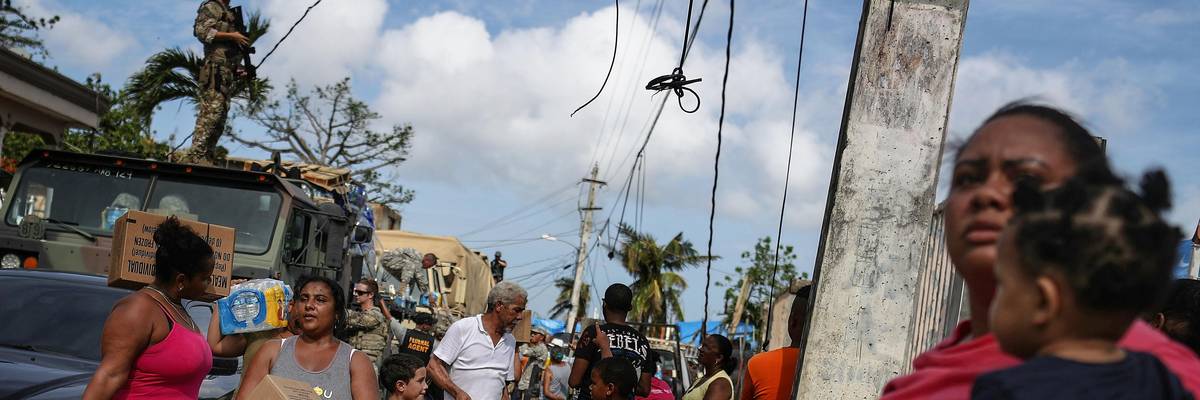
Puerto Ricans receive food and water, provided by FEMA, in a neighborhood without grid electricity or running water on October 17. Residents said this was the first official governmental delivery of food and water to the community, nearly four weeks after the Hurricane Maria hit. (Photo: Mario Tama/Getty Images)
Despite an estimated one million people still living without drinking water, 80 percent of the island wihout electricity, and fresh reports that people are "dying" on the island, President Donald Trump stirred outrage on Thursday by giving himself a perfect "ten" on his response to the crisis in Puerto Rico.
"Trump's callous, self-appointed grade reflects everything that is wrong with the alleged relief effort in Puerto Rico." --Bonnie Castillo, NNU/RNRN"The people in Puerto Rico are dying," said National Nurses United (NNU) vice president Cathy Kennedy, who returned Wednesday from a two-week relief trip with the union's Registered Nurses Response Network (RNRN). "Nurses have been going out into communities, where all they ask for is water and food. And when you have to make a decision of who's going to get the food today or the water -- we shouldn't have to do that. The United States is the richest country in the world; Puerto Rico is part of the United States."
Yet Trump told a different story about the recovery in the Oval Office on Thursday, speaking to reporters as Puerto Rican governor Ricardo Rossello looked on.
"I would give myself a ten," he said. "We have provided so much, so fast."
"Trump's callous, self-appointed grade reflects everything that is wrong with the alleged relief effort in Puerto Rico," Bonnie Castillo, director of National Nurses United's Registered Nurse Response Network (RNRN), told Common Dreams via email.
The nurses who returned from the relief trip, she continued, "are horrified by the massive damage, dislocation, and trauma they have witnessed. It includes one million people living in darkness, many of them in homes with roofs blown off, soaked furniture, dangerous black mold growing everywhere, lengthy waits for food and water from FEMA that often never comes, a decimated transportation system, and hazardous materials abundant."
About one million Puerto Ricans were still without drinking water as of Thursday. According to status.pr, a website that is maintained by Puerto Rican officials with daily updates on the recovery, 80 percent of the island was still without electricity as Trump was speaking. More than half of the island's cell phone towers are still not working and more than 4,000 people are still living in shelters.
FEMA has distributed about 23 million liters of water throughout the island--accounting for only about nine percent of Puerto Rico's drinking water needs. Forced to drink from rivers, many on the island are being exposed to harmful bacteria and toxic chemicals.
The president put Rossello on the spot after grading himself, asking, "Did we do a great job?" The governor declined to give him a rating. He carefully thanked the administration for sending relief, while emphasizing that the island needs the same efforts that were afforded to Texas after Hurricane Harvey. "We need equal treatment, we need all the resources we can get."
According to Castillo, "the lasting image of this administration may well be Puerto Ricans having to drink contaminated water from polluted streams, putting their health in serious danger, while waiting for timely, appropriate federal aid to millions of U.S. citizens."
Dear Common Dreams reader, It’s been nearly 30 years since I co-founded Common Dreams with my late wife, Lina Newhouser. We had the radical notion that journalism should serve the public good, not corporate profits. It was clear to us from the outset what it would take to build such a project. No paid advertisements. No corporate sponsors. No millionaire publisher telling us what to think or do. Many people said we wouldn't last a year, but we proved those doubters wrong. Together with a tremendous team of journalists and dedicated staff, we built an independent media outlet free from the constraints of profits and corporate control. Our mission has always been simple: To inform. To inspire. To ignite change for the common good. Building Common Dreams was not easy. Our survival was never guaranteed. When you take on the most powerful forces—Wall Street greed, fossil fuel industry destruction, Big Tech lobbyists, and uber-rich oligarchs who have spent billions upon billions rigging the economy and democracy in their favor—the only bulwark you have is supporters who believe in your work. But here’s the urgent message from me today. It's never been this bad out there. And it's never been this hard to keep us going. At the very moment Common Dreams is most needed, the threats we face are intensifying. We need your support now more than ever. We don't accept corporate advertising and never will. We don't have a paywall because we don't think people should be blocked from critical news based on their ability to pay. Everything we do is funded by the donations of readers like you. When everyone does the little they can afford, we are strong. But if that support retreats or dries up, so do we. Will you donate now to make sure Common Dreams not only survives but thrives? —Craig Brown, Co-founder |
Despite an estimated one million people still living without drinking water, 80 percent of the island wihout electricity, and fresh reports that people are "dying" on the island, President Donald Trump stirred outrage on Thursday by giving himself a perfect "ten" on his response to the crisis in Puerto Rico.
"Trump's callous, self-appointed grade reflects everything that is wrong with the alleged relief effort in Puerto Rico." --Bonnie Castillo, NNU/RNRN"The people in Puerto Rico are dying," said National Nurses United (NNU) vice president Cathy Kennedy, who returned Wednesday from a two-week relief trip with the union's Registered Nurses Response Network (RNRN). "Nurses have been going out into communities, where all they ask for is water and food. And when you have to make a decision of who's going to get the food today or the water -- we shouldn't have to do that. The United States is the richest country in the world; Puerto Rico is part of the United States."
Yet Trump told a different story about the recovery in the Oval Office on Thursday, speaking to reporters as Puerto Rican governor Ricardo Rossello looked on.
"I would give myself a ten," he said. "We have provided so much, so fast."
"Trump's callous, self-appointed grade reflects everything that is wrong with the alleged relief effort in Puerto Rico," Bonnie Castillo, director of National Nurses United's Registered Nurse Response Network (RNRN), told Common Dreams via email.
The nurses who returned from the relief trip, she continued, "are horrified by the massive damage, dislocation, and trauma they have witnessed. It includes one million people living in darkness, many of them in homes with roofs blown off, soaked furniture, dangerous black mold growing everywhere, lengthy waits for food and water from FEMA that often never comes, a decimated transportation system, and hazardous materials abundant."
About one million Puerto Ricans were still without drinking water as of Thursday. According to status.pr, a website that is maintained by Puerto Rican officials with daily updates on the recovery, 80 percent of the island was still without electricity as Trump was speaking. More than half of the island's cell phone towers are still not working and more than 4,000 people are still living in shelters.
FEMA has distributed about 23 million liters of water throughout the island--accounting for only about nine percent of Puerto Rico's drinking water needs. Forced to drink from rivers, many on the island are being exposed to harmful bacteria and toxic chemicals.
The president put Rossello on the spot after grading himself, asking, "Did we do a great job?" The governor declined to give him a rating. He carefully thanked the administration for sending relief, while emphasizing that the island needs the same efforts that were afforded to Texas after Hurricane Harvey. "We need equal treatment, we need all the resources we can get."
According to Castillo, "the lasting image of this administration may well be Puerto Ricans having to drink contaminated water from polluted streams, putting their health in serious danger, while waiting for timely, appropriate federal aid to millions of U.S. citizens."
Despite an estimated one million people still living without drinking water, 80 percent of the island wihout electricity, and fresh reports that people are "dying" on the island, President Donald Trump stirred outrage on Thursday by giving himself a perfect "ten" on his response to the crisis in Puerto Rico.
"Trump's callous, self-appointed grade reflects everything that is wrong with the alleged relief effort in Puerto Rico." --Bonnie Castillo, NNU/RNRN"The people in Puerto Rico are dying," said National Nurses United (NNU) vice president Cathy Kennedy, who returned Wednesday from a two-week relief trip with the union's Registered Nurses Response Network (RNRN). "Nurses have been going out into communities, where all they ask for is water and food. And when you have to make a decision of who's going to get the food today or the water -- we shouldn't have to do that. The United States is the richest country in the world; Puerto Rico is part of the United States."
Yet Trump told a different story about the recovery in the Oval Office on Thursday, speaking to reporters as Puerto Rican governor Ricardo Rossello looked on.
"I would give myself a ten," he said. "We have provided so much, so fast."
"Trump's callous, self-appointed grade reflects everything that is wrong with the alleged relief effort in Puerto Rico," Bonnie Castillo, director of National Nurses United's Registered Nurse Response Network (RNRN), told Common Dreams via email.
The nurses who returned from the relief trip, she continued, "are horrified by the massive damage, dislocation, and trauma they have witnessed. It includes one million people living in darkness, many of them in homes with roofs blown off, soaked furniture, dangerous black mold growing everywhere, lengthy waits for food and water from FEMA that often never comes, a decimated transportation system, and hazardous materials abundant."
About one million Puerto Ricans were still without drinking water as of Thursday. According to status.pr, a website that is maintained by Puerto Rican officials with daily updates on the recovery, 80 percent of the island was still without electricity as Trump was speaking. More than half of the island's cell phone towers are still not working and more than 4,000 people are still living in shelters.
FEMA has distributed about 23 million liters of water throughout the island--accounting for only about nine percent of Puerto Rico's drinking water needs. Forced to drink from rivers, many on the island are being exposed to harmful bacteria and toxic chemicals.
The president put Rossello on the spot after grading himself, asking, "Did we do a great job?" The governor declined to give him a rating. He carefully thanked the administration for sending relief, while emphasizing that the island needs the same efforts that were afforded to Texas after Hurricane Harvey. "We need equal treatment, we need all the resources we can get."
According to Castillo, "the lasting image of this administration may well be Puerto Ricans having to drink contaminated water from polluted streams, putting their health in serious danger, while waiting for timely, appropriate federal aid to millions of U.S. citizens."

