SUBSCRIBE TO OUR FREE NEWSLETTER
Daily news & progressive opinion—funded by the people, not the corporations—delivered straight to your inbox.
5
#000000
#FFFFFF
To donate by check, phone, or other method, see our More Ways to Give page.
Daily news & progressive opinion—funded by the people, not the corporations—delivered straight to your inbox.
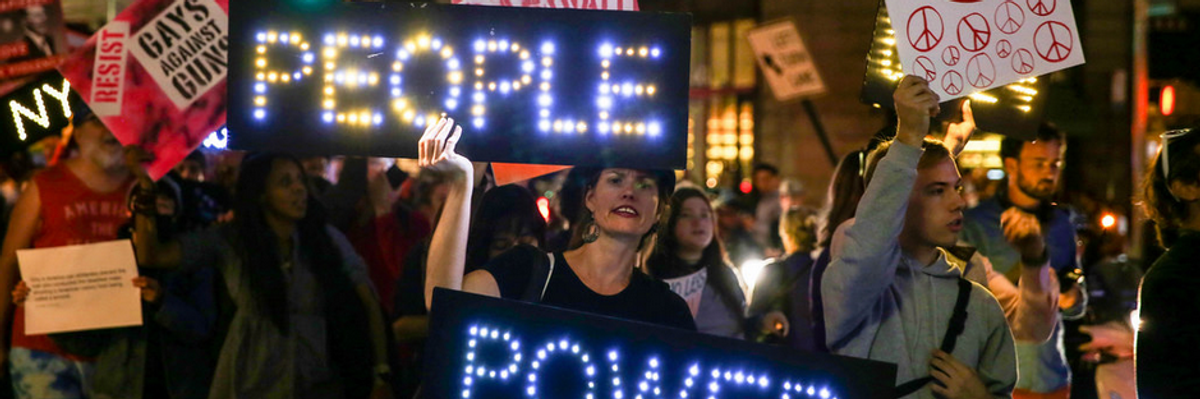
Protesters gathered in New York on Monday night to call for legislative action to prevent attacks like the one that killed 59 people in Las Vegas on Sunday. (Photo: Working Families Party/Flickr/cc)
Progressives, entertainers, and Democratic lawmakers are among the many Americans who are signaling a loss of patience with the predictable Republican response to the latest mass shooting.
"To those who say we can't talk about machine gun massacres right after the massacre: I'm done waiting for the 'right time' to talk about it. The 'can't talk about it now' crowd is killing us."--Gov. Jay Inslee (D-Wash.)
Late-night host Stephen Colbert was among several comedians this week who addressed the legislative inaction and denial that has become familiar after massacres like the one that took place in Las Vegas on Sunday night.
In his monologue Tuesday night, Colbert showed Republican leaders repeating after shootings in Newtown, Connecticut; San Bernardino, California; Orlando, Florida, and other cities that it wasn't "the time or place" to talk about stricter gun laws.
Senate Majority Leader Mitch McConnell (R-Ky.) joined the White House in rejecting any discussion of preventative measures that Congress might take, saying on Tuesday, "I think it's premature to be discussing legislative solutions, if there are any."
Sen. John Thune (R-S.D.) went as far to suggest that the burden is on Americans to protect themselves from firearms since their elected officials are unwilling to take steps to protect them.
"It's an open society and it's hard to prevent anything," he told MSNBC. "I think people are going to have to take steps in their own lives to take precautions. To protect themselves. And in situations like that, you know, try to stay safe."
Washington governor Jay Inslee was among the Democratic politicians who expressed deep frustration with Republicans.
"Once again, we are mourning the violent loss of innocent lives to a man who had access to weapons no civilian should have access to," he said in a statement. "It's impossible to know how to stop every act of gun violence, but I know with my whole being that our nation's leaders aren't even trying. To those who say we can't talk about machine gun massacres right after the massacre: I'm done waiting for the 'right time' to talk about it. The 'can't talk about it now' crowd is killing us."
Meanwhile, polls suggest that Americans don't share Republicans' concerns about "politicizing" mass murders by talking about how to prevent them. A CNN report showed that directly after a shooting like the one in Las Vegas, people tend to call for stricter gun laws.
Shortly after the Pulse nightclub shooting, 55 percent said they favored stricter gun control laws, 42 percent were opposed. That was up from 46 percent who felt that way in fall 2015 and the highest share to say so since January 2013, about a month after the Sandy Hook shootings...
The most recent public polling on the topic comes from Quinnipiac University, this June, just after the shooting at a congressional baseball team's practice. That poll found 57 percent of registered voters felt it was too easy to buy a gun in the US today, 6 percent said it was too difficult and 32 percent say it's about right. That poll also found that 57 percent felt the US would be less safe if more people carried guns and 35 percent thought the country would be safer.
CNN also reported that as time passes after a mass shooting, Americans' desire for stricter gun laws tends to fade--suggesting that the days after an attack is the exact right time to fight for laws that would help prevent the loss of life.
Dear Common Dreams reader, It’s been nearly 30 years since I co-founded Common Dreams with my late wife, Lina Newhouser. We had the radical notion that journalism should serve the public good, not corporate profits. It was clear to us from the outset what it would take to build such a project. No paid advertisements. No corporate sponsors. No millionaire publisher telling us what to think or do. Many people said we wouldn't last a year, but we proved those doubters wrong. Together with a tremendous team of journalists and dedicated staff, we built an independent media outlet free from the constraints of profits and corporate control. Our mission has always been simple: To inform. To inspire. To ignite change for the common good. Building Common Dreams was not easy. Our survival was never guaranteed. When you take on the most powerful forces—Wall Street greed, fossil fuel industry destruction, Big Tech lobbyists, and uber-rich oligarchs who have spent billions upon billions rigging the economy and democracy in their favor—the only bulwark you have is supporters who believe in your work. But here’s the urgent message from me today. It's never been this bad out there. And it's never been this hard to keep us going. At the very moment Common Dreams is most needed, the threats we face are intensifying. We need your support now more than ever. We don't accept corporate advertising and never will. We don't have a paywall because we don't think people should be blocked from critical news based on their ability to pay. Everything we do is funded by the donations of readers like you. When everyone does the little they can afford, we are strong. But if that support retreats or dries up, so do we. Will you donate now to make sure Common Dreams not only survives but thrives? —Craig Brown, Co-founder |
Progressives, entertainers, and Democratic lawmakers are among the many Americans who are signaling a loss of patience with the predictable Republican response to the latest mass shooting.
"To those who say we can't talk about machine gun massacres right after the massacre: I'm done waiting for the 'right time' to talk about it. The 'can't talk about it now' crowd is killing us."--Gov. Jay Inslee (D-Wash.)
Late-night host Stephen Colbert was among several comedians this week who addressed the legislative inaction and denial that has become familiar after massacres like the one that took place in Las Vegas on Sunday night.
In his monologue Tuesday night, Colbert showed Republican leaders repeating after shootings in Newtown, Connecticut; San Bernardino, California; Orlando, Florida, and other cities that it wasn't "the time or place" to talk about stricter gun laws.
Senate Majority Leader Mitch McConnell (R-Ky.) joined the White House in rejecting any discussion of preventative measures that Congress might take, saying on Tuesday, "I think it's premature to be discussing legislative solutions, if there are any."
Sen. John Thune (R-S.D.) went as far to suggest that the burden is on Americans to protect themselves from firearms since their elected officials are unwilling to take steps to protect them.
"It's an open society and it's hard to prevent anything," he told MSNBC. "I think people are going to have to take steps in their own lives to take precautions. To protect themselves. And in situations like that, you know, try to stay safe."
Washington governor Jay Inslee was among the Democratic politicians who expressed deep frustration with Republicans.
"Once again, we are mourning the violent loss of innocent lives to a man who had access to weapons no civilian should have access to," he said in a statement. "It's impossible to know how to stop every act of gun violence, but I know with my whole being that our nation's leaders aren't even trying. To those who say we can't talk about machine gun massacres right after the massacre: I'm done waiting for the 'right time' to talk about it. The 'can't talk about it now' crowd is killing us."
Meanwhile, polls suggest that Americans don't share Republicans' concerns about "politicizing" mass murders by talking about how to prevent them. A CNN report showed that directly after a shooting like the one in Las Vegas, people tend to call for stricter gun laws.
Shortly after the Pulse nightclub shooting, 55 percent said they favored stricter gun control laws, 42 percent were opposed. That was up from 46 percent who felt that way in fall 2015 and the highest share to say so since January 2013, about a month after the Sandy Hook shootings...
The most recent public polling on the topic comes from Quinnipiac University, this June, just after the shooting at a congressional baseball team's practice. That poll found 57 percent of registered voters felt it was too easy to buy a gun in the US today, 6 percent said it was too difficult and 32 percent say it's about right. That poll also found that 57 percent felt the US would be less safe if more people carried guns and 35 percent thought the country would be safer.
CNN also reported that as time passes after a mass shooting, Americans' desire for stricter gun laws tends to fade--suggesting that the days after an attack is the exact right time to fight for laws that would help prevent the loss of life.
Progressives, entertainers, and Democratic lawmakers are among the many Americans who are signaling a loss of patience with the predictable Republican response to the latest mass shooting.
"To those who say we can't talk about machine gun massacres right after the massacre: I'm done waiting for the 'right time' to talk about it. The 'can't talk about it now' crowd is killing us."--Gov. Jay Inslee (D-Wash.)
Late-night host Stephen Colbert was among several comedians this week who addressed the legislative inaction and denial that has become familiar after massacres like the one that took place in Las Vegas on Sunday night.
In his monologue Tuesday night, Colbert showed Republican leaders repeating after shootings in Newtown, Connecticut; San Bernardino, California; Orlando, Florida, and other cities that it wasn't "the time or place" to talk about stricter gun laws.
Senate Majority Leader Mitch McConnell (R-Ky.) joined the White House in rejecting any discussion of preventative measures that Congress might take, saying on Tuesday, "I think it's premature to be discussing legislative solutions, if there are any."
Sen. John Thune (R-S.D.) went as far to suggest that the burden is on Americans to protect themselves from firearms since their elected officials are unwilling to take steps to protect them.
"It's an open society and it's hard to prevent anything," he told MSNBC. "I think people are going to have to take steps in their own lives to take precautions. To protect themselves. And in situations like that, you know, try to stay safe."
Washington governor Jay Inslee was among the Democratic politicians who expressed deep frustration with Republicans.
"Once again, we are mourning the violent loss of innocent lives to a man who had access to weapons no civilian should have access to," he said in a statement. "It's impossible to know how to stop every act of gun violence, but I know with my whole being that our nation's leaders aren't even trying. To those who say we can't talk about machine gun massacres right after the massacre: I'm done waiting for the 'right time' to talk about it. The 'can't talk about it now' crowd is killing us."
Meanwhile, polls suggest that Americans don't share Republicans' concerns about "politicizing" mass murders by talking about how to prevent them. A CNN report showed that directly after a shooting like the one in Las Vegas, people tend to call for stricter gun laws.
Shortly after the Pulse nightclub shooting, 55 percent said they favored stricter gun control laws, 42 percent were opposed. That was up from 46 percent who felt that way in fall 2015 and the highest share to say so since January 2013, about a month after the Sandy Hook shootings...
The most recent public polling on the topic comes from Quinnipiac University, this June, just after the shooting at a congressional baseball team's practice. That poll found 57 percent of registered voters felt it was too easy to buy a gun in the US today, 6 percent said it was too difficult and 32 percent say it's about right. That poll also found that 57 percent felt the US would be less safe if more people carried guns and 35 percent thought the country would be safer.
CNN also reported that as time passes after a mass shooting, Americans' desire for stricter gun laws tends to fade--suggesting that the days after an attack is the exact right time to fight for laws that would help prevent the loss of life.