SUBSCRIBE TO OUR FREE NEWSLETTER
Daily news & progressive opinion—funded by the people, not the corporations—delivered straight to your inbox.
5
#000000
#FFFFFF
To donate by check, phone, or other method, see our More Ways to Give page.
Daily news & progressive opinion—funded by the people, not the corporations—delivered straight to your inbox.
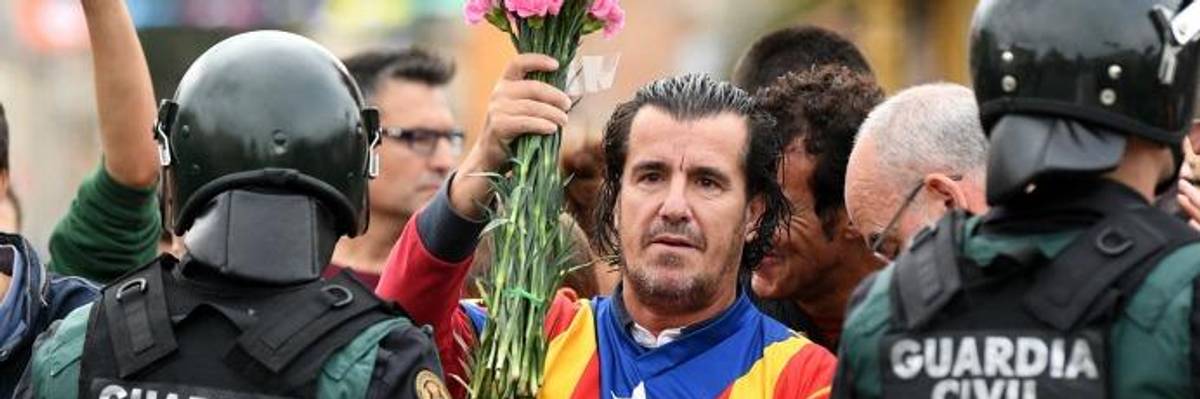
A man dressed in the Catalonian flag holds up pink flowers as police move in on the crowds of voters gathered on October 1, 2017 in Sant Julia de Ramis, Spain. (Photo: David Ramos/Getty Images)
As the Europe Commission stands by the Spanish government's efforts to quash Catalonia's independence referendum, the U.N. human rights chief is demanding an investigation into allegations of abuse by state police forces as the regional government is launching its own investigation into violence that left nearly 900 people injured this weekend.
"With hundreds of people reported injured, I urge the Spanish authorities to ensure thorough, independent, and impartial investigations into all acts of violence," Zeid Ra'ad Al Hussein, U.N. High Commissioner for Human Rights, said in a statement released Monday.
Madrid, which has maintained that the referendum violates Spain's constitution, sent additional police forces into the region ahead of the vote to seize ballot materials and close down polls, triggering massive protests and occupations of polling stations by voters.
The people of Catalonia, a wealthy northeast region of Spain, voted overwhelming in favor of independence on Sunday despite efforts by the Spanish government to prevent the referendum.
"Thousands of Spanish police were shipped in to the region to prevent the vote on secession," Reuters reports, "though scenes of violence due to heavy-handed tactics by armored, baton-carrying riot units have received international condemnation."
The U.N. commissioner, who said he was "very disturbed by the violence," urged leaders from Madrid and Catalonia to resolve the independence dispute "through political dialogue, with full respect for democratic freedoms," and called on the Spanish government "to accept without delay the requests by relevant U.N. human rights experts to visit."
Amnesty International has deployed a team of researchers in Catalonia to monitor human rights violations. John Dalhuisen, the group's Europe and Central Asia director, said: "There is plenty of footage to suggest that police officers have used excessive and disproportionate force at at least some of them. With tensions running high, it is essential that both Spanish law and international human rights law is respected."
Carles Puigdemont--the Catalan leader who was inaugurated as president after a reported 90 percent of voters expressed support for Catalonia's independence--announced on Monday that Catalonia will launch a special commission to investigate alarming actions by Spanish national police, which were documented and widely shared on social media throughout the weekend.
The violence towards #SpanishPolice shows why filming Gardai should be illegal.#CatalanReferendum #Jobstown #cblivepic.twitter.com/EILXrX7TpV
-- The Labour Parody (@Iab0ur) October 2, 2017
Puigdemont said in a news conference that the vote was valid and binding, but that he had not yet been in touch with the Spanish government. Although he had previously promised to "declare Catalan independence imminently," Puigdemont said on Sunday night that "the referendum results would be put before the regional parliament 'where the sovereignty of our people lies, so that it can act in accordance with the law of the referendum,'" the Guardian reports.
The Catalan leader called on Spanish Prime Minister Mariano Rajoy to declare whether he would engage in mediation talks overseen by the European Union to transition the region to an independent nation.
However, in a statement released Monday, the European Commission, the executive of the European Union, endorsed Madrid's claim that "under the Spanish Constitution," the vote for Catalan independence "was not legal."
"For the European Commission, as President [Jean-Claude] Juncker has reiterated repeatedly, this is an internal matter for Spain that has to be dealt with in line with the constitutional order of Spain," the statement continued, adding: "We trust the leadership of Prime Minister Mariano Rajoy to manage this difficult process."
On Sunday, Rajoy was rebuked for praising the actions of the Spanish police forces and refusing to condemn the violence that left hundreds of Catalan voters injured.
Dear Common Dreams reader, It’s been nearly 30 years since I co-founded Common Dreams with my late wife, Lina Newhouser. We had the radical notion that journalism should serve the public good, not corporate profits. It was clear to us from the outset what it would take to build such a project. No paid advertisements. No corporate sponsors. No millionaire publisher telling us what to think or do. Many people said we wouldn't last a year, but we proved those doubters wrong. Together with a tremendous team of journalists and dedicated staff, we built an independent media outlet free from the constraints of profits and corporate control. Our mission has always been simple: To inform. To inspire. To ignite change for the common good. Building Common Dreams was not easy. Our survival was never guaranteed. When you take on the most powerful forces—Wall Street greed, fossil fuel industry destruction, Big Tech lobbyists, and uber-rich oligarchs who have spent billions upon billions rigging the economy and democracy in their favor—the only bulwark you have is supporters who believe in your work. But here’s the urgent message from me today. It's never been this bad out there. And it's never been this hard to keep us going. At the very moment Common Dreams is most needed, the threats we face are intensifying. We need your support now more than ever. We don't accept corporate advertising and never will. We don't have a paywall because we don't think people should be blocked from critical news based on their ability to pay. Everything we do is funded by the donations of readers like you. When everyone does the little they can afford, we are strong. But if that support retreats or dries up, so do we. Will you donate now to make sure Common Dreams not only survives but thrives? —Craig Brown, Co-founder |
As the Europe Commission stands by the Spanish government's efforts to quash Catalonia's independence referendum, the U.N. human rights chief is demanding an investigation into allegations of abuse by state police forces as the regional government is launching its own investigation into violence that left nearly 900 people injured this weekend.
"With hundreds of people reported injured, I urge the Spanish authorities to ensure thorough, independent, and impartial investigations into all acts of violence," Zeid Ra'ad Al Hussein, U.N. High Commissioner for Human Rights, said in a statement released Monday.
Madrid, which has maintained that the referendum violates Spain's constitution, sent additional police forces into the region ahead of the vote to seize ballot materials and close down polls, triggering massive protests and occupations of polling stations by voters.
The people of Catalonia, a wealthy northeast region of Spain, voted overwhelming in favor of independence on Sunday despite efforts by the Spanish government to prevent the referendum.
"Thousands of Spanish police were shipped in to the region to prevent the vote on secession," Reuters reports, "though scenes of violence due to heavy-handed tactics by armored, baton-carrying riot units have received international condemnation."
The U.N. commissioner, who said he was "very disturbed by the violence," urged leaders from Madrid and Catalonia to resolve the independence dispute "through political dialogue, with full respect for democratic freedoms," and called on the Spanish government "to accept without delay the requests by relevant U.N. human rights experts to visit."
Amnesty International has deployed a team of researchers in Catalonia to monitor human rights violations. John Dalhuisen, the group's Europe and Central Asia director, said: "There is plenty of footage to suggest that police officers have used excessive and disproportionate force at at least some of them. With tensions running high, it is essential that both Spanish law and international human rights law is respected."
Carles Puigdemont--the Catalan leader who was inaugurated as president after a reported 90 percent of voters expressed support for Catalonia's independence--announced on Monday that Catalonia will launch a special commission to investigate alarming actions by Spanish national police, which were documented and widely shared on social media throughout the weekend.
The violence towards #SpanishPolice shows why filming Gardai should be illegal.#CatalanReferendum #Jobstown #cblivepic.twitter.com/EILXrX7TpV
-- The Labour Parody (@Iab0ur) October 2, 2017
Puigdemont said in a news conference that the vote was valid and binding, but that he had not yet been in touch with the Spanish government. Although he had previously promised to "declare Catalan independence imminently," Puigdemont said on Sunday night that "the referendum results would be put before the regional parliament 'where the sovereignty of our people lies, so that it can act in accordance with the law of the referendum,'" the Guardian reports.
The Catalan leader called on Spanish Prime Minister Mariano Rajoy to declare whether he would engage in mediation talks overseen by the European Union to transition the region to an independent nation.
However, in a statement released Monday, the European Commission, the executive of the European Union, endorsed Madrid's claim that "under the Spanish Constitution," the vote for Catalan independence "was not legal."
"For the European Commission, as President [Jean-Claude] Juncker has reiterated repeatedly, this is an internal matter for Spain that has to be dealt with in line with the constitutional order of Spain," the statement continued, adding: "We trust the leadership of Prime Minister Mariano Rajoy to manage this difficult process."
On Sunday, Rajoy was rebuked for praising the actions of the Spanish police forces and refusing to condemn the violence that left hundreds of Catalan voters injured.
As the Europe Commission stands by the Spanish government's efforts to quash Catalonia's independence referendum, the U.N. human rights chief is demanding an investigation into allegations of abuse by state police forces as the regional government is launching its own investigation into violence that left nearly 900 people injured this weekend.
"With hundreds of people reported injured, I urge the Spanish authorities to ensure thorough, independent, and impartial investigations into all acts of violence," Zeid Ra'ad Al Hussein, U.N. High Commissioner for Human Rights, said in a statement released Monday.
Madrid, which has maintained that the referendum violates Spain's constitution, sent additional police forces into the region ahead of the vote to seize ballot materials and close down polls, triggering massive protests and occupations of polling stations by voters.
The people of Catalonia, a wealthy northeast region of Spain, voted overwhelming in favor of independence on Sunday despite efforts by the Spanish government to prevent the referendum.
"Thousands of Spanish police were shipped in to the region to prevent the vote on secession," Reuters reports, "though scenes of violence due to heavy-handed tactics by armored, baton-carrying riot units have received international condemnation."
The U.N. commissioner, who said he was "very disturbed by the violence," urged leaders from Madrid and Catalonia to resolve the independence dispute "through political dialogue, with full respect for democratic freedoms," and called on the Spanish government "to accept without delay the requests by relevant U.N. human rights experts to visit."
Amnesty International has deployed a team of researchers in Catalonia to monitor human rights violations. John Dalhuisen, the group's Europe and Central Asia director, said: "There is plenty of footage to suggest that police officers have used excessive and disproportionate force at at least some of them. With tensions running high, it is essential that both Spanish law and international human rights law is respected."
Carles Puigdemont--the Catalan leader who was inaugurated as president after a reported 90 percent of voters expressed support for Catalonia's independence--announced on Monday that Catalonia will launch a special commission to investigate alarming actions by Spanish national police, which were documented and widely shared on social media throughout the weekend.
The violence towards #SpanishPolice shows why filming Gardai should be illegal.#CatalanReferendum #Jobstown #cblivepic.twitter.com/EILXrX7TpV
-- The Labour Parody (@Iab0ur) October 2, 2017
Puigdemont said in a news conference that the vote was valid and binding, but that he had not yet been in touch with the Spanish government. Although he had previously promised to "declare Catalan independence imminently," Puigdemont said on Sunday night that "the referendum results would be put before the regional parliament 'where the sovereignty of our people lies, so that it can act in accordance with the law of the referendum,'" the Guardian reports.
The Catalan leader called on Spanish Prime Minister Mariano Rajoy to declare whether he would engage in mediation talks overseen by the European Union to transition the region to an independent nation.
However, in a statement released Monday, the European Commission, the executive of the European Union, endorsed Madrid's claim that "under the Spanish Constitution," the vote for Catalan independence "was not legal."
"For the European Commission, as President [Jean-Claude] Juncker has reiterated repeatedly, this is an internal matter for Spain that has to be dealt with in line with the constitutional order of Spain," the statement continued, adding: "We trust the leadership of Prime Minister Mariano Rajoy to manage this difficult process."
On Sunday, Rajoy was rebuked for praising the actions of the Spanish police forces and refusing to condemn the violence that left hundreds of Catalan voters injured.