SUBSCRIBE TO OUR FREE NEWSLETTER
Daily news & progressive opinion—funded by the people, not the corporations—delivered straight to your inbox.
5
#000000
#FFFFFF
To donate by check, phone, or other method, see our More Ways to Give page.
Daily news & progressive opinion—funded by the people, not the corporations—delivered straight to your inbox.
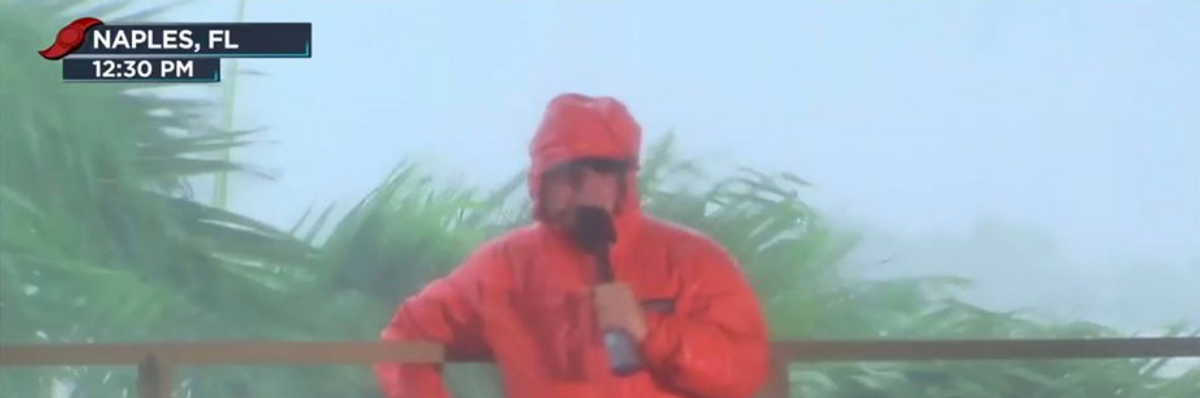
An analysis by Media Matters following Hurricane Harvey found that only one out of three major news networks addressed climate change in its coverage of the storm. (Photo: @THR/Twitter)
Using social media on Wednesday, advocates for climate action spoke out forcefully--and in huge numbers--against major media outlets that enable those who deny the connection between global warming and extreme weather events like Hurricane Harvey and Irma.
Using the hashtag #ClimateSilence, 350.org initiated a campaign aimed at calling out corporate media companies that have failed to include the issue of climate change--and humans' role in accelerating global warning--in most of their coverage of the recent hurricanes that have devastated Houston, the Caribbean, and South Florida.
"This is the most important story in the world and it needs to be told."--May Boeve, 350.org
"With a few exceptions, the major TV networks completely failed to cover the scientifically proven ways that climate change is intensifying extreme weather events like hurricanes Harvey and Irma," said 350.org's executive director, May Boeve. "That's not just disappointing, it's dangerous. We won't be able to turn this crisis around if our media is asleep at the wheel."
As Hurricane Irma approached the Miami area from the Caribbean last week, many recalled Florida governor Rick Scott's refusal to acknowledge the consensus of 97 percent of peer-reviewed climate scientists regarding the impact of carbon emissions and other human activities on climate change.
Though Florida's low-lying coastlines make it one of the most vulnerable states to rising sea levels and other effects of climate change, according to a 2015 report by the Florida Center for Investigative Reporting, state employees have been discouraged from using the terms "global warming" and "climate change." Scott has skirted around questions about climate science, telling reporters, "I am not a scientist."
Meanwhile, Environmental Protection Agency head Scott Pruitt scolded journalists for asking about the link between climate change and the size and strength of Hurricanes Harvey and Irma, telling CNN such questions were "misplaced" and "very, very insensitive" to victims of the storms.
350.org and millions of Twitter users argued on Wednesday that by not contextualizing the role of global warming throughout their coverage of storms like Irma and Harvey, media outlets are as much to blame for inaction on climate change as the politicians who deny its existence.
Jamie Henn, co-founder of 350.org, noted the enthusiasm the tweet storm generated over the course of the afternoon.
"The #ClimateSilence effort came together in under 24 hours, with all sorts of groups and individuals chipping in," said Boeve. "The huge traffic on the hashtag shows just how hungry the public is for the press to do their job and talk about climate change, the role of the fossil fuel industry, and the promise of clean energy. This is the most important story in the world and it needs to be told."
Dear Common Dreams reader, It’s been nearly 30 years since I co-founded Common Dreams with my late wife, Lina Newhouser. We had the radical notion that journalism should serve the public good, not corporate profits. It was clear to us from the outset what it would take to build such a project. No paid advertisements. No corporate sponsors. No millionaire publisher telling us what to think or do. Many people said we wouldn't last a year, but we proved those doubters wrong. Together with a tremendous team of journalists and dedicated staff, we built an independent media outlet free from the constraints of profits and corporate control. Our mission has always been simple: To inform. To inspire. To ignite change for the common good. Building Common Dreams was not easy. Our survival was never guaranteed. When you take on the most powerful forces—Wall Street greed, fossil fuel industry destruction, Big Tech lobbyists, and uber-rich oligarchs who have spent billions upon billions rigging the economy and democracy in their favor—the only bulwark you have is supporters who believe in your work. But here’s the urgent message from me today. It's never been this bad out there. And it's never been this hard to keep us going. At the very moment Common Dreams is most needed, the threats we face are intensifying. We need your support now more than ever. We don't accept corporate advertising and never will. We don't have a paywall because we don't think people should be blocked from critical news based on their ability to pay. Everything we do is funded by the donations of readers like you. When everyone does the little they can afford, we are strong. But if that support retreats or dries up, so do we. Will you donate now to make sure Common Dreams not only survives but thrives? —Craig Brown, Co-founder |
Using social media on Wednesday, advocates for climate action spoke out forcefully--and in huge numbers--against major media outlets that enable those who deny the connection between global warming and extreme weather events like Hurricane Harvey and Irma.
Using the hashtag #ClimateSilence, 350.org initiated a campaign aimed at calling out corporate media companies that have failed to include the issue of climate change--and humans' role in accelerating global warning--in most of their coverage of the recent hurricanes that have devastated Houston, the Caribbean, and South Florida.
"This is the most important story in the world and it needs to be told."--May Boeve, 350.org
"With a few exceptions, the major TV networks completely failed to cover the scientifically proven ways that climate change is intensifying extreme weather events like hurricanes Harvey and Irma," said 350.org's executive director, May Boeve. "That's not just disappointing, it's dangerous. We won't be able to turn this crisis around if our media is asleep at the wheel."
As Hurricane Irma approached the Miami area from the Caribbean last week, many recalled Florida governor Rick Scott's refusal to acknowledge the consensus of 97 percent of peer-reviewed climate scientists regarding the impact of carbon emissions and other human activities on climate change.
Though Florida's low-lying coastlines make it one of the most vulnerable states to rising sea levels and other effects of climate change, according to a 2015 report by the Florida Center for Investigative Reporting, state employees have been discouraged from using the terms "global warming" and "climate change." Scott has skirted around questions about climate science, telling reporters, "I am not a scientist."
Meanwhile, Environmental Protection Agency head Scott Pruitt scolded journalists for asking about the link between climate change and the size and strength of Hurricanes Harvey and Irma, telling CNN such questions were "misplaced" and "very, very insensitive" to victims of the storms.
350.org and millions of Twitter users argued on Wednesday that by not contextualizing the role of global warming throughout their coverage of storms like Irma and Harvey, media outlets are as much to blame for inaction on climate change as the politicians who deny its existence.
Jamie Henn, co-founder of 350.org, noted the enthusiasm the tweet storm generated over the course of the afternoon.
"The #ClimateSilence effort came together in under 24 hours, with all sorts of groups and individuals chipping in," said Boeve. "The huge traffic on the hashtag shows just how hungry the public is for the press to do their job and talk about climate change, the role of the fossil fuel industry, and the promise of clean energy. This is the most important story in the world and it needs to be told."
Using social media on Wednesday, advocates for climate action spoke out forcefully--and in huge numbers--against major media outlets that enable those who deny the connection between global warming and extreme weather events like Hurricane Harvey and Irma.
Using the hashtag #ClimateSilence, 350.org initiated a campaign aimed at calling out corporate media companies that have failed to include the issue of climate change--and humans' role in accelerating global warning--in most of their coverage of the recent hurricanes that have devastated Houston, the Caribbean, and South Florida.
"This is the most important story in the world and it needs to be told."--May Boeve, 350.org
"With a few exceptions, the major TV networks completely failed to cover the scientifically proven ways that climate change is intensifying extreme weather events like hurricanes Harvey and Irma," said 350.org's executive director, May Boeve. "That's not just disappointing, it's dangerous. We won't be able to turn this crisis around if our media is asleep at the wheel."
As Hurricane Irma approached the Miami area from the Caribbean last week, many recalled Florida governor Rick Scott's refusal to acknowledge the consensus of 97 percent of peer-reviewed climate scientists regarding the impact of carbon emissions and other human activities on climate change.
Though Florida's low-lying coastlines make it one of the most vulnerable states to rising sea levels and other effects of climate change, according to a 2015 report by the Florida Center for Investigative Reporting, state employees have been discouraged from using the terms "global warming" and "climate change." Scott has skirted around questions about climate science, telling reporters, "I am not a scientist."
Meanwhile, Environmental Protection Agency head Scott Pruitt scolded journalists for asking about the link between climate change and the size and strength of Hurricanes Harvey and Irma, telling CNN such questions were "misplaced" and "very, very insensitive" to victims of the storms.
350.org and millions of Twitter users argued on Wednesday that by not contextualizing the role of global warming throughout their coverage of storms like Irma and Harvey, media outlets are as much to blame for inaction on climate change as the politicians who deny its existence.
Jamie Henn, co-founder of 350.org, noted the enthusiasm the tweet storm generated over the course of the afternoon.
"The #ClimateSilence effort came together in under 24 hours, with all sorts of groups and individuals chipping in," said Boeve. "The huge traffic on the hashtag shows just how hungry the public is for the press to do their job and talk about climate change, the role of the fossil fuel industry, and the promise of clean energy. This is the most important story in the world and it needs to be told."