
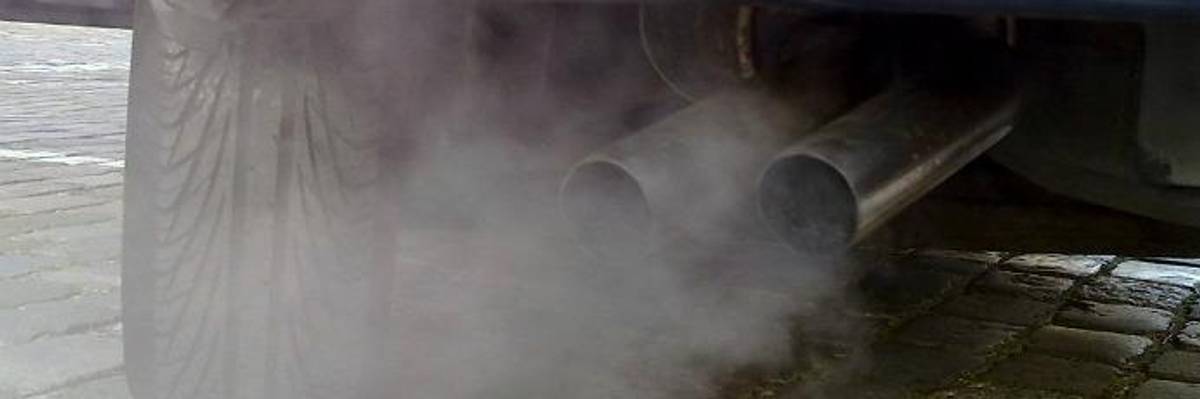
"The Trump administration's giveaway to the auto industry is an unlawful move that hurts efforts to fight global warming and shield children and the elderly from harmful tailpipe pollution," says a senior counsel for the Center for Biological Diversity. (Photo: Ruben de Rijcke/Wikimedia Commons)

As Scotland Vows 100% Transition to Electric Cars, US Caves to Auto Industry's Dirty Demands
While the Scottish government aims to decrease emissions from vehicles, green groups sue Trump's transportation agency for "an unlawful move that hurts efforts to fight global warming"
As Scotland becomes the most recent nation to pledge a phaseout of new petrol and diesel vehicles, the Trump administration was sued on Thursday for indefinitely suspending increased penalties for auto manufacturers that develop new cars and trucks that don't meet fuel-economy standards.
"Suspending meaningful fines for companies that don't comply is like legalizing pollution-control defeat devices."
--Vera Pardee, Center for Biological Diversity
The Center for Biological Diversity, joined by the Natural Resources Defense Council and the Sierra Club, filed a lawsuit in the 2nd U.S. Circuit Court of Appeals on Thursday to challenge the National Highway Traffic Safety Administration's recent decision to suspend a 2016 rule that adjusted fines to account for inflation.
Since 1975, Congress has maintained fuel-economy standards for new vehicles in an effort to decrease reliance on oil. In 2012, the Environmental Protection Agency added greenhouse gas emissions standards. Even so, transportation accounts for nearly 30 percent of the U.S.'s total emissions, more than almost any other industry, according to EPA data.
In 2015, the Center urged the transportation agency to increase fines, because some manufacturers opted to pay the fees and continue producing non-compliant vehicles. The new rule was introduced in 2016, and nearly tripled penalties from $5.50 to $14 for each 0.1 mile per gallon that new vehicles fall below the standards, but in July, the Trump administration suspended the rule, after being lobbied by the auto industry.
"Suspending meaningful fines for companies that don't comply is like legalizing pollution-control defeat devices," said Vera Pardee, senior counsel at the Center for Biological Diversity. "The Trump administration's giveaway to the auto industry is an unlawful move that hurts efforts to fight global warming and shield children and the elderly from harmful tailpipe pollution."
"Transitioning away from powering our cars and trucks with dirty, dangerous fossil fuels is crucial for our climate, our health and the nation's economic competitiveness," Pardee said. "Car companies churning out gas-guzzlers shouldn't get to pay their way out of following rules that cut fuel consumption and protect our climate."
Meanwhile in Scotland, the government has pledged to transition to new electric vehicles by 2032, eight years ahead of the 2040 deadline set by the British and French governments.
When First Minister Nicola Sturgeon unveiled the plan Tuesday, she emphasized a desire to build electric charging stations across Scotland, including along the country's longest highway, by 2022, to encourage drivers to invest in electric vehicles even earlier.
"Over the next few months we will set out detailed plans to massively expand the number of electric charging points in rural, urban , and domestic settings," she said. "We will make the A9, already a major infrastructure project, Scotland's first fully electric-enabled highway."
By increasing access to charging stations and implementing restrictions on production, the Scottish government is hoping "for almost all cars and vans on our roads to be zero emission by 2050," Jesse Norman, the parliamentary under-secretary at the Department for Transport, said in a statement. "We believe this would necessitate all new cars and van being zero emission vehicles by 2040."
In the announcement Tuesday, Sturgeon expressed hope that the move would not only win over Scots, but also motivate other countries to adopt similar goals.
"This is an exciting challenge, and one I hope all members and the whole country will get behind," she said. "It sends a message to the world--we look to the future with excitement, we welcome innovation, and we want to lead it."
The news was welcomed by Friends of the Earth Scotland director Richard Dixon, who called the plan "the greenest program for government in the history of the Scottish Parliament."
"The Scottish government has put improving and protecting the environment at the heart of their legislative and policy program," Dixon told The Press and Journal. "Promises here will reduce climate change emissions, save people from air pollution, and help Scotland become a leading example of a low carbon country."
We are at a crossroads
This country and this world are at a monumental crossroads. In a few short weeks, US voters will have an opportunity to beat back the forces of fascism and confront the billionaires who are rigging the economy, our media system, and our democracy, making it increasingly impossible for ordinary people to get by. We’re not just talking about the election. We’re talking about what must be done once these fascist elements are vanquished from power. We need a bolder set of solutions than what either major party has so far been willing to offer and a working-class movement ready to fight like hell for it. Trump didn't emerge from nowhere. The conditions that fueled MAGA authoritarianism were created by decades of radical neoliberal economic policies and a corrupt political system dominated by corporate interests. They slashed taxes on the super-rich, promising that the benefits would trickle down. They said giveaways to the corporate titans would make life more affordable for the rest of us. It was all bullshit. And when a bitter, betrayed populace searches for someone to blame, right-wing demagogues have little trouble finding scapegoats. People know when they're being lied to, but you won't hear any of this from the corporate media. Only independent journalism—powered and funded by people who believe in building a better world—can deliver truly trustworthy daily news. Our Fall Campaign is underway, and we need your help. To power our newsroom through the rest of the year, we need to raise $125,000 by midnight on October 31. So if you share our vision, please contribute whatever you can to sustain our work. |
As Scotland becomes the most recent nation to pledge a phaseout of new petrol and diesel vehicles, the Trump administration was sued on Thursday for indefinitely suspending increased penalties for auto manufacturers that develop new cars and trucks that don't meet fuel-economy standards.
"Suspending meaningful fines for companies that don't comply is like legalizing pollution-control defeat devices."
--Vera Pardee, Center for Biological Diversity
The Center for Biological Diversity, joined by the Natural Resources Defense Council and the Sierra Club, filed a lawsuit in the 2nd U.S. Circuit Court of Appeals on Thursday to challenge the National Highway Traffic Safety Administration's recent decision to suspend a 2016 rule that adjusted fines to account for inflation.
Since 1975, Congress has maintained fuel-economy standards for new vehicles in an effort to decrease reliance on oil. In 2012, the Environmental Protection Agency added greenhouse gas emissions standards. Even so, transportation accounts for nearly 30 percent of the U.S.'s total emissions, more than almost any other industry, according to EPA data.
In 2015, the Center urged the transportation agency to increase fines, because some manufacturers opted to pay the fees and continue producing non-compliant vehicles. The new rule was introduced in 2016, and nearly tripled penalties from $5.50 to $14 for each 0.1 mile per gallon that new vehicles fall below the standards, but in July, the Trump administration suspended the rule, after being lobbied by the auto industry.
"Suspending meaningful fines for companies that don't comply is like legalizing pollution-control defeat devices," said Vera Pardee, senior counsel at the Center for Biological Diversity. "The Trump administration's giveaway to the auto industry is an unlawful move that hurts efforts to fight global warming and shield children and the elderly from harmful tailpipe pollution."
"Transitioning away from powering our cars and trucks with dirty, dangerous fossil fuels is crucial for our climate, our health and the nation's economic competitiveness," Pardee said. "Car companies churning out gas-guzzlers shouldn't get to pay their way out of following rules that cut fuel consumption and protect our climate."
Meanwhile in Scotland, the government has pledged to transition to new electric vehicles by 2032, eight years ahead of the 2040 deadline set by the British and French governments.
When First Minister Nicola Sturgeon unveiled the plan Tuesday, she emphasized a desire to build electric charging stations across Scotland, including along the country's longest highway, by 2022, to encourage drivers to invest in electric vehicles even earlier.
"Over the next few months we will set out detailed plans to massively expand the number of electric charging points in rural, urban , and domestic settings," she said. "We will make the A9, already a major infrastructure project, Scotland's first fully electric-enabled highway."
By increasing access to charging stations and implementing restrictions on production, the Scottish government is hoping "for almost all cars and vans on our roads to be zero emission by 2050," Jesse Norman, the parliamentary under-secretary at the Department for Transport, said in a statement. "We believe this would necessitate all new cars and van being zero emission vehicles by 2040."
In the announcement Tuesday, Sturgeon expressed hope that the move would not only win over Scots, but also motivate other countries to adopt similar goals.
"This is an exciting challenge, and one I hope all members and the whole country will get behind," she said. "It sends a message to the world--we look to the future with excitement, we welcome innovation, and we want to lead it."
The news was welcomed by Friends of the Earth Scotland director Richard Dixon, who called the plan "the greenest program for government in the history of the Scottish Parliament."
"The Scottish government has put improving and protecting the environment at the heart of their legislative and policy program," Dixon told The Press and Journal. "Promises here will reduce climate change emissions, save people from air pollution, and help Scotland become a leading example of a low carbon country."
As Scotland becomes the most recent nation to pledge a phaseout of new petrol and diesel vehicles, the Trump administration was sued on Thursday for indefinitely suspending increased penalties for auto manufacturers that develop new cars and trucks that don't meet fuel-economy standards.
"Suspending meaningful fines for companies that don't comply is like legalizing pollution-control defeat devices."
--Vera Pardee, Center for Biological Diversity
The Center for Biological Diversity, joined by the Natural Resources Defense Council and the Sierra Club, filed a lawsuit in the 2nd U.S. Circuit Court of Appeals on Thursday to challenge the National Highway Traffic Safety Administration's recent decision to suspend a 2016 rule that adjusted fines to account for inflation.
Since 1975, Congress has maintained fuel-economy standards for new vehicles in an effort to decrease reliance on oil. In 2012, the Environmental Protection Agency added greenhouse gas emissions standards. Even so, transportation accounts for nearly 30 percent of the U.S.'s total emissions, more than almost any other industry, according to EPA data.
In 2015, the Center urged the transportation agency to increase fines, because some manufacturers opted to pay the fees and continue producing non-compliant vehicles. The new rule was introduced in 2016, and nearly tripled penalties from $5.50 to $14 for each 0.1 mile per gallon that new vehicles fall below the standards, but in July, the Trump administration suspended the rule, after being lobbied by the auto industry.
"Suspending meaningful fines for companies that don't comply is like legalizing pollution-control defeat devices," said Vera Pardee, senior counsel at the Center for Biological Diversity. "The Trump administration's giveaway to the auto industry is an unlawful move that hurts efforts to fight global warming and shield children and the elderly from harmful tailpipe pollution."
"Transitioning away from powering our cars and trucks with dirty, dangerous fossil fuels is crucial for our climate, our health and the nation's economic competitiveness," Pardee said. "Car companies churning out gas-guzzlers shouldn't get to pay their way out of following rules that cut fuel consumption and protect our climate."
Meanwhile in Scotland, the government has pledged to transition to new electric vehicles by 2032, eight years ahead of the 2040 deadline set by the British and French governments.
When First Minister Nicola Sturgeon unveiled the plan Tuesday, she emphasized a desire to build electric charging stations across Scotland, including along the country's longest highway, by 2022, to encourage drivers to invest in electric vehicles even earlier.
"Over the next few months we will set out detailed plans to massively expand the number of electric charging points in rural, urban , and domestic settings," she said. "We will make the A9, already a major infrastructure project, Scotland's first fully electric-enabled highway."
By increasing access to charging stations and implementing restrictions on production, the Scottish government is hoping "for almost all cars and vans on our roads to be zero emission by 2050," Jesse Norman, the parliamentary under-secretary at the Department for Transport, said in a statement. "We believe this would necessitate all new cars and van being zero emission vehicles by 2040."
In the announcement Tuesday, Sturgeon expressed hope that the move would not only win over Scots, but also motivate other countries to adopt similar goals.
"This is an exciting challenge, and one I hope all members and the whole country will get behind," she said. "It sends a message to the world--we look to the future with excitement, we welcome innovation, and we want to lead it."
The news was welcomed by Friends of the Earth Scotland director Richard Dixon, who called the plan "the greenest program for government in the history of the Scottish Parliament."
"The Scottish government has put improving and protecting the environment at the heart of their legislative and policy program," Dixon told The Press and Journal. "Promises here will reduce climate change emissions, save people from air pollution, and help Scotland become a leading example of a low carbon country."