
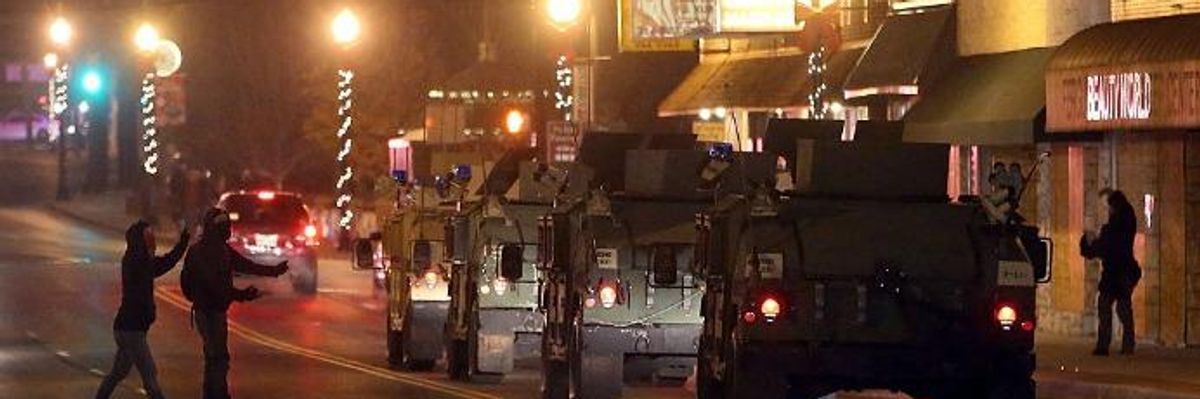
Protestors confront a convoy of Missouri National Guard humvees as they drive near the Ferguson police station on November 25, 2014 in Ferguson, Missouri. (Photo: Justin Sullivan/Getty Images)
In 'Open Effort to Escalate Racial Tensions,' Trump to Fully Militarize Police
Trump's plan to reverse ban on transfer of military equipment to police denounced by civil rights groups as "exceptionally dangerous and irresponsible"
In what critics are characterizing as a "dangerous" move in the direction of a fully militarized police force, the Trump administration is reportedly gearing up to reverse a partial ban on the transfer of surplus military equipment to police departments, according to documents obtained by USA Today.
"The president's decision to make this change in the wake of the tragedy in Charlottesville reflects this administration's now open effort to escalate racial tensions in our country."
--Janai Nelson, LDF
Civil rights groups immediately raised alarm. Janai Nelson, associate director-counsel at the NAACP Legal Defense Fund (LDF), said in a statement Sunday night that the Trump administration's plan would "give law enforcement unfettered access to equipment that has been used to intimidate communities of color, with little to no training or oversight."
Attorney General Jeff Sessions is expected to officially outline the administration's decision in a speech on Monday to the Fraternal Order of Police, America's largest police union.
The New York Times noted that it is "not immediately clear why Mr. Sessions would announce changes to a Pentagon program, but he has rolled back several Obama-era policing reforms and helped bolster the Trump administration's support among law enforcement."
"The new plan," explains USA Today's Kevin Johnson, "would roll back an Obama administration executive order that blocked armored vehicles, large-caliber weapons, ammunition, and other heavy equipment from being re-purposed from foreign battlefields to America's streets."
Johnson continued:
The administration's action would restore "the full scope of a longstanding program for recycling surplus, lifesaving gear from the Department of Defense, along with restoring the full scope of grants used to purchase this type of equipment from other sources,'' according to a administration summary of the new program recently circulated to some law enforcement groups.
Limits on the transfer of excess military equipment to local police departments were first implemented by former President Barack Obama in 2015 following outrage and widespread criticism of law enforcement's militaristic response to protests over the police killing of Michael Brown in Ferguson, Missouri in 2014.
"[L]ocal authorities... have employed armored vehicles, noise-based crowd-control devices, shotguns, M4 rifles like those used by forces in Iraq and Afghanistan, rubber-coated metal pellets, and tear gas," the Washington Post reported at the time.
Announcing his decision to impose restrictions on what equipment police can receive from the military, Obama said: "We've seen how militarized gear can sometimes give people a feeling like they're an occupying force, as opposed to a force that's part of the community that's protecting them and serving them."
"Welp. There's the fascism."
--Emily Gorcenski
Trump said he wished police officers would be more "rough" with suspects--a comment that was widely condemned as a presidential endorsement of police brutality.
Commentators responded to indications that Trump is looking to further militarize U.S. police with similar alarm.
"What you saw in Ferguson is what the Trump administration is proposing for all police in the U.S.," wrote Buzzfeed's Jason Leopold.
"It is both exceptionally dangerous and irresponsible for the administration to lift the ban on the transfer of certain surplus military equipment to state and local law enforcement organizations. Just a few summers ago, our nation watched as Ferguson raised the specter of increased police militarization," added LDF's Janai Nelson. "The president's decision to make this change in the wake of the tragedy in Charlottesville and against a backdrop of frayed relations between police and communities of color further reflects this administration's now open effort to escalate racial tensions in our country."
We are at a crossroads
This country and this world are at a monumental crossroads. In a few short weeks, US voters will have an opportunity to beat back the forces of fascism and confront the billionaires who are rigging the economy, our media system, and our democracy, making it increasingly impossible for ordinary people to get by. We’re not just talking about the election. We’re talking about what must be done once these fascist elements are vanquished from power. We need a bolder set of solutions than what either major party has so far been willing to offer and a working-class movement ready to fight like hell for it. Trump didn't emerge from nowhere. The conditions that fueled MAGA authoritarianism were created by decades of radical neoliberal economic policies and a corrupt political system dominated by corporate interests. They slashed taxes on the super-rich, promising that the benefits would trickle down. They said giveaways to the corporate titans would make life more affordable for the rest of us. It was all bullshit. And when a bitter, betrayed populace searches for someone to blame, right-wing demagogues have little trouble finding scapegoats. People know when they're being lied to, but you won't hear any of this from the corporate media. Only independent journalism—powered and funded by people who believe in building a better world—can deliver truly trustworthy daily news. Our Fall Campaign is underway, and we need your help. To power our newsroom through the rest of the year, we need to raise $125,000 by midnight on October 31. So if you share our vision, please contribute whatever you can to sustain our work. |
In what critics are characterizing as a "dangerous" move in the direction of a fully militarized police force, the Trump administration is reportedly gearing up to reverse a partial ban on the transfer of surplus military equipment to police departments, according to documents obtained by USA Today.
"The president's decision to make this change in the wake of the tragedy in Charlottesville reflects this administration's now open effort to escalate racial tensions in our country."
--Janai Nelson, LDF
Civil rights groups immediately raised alarm. Janai Nelson, associate director-counsel at the NAACP Legal Defense Fund (LDF), said in a statement Sunday night that the Trump administration's plan would "give law enforcement unfettered access to equipment that has been used to intimidate communities of color, with little to no training or oversight."
Attorney General Jeff Sessions is expected to officially outline the administration's decision in a speech on Monday to the Fraternal Order of Police, America's largest police union.
The New York Times noted that it is "not immediately clear why Mr. Sessions would announce changes to a Pentagon program, but he has rolled back several Obama-era policing reforms and helped bolster the Trump administration's support among law enforcement."
"The new plan," explains USA Today's Kevin Johnson, "would roll back an Obama administration executive order that blocked armored vehicles, large-caliber weapons, ammunition, and other heavy equipment from being re-purposed from foreign battlefields to America's streets."
Johnson continued:
The administration's action would restore "the full scope of a longstanding program for recycling surplus, lifesaving gear from the Department of Defense, along with restoring the full scope of grants used to purchase this type of equipment from other sources,'' according to a administration summary of the new program recently circulated to some law enforcement groups.
Limits on the transfer of excess military equipment to local police departments were first implemented by former President Barack Obama in 2015 following outrage and widespread criticism of law enforcement's militaristic response to protests over the police killing of Michael Brown in Ferguson, Missouri in 2014.
"[L]ocal authorities... have employed armored vehicles, noise-based crowd-control devices, shotguns, M4 rifles like those used by forces in Iraq and Afghanistan, rubber-coated metal pellets, and tear gas," the Washington Post reported at the time.
Announcing his decision to impose restrictions on what equipment police can receive from the military, Obama said: "We've seen how militarized gear can sometimes give people a feeling like they're an occupying force, as opposed to a force that's part of the community that's protecting them and serving them."
"Welp. There's the fascism."
--Emily Gorcenski
Trump said he wished police officers would be more "rough" with suspects--a comment that was widely condemned as a presidential endorsement of police brutality.
Commentators responded to indications that Trump is looking to further militarize U.S. police with similar alarm.
"What you saw in Ferguson is what the Trump administration is proposing for all police in the U.S.," wrote Buzzfeed's Jason Leopold.
"It is both exceptionally dangerous and irresponsible for the administration to lift the ban on the transfer of certain surplus military equipment to state and local law enforcement organizations. Just a few summers ago, our nation watched as Ferguson raised the specter of increased police militarization," added LDF's Janai Nelson. "The president's decision to make this change in the wake of the tragedy in Charlottesville and against a backdrop of frayed relations between police and communities of color further reflects this administration's now open effort to escalate racial tensions in our country."
In what critics are characterizing as a "dangerous" move in the direction of a fully militarized police force, the Trump administration is reportedly gearing up to reverse a partial ban on the transfer of surplus military equipment to police departments, according to documents obtained by USA Today.
"The president's decision to make this change in the wake of the tragedy in Charlottesville reflects this administration's now open effort to escalate racial tensions in our country."
--Janai Nelson, LDF
Civil rights groups immediately raised alarm. Janai Nelson, associate director-counsel at the NAACP Legal Defense Fund (LDF), said in a statement Sunday night that the Trump administration's plan would "give law enforcement unfettered access to equipment that has been used to intimidate communities of color, with little to no training or oversight."
Attorney General Jeff Sessions is expected to officially outline the administration's decision in a speech on Monday to the Fraternal Order of Police, America's largest police union.
The New York Times noted that it is "not immediately clear why Mr. Sessions would announce changes to a Pentagon program, but he has rolled back several Obama-era policing reforms and helped bolster the Trump administration's support among law enforcement."
"The new plan," explains USA Today's Kevin Johnson, "would roll back an Obama administration executive order that blocked armored vehicles, large-caliber weapons, ammunition, and other heavy equipment from being re-purposed from foreign battlefields to America's streets."
Johnson continued:
The administration's action would restore "the full scope of a longstanding program for recycling surplus, lifesaving gear from the Department of Defense, along with restoring the full scope of grants used to purchase this type of equipment from other sources,'' according to a administration summary of the new program recently circulated to some law enforcement groups.
Limits on the transfer of excess military equipment to local police departments were first implemented by former President Barack Obama in 2015 following outrage and widespread criticism of law enforcement's militaristic response to protests over the police killing of Michael Brown in Ferguson, Missouri in 2014.
"[L]ocal authorities... have employed armored vehicles, noise-based crowd-control devices, shotguns, M4 rifles like those used by forces in Iraq and Afghanistan, rubber-coated metal pellets, and tear gas," the Washington Post reported at the time.
Announcing his decision to impose restrictions on what equipment police can receive from the military, Obama said: "We've seen how militarized gear can sometimes give people a feeling like they're an occupying force, as opposed to a force that's part of the community that's protecting them and serving them."
"Welp. There's the fascism."
--Emily Gorcenski
Trump said he wished police officers would be more "rough" with suspects--a comment that was widely condemned as a presidential endorsement of police brutality.
Commentators responded to indications that Trump is looking to further militarize U.S. police with similar alarm.
"What you saw in Ferguson is what the Trump administration is proposing for all police in the U.S.," wrote Buzzfeed's Jason Leopold.
"It is both exceptionally dangerous and irresponsible for the administration to lift the ban on the transfer of certain surplus military equipment to state and local law enforcement organizations. Just a few summers ago, our nation watched as Ferguson raised the specter of increased police militarization," added LDF's Janai Nelson. "The president's decision to make this change in the wake of the tragedy in Charlottesville and against a backdrop of frayed relations between police and communities of color further reflects this administration's now open effort to escalate racial tensions in our country."