

SUBSCRIBE TO OUR FREE NEWSLETTER
Daily news & progressive opinion—funded by the people, not the corporations—delivered straight to your inbox.
5
#000000
#FFFFFF
To donate by check, phone, or other method, see our More Ways to Give page.
Daily news & progressive opinion—funded by the people, not the corporations—delivered straight to your inbox.
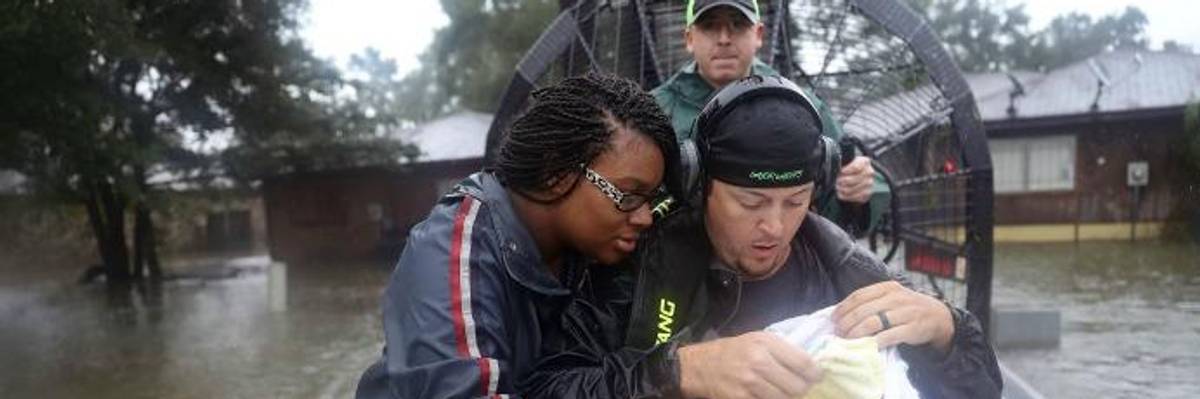
Shardea Harrison looks on at her 3 week old baby Sarai Harrison being held by Dean Mize as he and Jason Legnon used his airboat to rescue them from their home after the area was inundated with flooding from Hurricane Harvey on August 28, 2017 in Houston, Texas. (Photo: Joe Raedle/Getty Images)
As Hurricane Harvey continues to batter Texas--and as the death toll from monsoon flooding in India, Nepal, and Bangladesh surpasses 1,200--experts are putting a spotlight on how climate change is linked to the "unprecedented" storm's devastation.
Trying to attribute Harvey to climate change "is an ill-posed question," argues Michael E. Mann, distinguished professor of atmospheric science at Pennsylvania State University. "While we cannot say climate change 'caused' Hurricane Harvey," writes Mann at the Guardian, "we can say is that it exacerbated several characteristics of the storm in a way that greatly increased the risk of damage and loss of life."
One way, he explains, is because of sea level rise, which contributed to a higher storm surge. In addition, warmer than average sea surface temperatures led to more moisture in the air. "That large amount of moisture," writes Mann, "creates the potential for much greater rainfalls and greater flooding. The combination of coastal flooding and heavy rainfall is responsible for the devastating flooding that Houston is experiencing."
Indeed, meteorologist Jeff Masters notes:
Here we are, in the midst of a mega-disaster on the scale only surpassed by Hurricane Sandy and Hurricane Katrina in recent decades, from a hurricane hazard we've never seen on such a large and destructive scale--torrential rain. The damages from Harvey will undoubtedly run into the tens of billions of dollars, making Harvey's rains the most destructive ever experienced from a hurricane.
In addition, Mann writes, "Harvey was able to feed upon" warmer waters deeper within the Gulf "when it intensified at near record pace as it neared the coast." Another potential link to climate change is how the storm is stalling near the coast, allowing it to continue to wreak havoc, in a pattern "associated with a greatly expanded subtropical high pressure system over much of the U.S. at the moment, with the jet stream pushed well to the north."
Climate journalist David Roberts also explores how climate change is "a huge part of the story" of Harvey, and explains why "without mitigation, adaptation [to climate change] is a cruel joke."
Reducing greenhouse gas emissions, or mitigation, he writes,
generates benefits that are unavoidably egalitarian (distributed across the globe, to everyone who lives in the atmosphere) and progressive (the poor are most vulnerable, so they benefit first and most from harm prevention).
Adaption, in contrast, like erecting higher sea walls, is necessarily local and "regressive (wealthy people and places will adapt first, best, and most)."
Putting adaptation in the context of Harvey's "mind-boggling rainfall amounts," he writes:
What is good or adequate adaptation to 40 to 50 inches of rain falling on your head in 72 hours?
There's just no way to prepare for that and no painless way to respond to it. There's no adapting. There's destruction and suffering, followed by slow rebuilding.
According to David Helvarg, executive director of ocean conservation organization Blue Frontier, with Harvey, "we're seeing the impacts of climate change."
There was "a flooding event right there in Houston last year that the Houston flood control district said was a one in 10,000-year rain event. Well, it's a year later, and you're having another one," he said to Democracy Now! Monday.
In 2000, he added, he was speaking with a scientist from the NASA Ames laboratory at Columbia who was "explaining the big 1993 nor'easter. And she said that yeah, one-in-a-century storms like that are now going to become decadal, happen every decade or more frequently. And since then, I was down at Katrina. We had Sandy. Now we have this hurricane. We are seeing the impacts."
Referring to the historic flooding unleashed by Harvey, he said, "this is the new normal. This is the new reality. And the challenge is how we address it. How rapidly we're going to transition from fossil fuels to clean energy."
Linking the dots between the hurricane, the devastation in Asia, and climate change, economist Dean Baker writes: "The monsoon rains and cyclones [Bangladesh experiences] are likely to get worse in the years ahead, as one of the effects of global warming." And, given that the country is lacking vast resources, "many more people are likely to be dying from floods." As such, it behooves the U.S to take urgent climate action. He continues:
Emissions of the greenhouse gases responsible for global warming is often treated as a natural market outcome, whereas efforts to restrict emissions are viewed as government intervention. This is nonsense.
Allowing people to emit greenhouse gases without paying for the damage done is like allowing them to dump their sewage on their neighbor's lawn. Everyone understands that we are responsible for dealing with our own sewage and not imposing a cost on our neighbor. It's the same story with greenhouse gases.
It is understandable that a rich jerk like Donald Trump might not want to pay for the damage he does to the world, especially when the people most affected are dark-skinned, but it is not a serious position. The emissions from the United States and other wealthy countries will result in a lot of Harvey-like disasters in Bangladesh and elsewhere in the developing world. We have to take responsibility for this human catastrophe.
Dear Common Dreams reader, It’s been nearly 30 years since I co-founded Common Dreams with my late wife, Lina Newhouser. We had the radical notion that journalism should serve the public good, not corporate profits. It was clear to us from the outset what it would take to build such a project. No paid advertisements. No corporate sponsors. No millionaire publisher telling us what to think or do. Many people said we wouldn't last a year, but we proved those doubters wrong. Together with a tremendous team of journalists and dedicated staff, we built an independent media outlet free from the constraints of profits and corporate control. Our mission has always been simple: To inform. To inspire. To ignite change for the common good. Building Common Dreams was not easy. Our survival was never guaranteed. When you take on the most powerful forces—Wall Street greed, fossil fuel industry destruction, Big Tech lobbyists, and uber-rich oligarchs who have spent billions upon billions rigging the economy and democracy in their favor—the only bulwark you have is supporters who believe in your work. But here’s the urgent message from me today. It's never been this bad out there. And it's never been this hard to keep us going. At the very moment Common Dreams is most needed, the threats we face are intensifying. We need your support now more than ever. We don't accept corporate advertising and never will. We don't have a paywall because we don't think people should be blocked from critical news based on their ability to pay. Everything we do is funded by the donations of readers like you. When everyone does the little they can afford, we are strong. But if that support retreats or dries up, so do we. Will you donate now to make sure Common Dreams not only survives but thrives? —Craig Brown, Co-founder |
As Hurricane Harvey continues to batter Texas--and as the death toll from monsoon flooding in India, Nepal, and Bangladesh surpasses 1,200--experts are putting a spotlight on how climate change is linked to the "unprecedented" storm's devastation.
Trying to attribute Harvey to climate change "is an ill-posed question," argues Michael E. Mann, distinguished professor of atmospheric science at Pennsylvania State University. "While we cannot say climate change 'caused' Hurricane Harvey," writes Mann at the Guardian, "we can say is that it exacerbated several characteristics of the storm in a way that greatly increased the risk of damage and loss of life."
One way, he explains, is because of sea level rise, which contributed to a higher storm surge. In addition, warmer than average sea surface temperatures led to more moisture in the air. "That large amount of moisture," writes Mann, "creates the potential for much greater rainfalls and greater flooding. The combination of coastal flooding and heavy rainfall is responsible for the devastating flooding that Houston is experiencing."
Indeed, meteorologist Jeff Masters notes:
Here we are, in the midst of a mega-disaster on the scale only surpassed by Hurricane Sandy and Hurricane Katrina in recent decades, from a hurricane hazard we've never seen on such a large and destructive scale--torrential rain. The damages from Harvey will undoubtedly run into the tens of billions of dollars, making Harvey's rains the most destructive ever experienced from a hurricane.
In addition, Mann writes, "Harvey was able to feed upon" warmer waters deeper within the Gulf "when it intensified at near record pace as it neared the coast." Another potential link to climate change is how the storm is stalling near the coast, allowing it to continue to wreak havoc, in a pattern "associated with a greatly expanded subtropical high pressure system over much of the U.S. at the moment, with the jet stream pushed well to the north."
Climate journalist David Roberts also explores how climate change is "a huge part of the story" of Harvey, and explains why "without mitigation, adaptation [to climate change] is a cruel joke."
Reducing greenhouse gas emissions, or mitigation, he writes,
generates benefits that are unavoidably egalitarian (distributed across the globe, to everyone who lives in the atmosphere) and progressive (the poor are most vulnerable, so they benefit first and most from harm prevention).
Adaption, in contrast, like erecting higher sea walls, is necessarily local and "regressive (wealthy people and places will adapt first, best, and most)."
Putting adaptation in the context of Harvey's "mind-boggling rainfall amounts," he writes:
What is good or adequate adaptation to 40 to 50 inches of rain falling on your head in 72 hours?
There's just no way to prepare for that and no painless way to respond to it. There's no adapting. There's destruction and suffering, followed by slow rebuilding.
According to David Helvarg, executive director of ocean conservation organization Blue Frontier, with Harvey, "we're seeing the impacts of climate change."
There was "a flooding event right there in Houston last year that the Houston flood control district said was a one in 10,000-year rain event. Well, it's a year later, and you're having another one," he said to Democracy Now! Monday.
In 2000, he added, he was speaking with a scientist from the NASA Ames laboratory at Columbia who was "explaining the big 1993 nor'easter. And she said that yeah, one-in-a-century storms like that are now going to become decadal, happen every decade or more frequently. And since then, I was down at Katrina. We had Sandy. Now we have this hurricane. We are seeing the impacts."
Referring to the historic flooding unleashed by Harvey, he said, "this is the new normal. This is the new reality. And the challenge is how we address it. How rapidly we're going to transition from fossil fuels to clean energy."
Linking the dots between the hurricane, the devastation in Asia, and climate change, economist Dean Baker writes: "The monsoon rains and cyclones [Bangladesh experiences] are likely to get worse in the years ahead, as one of the effects of global warming." And, given that the country is lacking vast resources, "many more people are likely to be dying from floods." As such, it behooves the U.S to take urgent climate action. He continues:
Emissions of the greenhouse gases responsible for global warming is often treated as a natural market outcome, whereas efforts to restrict emissions are viewed as government intervention. This is nonsense.
Allowing people to emit greenhouse gases without paying for the damage done is like allowing them to dump their sewage on their neighbor's lawn. Everyone understands that we are responsible for dealing with our own sewage and not imposing a cost on our neighbor. It's the same story with greenhouse gases.
It is understandable that a rich jerk like Donald Trump might not want to pay for the damage he does to the world, especially when the people most affected are dark-skinned, but it is not a serious position. The emissions from the United States and other wealthy countries will result in a lot of Harvey-like disasters in Bangladesh and elsewhere in the developing world. We have to take responsibility for this human catastrophe.
As Hurricane Harvey continues to batter Texas--and as the death toll from monsoon flooding in India, Nepal, and Bangladesh surpasses 1,200--experts are putting a spotlight on how climate change is linked to the "unprecedented" storm's devastation.
Trying to attribute Harvey to climate change "is an ill-posed question," argues Michael E. Mann, distinguished professor of atmospheric science at Pennsylvania State University. "While we cannot say climate change 'caused' Hurricane Harvey," writes Mann at the Guardian, "we can say is that it exacerbated several characteristics of the storm in a way that greatly increased the risk of damage and loss of life."
One way, he explains, is because of sea level rise, which contributed to a higher storm surge. In addition, warmer than average sea surface temperatures led to more moisture in the air. "That large amount of moisture," writes Mann, "creates the potential for much greater rainfalls and greater flooding. The combination of coastal flooding and heavy rainfall is responsible for the devastating flooding that Houston is experiencing."
Indeed, meteorologist Jeff Masters notes:
Here we are, in the midst of a mega-disaster on the scale only surpassed by Hurricane Sandy and Hurricane Katrina in recent decades, from a hurricane hazard we've never seen on such a large and destructive scale--torrential rain. The damages from Harvey will undoubtedly run into the tens of billions of dollars, making Harvey's rains the most destructive ever experienced from a hurricane.
In addition, Mann writes, "Harvey was able to feed upon" warmer waters deeper within the Gulf "when it intensified at near record pace as it neared the coast." Another potential link to climate change is how the storm is stalling near the coast, allowing it to continue to wreak havoc, in a pattern "associated with a greatly expanded subtropical high pressure system over much of the U.S. at the moment, with the jet stream pushed well to the north."
Climate journalist David Roberts also explores how climate change is "a huge part of the story" of Harvey, and explains why "without mitigation, adaptation [to climate change] is a cruel joke."
Reducing greenhouse gas emissions, or mitigation, he writes,
generates benefits that are unavoidably egalitarian (distributed across the globe, to everyone who lives in the atmosphere) and progressive (the poor are most vulnerable, so they benefit first and most from harm prevention).
Adaption, in contrast, like erecting higher sea walls, is necessarily local and "regressive (wealthy people and places will adapt first, best, and most)."
Putting adaptation in the context of Harvey's "mind-boggling rainfall amounts," he writes:
What is good or adequate adaptation to 40 to 50 inches of rain falling on your head in 72 hours?
There's just no way to prepare for that and no painless way to respond to it. There's no adapting. There's destruction and suffering, followed by slow rebuilding.
According to David Helvarg, executive director of ocean conservation organization Blue Frontier, with Harvey, "we're seeing the impacts of climate change."
There was "a flooding event right there in Houston last year that the Houston flood control district said was a one in 10,000-year rain event. Well, it's a year later, and you're having another one," he said to Democracy Now! Monday.
In 2000, he added, he was speaking with a scientist from the NASA Ames laboratory at Columbia who was "explaining the big 1993 nor'easter. And she said that yeah, one-in-a-century storms like that are now going to become decadal, happen every decade or more frequently. And since then, I was down at Katrina. We had Sandy. Now we have this hurricane. We are seeing the impacts."
Referring to the historic flooding unleashed by Harvey, he said, "this is the new normal. This is the new reality. And the challenge is how we address it. How rapidly we're going to transition from fossil fuels to clean energy."
Linking the dots between the hurricane, the devastation in Asia, and climate change, economist Dean Baker writes: "The monsoon rains and cyclones [Bangladesh experiences] are likely to get worse in the years ahead, as one of the effects of global warming." And, given that the country is lacking vast resources, "many more people are likely to be dying from floods." As such, it behooves the U.S to take urgent climate action. He continues:
Emissions of the greenhouse gases responsible for global warming is often treated as a natural market outcome, whereas efforts to restrict emissions are viewed as government intervention. This is nonsense.
Allowing people to emit greenhouse gases without paying for the damage done is like allowing them to dump their sewage on their neighbor's lawn. Everyone understands that we are responsible for dealing with our own sewage and not imposing a cost on our neighbor. It's the same story with greenhouse gases.
It is understandable that a rich jerk like Donald Trump might not want to pay for the damage he does to the world, especially when the people most affected are dark-skinned, but it is not a serious position. The emissions from the United States and other wealthy countries will result in a lot of Harvey-like disasters in Bangladesh and elsewhere in the developing world. We have to take responsibility for this human catastrophe.

