SUBSCRIBE TO OUR FREE NEWSLETTER
Daily news & progressive opinion—funded by the people, not the corporations—delivered straight to your inbox.
5
#000000
#FFFFFF
To donate by check, phone, or other method, see our More Ways to Give page.
Daily news & progressive opinion—funded by the people, not the corporations—delivered straight to your inbox.
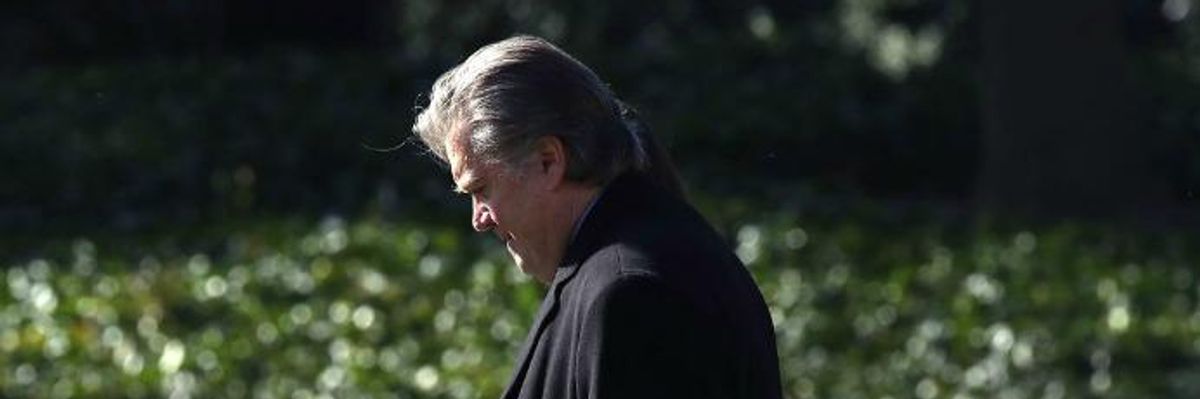
Chief Strategist Steve Bannon walks behind U.S. President Donald Trump toward Marine One before departing from the White House on February 24, 2017 in Washington, D.C. (Photo: Mark Wilson/Getty Images)
"The problem was never just Steve Bannon. It was and always will be Donald Trump."
That's how Sen. Bernie Sanders (I-Vt.) responded to news that Friday would the last day on the job for Trump's top political strategist.
"The larger and more urgent crisis however is that a white supremacist sympathizer is the president of the United States."
--Ultraviolet
Others echoed Sanders on the heels of the breaking reports, saying that while Bannon's departure is a welcome step, the fight against white nationalism is far from over.
"Bannon has unquestionably been a driving force behind the racial turmoil that threatens to tear this country apart. Such a divisive figure has no place in the White House," Kristen Clarke, president and executive director of the Lawyers' Committee for Civil Rights Under Law, said in a statement.
"While it is appropriate that Steve Bannon go, his departure is not enough," Clarke concluded. "The Trump administration must end its pursuit of policies that promote the marginalization of minority communities which emboldens the very white nationalists who descended on Charlottesville last weekend."
Echoing this argument, UltraViolet said on Friday: "Good riddance Steve. The larger and more urgent crisis however is that a white supremacist sympathizer is the president of the United States."
Friends of the Earth also weighed in:
It is unclear whether Bannon resigned or if Trump, who has of late been under pressure to remove the "nationalist wing" of his administration, ultimately decided to fire him.
The New York Times summarized:
The president and senior White House officials were debating when and how to dismiss Mr. Bannon. The two administration officials cautioned that Mr. Trump is known to be averse to confrontation within his inner circle, and could decide to keep on Mr. Bannon for some time. As of Friday morning, the two men were still discussing Mr. Bannon's future, the officials said. A person close to Mr. Bannon insisted the parting of ways was his idea, and that he had submitted his resignation to the president on Aug. 7.
Bannon made headlines earlier this week after The American Prospect's Robert Kuttner published the details of a phone conversation he had with the former executive chair of the right-wing outlet Breitbart.
During the call, Bannon casually discussed administration in-fighting and mocked the White House's stance on North Korea.
At an impromptu press conference on Tuesday, Trump seemed to express doubt about Bannon's future.
"We'll see," he said in response to questions about Bannon's status.
In a now infamous speech at the Conservative Political Action Conference (CPAC) earlier this year, Bannon described his ambitious plan to fundamentally alter the American political system. The called the end goal of his vision "the deconstruction of the administrative state"--everything from the tax system to trade deals to regulations.
For now, at least, that plan appears to be on hold.
White House officials, for their part, don't seem worried that his departure will cause any internal turmoil.
"His departure may seem turbulent in the media, but inside it will be very smooth," one official told Swan. "He has no projects or responsibilities to hand off."
Dear Common Dreams reader, It’s been nearly 30 years since I co-founded Common Dreams with my late wife, Lina Newhouser. We had the radical notion that journalism should serve the public good, not corporate profits. It was clear to us from the outset what it would take to build such a project. No paid advertisements. No corporate sponsors. No millionaire publisher telling us what to think or do. Many people said we wouldn't last a year, but we proved those doubters wrong. Together with a tremendous team of journalists and dedicated staff, we built an independent media outlet free from the constraints of profits and corporate control. Our mission has always been simple: To inform. To inspire. To ignite change for the common good. Building Common Dreams was not easy. Our survival was never guaranteed. When you take on the most powerful forces—Wall Street greed, fossil fuel industry destruction, Big Tech lobbyists, and uber-rich oligarchs who have spent billions upon billions rigging the economy and democracy in their favor—the only bulwark you have is supporters who believe in your work. But here’s the urgent message from me today. It's never been this bad out there. And it's never been this hard to keep us going. At the very moment Common Dreams is most needed, the threats we face are intensifying. We need your support now more than ever. We don't accept corporate advertising and never will. We don't have a paywall because we don't think people should be blocked from critical news based on their ability to pay. Everything we do is funded by the donations of readers like you. When everyone does the little they can afford, we are strong. But if that support retreats or dries up, so do we. Will you donate now to make sure Common Dreams not only survives but thrives? —Craig Brown, Co-founder |
"The problem was never just Steve Bannon. It was and always will be Donald Trump."
That's how Sen. Bernie Sanders (I-Vt.) responded to news that Friday would the last day on the job for Trump's top political strategist.
"The larger and more urgent crisis however is that a white supremacist sympathizer is the president of the United States."
--Ultraviolet
Others echoed Sanders on the heels of the breaking reports, saying that while Bannon's departure is a welcome step, the fight against white nationalism is far from over.
"Bannon has unquestionably been a driving force behind the racial turmoil that threatens to tear this country apart. Such a divisive figure has no place in the White House," Kristen Clarke, president and executive director of the Lawyers' Committee for Civil Rights Under Law, said in a statement.
"While it is appropriate that Steve Bannon go, his departure is not enough," Clarke concluded. "The Trump administration must end its pursuit of policies that promote the marginalization of minority communities which emboldens the very white nationalists who descended on Charlottesville last weekend."
Echoing this argument, UltraViolet said on Friday: "Good riddance Steve. The larger and more urgent crisis however is that a white supremacist sympathizer is the president of the United States."
Friends of the Earth also weighed in:
It is unclear whether Bannon resigned or if Trump, who has of late been under pressure to remove the "nationalist wing" of his administration, ultimately decided to fire him.
The New York Times summarized:
The president and senior White House officials were debating when and how to dismiss Mr. Bannon. The two administration officials cautioned that Mr. Trump is known to be averse to confrontation within his inner circle, and could decide to keep on Mr. Bannon for some time. As of Friday morning, the two men were still discussing Mr. Bannon's future, the officials said. A person close to Mr. Bannon insisted the parting of ways was his idea, and that he had submitted his resignation to the president on Aug. 7.
Bannon made headlines earlier this week after The American Prospect's Robert Kuttner published the details of a phone conversation he had with the former executive chair of the right-wing outlet Breitbart.
During the call, Bannon casually discussed administration in-fighting and mocked the White House's stance on North Korea.
At an impromptu press conference on Tuesday, Trump seemed to express doubt about Bannon's future.
"We'll see," he said in response to questions about Bannon's status.
In a now infamous speech at the Conservative Political Action Conference (CPAC) earlier this year, Bannon described his ambitious plan to fundamentally alter the American political system. The called the end goal of his vision "the deconstruction of the administrative state"--everything from the tax system to trade deals to regulations.
For now, at least, that plan appears to be on hold.
White House officials, for their part, don't seem worried that his departure will cause any internal turmoil.
"His departure may seem turbulent in the media, but inside it will be very smooth," one official told Swan. "He has no projects or responsibilities to hand off."
"The problem was never just Steve Bannon. It was and always will be Donald Trump."
That's how Sen. Bernie Sanders (I-Vt.) responded to news that Friday would the last day on the job for Trump's top political strategist.
"The larger and more urgent crisis however is that a white supremacist sympathizer is the president of the United States."
--Ultraviolet
Others echoed Sanders on the heels of the breaking reports, saying that while Bannon's departure is a welcome step, the fight against white nationalism is far from over.
"Bannon has unquestionably been a driving force behind the racial turmoil that threatens to tear this country apart. Such a divisive figure has no place in the White House," Kristen Clarke, president and executive director of the Lawyers' Committee for Civil Rights Under Law, said in a statement.
"While it is appropriate that Steve Bannon go, his departure is not enough," Clarke concluded. "The Trump administration must end its pursuit of policies that promote the marginalization of minority communities which emboldens the very white nationalists who descended on Charlottesville last weekend."
Echoing this argument, UltraViolet said on Friday: "Good riddance Steve. The larger and more urgent crisis however is that a white supremacist sympathizer is the president of the United States."
Friends of the Earth also weighed in:
It is unclear whether Bannon resigned or if Trump, who has of late been under pressure to remove the "nationalist wing" of his administration, ultimately decided to fire him.
The New York Times summarized:
The president and senior White House officials were debating when and how to dismiss Mr. Bannon. The two administration officials cautioned that Mr. Trump is known to be averse to confrontation within his inner circle, and could decide to keep on Mr. Bannon for some time. As of Friday morning, the two men were still discussing Mr. Bannon's future, the officials said. A person close to Mr. Bannon insisted the parting of ways was his idea, and that he had submitted his resignation to the president on Aug. 7.
Bannon made headlines earlier this week after The American Prospect's Robert Kuttner published the details of a phone conversation he had with the former executive chair of the right-wing outlet Breitbart.
During the call, Bannon casually discussed administration in-fighting and mocked the White House's stance on North Korea.
At an impromptu press conference on Tuesday, Trump seemed to express doubt about Bannon's future.
"We'll see," he said in response to questions about Bannon's status.
In a now infamous speech at the Conservative Political Action Conference (CPAC) earlier this year, Bannon described his ambitious plan to fundamentally alter the American political system. The called the end goal of his vision "the deconstruction of the administrative state"--everything from the tax system to trade deals to regulations.
For now, at least, that plan appears to be on hold.
White House officials, for their part, don't seem worried that his departure will cause any internal turmoil.
"His departure may seem turbulent in the media, but inside it will be very smooth," one official told Swan. "He has no projects or responsibilities to hand off."