SUBSCRIBE TO OUR FREE NEWSLETTER
Daily news & progressive opinion—funded by the people, not the corporations—delivered straight to your inbox.
5
#000000
#FFFFFF
To donate by check, phone, or other method, see our More Ways to Give page.
Daily news & progressive opinion—funded by the people, not the corporations—delivered straight to your inbox.
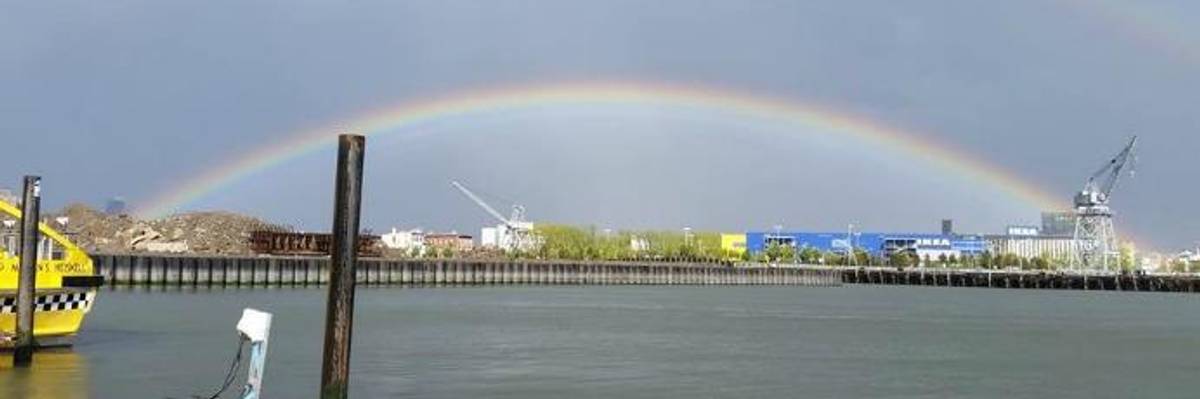
Environmental advocates in New York State are celebrating a federal court's decision to allow the state to ban a major pipeline project that the state says would endanger its water resources. (Photo: Riverkeeper/Facebook)
Environmentalists are celebrating a federal appeals court ruling on Friday that reaffirmed New York State's decision to block a 124-mile natural gas pipeline project.
"Today's ruling confirms the independent authority and responsibility of states to protect their waterbodies from natural gas pipelines that carve through and degrade critical watersheds."
--Moneen Nasmith, Earthjustice
"This project would have been bad news for New York waters and communities, and the court's decision will help ensure that important waterways in the state, including the Hudson River and Schoharie Creek, will be protected," said Riverkeeper president Paul Gallay.
The U.S. Court of Appeals for the Second Circuit ruled that the New York State Department of Environmental Conservation (NYSDEC) had the authority to deny a Clean Water Act permit to four companies planning to construct the Constitution Pipeline, which would have carried fracked gas from Pennsylvania to Eastern New York State.
The pipeline--which would have crossed waterways 251 times and run through more than 80 acres of wetlands--received initial approval from the Federal Energy Regulatory Commission (FERC), the federal agency that regulates interstates pipeline projects. However, it was blocked by NYSDEC last year, when the state agency determined the gas companies had not provided enough information to ensure that the pipeline would comply with state water quality standards.
The companies argued in court that FERC's approval preempted any state-level decision, but the court's three-judge panel determined "NYSDEC is responsible for evaluating the environmental impacts of a proposed pipeline on New York waterbodies in light of the state's water quality standards," and upheld the agency's decision to prevent the pipeline.
"The collective efforts of individuals and local, regional, and national groups--including terrific legal representation by Earthjustice--prevented the pipeline from plowing through our communities and damaging our waterways," said Wes Gillingham of Catskill Mountainkeeper, which along with Earthjustice, Riverkeeper, and Sierra Club, helped to defend NYSDEC's decision in court.
The ruling is being lauded as a win for state regulatory agencies to deny construction projects because of environmental impact concerns, even if they have federal approval.
"Today's ruling confirms the independent authority and responsibility of states to protect their waterbodies from natural gas pipelines that carve through and degrade critical watersheds," said Earthjustice attorney Moneen Nasmith.
Echoing Nasmith's remarks, Roger Downs of Sierra Club's Atlantic Chapter said: "With today's ruling, the Court of Appeals has affirmed the rights of states to reasonably protect their water resources from oversized infrastructure projects that run roughshod over states' natural resources." Downs also praised New York Gov. Andrew Cuomo and Attorney General Eric Schneiderman for defending NYSDEC's decision to halt pipeline.
"New York must be able to do what's necessary to protect our environment--and we're glad that the court agreed," Schneiderman said in a statement. "It would be unacceptable for a pipeline--or any project--to pollute our waters and undermine New Yorkers' health and water resources. Today's decision marks a major win for New Yorkers, and for the state's right to take the actions necessary to protect the public and our environment."
Those celebrating the decision were optimistic that it could help to set a precedent for challenges to other proposed pipeline projects around the United States.
"This is not just a victory for the people impacted along the pipeline route," said Gillingham, "but gives hope across the country for people facing the onslaught of oil and gas infrastructure."
Dear Common Dreams reader, It’s been nearly 30 years since I co-founded Common Dreams with my late wife, Lina Newhouser. We had the radical notion that journalism should serve the public good, not corporate profits. It was clear to us from the outset what it would take to build such a project. No paid advertisements. No corporate sponsors. No millionaire publisher telling us what to think or do. Many people said we wouldn't last a year, but we proved those doubters wrong. Together with a tremendous team of journalists and dedicated staff, we built an independent media outlet free from the constraints of profits and corporate control. Our mission has always been simple: To inform. To inspire. To ignite change for the common good. Building Common Dreams was not easy. Our survival was never guaranteed. When you take on the most powerful forces—Wall Street greed, fossil fuel industry destruction, Big Tech lobbyists, and uber-rich oligarchs who have spent billions upon billions rigging the economy and democracy in their favor—the only bulwark you have is supporters who believe in your work. But here’s the urgent message from me today. It's never been this bad out there. And it's never been this hard to keep us going. At the very moment Common Dreams is most needed, the threats we face are intensifying. We need your support now more than ever. We don't accept corporate advertising and never will. We don't have a paywall because we don't think people should be blocked from critical news based on their ability to pay. Everything we do is funded by the donations of readers like you. When everyone does the little they can afford, we are strong. But if that support retreats or dries up, so do we. Will you donate now to make sure Common Dreams not only survives but thrives? —Craig Brown, Co-founder |
Environmentalists are celebrating a federal appeals court ruling on Friday that reaffirmed New York State's decision to block a 124-mile natural gas pipeline project.
"Today's ruling confirms the independent authority and responsibility of states to protect their waterbodies from natural gas pipelines that carve through and degrade critical watersheds."
--Moneen Nasmith, Earthjustice
"This project would have been bad news for New York waters and communities, and the court's decision will help ensure that important waterways in the state, including the Hudson River and Schoharie Creek, will be protected," said Riverkeeper president Paul Gallay.
The U.S. Court of Appeals for the Second Circuit ruled that the New York State Department of Environmental Conservation (NYSDEC) had the authority to deny a Clean Water Act permit to four companies planning to construct the Constitution Pipeline, which would have carried fracked gas from Pennsylvania to Eastern New York State.
The pipeline--which would have crossed waterways 251 times and run through more than 80 acres of wetlands--received initial approval from the Federal Energy Regulatory Commission (FERC), the federal agency that regulates interstates pipeline projects. However, it was blocked by NYSDEC last year, when the state agency determined the gas companies had not provided enough information to ensure that the pipeline would comply with state water quality standards.
The companies argued in court that FERC's approval preempted any state-level decision, but the court's three-judge panel determined "NYSDEC is responsible for evaluating the environmental impacts of a proposed pipeline on New York waterbodies in light of the state's water quality standards," and upheld the agency's decision to prevent the pipeline.
"The collective efforts of individuals and local, regional, and national groups--including terrific legal representation by Earthjustice--prevented the pipeline from plowing through our communities and damaging our waterways," said Wes Gillingham of Catskill Mountainkeeper, which along with Earthjustice, Riverkeeper, and Sierra Club, helped to defend NYSDEC's decision in court.
The ruling is being lauded as a win for state regulatory agencies to deny construction projects because of environmental impact concerns, even if they have federal approval.
"Today's ruling confirms the independent authority and responsibility of states to protect their waterbodies from natural gas pipelines that carve through and degrade critical watersheds," said Earthjustice attorney Moneen Nasmith.
Echoing Nasmith's remarks, Roger Downs of Sierra Club's Atlantic Chapter said: "With today's ruling, the Court of Appeals has affirmed the rights of states to reasonably protect their water resources from oversized infrastructure projects that run roughshod over states' natural resources." Downs also praised New York Gov. Andrew Cuomo and Attorney General Eric Schneiderman for defending NYSDEC's decision to halt pipeline.
"New York must be able to do what's necessary to protect our environment--and we're glad that the court agreed," Schneiderman said in a statement. "It would be unacceptable for a pipeline--or any project--to pollute our waters and undermine New Yorkers' health and water resources. Today's decision marks a major win for New Yorkers, and for the state's right to take the actions necessary to protect the public and our environment."
Those celebrating the decision were optimistic that it could help to set a precedent for challenges to other proposed pipeline projects around the United States.
"This is not just a victory for the people impacted along the pipeline route," said Gillingham, "but gives hope across the country for people facing the onslaught of oil and gas infrastructure."
Environmentalists are celebrating a federal appeals court ruling on Friday that reaffirmed New York State's decision to block a 124-mile natural gas pipeline project.
"Today's ruling confirms the independent authority and responsibility of states to protect their waterbodies from natural gas pipelines that carve through and degrade critical watersheds."
--Moneen Nasmith, Earthjustice
"This project would have been bad news for New York waters and communities, and the court's decision will help ensure that important waterways in the state, including the Hudson River and Schoharie Creek, will be protected," said Riverkeeper president Paul Gallay.
The U.S. Court of Appeals for the Second Circuit ruled that the New York State Department of Environmental Conservation (NYSDEC) had the authority to deny a Clean Water Act permit to four companies planning to construct the Constitution Pipeline, which would have carried fracked gas from Pennsylvania to Eastern New York State.
The pipeline--which would have crossed waterways 251 times and run through more than 80 acres of wetlands--received initial approval from the Federal Energy Regulatory Commission (FERC), the federal agency that regulates interstates pipeline projects. However, it was blocked by NYSDEC last year, when the state agency determined the gas companies had not provided enough information to ensure that the pipeline would comply with state water quality standards.
The companies argued in court that FERC's approval preempted any state-level decision, but the court's three-judge panel determined "NYSDEC is responsible for evaluating the environmental impacts of a proposed pipeline on New York waterbodies in light of the state's water quality standards," and upheld the agency's decision to prevent the pipeline.
"The collective efforts of individuals and local, regional, and national groups--including terrific legal representation by Earthjustice--prevented the pipeline from plowing through our communities and damaging our waterways," said Wes Gillingham of Catskill Mountainkeeper, which along with Earthjustice, Riverkeeper, and Sierra Club, helped to defend NYSDEC's decision in court.
The ruling is being lauded as a win for state regulatory agencies to deny construction projects because of environmental impact concerns, even if they have federal approval.
"Today's ruling confirms the independent authority and responsibility of states to protect their waterbodies from natural gas pipelines that carve through and degrade critical watersheds," said Earthjustice attorney Moneen Nasmith.
Echoing Nasmith's remarks, Roger Downs of Sierra Club's Atlantic Chapter said: "With today's ruling, the Court of Appeals has affirmed the rights of states to reasonably protect their water resources from oversized infrastructure projects that run roughshod over states' natural resources." Downs also praised New York Gov. Andrew Cuomo and Attorney General Eric Schneiderman for defending NYSDEC's decision to halt pipeline.
"New York must be able to do what's necessary to protect our environment--and we're glad that the court agreed," Schneiderman said in a statement. "It would be unacceptable for a pipeline--or any project--to pollute our waters and undermine New Yorkers' health and water resources. Today's decision marks a major win for New Yorkers, and for the state's right to take the actions necessary to protect the public and our environment."
Those celebrating the decision were optimistic that it could help to set a precedent for challenges to other proposed pipeline projects around the United States.
"This is not just a victory for the people impacted along the pipeline route," said Gillingham, "but gives hope across the country for people facing the onslaught of oil and gas infrastructure."