SUBSCRIBE TO OUR FREE NEWSLETTER
Daily news & progressive opinion—funded by the people, not the corporations—delivered straight to your inbox.
5
#000000
#FFFFFF
To donate by check, phone, or other method, see our More Ways to Give page.
Daily news & progressive opinion—funded by the people, not the corporations—delivered straight to your inbox.
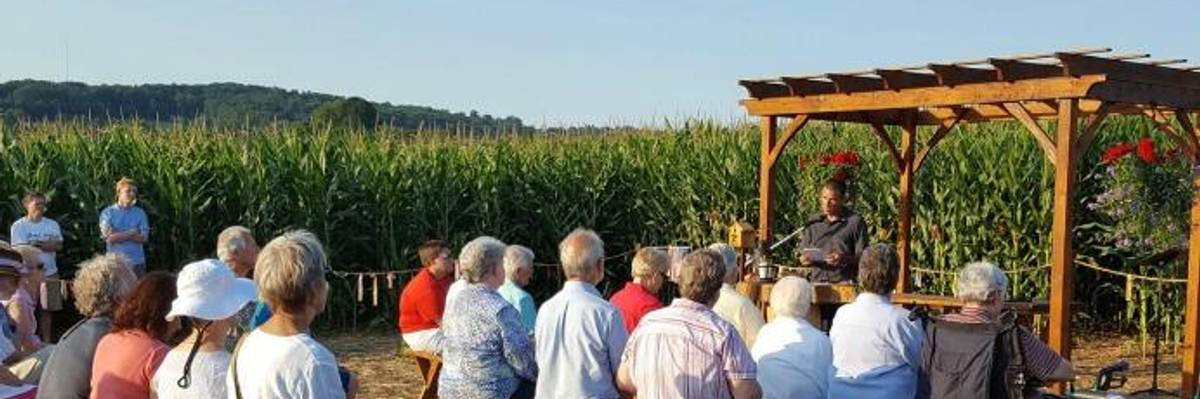
Supporters of the nuns' fight to protect their farmland from the pipeline project gathered at their open-air chapel for a vigil on Sunday. (Photo: @alexgeli/Twitter)
A group of about 30 Catholic nuns in Lancaster County, Pennsylvania, who constructed an open-air chapel on the proposed path of a natural gas pipeline, are in court on Monday fighting efforts by the fossil fuel company trying to seize their land.
"We honor God by protecting and preserving His creation."
--Sister George Ann Biscan
The sisters appeared at a U.S. District courthouse in Reading for an 11:00am hearing, following two prayer vigils earlier Monday morning.
About six months ago, they came up with the idea to build the chapel on their farmland as "a visible symbol of their commitment to the land," Mark Clatterbuck, of Lancaster Against Pipelines--which helped build the chapel--told the York Daily Record, a local paper.
"We have to pay reverence to the land God has given us," said Sister George Ann Biscan. "We honor God by protecting and preserving His creation."
Friday, seeking a federal injunction, the Adorers filed a complaint in the U.S. District Court for the Eastern District of Pennsylvania, claiming the Federal Energy Regulatory Commission (FERC), which regulates interstate natural gas pipelines, and its commissioner have violated the Religious Freedom Restoration Act, "by forcing the Adorers to use their land to accommodate a fossil fuel pipeline," the order said in a statement.
The nuns, the statement continued, "allege that FERC's action places a substantial burden on their exercise of religion by taking their land, which they want to protect and preserve as part of their faith, and forces the Adorers to use their land in a manner and for a purpose they believe is harmful to the earth."
The complaint followed an emergency motion filed by the pipeline's developer, Tulsa-based Williams Companies, "in an attempt to take immediate possession of the property and get permission to deploy U.S. Marshals on the nuns and 'any third parties authorized by the sisters to be on the property,'" Sojourners reported.
The pipeline, called "Atlantic Sunrise," is slated to stretch across more than 180 miles of central Pennsylvania and link to the company's Transco pipeline, which carries gas from the Gulf of Mexico to the East Coast. FERC approved the project in February, and Williams began construction in early spring. The company has settled with more than 1,000 landowners impacted by the pipeline, and when attempts to negotiate with Adorers failed, it tried to seize the land through eminent domain.
Speaking of their battle with Williams, Sister Bernice Klostermann told YDR: "They've said we're just looking to get more money. We're not looking for money. We want to preserve this land."
The sisters belong to the Adorers of the Blood of Christ, which was founded in 1834 in the rural mountains of Italy. The order--which today has 2,000 members worldwide, with more than 200 in the U.S.--reached nearby Columbia, Pennsylvania, in 1925, and acquired 90 acres of farmland, which is now leased to local farmers. The order has made environmental protection a part its mission, and the sisters embroiled in this land battle with Williams seem to exemplify its motto: "You will lack nothing if God is with you. Be a woman of great courage."
Their chapel--nestled in a carved-out section of their cornfield--sits atop a bed of straw, and features an arbor as well as a pulpit composed of wood from fallen trees. Eight benches placed in front of the altar serve as pews. A rope full of colorful solidarity ribbons runs along the chapel's perimeter.
"People can come at any time of the day, and even night if they want to pray and they're free to walk around, to tie another ribbon on just to let people know that they've been here and that they are praying and supporting us," Sister Biscan said.
One supporter left a homemade wooden birdhouse at the site, with the inscription: "One day a family of beautiful choir singers will move in this house to help defend this chapel and to remind you of why you stand strong."
Sunday night, about 100 supporters gathered at the chapel for a public vigil sponsored by Lancaster Against Pipelines, according to local reports. "Everyone of good will is invited to join in this vigil as we continue to #StandWithTheSisters against corporate violation of religious, environmental, and community rights," the group said Saturday. The vigil included a ribbon-tying ceremony, during which attendees added solidarity ribbons to the perimeter rope.
The fate of the sisters' cornfield chapel remains uncertain. As Washington Post reported Sunday:
U.S. appeals court judges have ruled inconsistently on whether federal law protects religious groups from eminent domain in such cases. The U.S. Court of Appeals for the 3rd Circuit, which covers Delaware, New Jersey and the part of Pennsylvania where the nuns reside, has yet to issue a ruling on the matter. Legal observers say a case could make its way to the U.S. Supreme Court.
However, even if the injunction is granted, it is unclear the degree to which the sisters' chapel will impact construction of the Atlantic Sunrise pipeline. According to a website managed by the developer, "Williams has already incorporated more than 400 route variations into the proposed route to address stakeholder concerns--and we are still making adjustments."
Dear Common Dreams reader, It’s been nearly 30 years since I co-founded Common Dreams with my late wife, Lina Newhouser. We had the radical notion that journalism should serve the public good, not corporate profits. It was clear to us from the outset what it would take to build such a project. No paid advertisements. No corporate sponsors. No millionaire publisher telling us what to think or do. Many people said we wouldn't last a year, but we proved those doubters wrong. Together with a tremendous team of journalists and dedicated staff, we built an independent media outlet free from the constraints of profits and corporate control. Our mission has always been simple: To inform. To inspire. To ignite change for the common good. Building Common Dreams was not easy. Our survival was never guaranteed. When you take on the most powerful forces—Wall Street greed, fossil fuel industry destruction, Big Tech lobbyists, and uber-rich oligarchs who have spent billions upon billions rigging the economy and democracy in their favor—the only bulwark you have is supporters who believe in your work. But here’s the urgent message from me today. It's never been this bad out there. And it's never been this hard to keep us going. At the very moment Common Dreams is most needed, the threats we face are intensifying. We need your support now more than ever. We don't accept corporate advertising and never will. We don't have a paywall because we don't think people should be blocked from critical news based on their ability to pay. Everything we do is funded by the donations of readers like you. When everyone does the little they can afford, we are strong. But if that support retreats or dries up, so do we. Will you donate now to make sure Common Dreams not only survives but thrives? —Craig Brown, Co-founder |
A group of about 30 Catholic nuns in Lancaster County, Pennsylvania, who constructed an open-air chapel on the proposed path of a natural gas pipeline, are in court on Monday fighting efforts by the fossil fuel company trying to seize their land.
"We honor God by protecting and preserving His creation."
--Sister George Ann Biscan
The sisters appeared at a U.S. District courthouse in Reading for an 11:00am hearing, following two prayer vigils earlier Monday morning.
About six months ago, they came up with the idea to build the chapel on their farmland as "a visible symbol of their commitment to the land," Mark Clatterbuck, of Lancaster Against Pipelines--which helped build the chapel--told the York Daily Record, a local paper.
"We have to pay reverence to the land God has given us," said Sister George Ann Biscan. "We honor God by protecting and preserving His creation."
Friday, seeking a federal injunction, the Adorers filed a complaint in the U.S. District Court for the Eastern District of Pennsylvania, claiming the Federal Energy Regulatory Commission (FERC), which regulates interstate natural gas pipelines, and its commissioner have violated the Religious Freedom Restoration Act, "by forcing the Adorers to use their land to accommodate a fossil fuel pipeline," the order said in a statement.
The nuns, the statement continued, "allege that FERC's action places a substantial burden on their exercise of religion by taking their land, which they want to protect and preserve as part of their faith, and forces the Adorers to use their land in a manner and for a purpose they believe is harmful to the earth."
The complaint followed an emergency motion filed by the pipeline's developer, Tulsa-based Williams Companies, "in an attempt to take immediate possession of the property and get permission to deploy U.S. Marshals on the nuns and 'any third parties authorized by the sisters to be on the property,'" Sojourners reported.
The pipeline, called "Atlantic Sunrise," is slated to stretch across more than 180 miles of central Pennsylvania and link to the company's Transco pipeline, which carries gas from the Gulf of Mexico to the East Coast. FERC approved the project in February, and Williams began construction in early spring. The company has settled with more than 1,000 landowners impacted by the pipeline, and when attempts to negotiate with Adorers failed, it tried to seize the land through eminent domain.
Speaking of their battle with Williams, Sister Bernice Klostermann told YDR: "They've said we're just looking to get more money. We're not looking for money. We want to preserve this land."
The sisters belong to the Adorers of the Blood of Christ, which was founded in 1834 in the rural mountains of Italy. The order--which today has 2,000 members worldwide, with more than 200 in the U.S.--reached nearby Columbia, Pennsylvania, in 1925, and acquired 90 acres of farmland, which is now leased to local farmers. The order has made environmental protection a part its mission, and the sisters embroiled in this land battle with Williams seem to exemplify its motto: "You will lack nothing if God is with you. Be a woman of great courage."
Their chapel--nestled in a carved-out section of their cornfield--sits atop a bed of straw, and features an arbor as well as a pulpit composed of wood from fallen trees. Eight benches placed in front of the altar serve as pews. A rope full of colorful solidarity ribbons runs along the chapel's perimeter.
"People can come at any time of the day, and even night if they want to pray and they're free to walk around, to tie another ribbon on just to let people know that they've been here and that they are praying and supporting us," Sister Biscan said.
One supporter left a homemade wooden birdhouse at the site, with the inscription: "One day a family of beautiful choir singers will move in this house to help defend this chapel and to remind you of why you stand strong."
Sunday night, about 100 supporters gathered at the chapel for a public vigil sponsored by Lancaster Against Pipelines, according to local reports. "Everyone of good will is invited to join in this vigil as we continue to #StandWithTheSisters against corporate violation of religious, environmental, and community rights," the group said Saturday. The vigil included a ribbon-tying ceremony, during which attendees added solidarity ribbons to the perimeter rope.
The fate of the sisters' cornfield chapel remains uncertain. As Washington Post reported Sunday:
U.S. appeals court judges have ruled inconsistently on whether federal law protects religious groups from eminent domain in such cases. The U.S. Court of Appeals for the 3rd Circuit, which covers Delaware, New Jersey and the part of Pennsylvania where the nuns reside, has yet to issue a ruling on the matter. Legal observers say a case could make its way to the U.S. Supreme Court.
However, even if the injunction is granted, it is unclear the degree to which the sisters' chapel will impact construction of the Atlantic Sunrise pipeline. According to a website managed by the developer, "Williams has already incorporated more than 400 route variations into the proposed route to address stakeholder concerns--and we are still making adjustments."
A group of about 30 Catholic nuns in Lancaster County, Pennsylvania, who constructed an open-air chapel on the proposed path of a natural gas pipeline, are in court on Monday fighting efforts by the fossil fuel company trying to seize their land.
"We honor God by protecting and preserving His creation."
--Sister George Ann Biscan
The sisters appeared at a U.S. District courthouse in Reading for an 11:00am hearing, following two prayer vigils earlier Monday morning.
About six months ago, they came up with the idea to build the chapel on their farmland as "a visible symbol of their commitment to the land," Mark Clatterbuck, of Lancaster Against Pipelines--which helped build the chapel--told the York Daily Record, a local paper.
"We have to pay reverence to the land God has given us," said Sister George Ann Biscan. "We honor God by protecting and preserving His creation."
Friday, seeking a federal injunction, the Adorers filed a complaint in the U.S. District Court for the Eastern District of Pennsylvania, claiming the Federal Energy Regulatory Commission (FERC), which regulates interstate natural gas pipelines, and its commissioner have violated the Religious Freedom Restoration Act, "by forcing the Adorers to use their land to accommodate a fossil fuel pipeline," the order said in a statement.
The nuns, the statement continued, "allege that FERC's action places a substantial burden on their exercise of religion by taking their land, which they want to protect and preserve as part of their faith, and forces the Adorers to use their land in a manner and for a purpose they believe is harmful to the earth."
The complaint followed an emergency motion filed by the pipeline's developer, Tulsa-based Williams Companies, "in an attempt to take immediate possession of the property and get permission to deploy U.S. Marshals on the nuns and 'any third parties authorized by the sisters to be on the property,'" Sojourners reported.
The pipeline, called "Atlantic Sunrise," is slated to stretch across more than 180 miles of central Pennsylvania and link to the company's Transco pipeline, which carries gas from the Gulf of Mexico to the East Coast. FERC approved the project in February, and Williams began construction in early spring. The company has settled with more than 1,000 landowners impacted by the pipeline, and when attempts to negotiate with Adorers failed, it tried to seize the land through eminent domain.
Speaking of their battle with Williams, Sister Bernice Klostermann told YDR: "They've said we're just looking to get more money. We're not looking for money. We want to preserve this land."
The sisters belong to the Adorers of the Blood of Christ, which was founded in 1834 in the rural mountains of Italy. The order--which today has 2,000 members worldwide, with more than 200 in the U.S.--reached nearby Columbia, Pennsylvania, in 1925, and acquired 90 acres of farmland, which is now leased to local farmers. The order has made environmental protection a part its mission, and the sisters embroiled in this land battle with Williams seem to exemplify its motto: "You will lack nothing if God is with you. Be a woman of great courage."
Their chapel--nestled in a carved-out section of their cornfield--sits atop a bed of straw, and features an arbor as well as a pulpit composed of wood from fallen trees. Eight benches placed in front of the altar serve as pews. A rope full of colorful solidarity ribbons runs along the chapel's perimeter.
"People can come at any time of the day, and even night if they want to pray and they're free to walk around, to tie another ribbon on just to let people know that they've been here and that they are praying and supporting us," Sister Biscan said.
One supporter left a homemade wooden birdhouse at the site, with the inscription: "One day a family of beautiful choir singers will move in this house to help defend this chapel and to remind you of why you stand strong."
Sunday night, about 100 supporters gathered at the chapel for a public vigil sponsored by Lancaster Against Pipelines, according to local reports. "Everyone of good will is invited to join in this vigil as we continue to #StandWithTheSisters against corporate violation of religious, environmental, and community rights," the group said Saturday. The vigil included a ribbon-tying ceremony, during which attendees added solidarity ribbons to the perimeter rope.
The fate of the sisters' cornfield chapel remains uncertain. As Washington Post reported Sunday:
U.S. appeals court judges have ruled inconsistently on whether federal law protects religious groups from eminent domain in such cases. The U.S. Court of Appeals for the 3rd Circuit, which covers Delaware, New Jersey and the part of Pennsylvania where the nuns reside, has yet to issue a ruling on the matter. Legal observers say a case could make its way to the U.S. Supreme Court.
However, even if the injunction is granted, it is unclear the degree to which the sisters' chapel will impact construction of the Atlantic Sunrise pipeline. According to a website managed by the developer, "Williams has already incorporated more than 400 route variations into the proposed route to address stakeholder concerns--and we are still making adjustments."